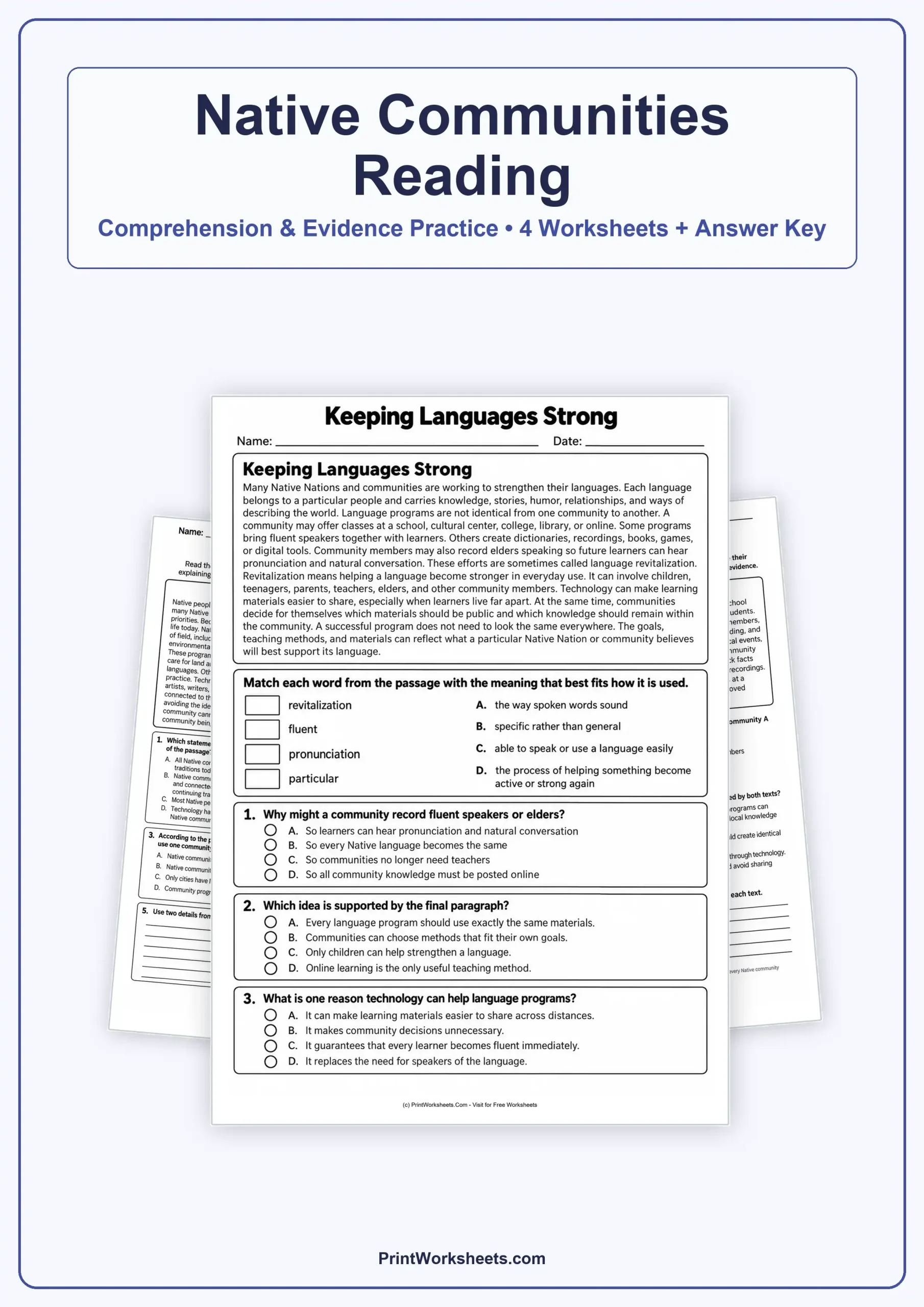
These Native communities reading worksheets help upper-elementary students build reading comprehension while learning about contemporary Native Nations, communities, languages, and community programs. Instead of treating Native cultures as something that belongs only to the past, the printable set focuses on present-day life, language revitalization, community decision-making, technology, environmental learning, and the ways communities can maintain traditions while adapting to new needs. Students work with several different reading formats, so the set can support close reading, independent practice, small-group instruction, or a focused social studies and ELA connection.
Native Communities Reading Worksheets for Close Reading
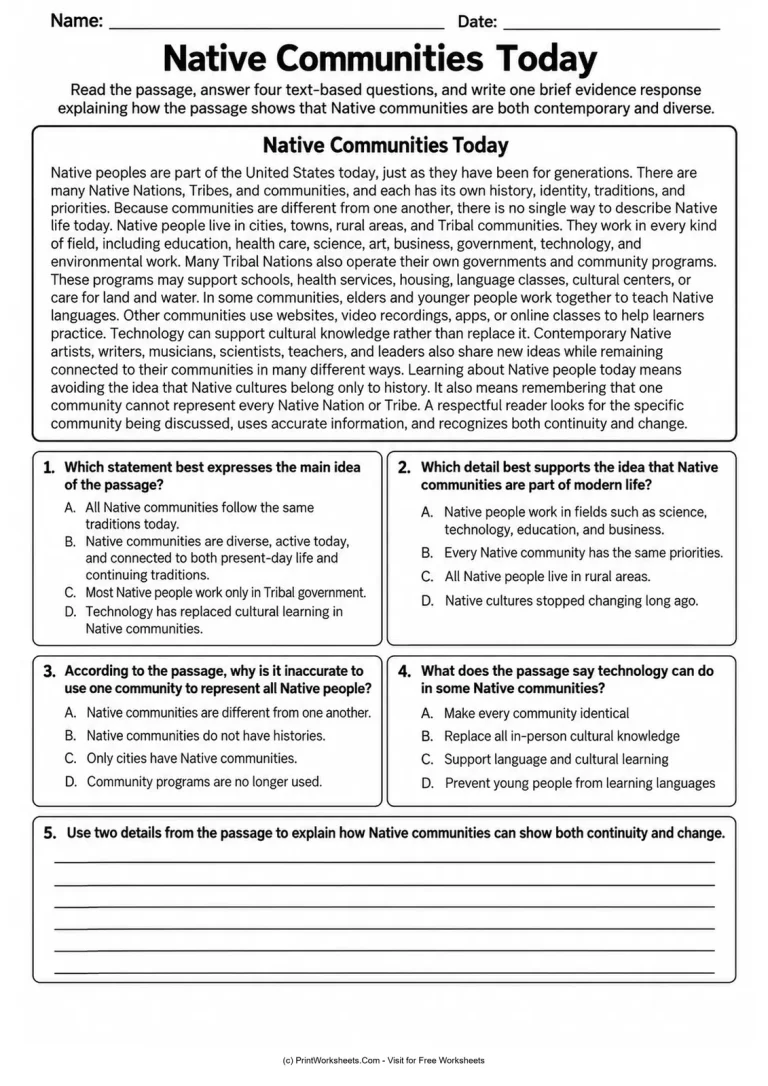
The first worksheet, Native Communities Today, introduces students to the idea that Native Nations, Tribes, and communities are diverse and active today. The passage describes people living in cities, towns, rural areas, and Tribal communities, and it gives examples of work in education, science, health care, art, business, government, technology, and environmental fields. It also explains that community programs may support schools, health services, housing, language classes, cultural centers, and care for land and water.
Students answer text-based questions about the main idea, supporting details, diversity among communities, and the role of technology. A short written-response task then asks students to use two details from the passage to explain how Native communities can show both continuity and change. This makes the page especially useful for practicing evidence-based responses rather than relying only on multiple-choice comprehension.
Language Revitalization and Vocabulary in Context
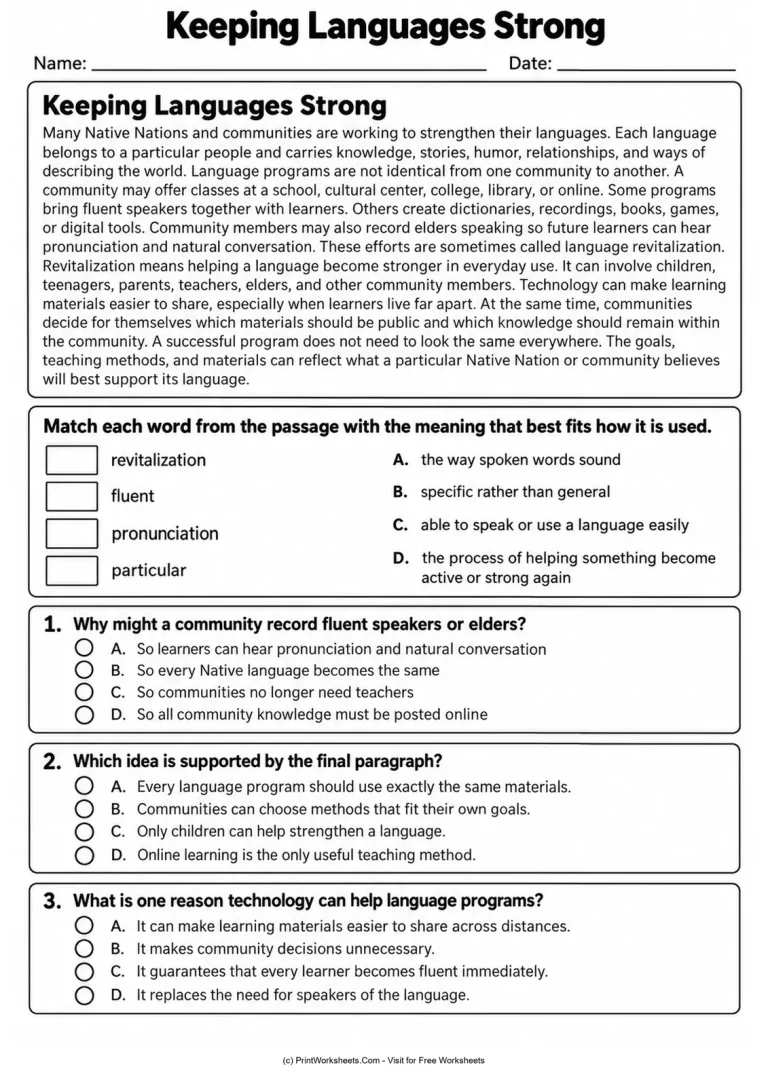
Keeping Languages Strong shifts the reading focus to Native language revitalization. Students read about community language programs that may include classes, fluent speakers, recordings, books, games, dictionaries, and digital tools. The passage also emphasizes that communities can decide which teaching methods, materials, and knowledge are appropriate for their own goals.
The worksheet combines vocabulary-in-context work with reading comprehension. Students match the words revitalization, fluent, pronunciation, and particular to meanings that fit the passage. They then answer questions about why communities may record speakers, how local goals shape language programs, and how technology can help learning materials reach people across distances. This mixture of vocabulary and comprehension gives students practice using context while still returning to the central ideas of the text.
Compare Two Community Programs
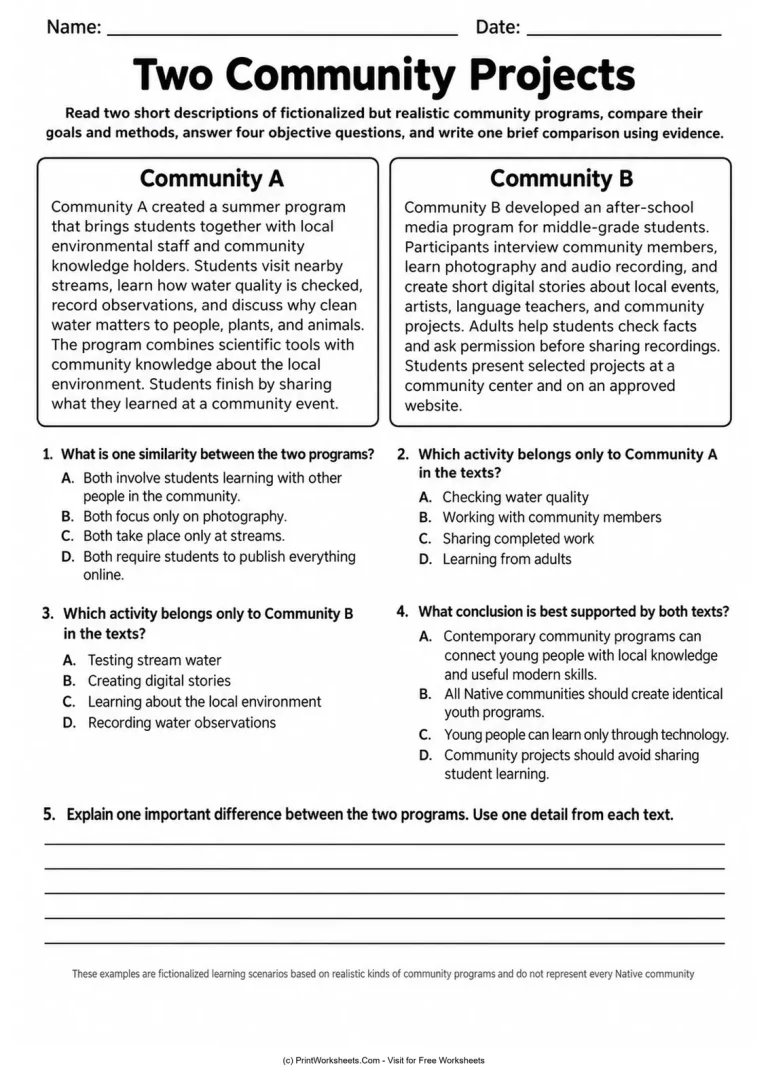
The paired-text worksheet Two Community Projects asks students to compare two fictionalized but realistic community learning programs. Community A centers on a summer environmental program in which students work with local staff and knowledge holders, visit streams, check water quality, record observations, and discuss why clean water matters. Community B focuses on a media program in which students interview community members, learn photography and audio recording, create digital stories, check facts, and ask permission before sharing recordings.
Students identify similarities and differences between the programs, determine which activities belong to each one, and choose a conclusion supported by both texts. A written comparison requires one detail from each passage. This page is a strong fit for students who are moving from single-passage comprehension into paired-text analysis.
Sequencing, Inference, and Summary Practice
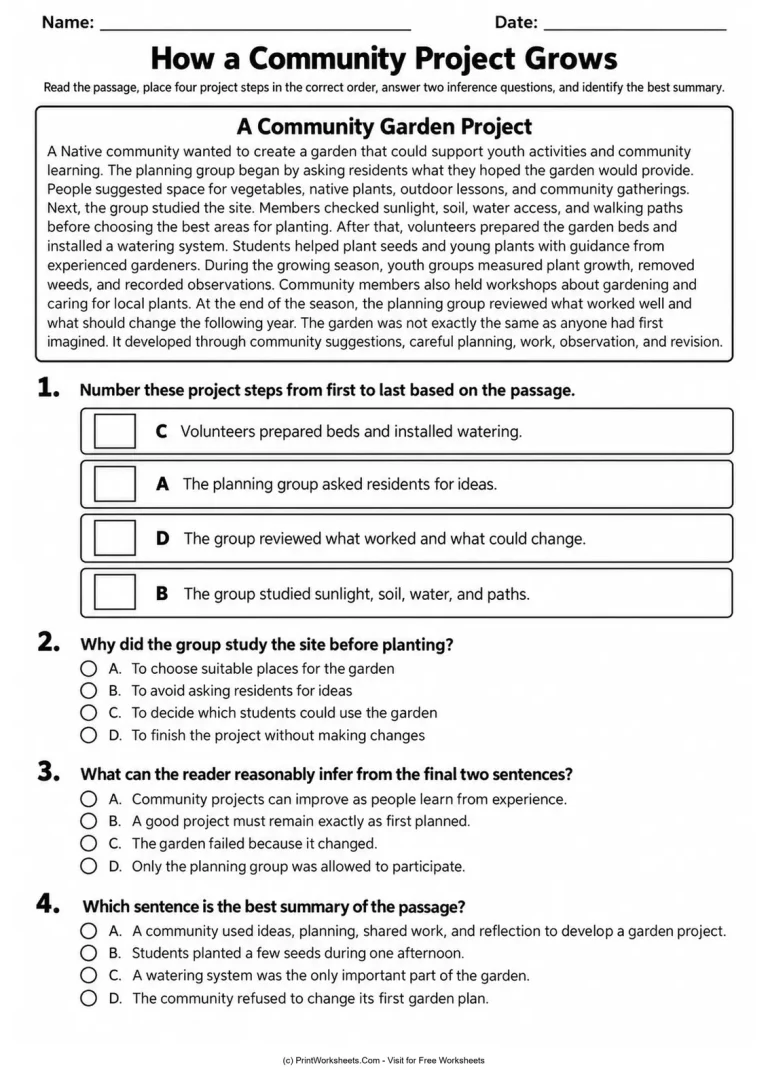
How a Community Project Grows follows the development of a community garden from early ideas through planning, planting, observation, and revision. Students place major project steps in the correct order, explain why the group studied sunlight, soil, water, access, and walking paths before planting, make an inference from the ending, and identify the best summary of the passage.
The sequence is especially useful because students must track how a project changes over time rather than locate one isolated fact. The passage shows that community projects can develop through suggestions, careful planning, shared work, observation, and reflection.
A Flexible Printable Reading Set
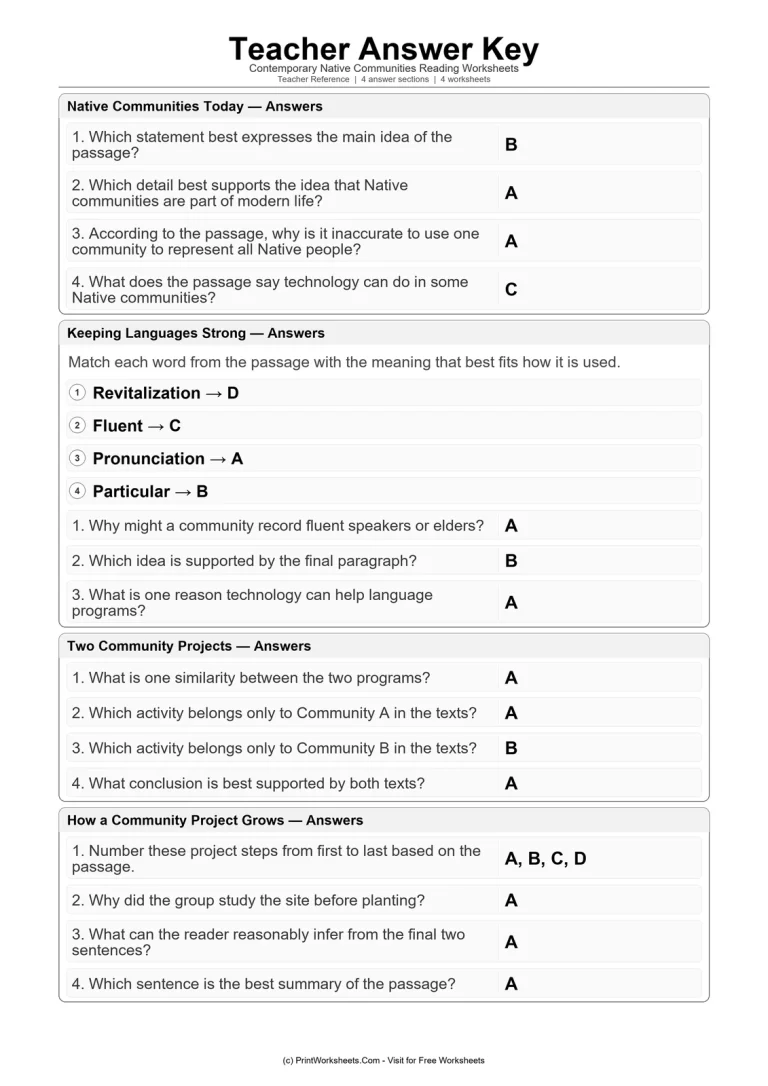
Together, the worksheets cover main idea, supporting details, vocabulary, text evidence, compare-and-contrast, sequencing, inference, summary, and short written responses. The included teacher answer key provides answers for the objective items across the set. The reading level and task demands are well suited to upper-elementary learners, especially students working around fourth- and fifth-grade comprehension skills. Teachers and families can use the pages as a short thematic unit, assign individual worksheets by skill, or combine them with lessons about contemporary Native communities and respectful reading of informational texts.