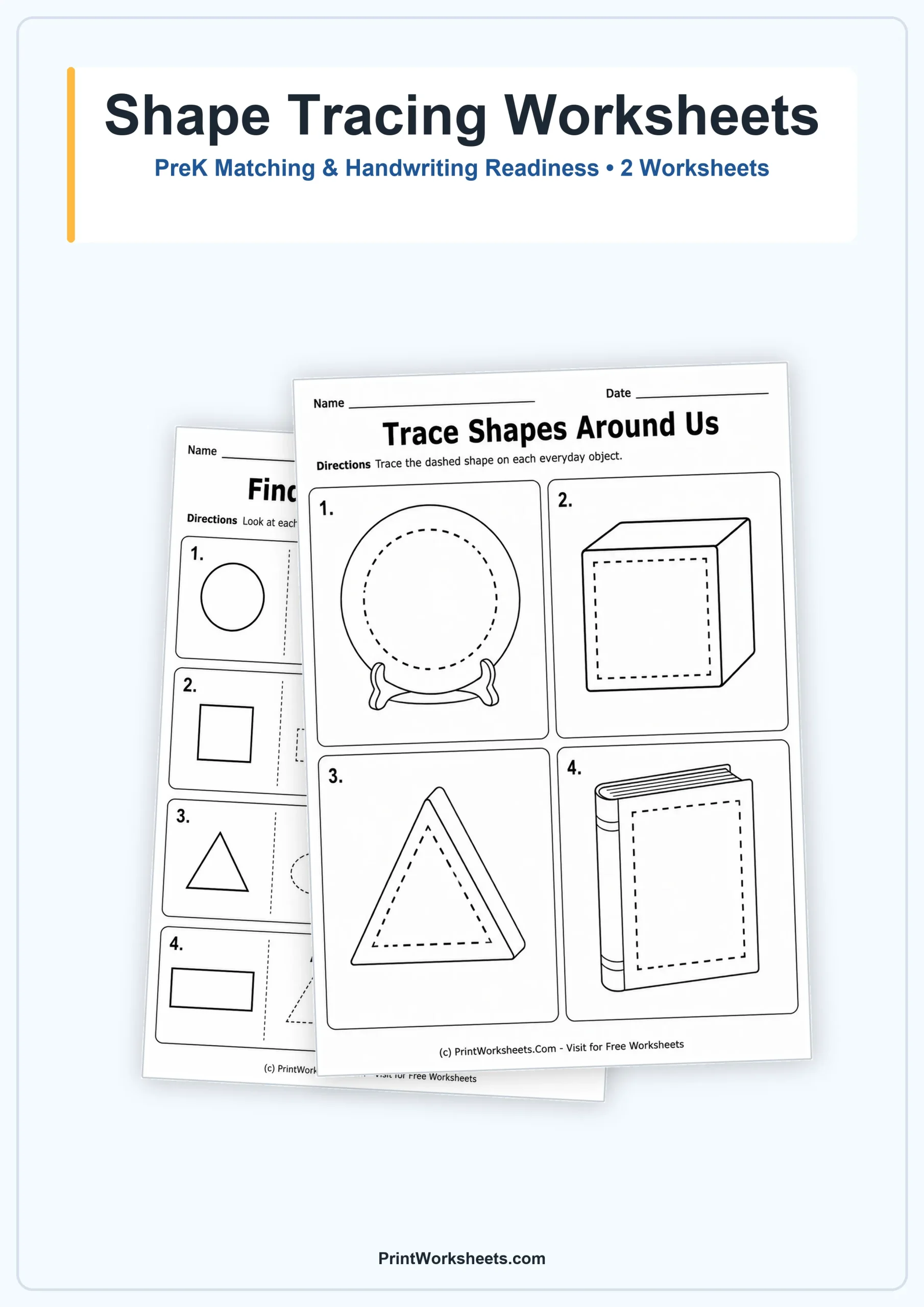
These shape tracing worksheets give preschool children a focused way to connect visual shape recognition with early handwriting readiness. Instead of asking children to repeat isolated marks, the activities use familiar basic shapes and two different kinds of thinking. One page asks children to compare a model with several choices before tracing the correct match, while the other places shapes inside recognizable everyday objects. Together, the pages build attention to form, controlled pencil movement, and confidence with circles, squares, triangles, and rectangles.
Shape Tracing Worksheets That Combine Recognition and Pencil Practice
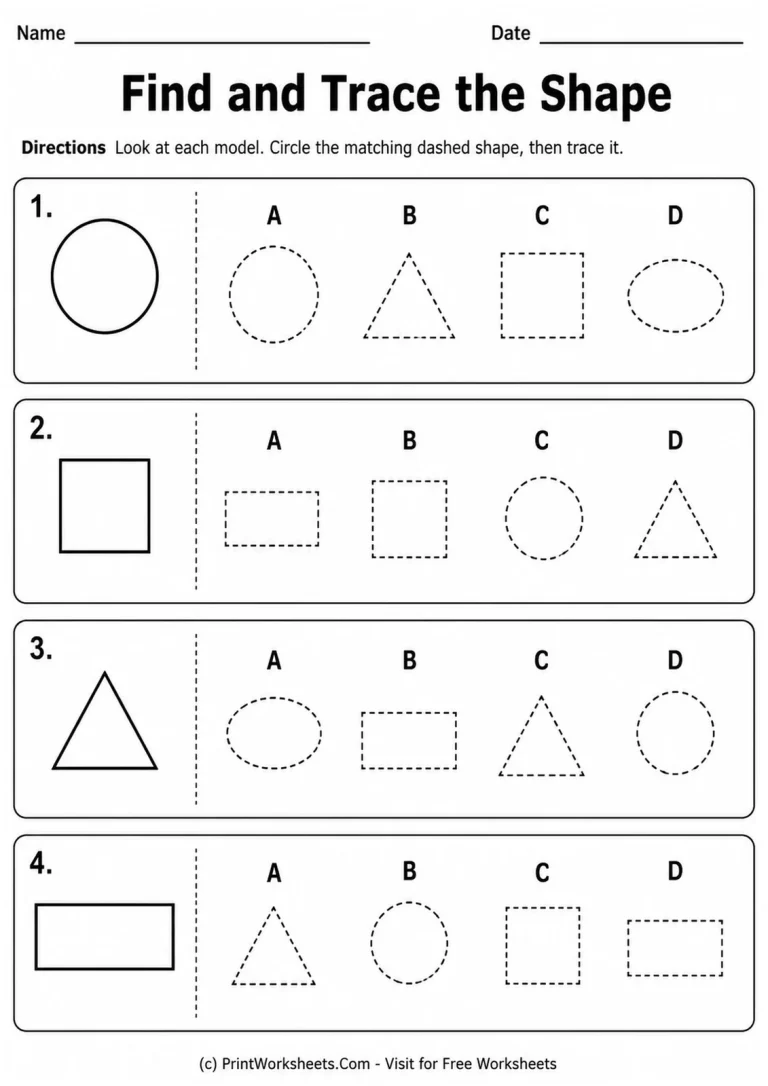
The first worksheet, Find and Trace the Shape, adds a useful visual discrimination step before the tracing begins. In each of four problems, a solid model appears on the left and four dashed choices labeled A through D appear on the right. Children first identify which dashed outline matches the model, circle that choice, and then trace it. The models progress through a circle, square, triangle, and rectangle.
This format is valuable because the child must look carefully before making a mark. A circle must be distinguished from an oval, a square from a rectangle, and a triangle from other closed figures. The correct choices are clear and unique, so young learners can practice making a visual decision without unnecessary ambiguity. Teachers and parents can also use the page to introduce simple shape vocabulary by asking questions such as, “Which one has three sides?” or “Which shape has four equal sides?” before the child traces.
Tracing Basic Shapes in Everyday Objects
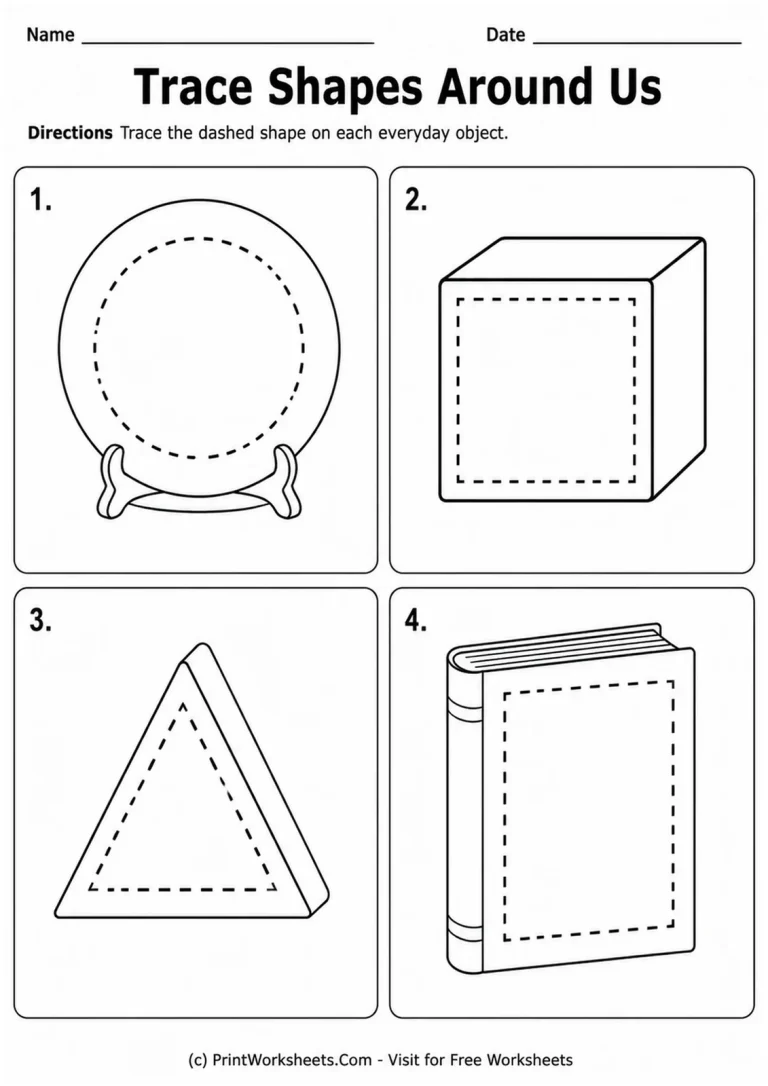
The second worksheet, Trace Shapes Around Us, moves the same core skill into a more concrete setting. Four large pictures show a plate, a block, a triangular object, and a book. A dashed target shape is placed directly on each object: a circle on the plate, a square on the block face, a triangle on the triangular object, and a rectangle on the book cover.
This change of context helps children understand that basic geometric forms are not limited to flashcards or worksheets. Shapes appear in real things around them. A round plate becomes an example of a circle, a block face provides a square, and a book cover shows a rectangle. Children still receive the fine-motor benefit of following a dashed outline, but they also make a useful connection between an abstract shape name and a recognizable object.
How to Use the Pages for Handwriting Readiness
For most PreK learners, accuracy is more important than speed. Encourage children to begin with a comfortable pencil or crayon grip and trace slowly enough to stay near the dashed line. Curved shapes such as the circle require continuous directional control, while the square, triangle, and rectangle add changes in direction at corners. Those different movement patterns provide varied practice for the hand and eyes without introducing letters before a child is ready.
The matching worksheet can work well as the first activity because it asks the child to identify the target before tracing. Follow it with the everyday-object page to reinforce the same four shapes in a new visual format. For children who need extra support, name each shape aloud and let them point to the correct option before using a pencil. Children who are ready for more challenge can describe one feature of the shape, such as the number of sides or whether it has corners.
Teaching Ideas for Preschool and Home Practice
These pages can be used during a handwriting readiness center, a preschool math-and-fine-motor station, morning work, or short home practice. Because each page has only four clearly organized tasks, the set is manageable for young learners who may tire during longer tracing sessions. Adults can also turn the object page into a quick scavenger hunt by asking children to find another circle, square, triangle, or rectangle in the classroom or at home after tracing.
Another simple extension is to have children draw one large version of each shape on blank paper after completing the worksheet. The dashed outlines provide guidance first, while the follow-up drawing asks the child to reproduce the form independently. This makes it easy to see whether the child is beginning to transfer tracing control into freehand shape formation.
A Focused PreK Shape and Handwriting Activity
This two-page set is best suited to preschool learners who are beginning to recognize basic shapes and practice controlled pencil movement. The combination of matching, tracing, and real-object connections keeps the skill specific without making the activity repetitive. Use the pages together for a short lesson on shape names and pencil control, or print them separately for centers, intervention, or extra practice with early handwriting readiness.