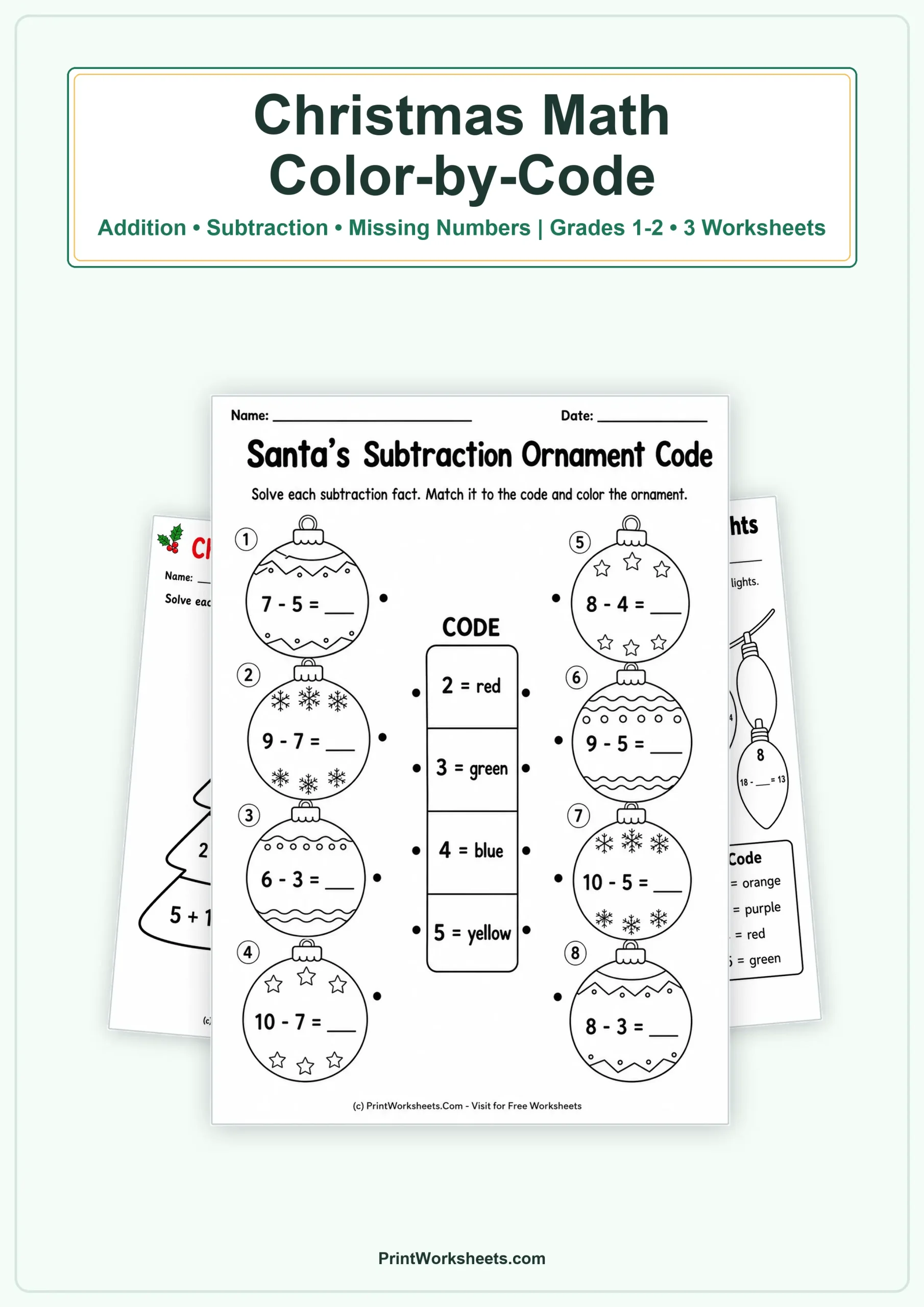
These Christmas color by code math worksheets give first- and second-grade students three connected ways to practice early operations during the holiday season. Instead of repeating one skill across identical pages, the set moves from addition facts on a Christmas tree to subtraction facts on ornaments and then to missing-number equations on Christmas lights. Students solve each problem first and use the result to choose the correct color, so the coloring step depends on accurate mathematical thinking rather than guessing.
Christmas Color by Code Math Practice Across Three Skills
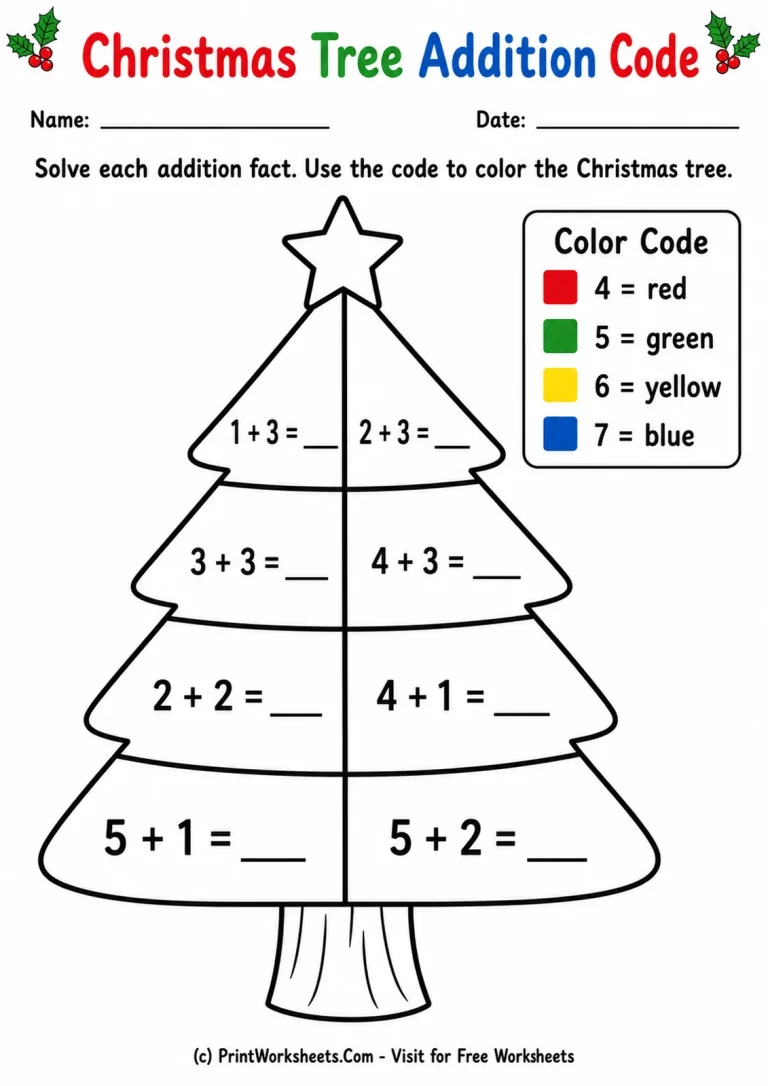
The first worksheet, Christmas Tree Addition Code, focuses on eight basic addition facts. Problems such as 1+3, 2+3, 3+3, 4+3, 2+2, 4+1, 5+1, and 5+2 appear inside sections of a Christmas tree. After finding each sum, students follow a four-color code using red, green, yellow, and blue. Because the answers are limited to 4, 5, 6, and 7, children can concentrate on building fluency with small-number addition while also checking each result against the code.
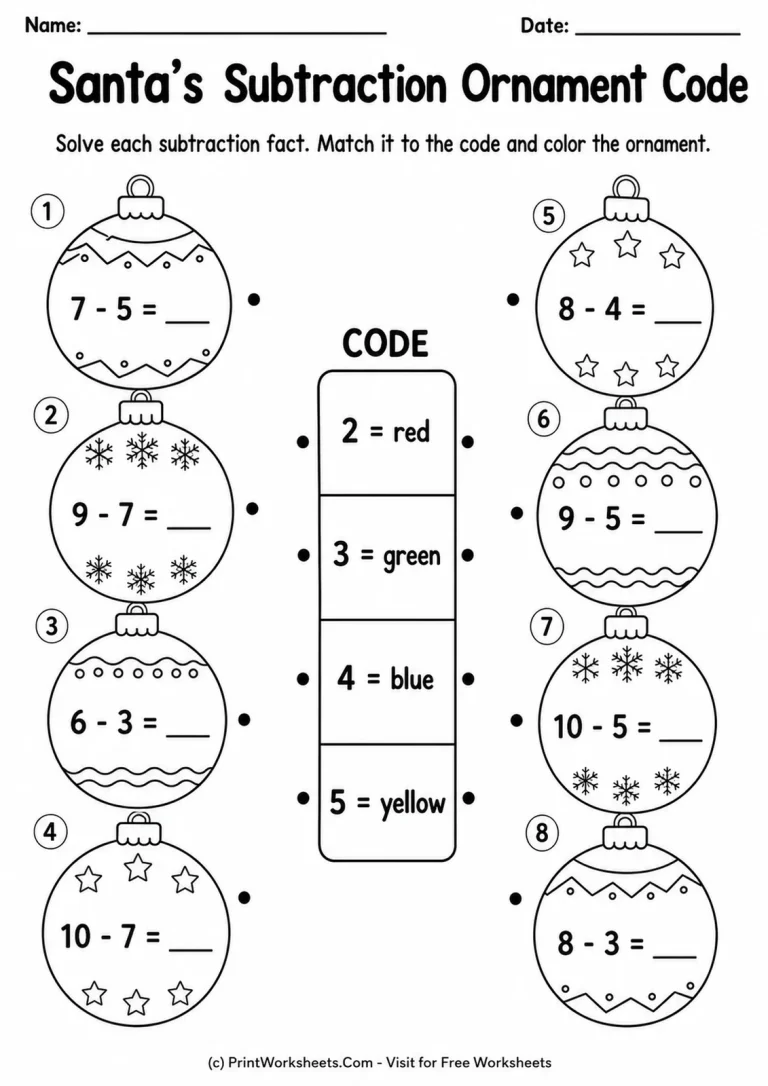
The second page, Santa’s Subtraction Ornament Code, changes both the operation and the visual format. Eight subtraction facts appear inside decorated Christmas ornaments. Students solve each fact and then match answers 2, 3, 4, and 5 to red, green, blue, or yellow. This makes the page useful after an addition lesson or as a quick review of subtraction facts within an early elementary range.
From Fact Fluency to Missing-Number Reasoning
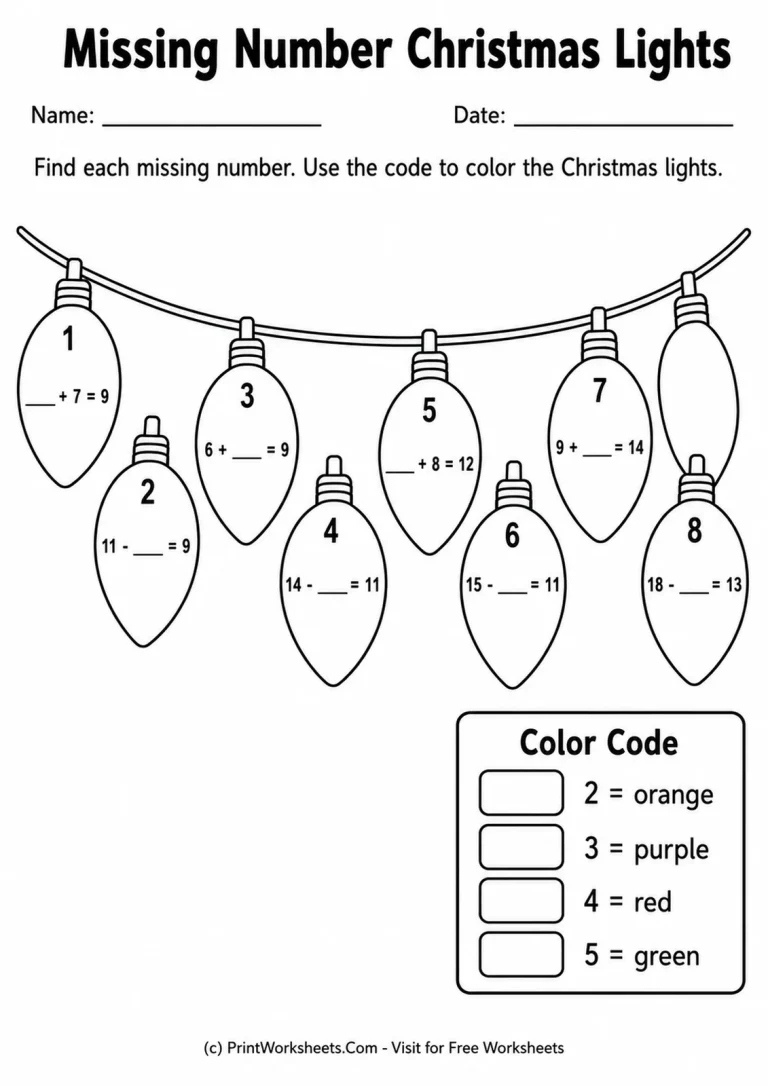
The third worksheet, Missing Number Christmas Lights, raises the reasoning level. Eight equations are placed on Christmas light bulbs, and students must determine a missing addend or a missing subtrahend. The missing values 2, 3, 4, and 5 correspond to orange, purple, red, and green. Students therefore have to think about the relationship between addition and subtraction before they can complete the coloring pattern.
This progression makes the set especially useful for Grades 1-2. A first grader can begin with the straightforward addition page and move to subtraction when ready. A second grader can use the first two pages for fluency review before working on equations with an unknown value. Teachers can also use the pages separately when a class is at different points in an operations unit.
Ways to Use the Christmas Math Worksheets
These pages work well for short independent practice because each task has a clear visual code and a limited set of answer values. They can be placed in a December math center, used for morning work, assigned as holiday-week review, or sent home for additional practice. The coloring component provides a natural completion goal without replacing the mathematics at the center of the activity.
For a small-group lesson, ask students to solve every equation in pencil before picking up crayons. This separates computation from coloring and makes it easier to notice which facts need support. Students who are still developing fact fluency can use counters, a number line, or drawings. Students who are ready for more independence can solve mentally and explain how they know an answer is correct.
Teacher Notes and Differentiation
For additional support, begin with the Christmas tree addition page and have students say each equation aloud before solving. On the ornament subtraction page, encourage students to check a subtraction fact with addition. When students reach the missing-number lights, model one example by asking what number makes the equation true instead of treating the blank as a symbol to guess.
For an extension, have students write one new addition fact with an answer of 4, 5, 6, or 7 and create a matching color-code section. They can also write a subtraction equation with an answer from 2 through 5 or invent a missing-number equation using one of the values in the Christmas-light code. This turns the existing color system into a simple equation-writing challenge.
Quick Checks for Understanding
Use the completed pages as a starting point for brief math conversations. Ask a student to choose one addition fact and explain the strategy used, identify a subtraction fact that can be checked with addition, or describe how to solve a missing-addend problem. A fast exit ticket can include one addition fact, one subtraction fact, and one missing-number equation modeled after the worksheets.
Together, the three printable pages provide a compact holiday sequence that combines computation, equation reasoning, and purposeful coloring. The changing Christmas visuals keep the activities distinct, while the progression from basic facts to unknown-number equations gives teachers and families several ways to match the practice to a child’s current skill level.