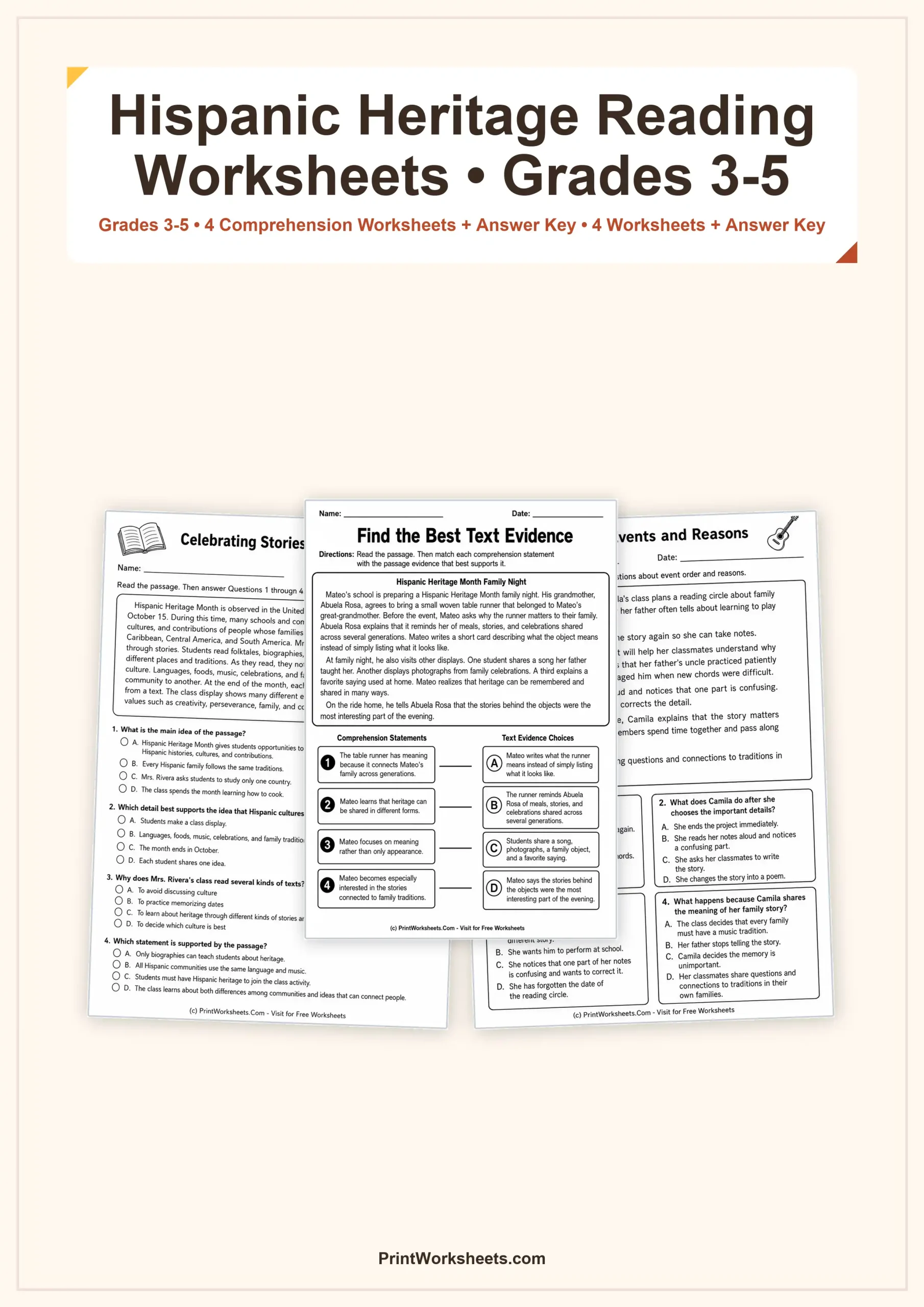
These Hispanic Heritage reading passages give students in Grades 3-5 a meaningful way to practice comprehension while learning how family stories, traditions, music, language, objects, and community projects can preserve heritage. The four printable student worksheets build from straightforward main-idea work to evidence matching, sequence and cause-effect reasoning, and comparison of two related passages. Because each page uses a different reading task, the set can work as a short Hispanic Heritage Month reading unit rather than four repetitions of the same question format.
Hispanic Heritage Reading Passages That Build Comprehension Skills
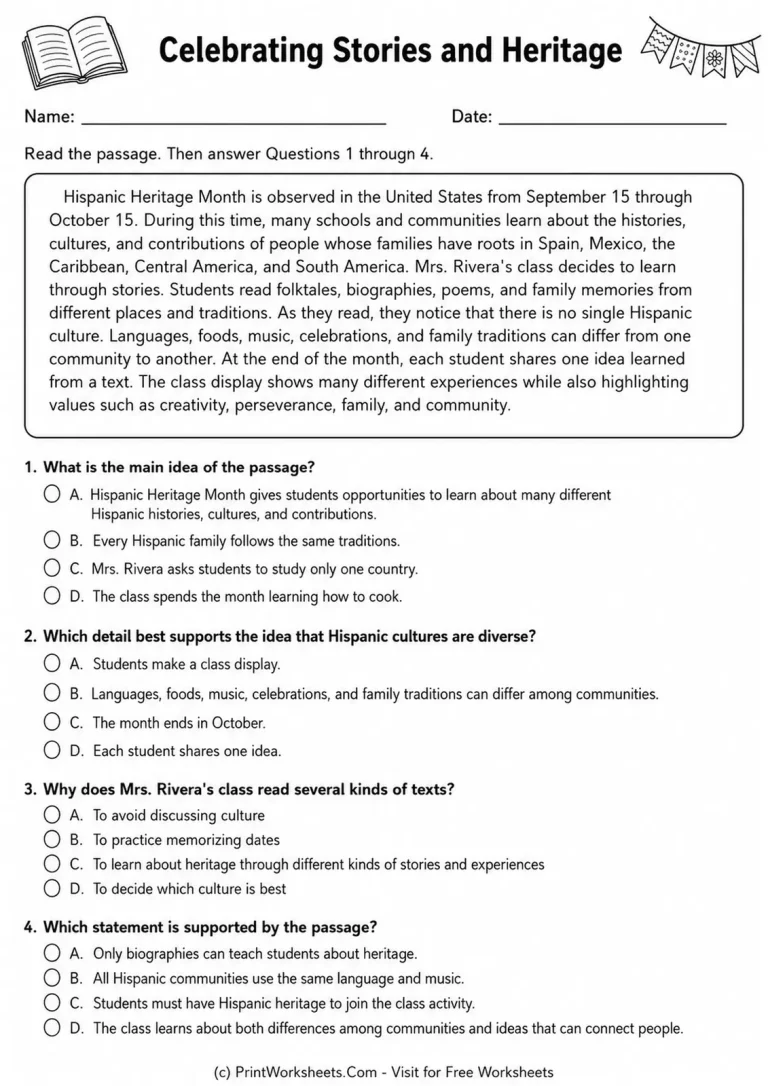
The first worksheet, Celebrating Stories and Heritage, introduces Hispanic Heritage Month and explains that it is observed from September 15 through October 15. Students read about the many ways people can explore Hispanic histories, cultures, contributions, languages, foods, music, celebrations, and family traditions. Four multiple-choice questions ask readers to identify the main idea, choose a supporting detail, think about the purpose of different kinds of texts, and select a statement supported by the passage. This page makes a useful starting point because students can establish the topic while reviewing core comprehension skills.
Teachers who want to extend the cultural theme beyond reading can pair this set with the Hispanic Heritage Month vocabulary worksheets. The vocabulary practice can help students discuss the reading topics with more confidence before or after completing the passages.
Move from Answers to Strong Text Evidence
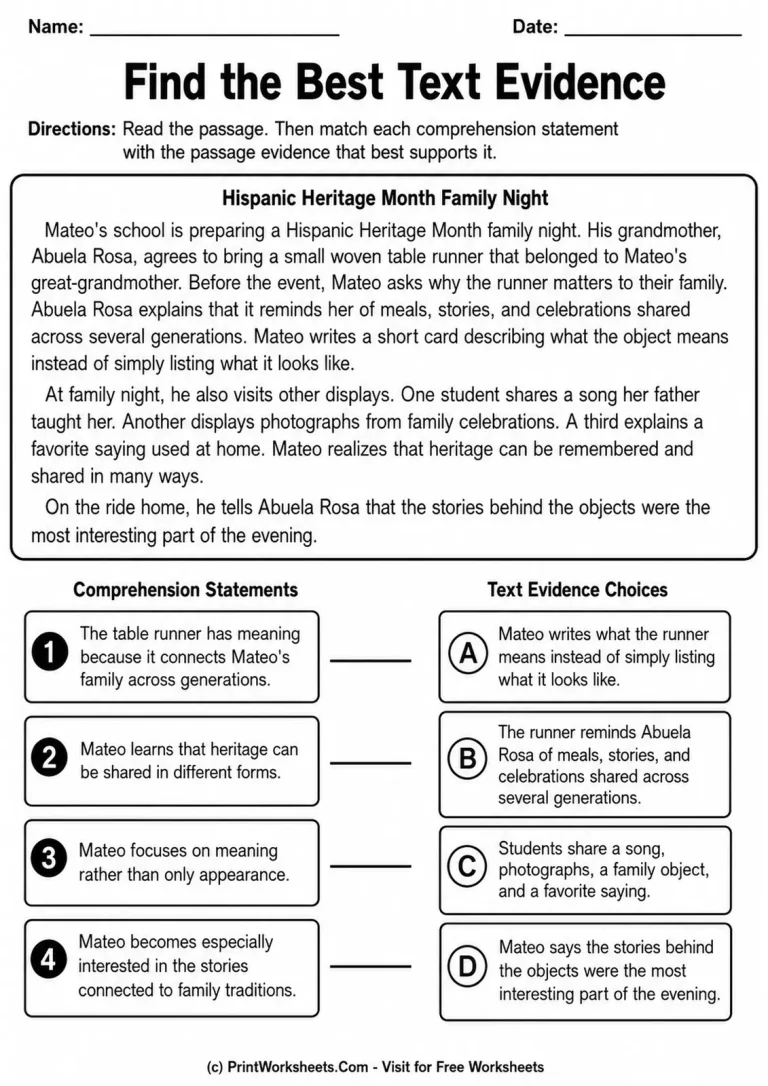
The second page, Find the Best Text Evidence, shifts the focus from choosing a general answer to locating the strongest support for an idea. Mateo attends a Hispanic Heritage Month family night at school and shares a woven table runner that belonged to his great-grandmother. The passage also includes family stories, a song, photographs, and a favorite saying, showing students that heritage can be shared through objects, memories, words, and traditions. Instead of answering standard multiple-choice questions, students match four comprehension statements to the best pieces of evidence labeled A-D.
This activity is especially helpful for students who can tell what happened in a story but still need practice proving an answer with information from the text. It can also prepare learners for written responses that require evidence rather than unsupported opinions.
Practice Sequence, Cause and Effect, and Family Storytelling
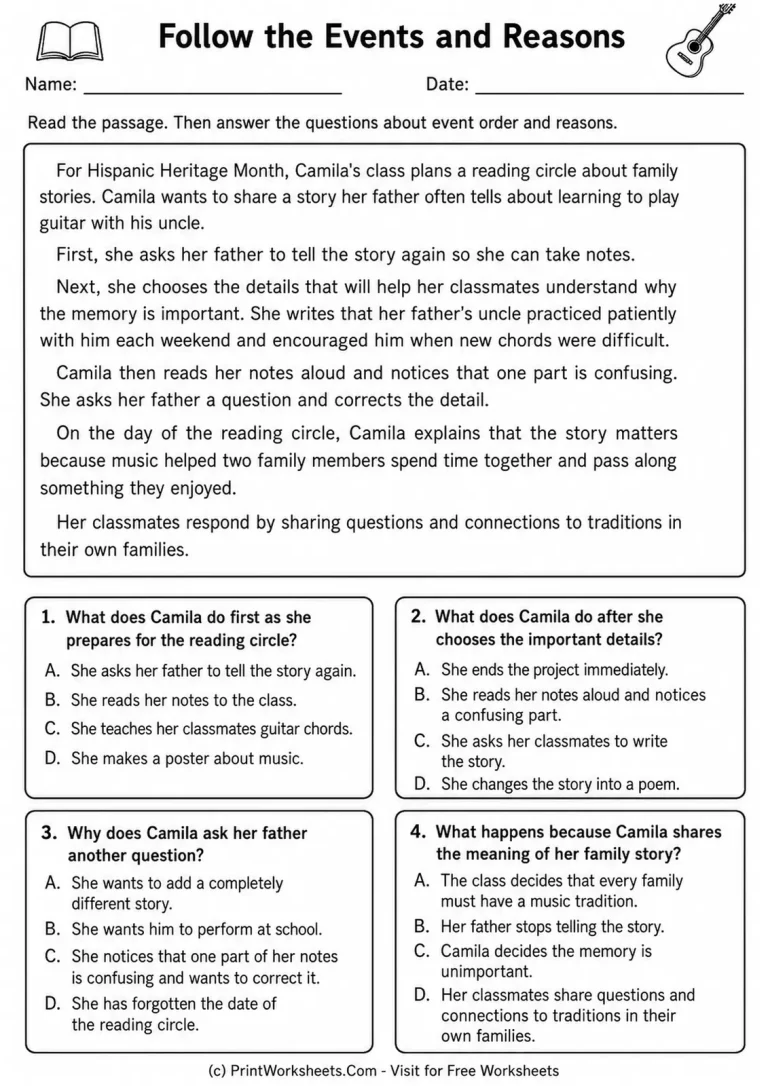
On the third worksheet, Follow the Events and Reasons, students read about Camila preparing a family story for a Hispanic Heritage Month reading circle. She listens again to her father’s memory of learning guitar from his uncle, chooses important details, corrects a mixed-up piece of information, and then shares why the story matters to her family. Questions ask students what happened first, what happened next, why a character took a particular action, and what resulted from sharing the story.
The combination of sequence and cause-and-effect questions encourages students to track both order and reasoning. Details about patience, encouragement, music, and family connection also create an opportunity for discussion about why personal stories can remain important across generations. For a related extension centered on people and their contributions, students can use the Hispanic Heritage Month biography worksheets.
Compare Two Heritage Projects
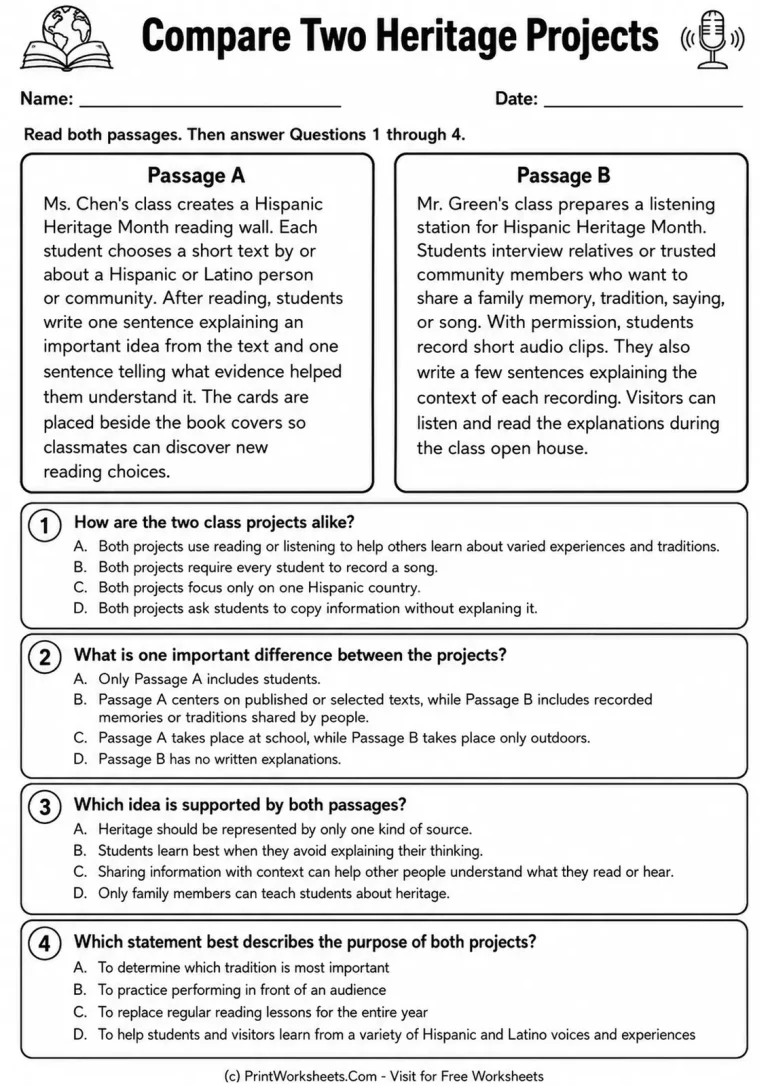
The fourth worksheet raises the challenge with paired passages. Passage A describes a Hispanic Heritage Month reading wall, while Passage B describes a listening station containing recorded memories, traditions, sayings, or songs from family and community members. Students must read across both texts to identify a similarity, recognize an important difference, find an idea supported by both passages, and determine their shared purpose.
This paired-text format makes the final page a strong choice for upper elementary students who are ready to compare information rather than answer questions from only one passage. It also gives teachers a natural checkpoint after the earlier work with main idea, evidence, sequence, and cause and effect.
Ways to Use These Grades 3-5 Reading Worksheets
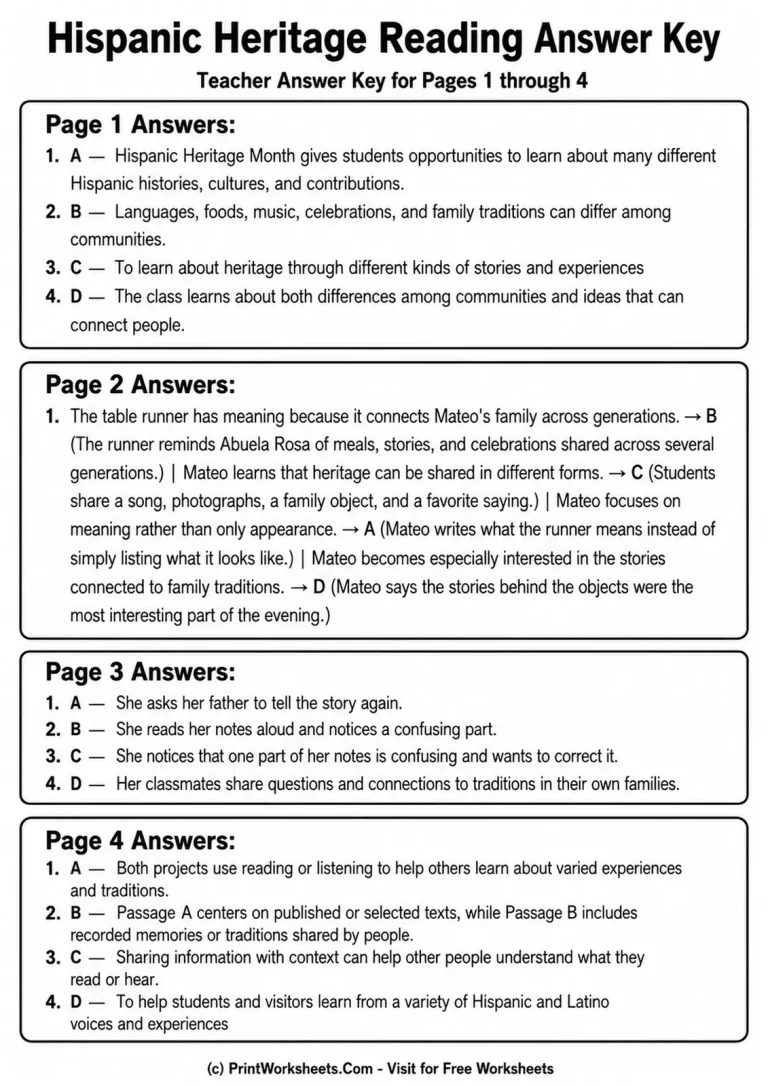
The four pages can be assigned in order over several days, used as independent literacy centers, sent home for reading practice, or divided among small groups. Grade 3 students may benefit from teacher modeling on the text-evidence and paired-passage pages, while Grade 4 and Grade 5 students can use the progression for independent review or seasonal reading practice. A complete answer key supports quick checking of all objective questions.
After students finish the reading set, the Hispanic Heritage Month writing prompts provide a useful next step. Students can move from analyzing how the passages present memories, traditions, and cultural connections to organizing and expressing ideas of their own.
A Short Reading Sequence with a Clear Skill Progression
What makes this printable set useful is the progression across the four worksheets: identify important ideas, connect claims to evidence, follow events and reasons, and finally compare two texts. Teachers and parents can use the pages separately, but together they create a focused Hispanic Heritage Month comprehension sequence that combines culturally relevant reading topics with practical Grades 3-5 literacy skills.