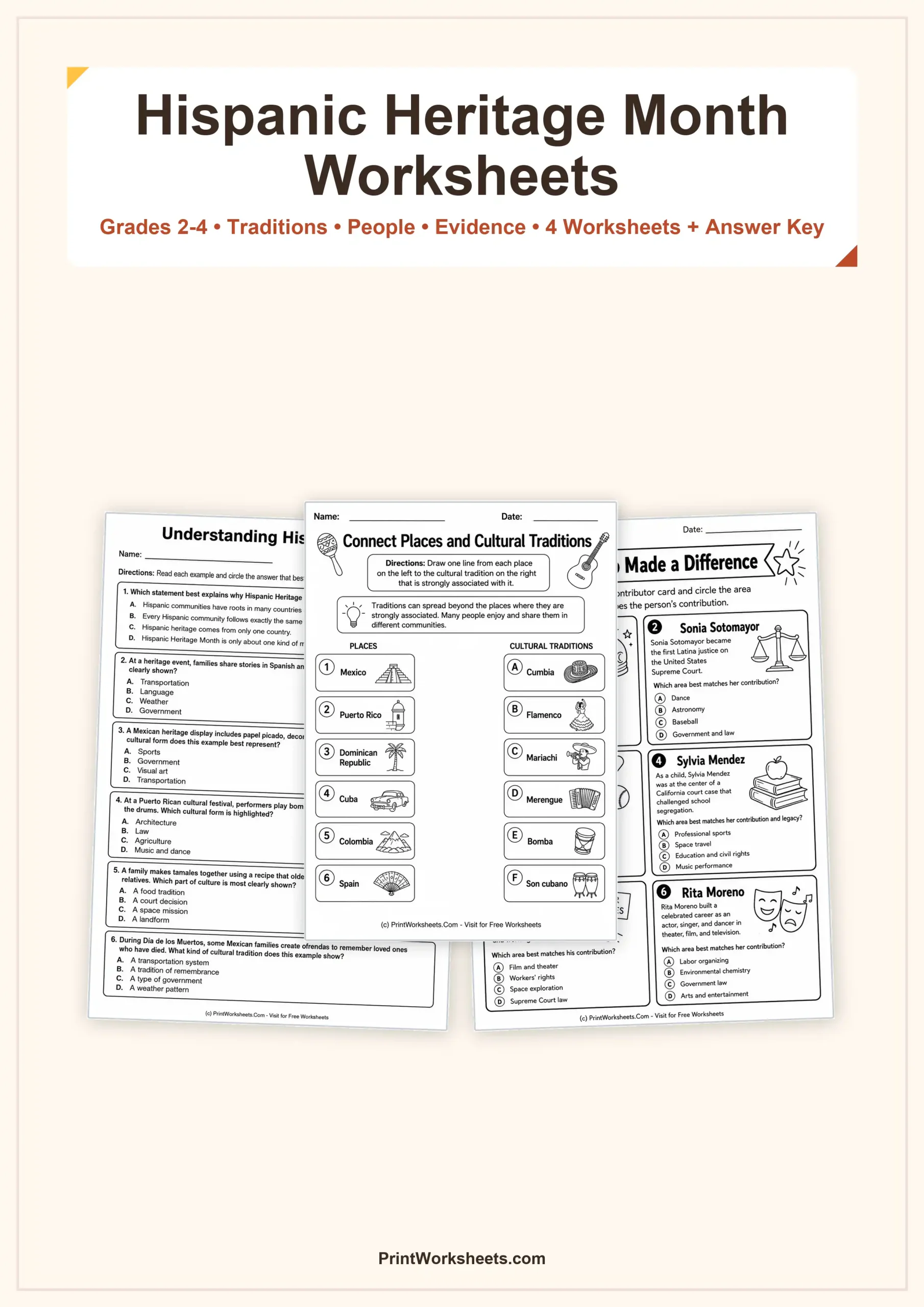

These Hispanic Heritage culture worksheets give students in Grades 2-4 several ways to explore traditions, places, people, and contributions during Hispanic Heritage Month. Instead of repeating one question format, the four student pages move from concrete cultural examples to matching, short biography reading, and evidence-based thinking. Students encounter examples such as papel picado, bomba, tamales, Día de los Muertos ofrendas, Mariachi, Merengue, Cumbia, and Flamenco while also learning about people whose work influenced science, law, sports, civil rights, workers’ rights, entertainment, and public service.
What Students Practice with These Hispanic Heritage Culture Worksheets
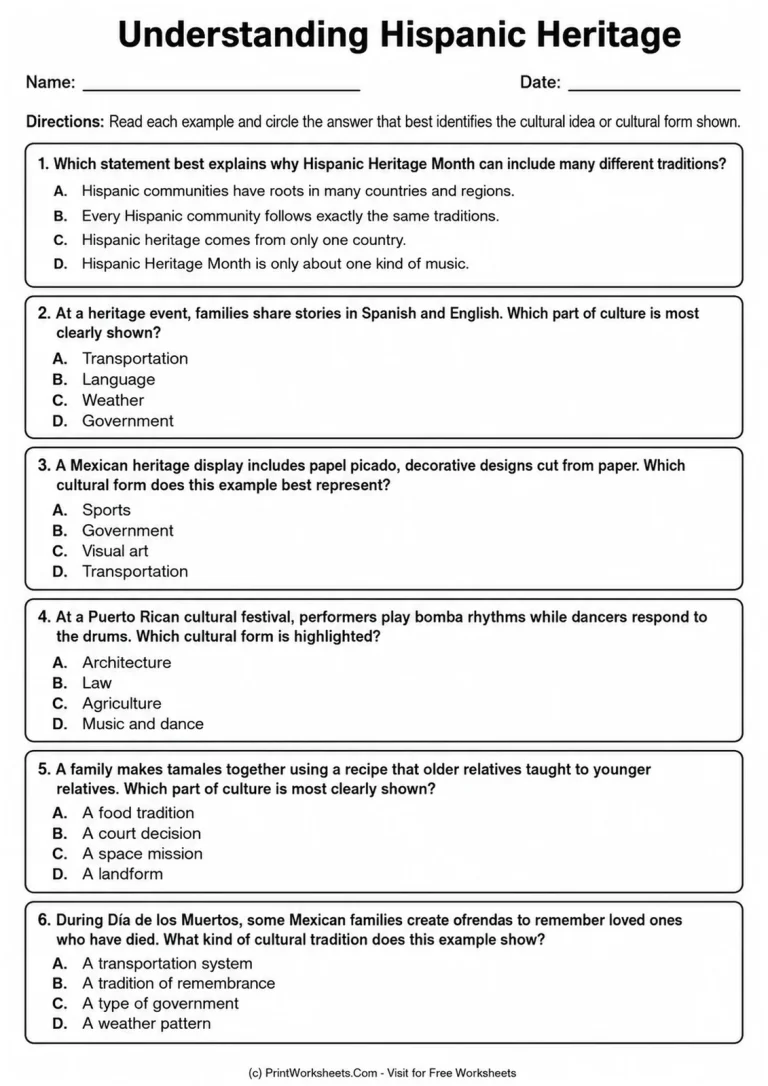
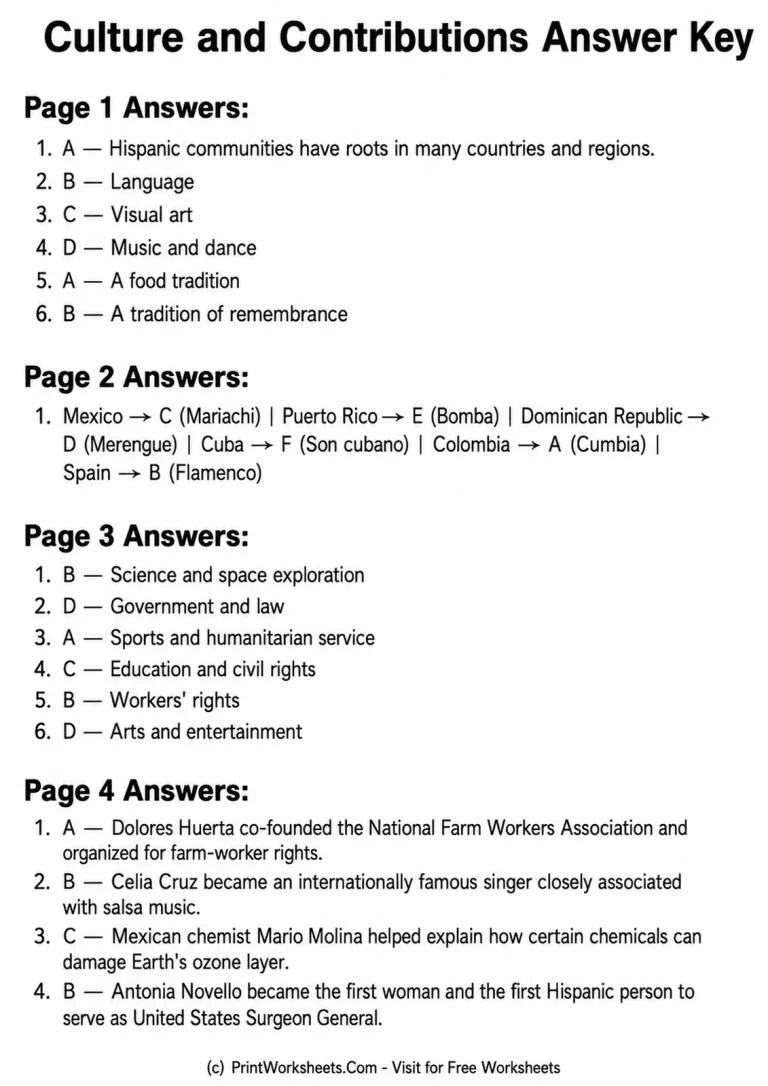
The first worksheet, Understanding Hispanic Heritage, introduces the idea that Hispanic heritage has roots in many countries and regions. Six multiple-choice questions ask students to recognize examples of language, art, music and dance, food traditions, and remembrance traditions. Visible examples include Spanish and English language use, Mexican papel picado, Puerto Rican bomba, tamales, and Día de los Muertos ofrendas. This page works well as an accessible starting point because students respond to specific examples before moving into more complex reading tasks.
The second worksheet, Connect Places and Cultural Traditions, shifts from recognition to association. Students draw lines to connect six places with traditions strongly linked to them: Mexico with Mariachi, Puerto Rico with Bomba, the Dominican Republic with Merengue, Cuba with Son cubano, Colombia with Cumbia, and Spain with Flamenco. The matching format creates a concise social studies connection while reinforcing that Hispanic cultures include many distinct regional traditions rather than one single cultural experience.
From Cultural Traditions to People and Contributions
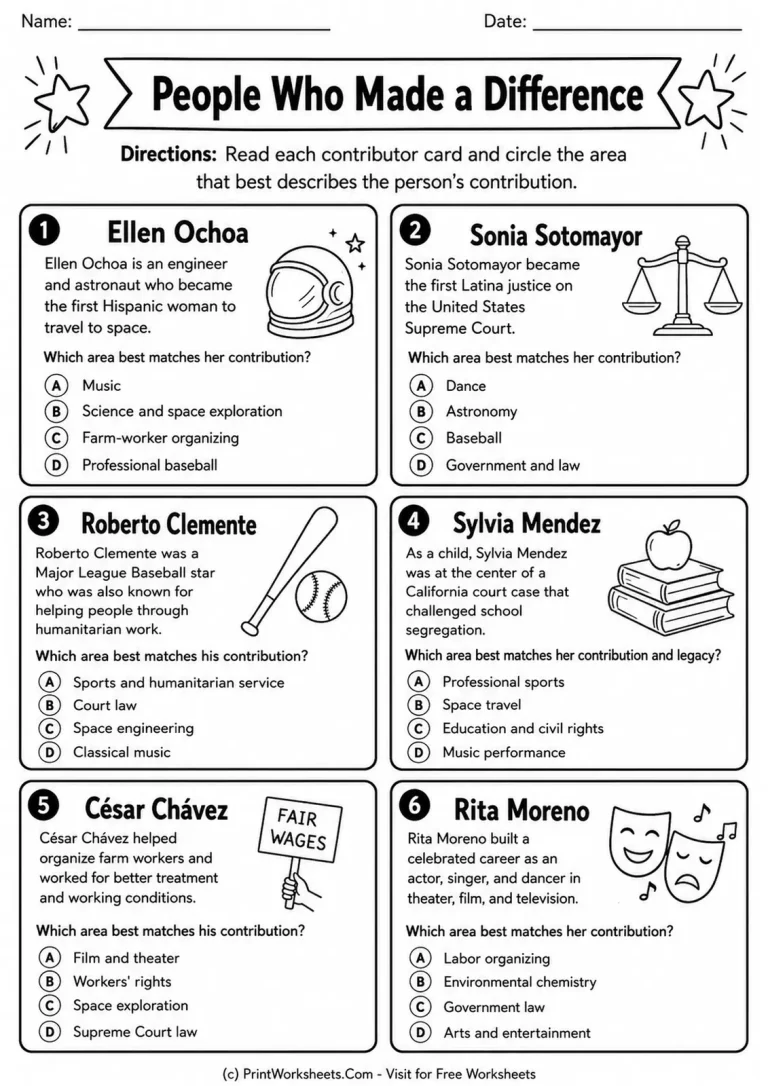
The third page, People Who Made a Difference, introduces six notable contributors through short biography cards. Students identify each person’s main area of contribution. Ellen Ochoa connects to science and space exploration, Sonia Sotomayor to government and law, Roberto Clemente to sports, Sylvia Mendez to civil rights, César Chávez to workers’ rights, and Rita Moreno to entertainment. Because the task requires students to read short informational details and categorize each person’s impact, it can support both Hispanic Heritage Month social studies lessons and elementary informational-reading practice.
Teachers looking for a deeper biography extension can pair this set with the Hispanic Heritage Month biography worksheets. That collection provides a more concentrated biography focus for older elementary students, while this set keeps biography work as one part of a broader culture-and-contributions sequence.
Building Claim-and-Evidence Skills
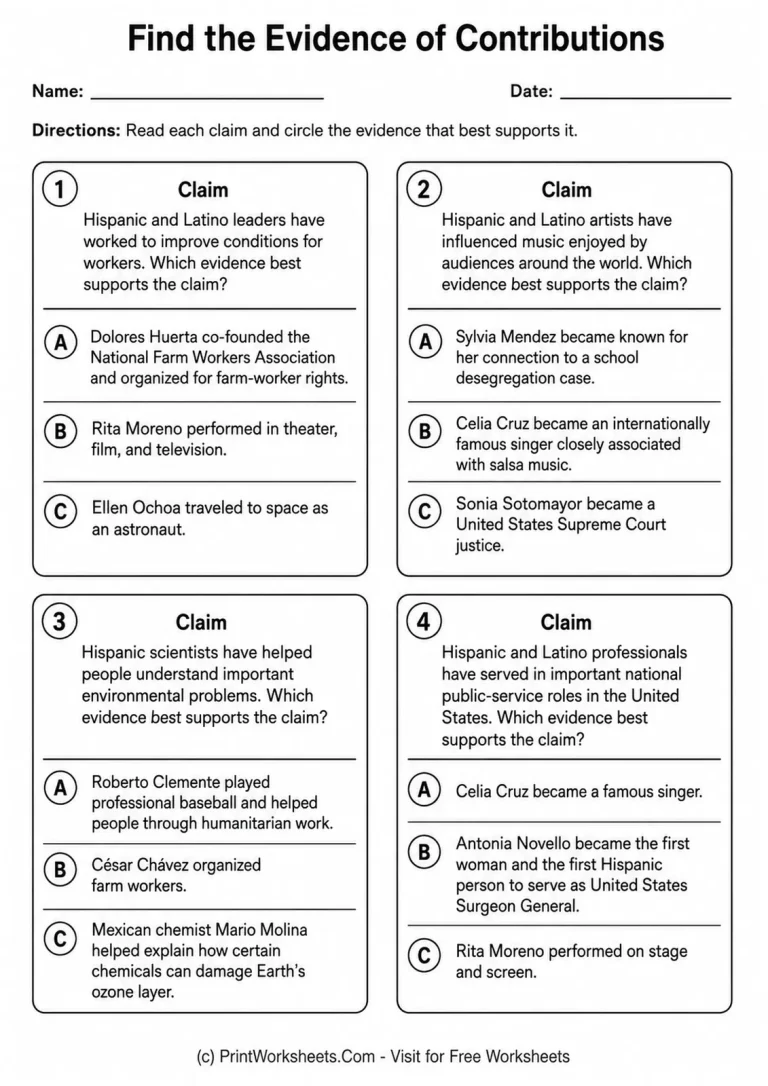
The fourth student page, Find the Evidence of Contributions, raises the reading demand by asking students to select evidence that best supports a stated claim. The four examples feature Dolores Huerta and farm-worker rights, Celia Cruz and salsa music, Mario Molina and ozone research, and Antonia Novello and public service. Students are not simply identifying a famous person; they must connect a claim to the biographical detail that supports it. This makes the page especially useful for Grade 3-4 students practicing evidence selection in short informational texts.
The progression also gives teachers flexibility. Grade 2 students can begin with the concrete multiple-choice and matching pages, while Grades 3-4 can move through the contributor cards and claim-and-evidence questions. The pages can be used together as a short Hispanic Heritage Month mini-unit or separately for morning work, literacy centers, social studies practice, independent work, or review.
Extend the Hispanic Heritage Month Learning
Students who need additional language practice can continue with the Hispanic Heritage Month vocabulary worksheets. After learning about cultures and contributors, students can also respond in their own words with the Hispanic Heritage Month writing prompts. Together, these resources allow teachers to move from recognizing cultural examples to building vocabulary, reading about contributions, using evidence, and developing written responses.
An included answer key covers all four student pages, making the set practical for whole-class checking, independent practice, homework review, or small-group instruction. The variety of tasks keeps the topic focused without making every page feel the same, while the combination of culture, traditions, notable people, and evidence-based reading gives students multiple entry points into Hispanic Heritage Month learning.