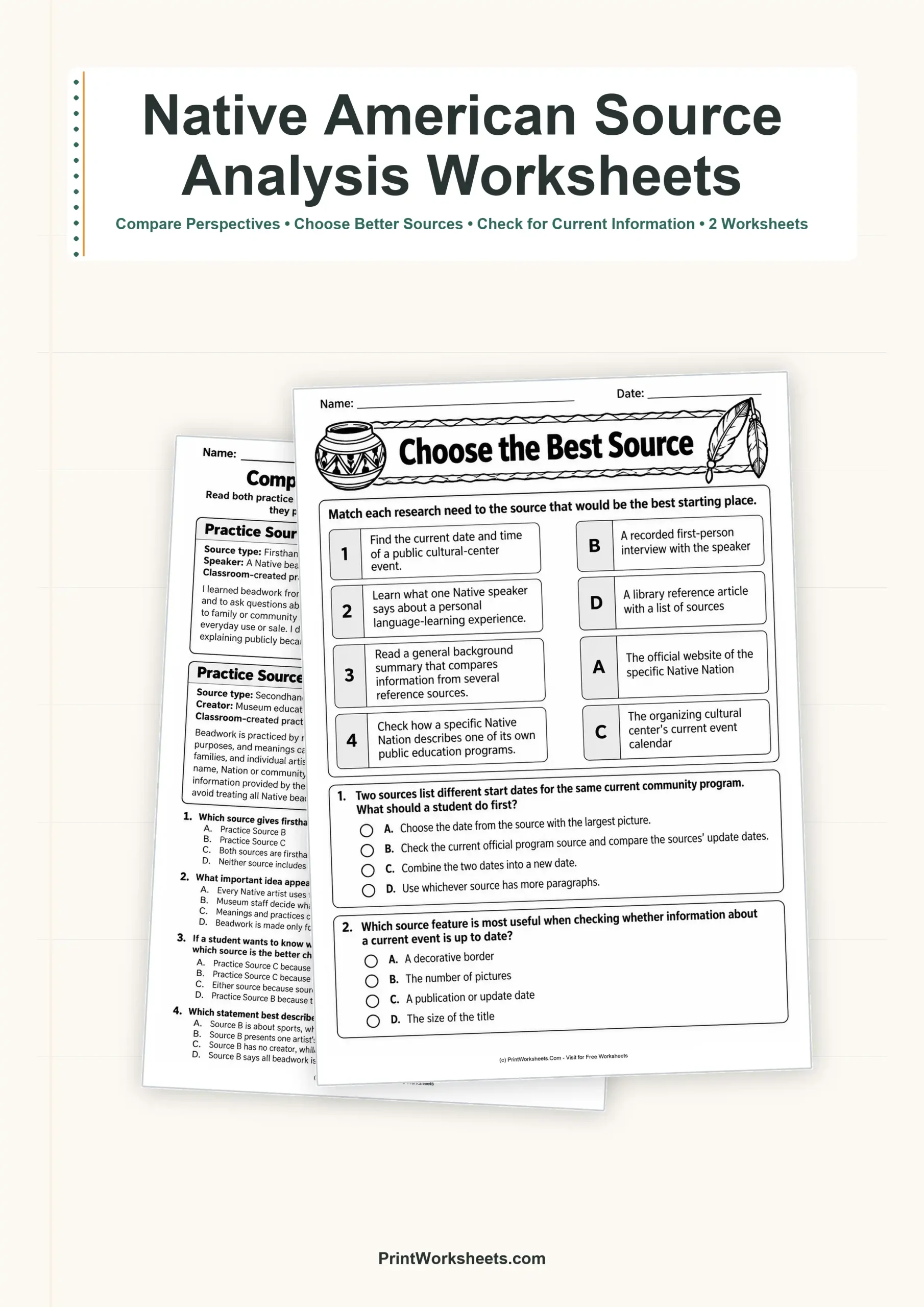
These Native American source analysis worksheets give fifth-grade students focused practice with an important research skill: deciding what a source can tell them and when one source is more useful than another. Designed for Native American Heritage Month research practice, the printable activities use an artist interview, a museum education summary, an official Native Nation website, a first-person interview, a library reference article, and a current cultural-center event calendar. Rather than simply locating facts, students must think about who created information, whether it is firsthand or secondhand, what question it can answer best, and whether the information is current enough for the research task.
Native American Source Analysis Practice
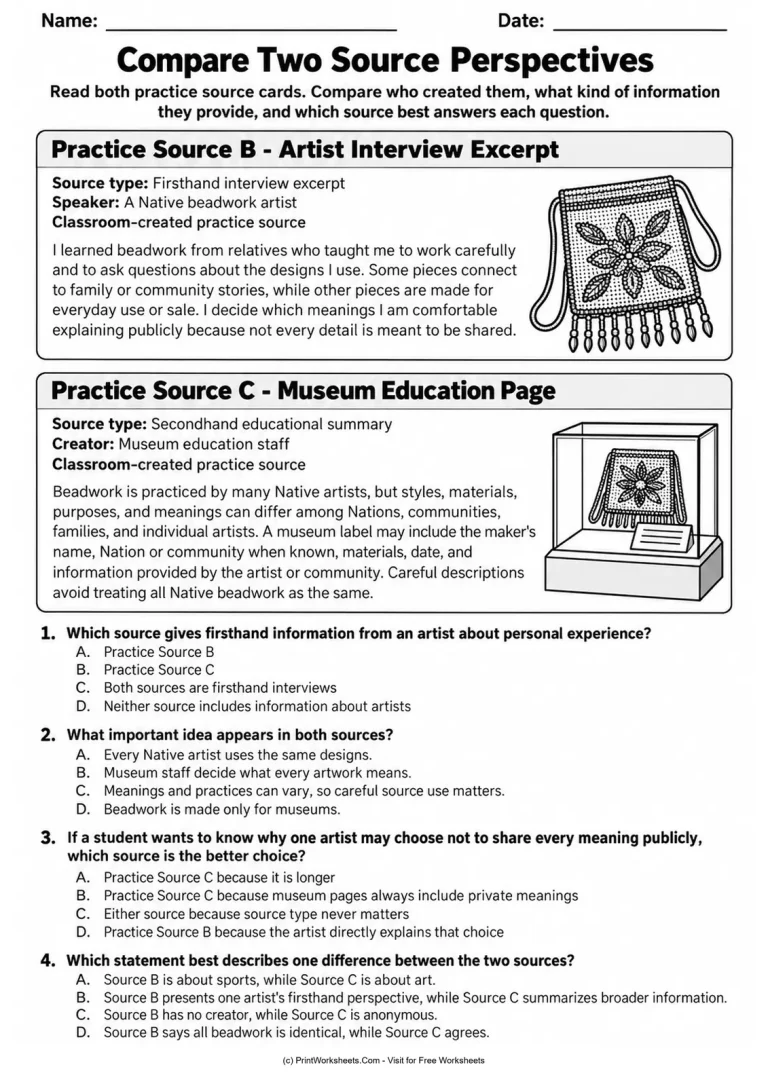
The first worksheet centers on comparing two source perspectives. Students read a classroom-created interview excerpt from a Native beadwork artist alongside a museum education summary. The artist explains learning beadwork from relatives, asking questions about designs, and deciding which meanings are appropriate to share publicly. The museum source offers broader background information and emphasizes that beadwork styles, materials, purposes, and meanings may differ among Nations, communities, families, and individual artists.
The questions require students to identify which source contains firsthand information, recognize an idea supported by both texts, choose the best source for understanding one artist’s personal decision, and describe the difference between an individual firsthand perspective and a broader educational summary. This makes the activity useful for teaching students that sources do not become interchangeable simply because they address the same topic.
Compare Firsthand and Secondhand Sources
One of the strongest features of the set is its emphasis on perspective. Students see that an interview can provide direct personal experience while a museum education page can summarize information from a wider viewpoint. They also encounter an important research habit: careful source use matters when cultural practices and meanings vary among communities and individuals.
This type of comparison supports close reading because students cannot answer correctly from keywords alone. They need to pay attention to the creator, source type, purpose, and specific details contained in each source. Teachers can also use the questions as a starting point for discussion about why a firsthand account may be the best choice for one question while a broader secondary source may be more useful for another.
Choose the Best Source for a Research Question
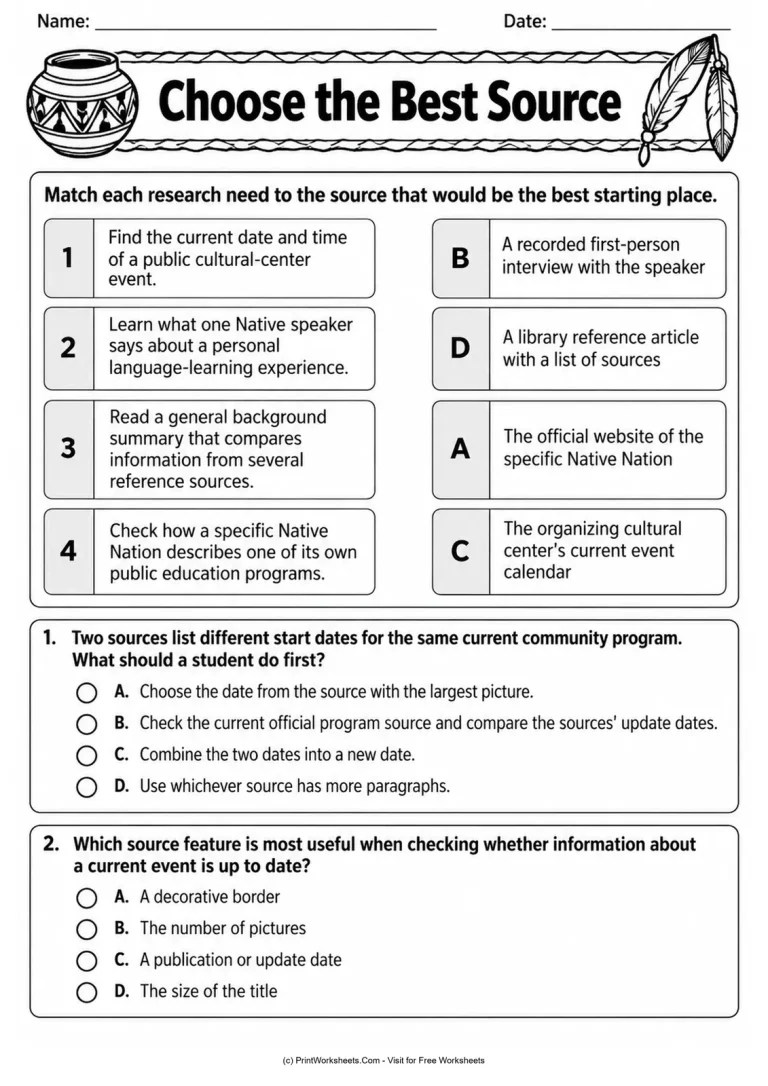
The second printable shifts from comparing two texts to selecting the most appropriate starting source for several research needs. Students match a current cultural-center event with the center’s event calendar, a personal language-learning experience with a recorded first-person interview, a general background summary with a library reference article, and information about a Native Nation’s own education program with that Nation’s official website.
This activity helps students connect the research question to the source type instead of assuming that one source is always best. The matching task is followed by questions about conflicting dates and source freshness. When two sources list different start dates for the same current program, students are directed toward checking the current official source and comparing update dates. They also identify a publication or update date as the most useful feature for judging whether information about a current event is up to date.
Build Better Source-Selection Habits
These worksheets are especially useful for lessons on research readiness, informational reading, digital literacy, and evidence evaluation. They can be completed independently, used in small groups, or discussed as a class before students begin a larger research project. Because the scenarios include interviews, official websites, reference sources, museum information, and event calendars, students practice choosing among realistic source types rather than working with abstract definitions only.
The set also gives teachers and parents a concrete way to introduce the idea that source quality depends partly on the question being asked. A first-person interview may be best for understanding one person’s experience, while an official website may be a stronger starting point for current information about an organization’s own program. A library reference article may help with broad background knowledge, while an event calendar is more appropriate for current dates and times.
Skills Practiced in These Printable Worksheets
Students practice distinguishing firsthand from secondhand information, comparing perspectives, matching research needs to source types, identifying official sources, checking publication or update dates, and selecting evidence based on purpose. The Native American Heritage Month context also encourages careful reading of information that may vary across Nations, communities, families, and individual artists.
Use these printables as a focused Grade 5 source-analysis lesson, a research-skills review, or a preparation activity before a longer project. The two-page set moves from close comparison to independent source selection, giving students a practical sequence for thinking more carefully about where information comes from and why that matters.