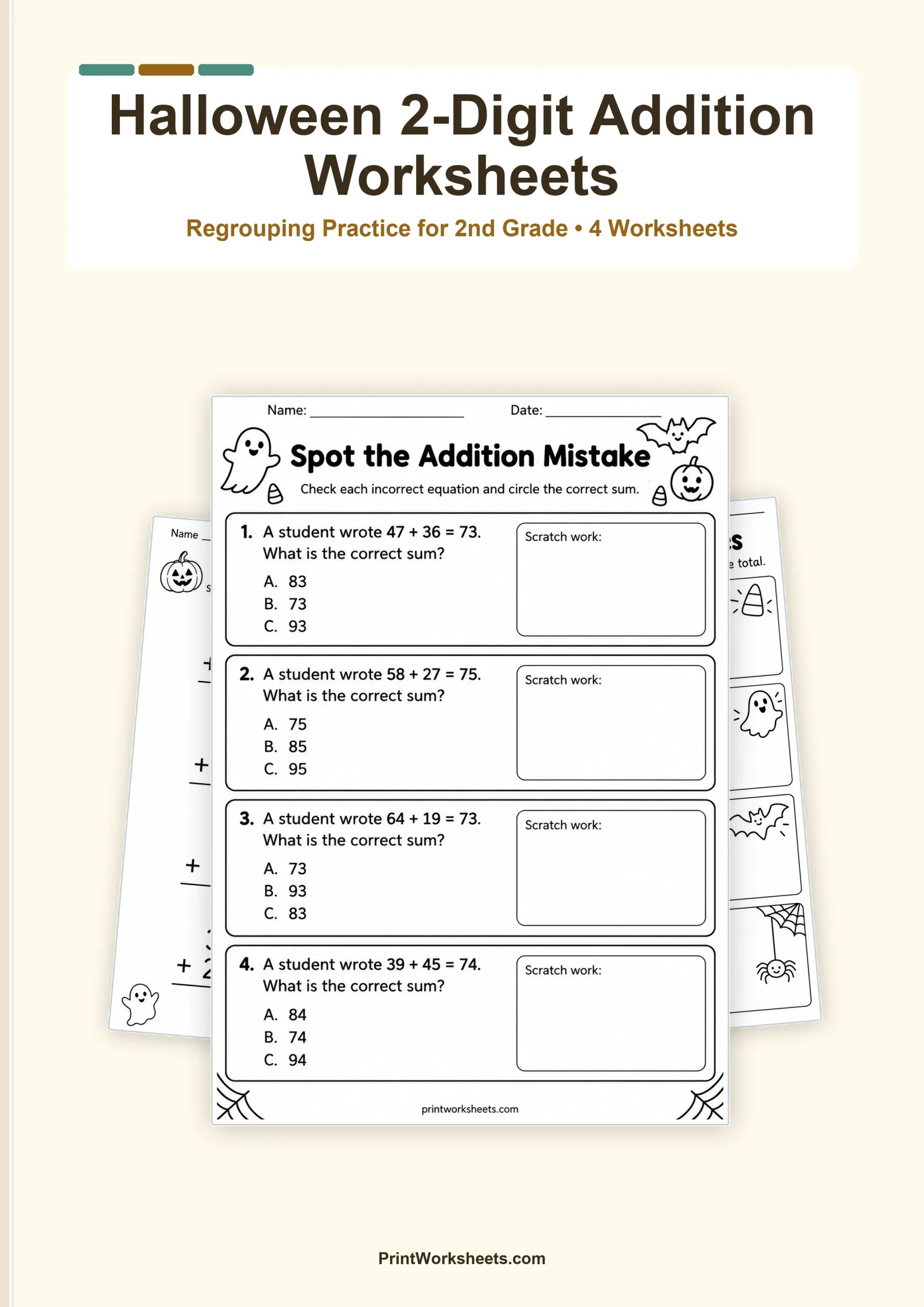
These Halloween 2-digit addition worksheets give second-grade students focused practice with regrouping while keeping the work varied enough for a full math center, independent practice session, or seasonal review. The set includes four student worksheets built around the same core skill: adding two-digit numbers when the ones place makes a new ten. Instead of repeating one page format, students solve vertical equations, correct addition mistakes, work through Halloween story problems, and match equations to their sums.
Halloween 2-Digit Addition Practice with Regrouping
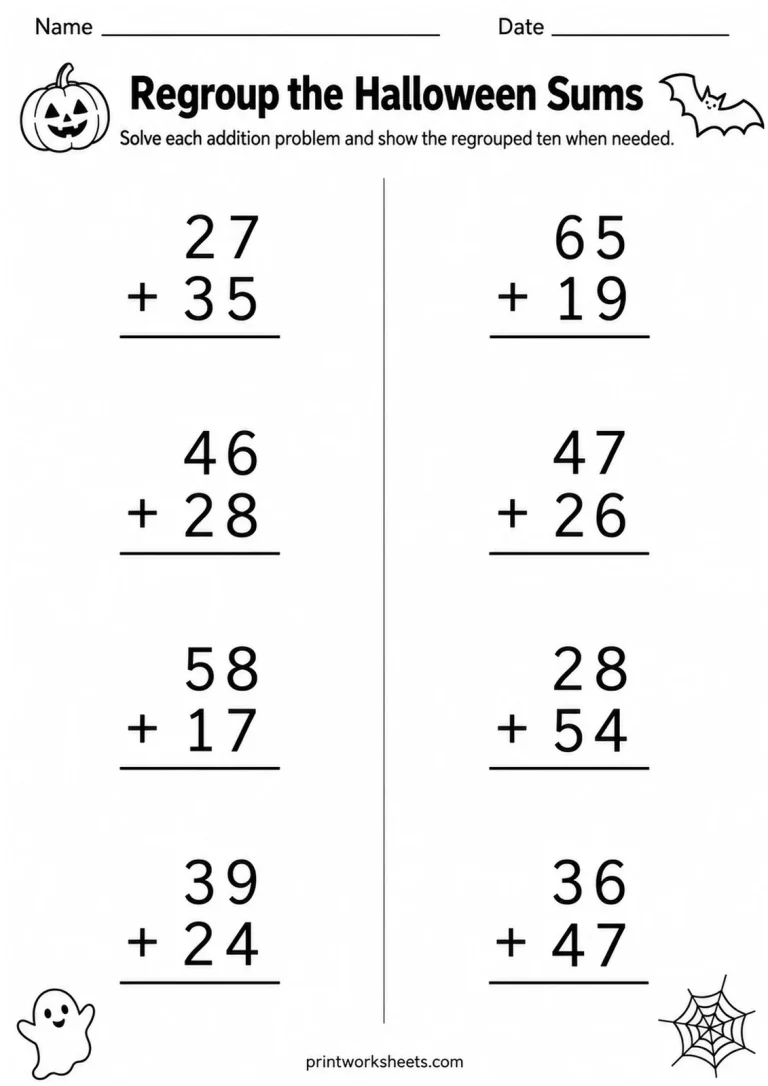
The first worksheet, Regroup the Halloween Sums, is a straightforward computation page with eight vertical addition problems. Each equation requires regrouping, so students repeatedly practice the important step of combining the ones, recording the ones digit, and regrouping one ten before adding the tens column. Problems include 27 + 35, 46 + 28, 58 + 17, 65 + 19, 47 + 26, and other similar combinations. The clean two-column layout leaves students room to show their work rather than simply writing a final answer.
This page works well when students are first becoming more independent with the standard addition process. Teachers can also pair it with the vertical double digit addition without regrouping worksheets when students need a progression from easier place-value practice to regrouping.
Four Ways to Practice the Same Addition Skill
Find and Fix Addition Mistakes
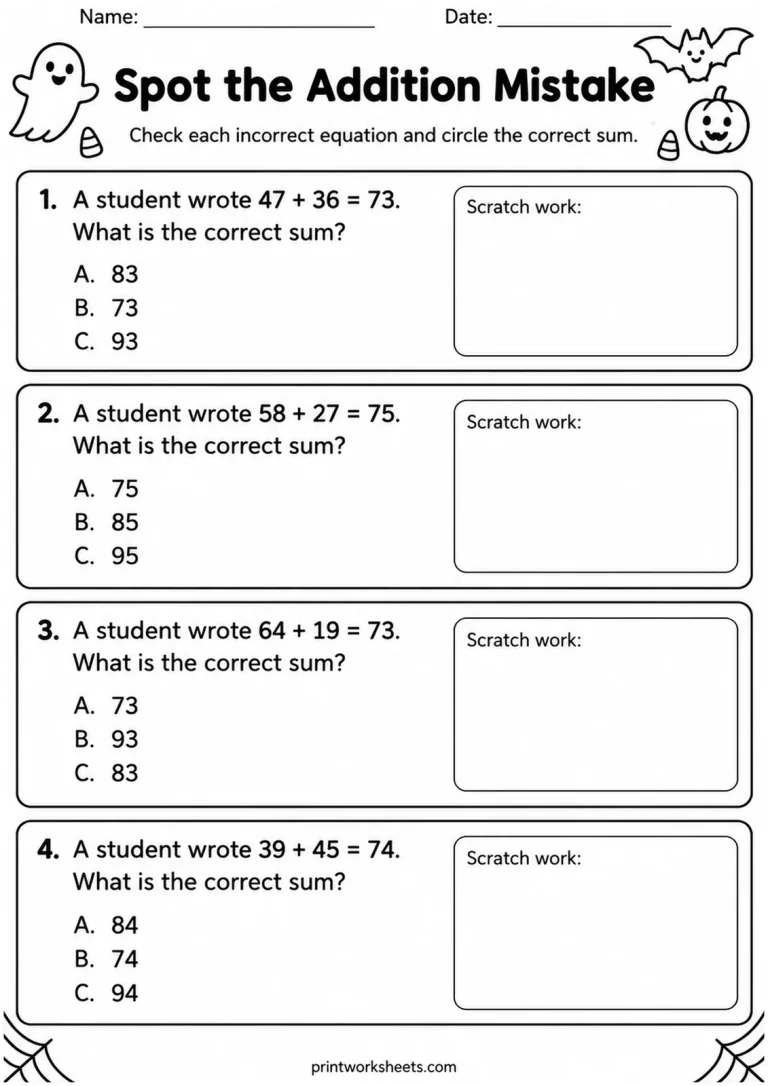
Spot the Addition Mistake changes the task from solving from scratch to checking someone else’s work. Students examine four incorrect equations, such as 47 + 36 = 73, then choose the correct sum from three answer choices. Each question includes a separate scratch-work box, making it easy for students to recompute the addition before making a choice. This format is useful for building mathematical attention because students must decide what went wrong instead of relying only on a familiar worksheet routine.
Solve Halloween Addition Stories
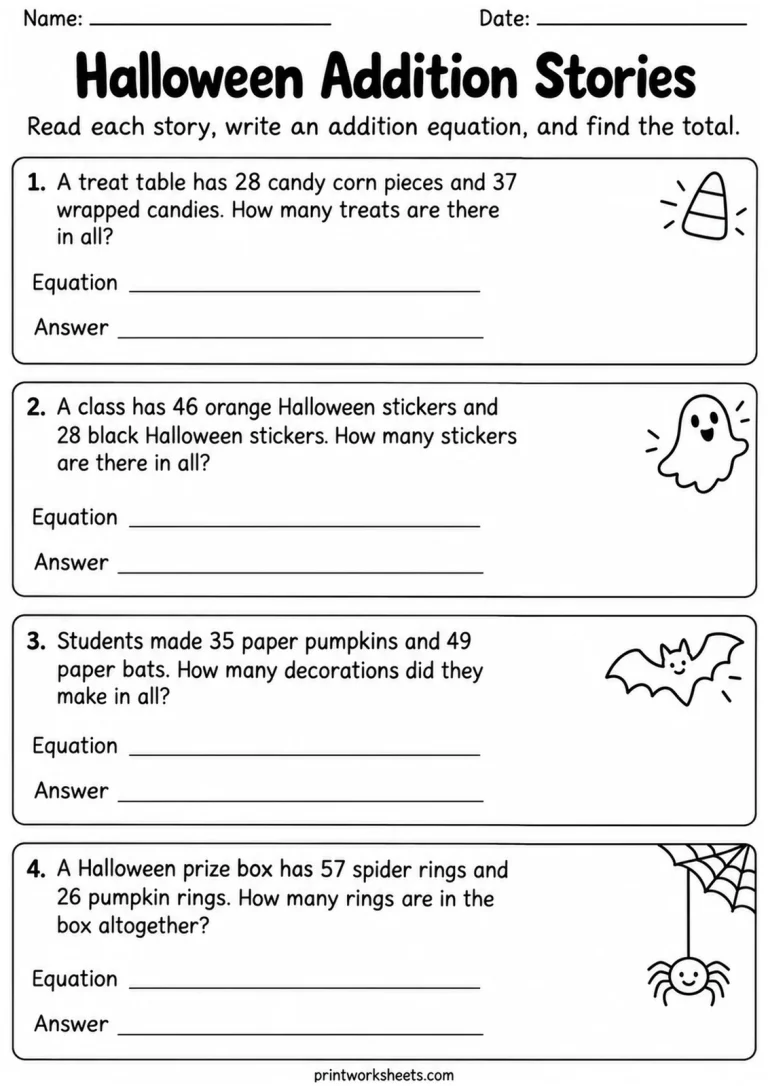
The Halloween Addition Stories page gives students four short word problems using seasonal situations such as candy corn, wrapped candies, Halloween stickers, paper pumpkins, bats, spider rings, and pumpkin rings. Students first write an equation and then record the answer. The quantities stay within two-digit addition and require regrouping, so the story context supports the same exact skill as the computation page while adding reading and problem-solving practice.
Because the page asks for both an equation and a final answer, it can help teachers see whether a student understands how to translate a story into an addition expression rather than guessing from the numbers alone.
Match Equations to Their Sums
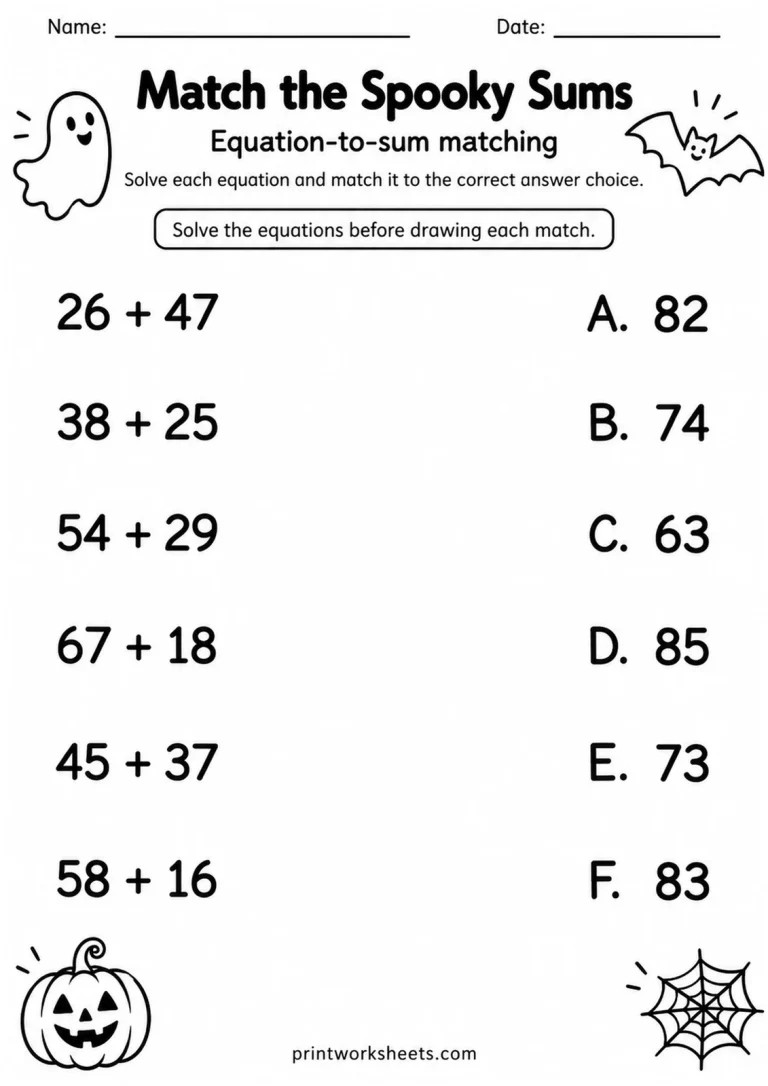
Match the Spooky Sums includes six equations on the left and six lettered answer choices on the right. Students solve each equation before drawing a match to the correct total. The answers are intentionally mixed rather than placed in matching rows, so students must actually compute each sum. Examples include 26 + 47, 38 + 25, 54 + 29, 67 + 18, 45 + 37, and 58 + 16.
Ways to Use These Halloween Addition Worksheets
These pages can be used together as a short seasonal mini-unit or separated across several days. The vertical-sums page is a good choice for direct skill practice, while the error-analysis page fits a math center or partner discussion. The story-problem page works well when the goal is to connect computation with real situations, and the matching page can provide a lighter review activity after students have practiced the procedure.
For students who are ready for more practice with the same operation in a different seasonal setting, the Fall 2-Digit Addition with Regrouping worksheets provide another set of problems without duplicating the Halloween theme. Students who still need confidence before carrying a ten can also use the double digit addition practice sheets without regrouping first.
What Students Practice
Across the four worksheets, students repeatedly add two-digit numbers, regroup from the ones place, check incorrect sums, write addition equations from short stories, and connect equations with correct totals. The Halloween illustrations add seasonal interest without changing the mathematical goal. This makes the set practical for October homework, morning work, math stations, intervention groups, sub plans, or extra review before moving into more advanced multi-digit addition.
Use one page for a quick lesson follow-up or print the full set for several rounds of targeted Halloween math practice. The variety of formats keeps students working on the same essential regrouping skill while giving teachers more than one way to observe how well that skill is transferring.