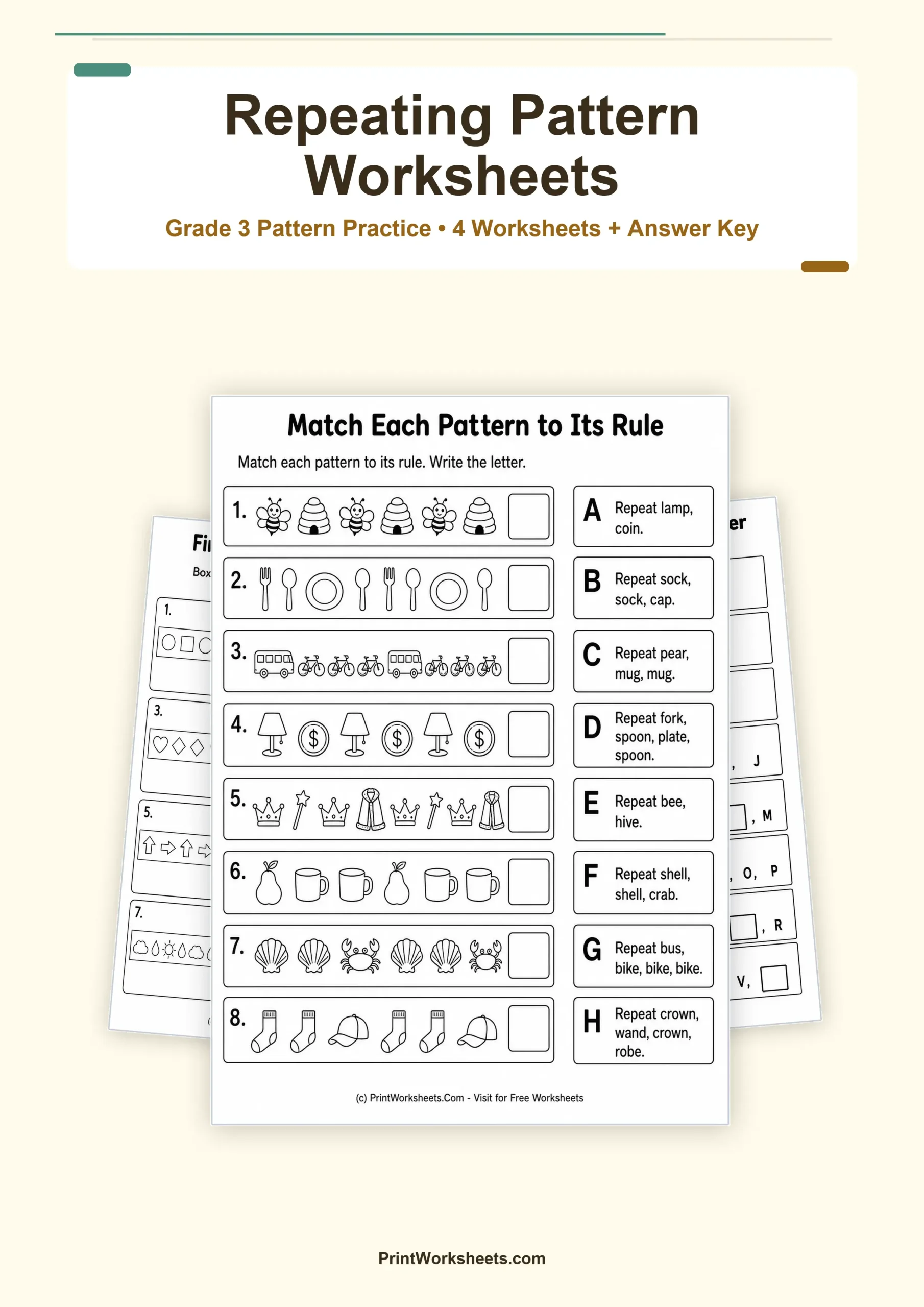
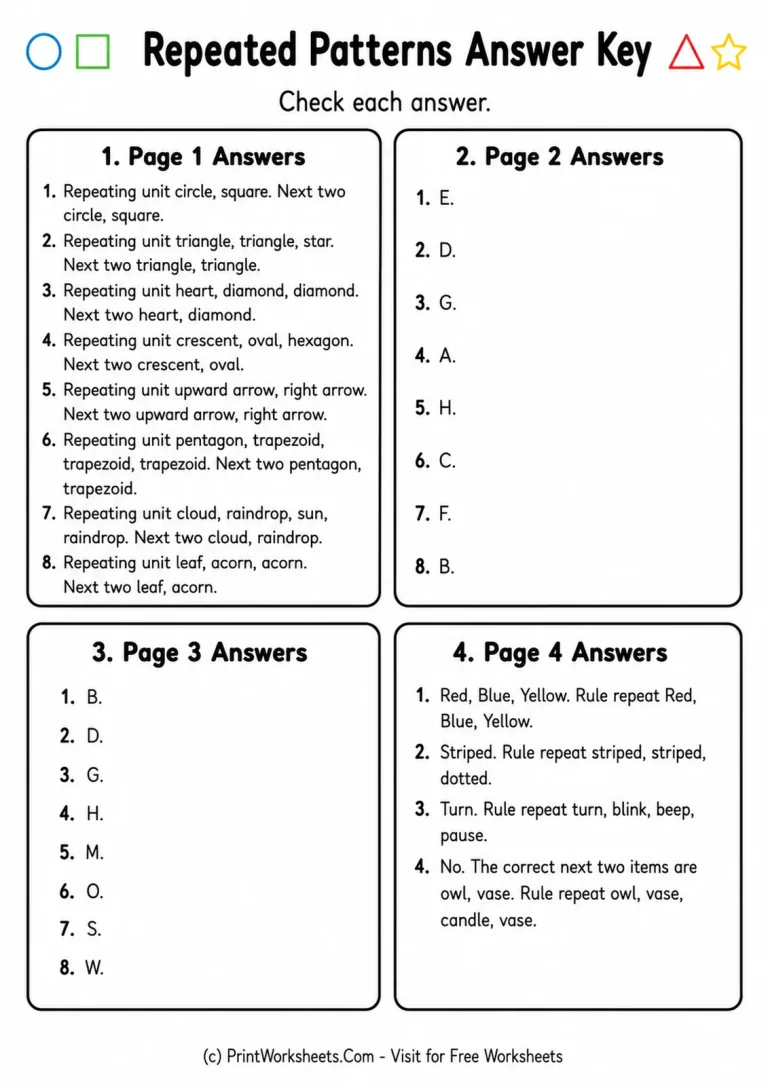
A repeating pattern may look simple at first, but recognizing exactly what repeats requires careful observation and logical thinking. These free repeating pattern worksheets for Grade 3 give students several ways to practice that reasoning. Across four student pages, children identify the smallest repeating unit, extend visual sequences, connect picture patterns to written rules, complete missing positions in letter patterns, and solve story problems that require them to explain or apply a repeating rule. A complete answer key is included for all four activities.
Repeating Pattern Worksheets for Grade 3
This printable set is designed for students who are ready to move beyond simply guessing what comes next. The activities ask children to pay attention to the structure of each pattern and use that structure to justify their answers. Some patterns repeat every two positions, while others use longer units with three or four parts. That variety helps students notice that the repeating unit, rather than the total length of the visible sequence, determines how the pattern continues.
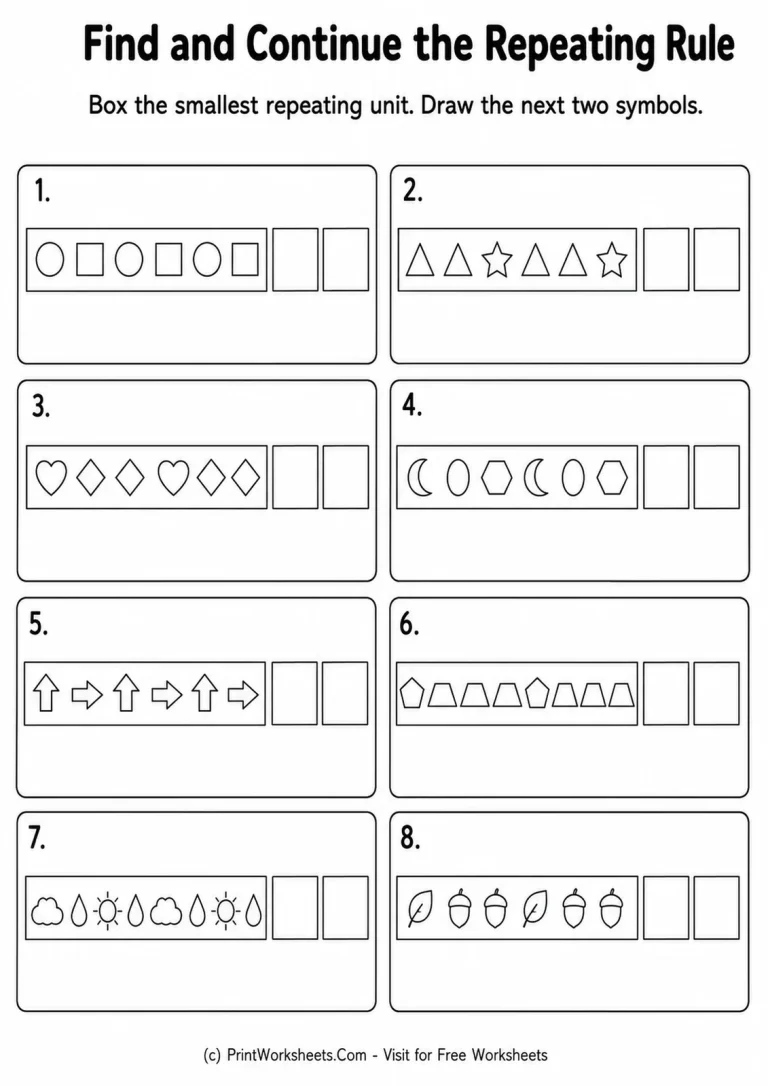
The first worksheet, Find and Continue the Repeating Rule, presents eight visual sequences made from shapes and familiar symbols. Students box the smallest unit that repeats and then draw the next two symbols. Examples include circle-square patterns, triangle-triangle-star patterns, heart-diamond-diamond sequences, arrows, weather symbols, geometric shapes, and leaf-acorn arrangements. Because students must identify the smallest complete repeat before extending the sequence, the page encourages precise pattern analysis rather than simple visual imitation.
Connect Picture Patterns to Written Rules
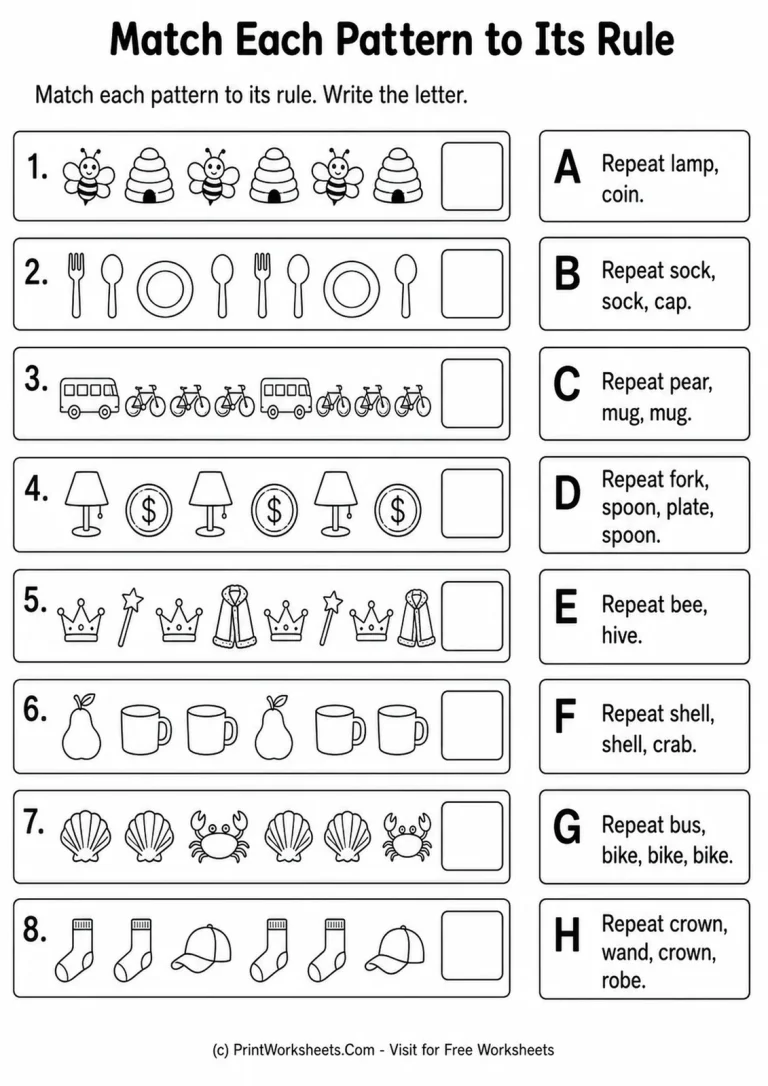
The second worksheet changes the representation. Instead of only extending a sequence, students examine eight picture patterns and match each one to a written rule labeled A through H. The examples use recognizable objects such as bees and hives, utensils, buses and bikes, lamps and coins, pears and mugs, shells and crabs, socks and caps, and other familiar images.
This matching format is useful because students must translate between what they see and how the pattern can be described in words. A child who can continue a picture sequence may still need practice explaining its organization. Matching each visual pattern to the correct written rule gives teachers and parents a clear way to check whether the student understands the repeating structure itself.
Practice Missing Letters in Repeating Sequences
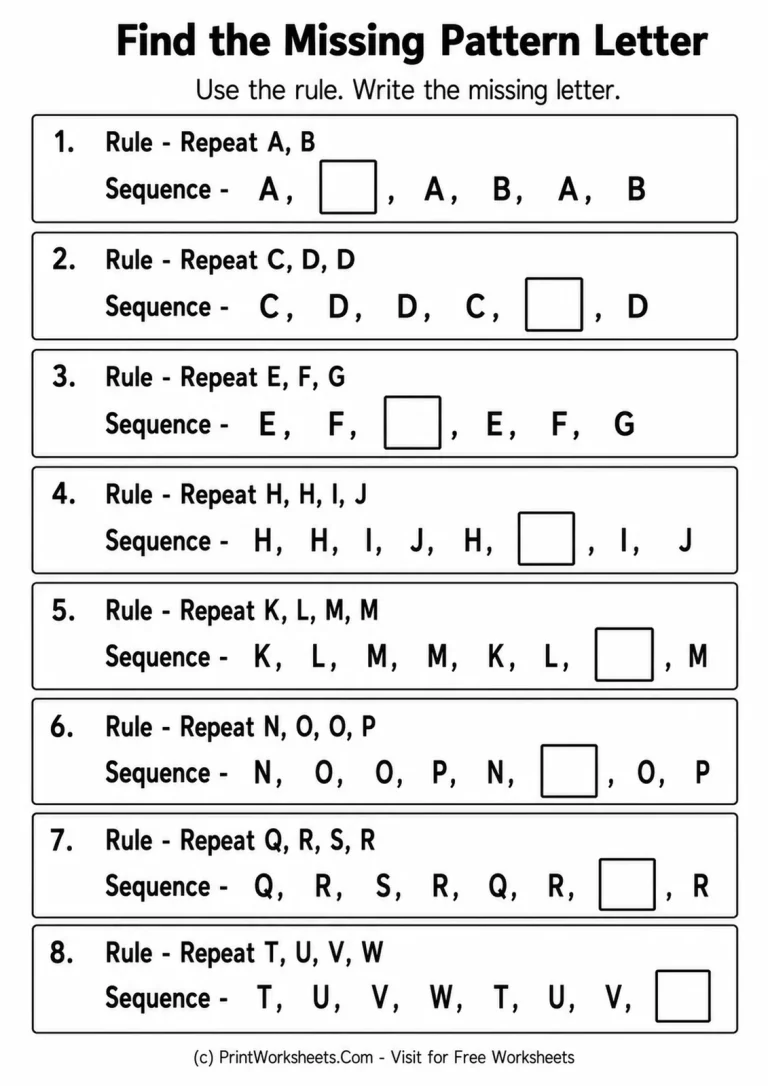
The third page, Find the Missing Pattern Letter, removes the picture clues and uses letters instead. Each of the eight problems gives a repeating rule and a sequence with one missing position. Students determine which letter belongs in the blank by following the stated rule.
The rules include simple two-part repeats as well as longer structures such as C-D-D, E-F-G, H-H-I-J, K-L-M-M, N-O-O-P, Q-R-S-R, and T-U-V-W. Working with symbolic patterns helps students focus on order and repetition without relying on the meaning of pictures. It also gives practice tracking positions in patterns whose repeating units contain more than two elements.
Apply Repeating Rules in Story Problems
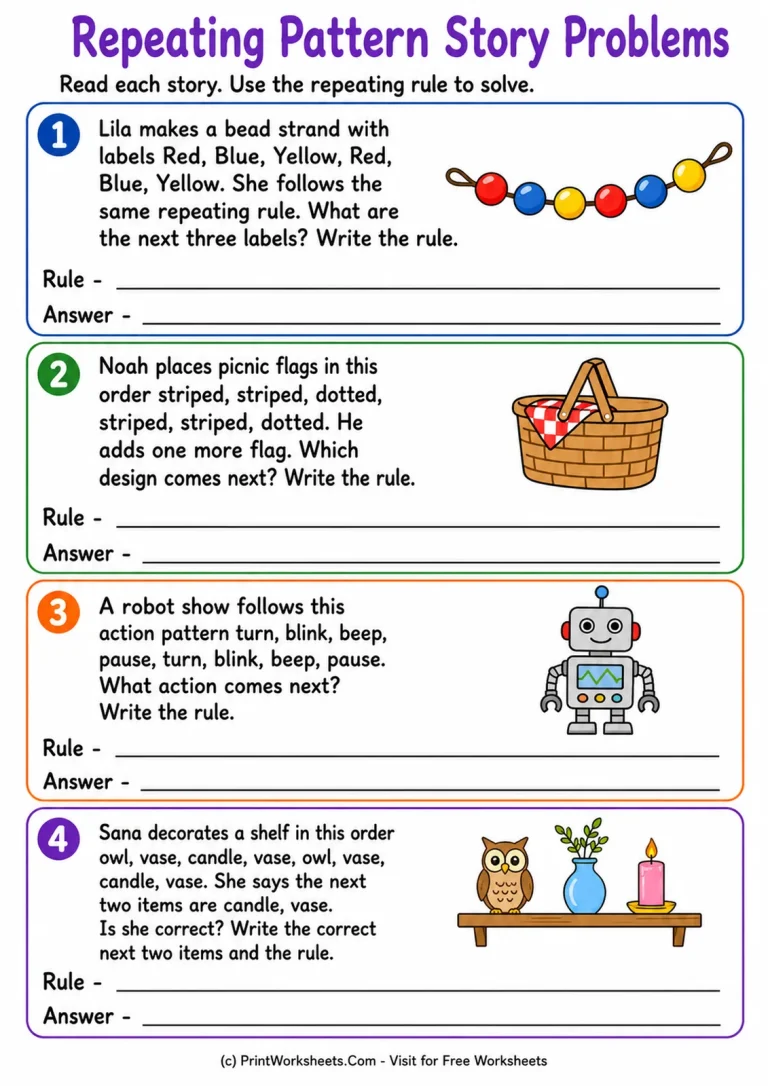
The fourth worksheet asks students to use repeating-pattern reasoning in short real-world situations. Four story problems involve bead colors, picnic flag designs, robot actions, and shelf decorations. Students identify or write the rule, determine upcoming items, and in one problem consider whether a prediction about the pattern is correct.
These problems make the set especially useful as a Grade 3 review because students must interpret information from text before applying the pattern rule. Instead of receiving a ready-made row of symbols, they have to decide what is repeating and use that information to answer the question. This provides a natural bridge from visual pattern work to more general algebraic thinking.
Ways to Use These Pattern Worksheets
The four-page progression works well for independent practice, math centers, small-group instruction, homework, or a short pattern review. Teachers can begin with the visual page to observe how students identify repeating units, then move to the matching activity to check whether they can connect a sequence with a verbal rule. The letter-pattern page offers a more abstract challenge, while the story-problem page can be used to see whether students transfer the same idea into a new context.
Parents can also use the pages one at a time rather than completing the entire packet in one sitting. When checking work, ask the child to say the repeating unit aloud before giving the next item. Questions such as “What part repeats?” or “Where does the rule start again?” can reveal whether the answer came from understanding the structure or from guessing.
What Students Practice
By the end of the set, students have practiced identifying the smallest repeating unit, extending picture patterns accurately, matching patterns with written descriptions, completing missing positions in letter sequences, describing repeating rules, and applying those rules in contextual problems. The included answer key provides solutions for all four student worksheets, making the packet practical for classroom checking, home practice, and targeted Grade 3 algebraic-thinking review.