Add fractions with unlike denominators worksheets for grade 5 give students three different ways to practice finding common denominators. Students use fraction bars, match equations with simplified sums, and solve holiday-themed story problems.
The printable pages are best for students who already understand equivalent fractions and can multiply to find common multiples. The activities move from a structured visual page to more independent calculations with larger denominators.
Add Fractions with Unlike Denominators Worksheets for Grade 5
The download includes three student worksheets. Each page focuses on the same fraction addition process while changing how students show their understanding.
Students who still need practice adding fraction parts can begin with the add fractions with like denominators worksheets for grade 4 before moving to common denominators.
Build Common Denominator Sums with Fraction Bars
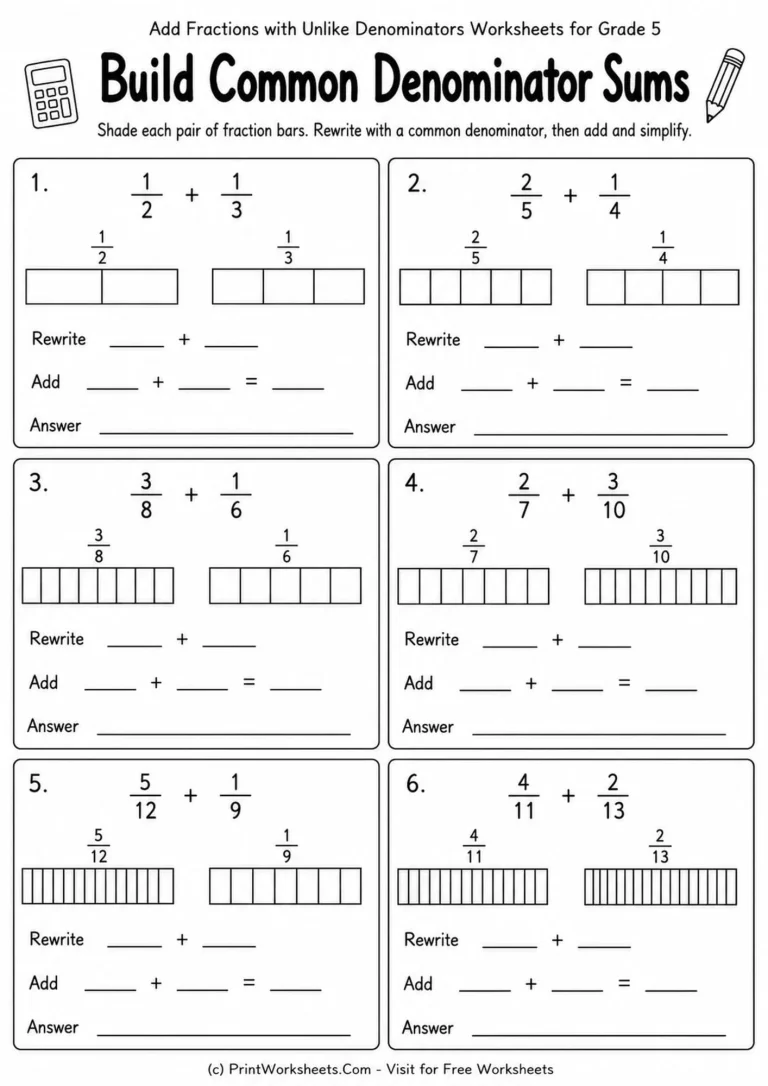
The first worksheet includes six fraction addition problems. A separate fraction bar appears below each addend, allowing students to shade the original fractions before rewriting them with a common denominator.
Students complete three steps for each problem. They rewrite both fractions, add the equivalent numerators, and record a simplified answer. The first questions use familiar denominators such as halves, thirds, fourths, and fifths. Later questions include denominators such as 11 and 13 for a greater challenge.
The visual models help students connect the symbolic calculation with the size of each fraction. They also provide a useful place for teachers to discuss why the original pieces cannot be added until they represent equal-sized parts.
A Consistent Addition Routine
- Find a common denominator: Identify a number that both denominators divide into evenly.
- Rewrite both fractions: Multiply the numerator and denominator by the same number.
- Add the numerators: Keep the common denominator unchanged.
- Simplify the sum: Divide the numerator and denominator by a shared factor when possible.
Students who need more support rewriting fractions can review the equivalent fractions with multiplication worksheets for grade 4.
Match Unlike Denominator Equations to Simplified Sums
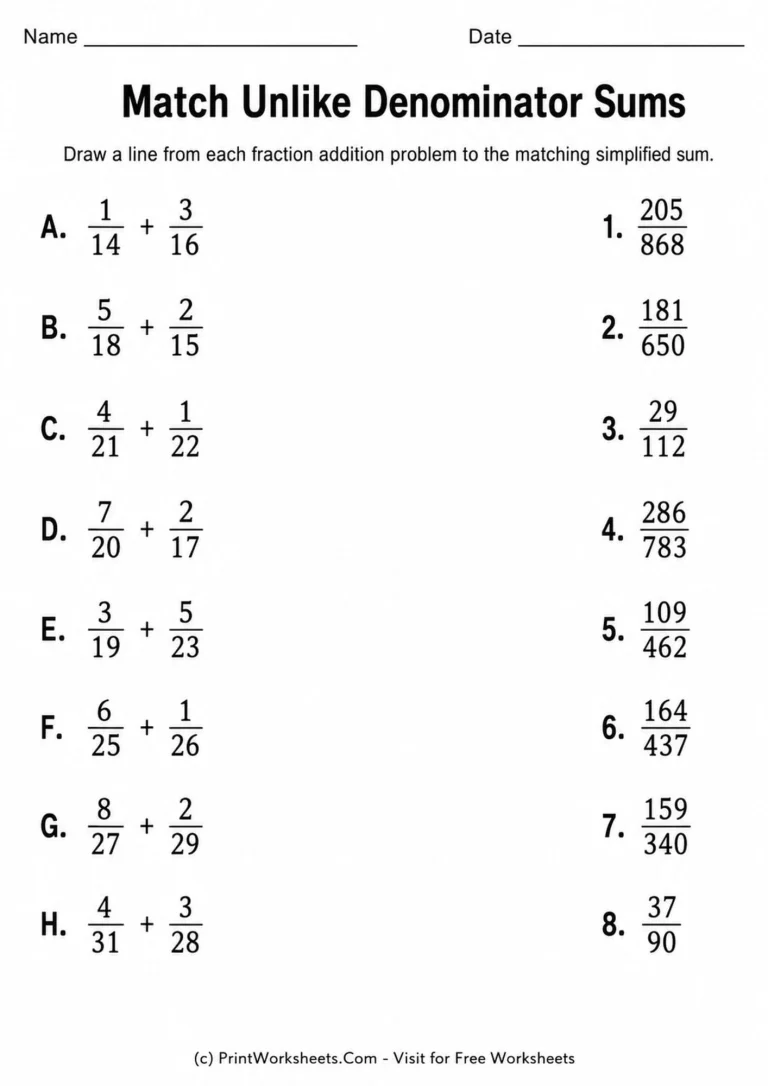
The matching worksheet contains eight lettered fraction addition equations and eight numbered results. Students calculate each equation and draw a line to its simplified sum.
The open center gives students enough room to draw clear matching lines. Because the denominators range from 14 to 31, this page is most appropriate after students can find common denominators independently.
The answer choices allow students to check whether their calculation is reasonable, but every equation still requires careful work. None of the result cards are repeated, so every equation has one unique match.
Solve Holiday Fraction Addition Stories
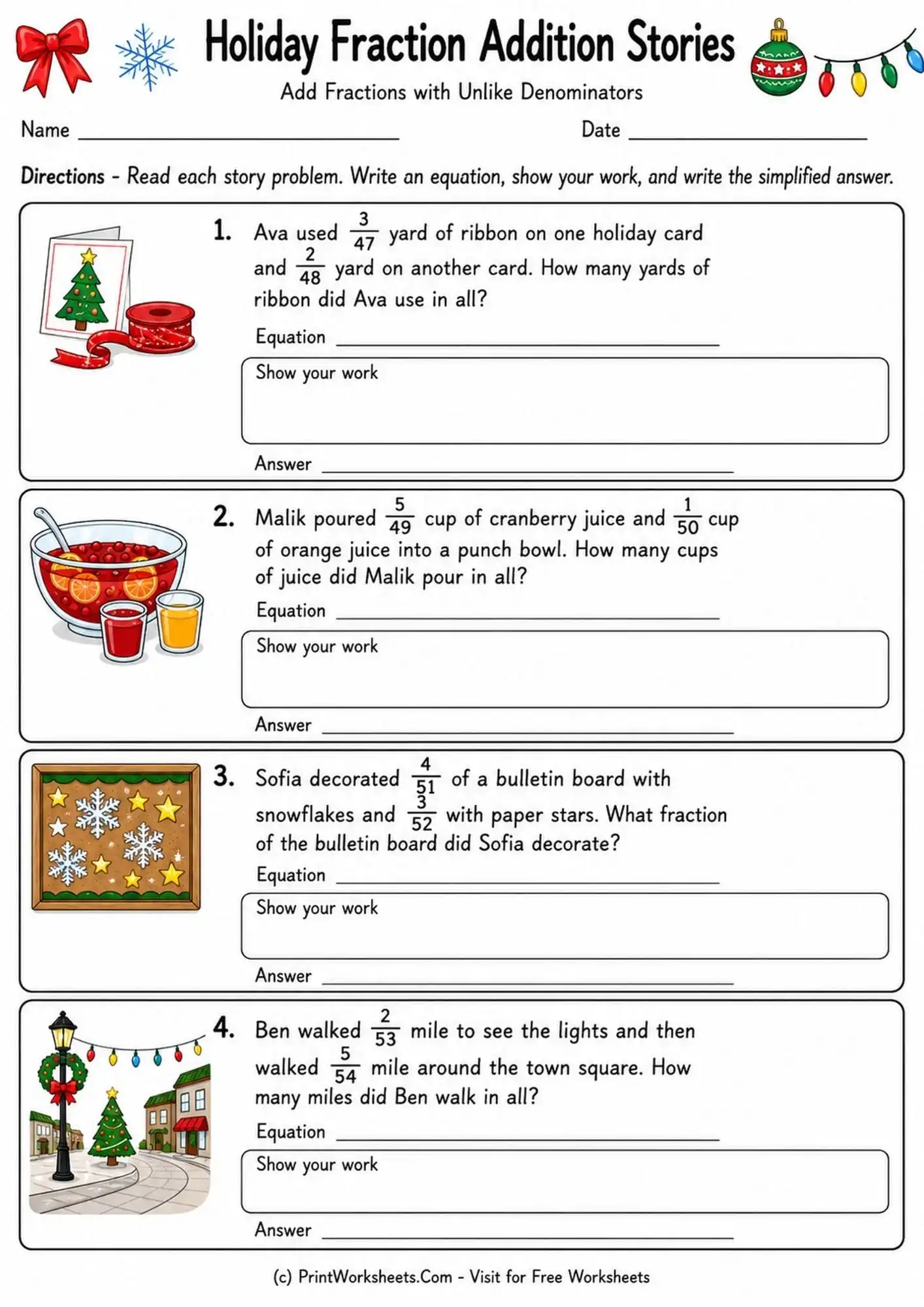
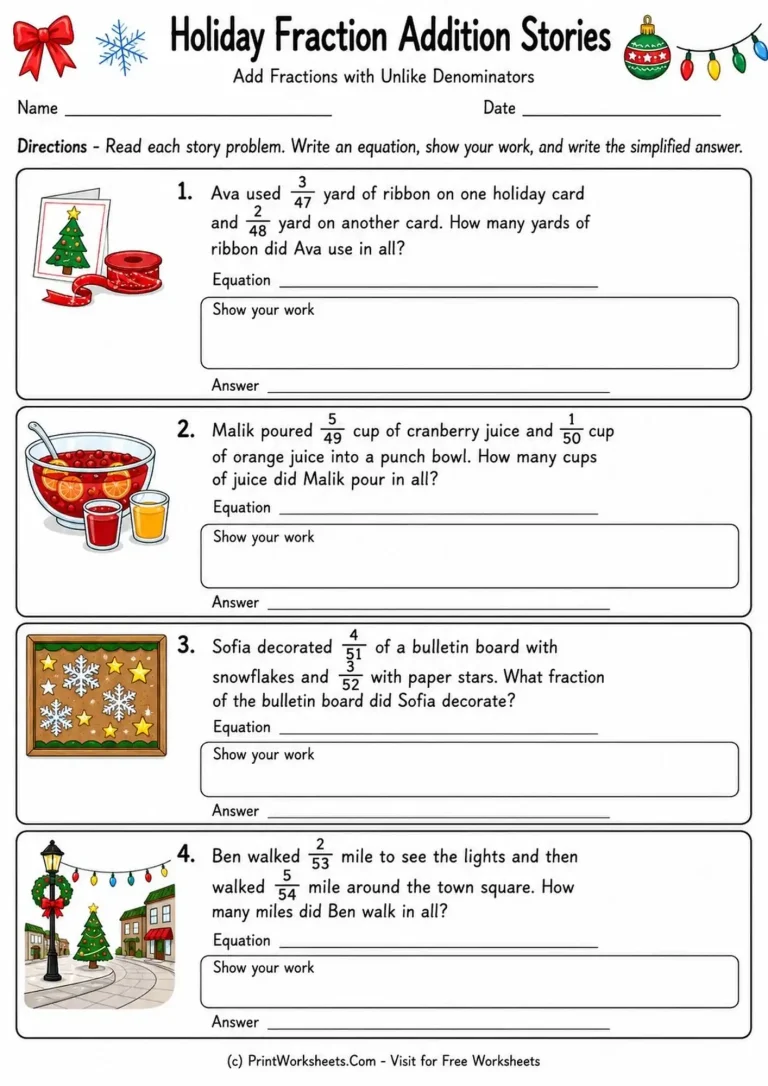
The colorful story page contains four holiday situations involving ribbon, juice, bulletin board decorations, and walking distances. Students identify the two fractions in each story, write an addition equation, show their calculations, and record the simplified result.
Each problem includes a large workspace. This is useful because the denominators are larger and students may need several steps to build the common denominator and simplify the result.
The measurement labels also encourage complete answers. Students must include yards, cups, or miles when the story calls for a unit rather than writing only a fraction.
Ways to Use the Three Printable Pages
- Teacher-led practice: Model the first fraction-bar problem and discuss how the common denominator is selected.
- Independent challenge: Use the matching page after students are comfortable multiplying two-digit denominators.
- Small-group support: Ask students to compare two possible common denominators before calculating.
- Application practice: Use the holiday stories to check whether students can translate written information into equations.
These pages can be used across several lessons rather than completed in one sitting. Beginning with the visual models gives students a clear process before they move to the larger denominators on the matching and story pages.