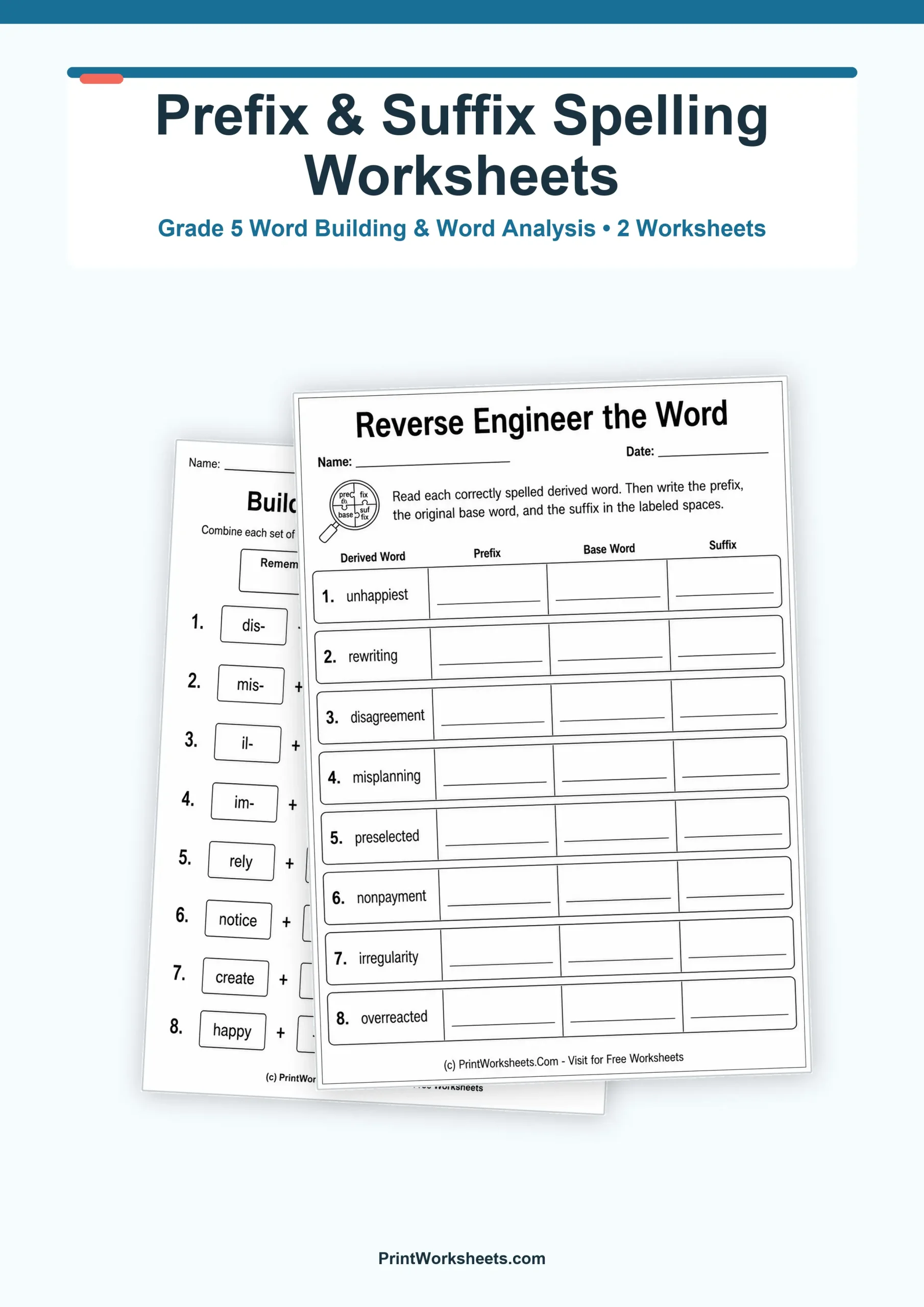
These prefix suffix spelling worksheets give fifth-grade students focused practice with a skill that becomes more demanding as words grow longer: adding affixes while keeping the spelling of the new word correct. The printable set moves beyond simply identifying a prefix or suffix. Students actively build derived words, apply spelling changes when needed, and then take completed words apart to identify the prefix, original base word, and suffix. This combination makes the pages useful for spelling instruction, morphology work, vocabulary development, and independent language practice.
How These Prefix Suffix Spelling Worksheets Build Word Knowledge
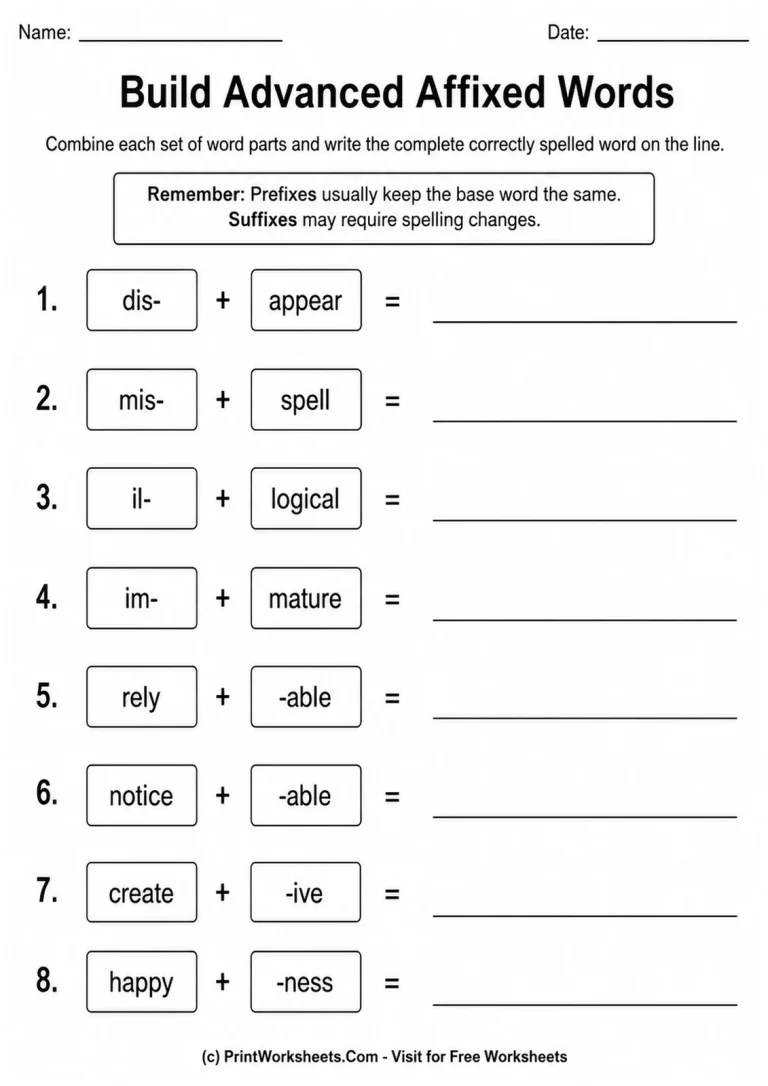
The first worksheet, Build Advanced Affixed Words, asks students to combine a given prefix or suffix with a base word and write the completed word correctly. Each item requires attention to both word meaning and spelling structure. Students work with examples such as dis- + appear to form disappear, il- + logical to form illogical, and im- + mature to form immature. These combinations reinforce common prefixes while also helping students see how affixes attach to recognizable base words.
Other items make the spelling work more challenging because the base word does not always remain visually unchanged. When students combine rely + -able, they must change the final y to create reliable. With notice + -able, they preserve the final e in noticeable. When forming creative from create + -ive, they drop the final e. Additional words such as misspell and happiness broaden the practice so students are not applying one spelling pattern repeatedly.
From Building Words to Analyzing Their Parts
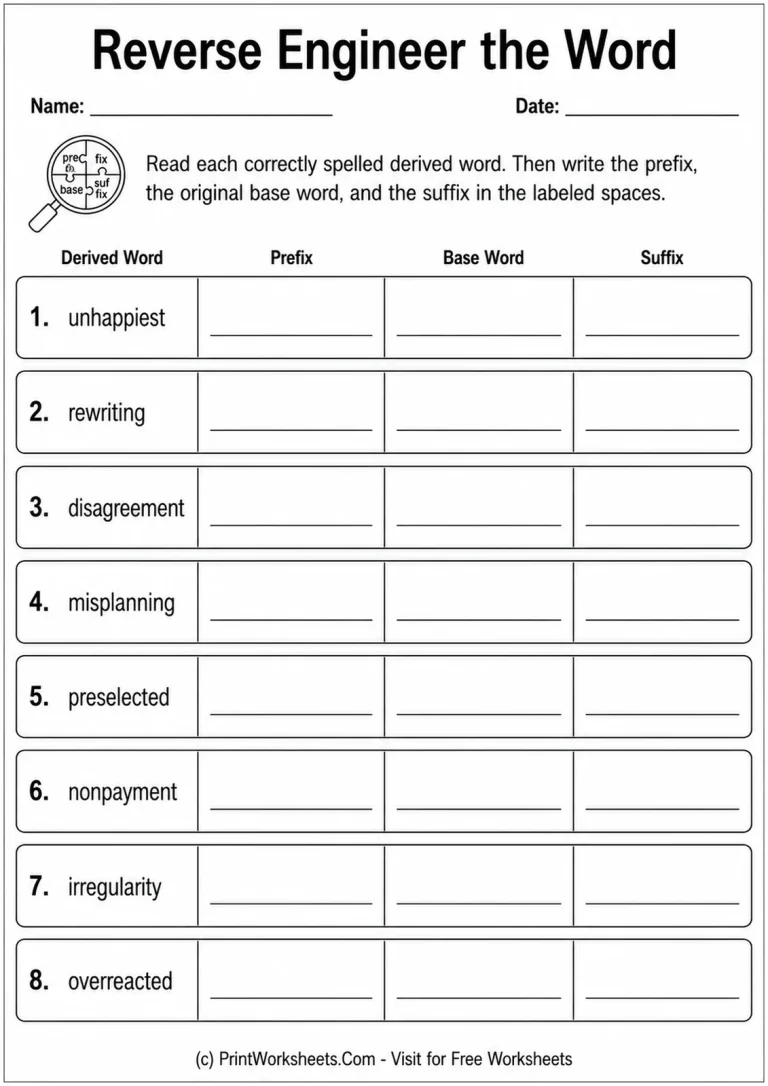
The second worksheet, Reverse Engineer the Word, changes the direction of the task. Instead of starting with a base word and an affix, students receive a correctly spelled derived word and work backward. They identify the prefix, recover the original base word, and identify the suffix. This requires students to think about how the word was constructed rather than relying only on its visible beginning or ending.
The words provide substantial Grade 5 morphology practice. Students analyze unhappiest, rewriting, disagreement, misplanning, preselected, nonpayment, irregularity, and overreacted. Because these words include different combinations of prefixes, suffixes, and spelling adjustments, students must pay attention to the original base rather than simply cutting a word into arbitrary chunks. For example, recognizing the underlying word in a longer form helps connect spelling study with vocabulary and word meaning.
Why Word Building and Word Decomposition Work Well Together
The two activities create a useful progression. Building words requires students to predict what happens when an affix is added. Decomposing words asks them to explain the structure after the change has already occurred. Moving between these two directions can strengthen understanding because students practice both production and analysis. A learner who can correctly form reliable from rely is practicing a spelling rule; a learner who can recover a base word from a complex derived form is showing that the underlying word structure is understood.
Ways to Use the Worksheets in Grade 5
Teachers can use the first page after a lesson on prefixes, suffixes, and spelling changes, then use the second page as a follow-up word-analysis activity. The pages also work well for independent literacy centers, small-group spelling instruction, morning work, homework, or targeted review with students who can recognize affixes but still need practice applying them accurately in longer words.
Parents can use the same progression at home by asking a child to say the base word aloud before writing the derived form, then explain what changed in the spelling. On the analysis page, students can read each word, locate any recognizable prefix or suffix, and then identify the original base word. This verbal explanation adds useful reasoning to the written practice without changing the worksheet itself.
Practice More Than Memorized Spelling
Advanced affixed words often become difficult because students have to manage several pieces of information at once: the meaning of an affix, the spelling of the base word, and any change required when the pieces are joined. These Grade 5 worksheets address that challenge directly. By working with specific transformations such as rely to reliable, create to creative, and complex words such as disagreement and irregularity, students practice seeing spelling as a structured system rather than a list of isolated words to memorize.