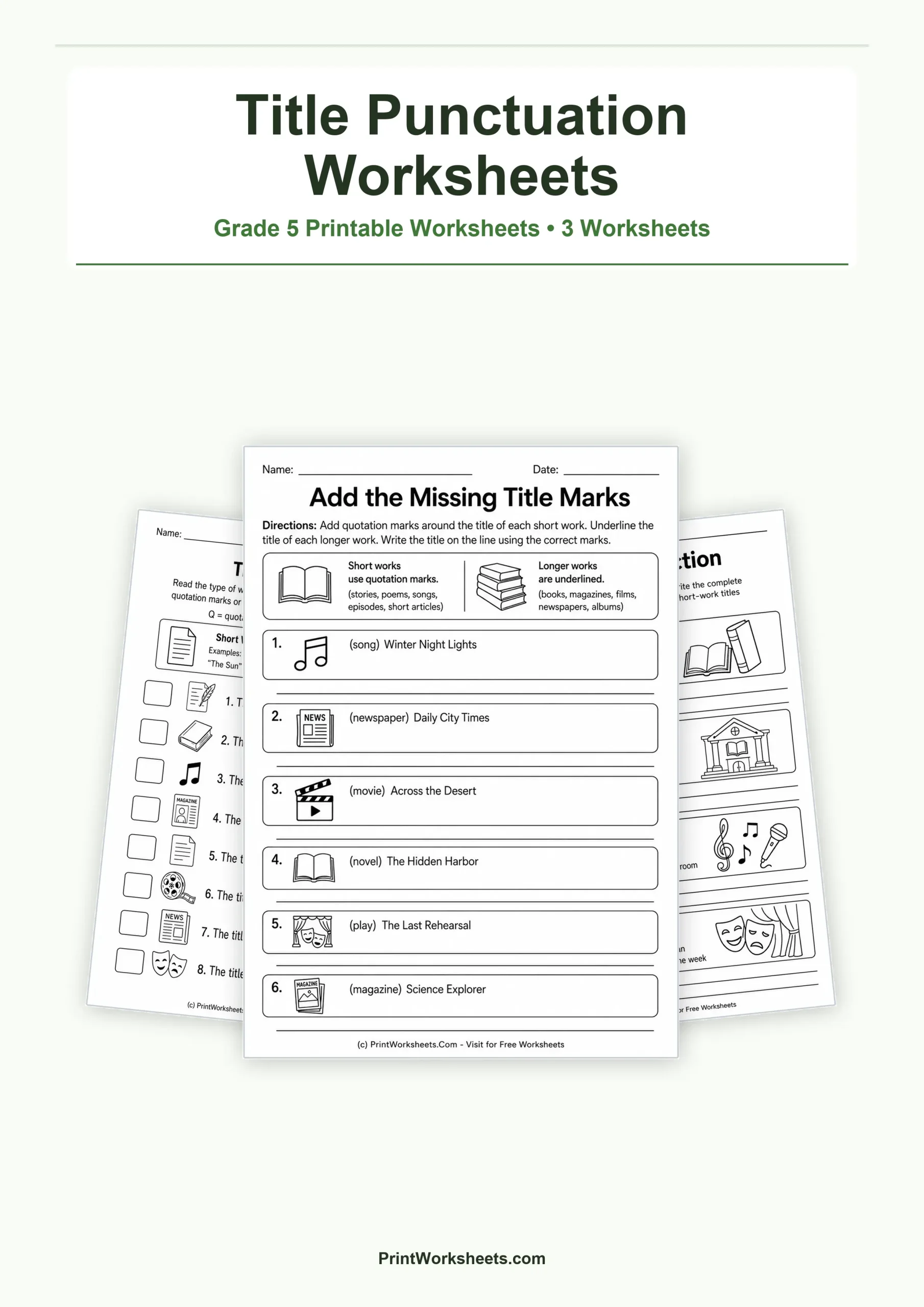
When fifth graders read book lists, music recommendations, magazine names, or school announcements, they need to recognize that different kinds of titles are marked in different ways. These title punctuation worksheets give students focused practice choosing quotation marks for shorter works and underlining for longer works. Across three printable activities, students move from identifying the correct convention to applying it independently and then correcting title punctuation inside complete messages.
What These Title Punctuation Worksheets Practice
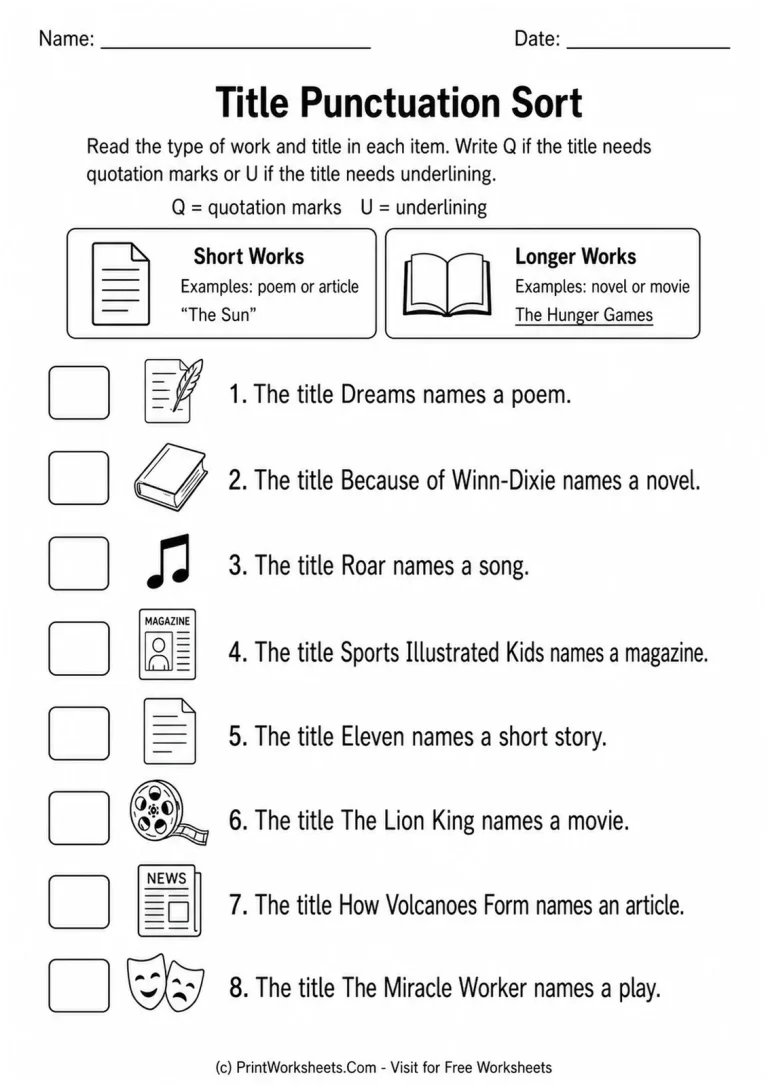
The first worksheet, Title Punctuation Sort, gives students a quick way to check whether they can distinguish short works from longer works. Students write Q when a title needs quotation marks and U when it needs underlining. The eight examples include several kinds of works, such as a poem, novel, song, magazine, short story, movie, article, and play. This variety matters because students must pay attention to the type of work instead of relying on one repeated pattern.
Examples such as Dreams, Because of Winn-Dixie, Roar, Sports Illustrated Kids, and The Lion King require students to decide which title convention fits each kind of work. The simple Q/U response format keeps the activity efficient while still asking students to make a meaningful grammar and punctuation decision for every item.
From Identifying the Rule to Rewriting Titles
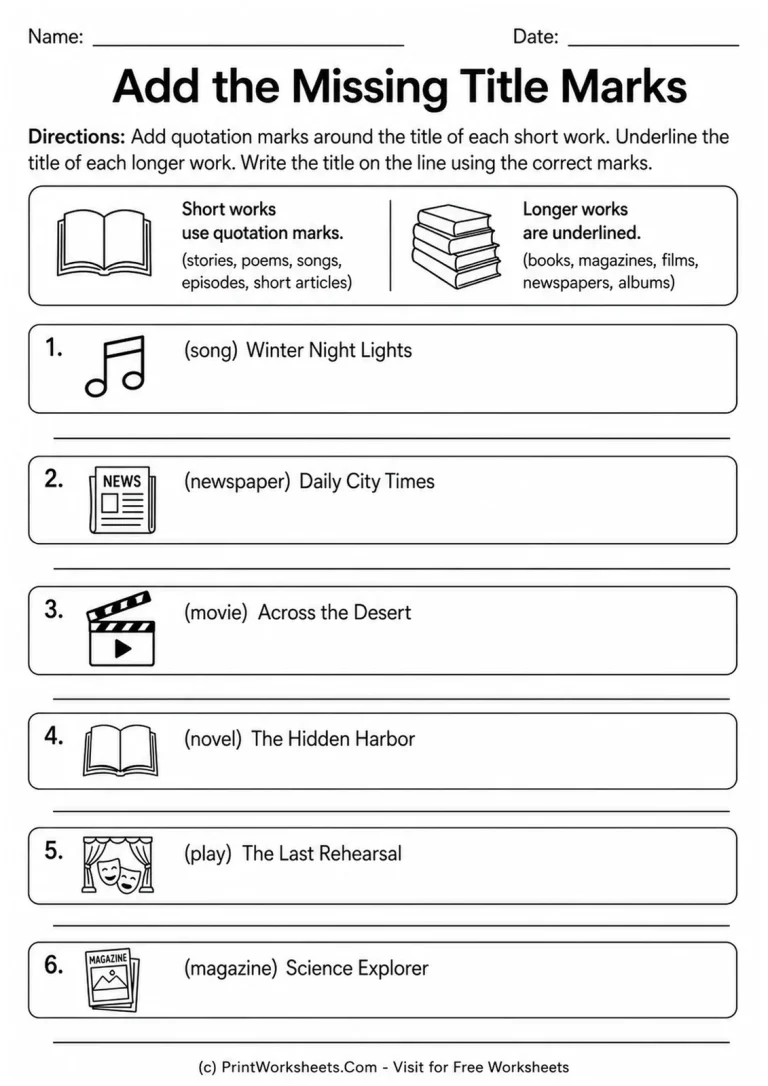
The second worksheet, Add the Missing Title Marks, increases the level of independence. Instead of only labeling each title, students rewrite six titles and add the appropriate marks themselves. Shorter works must be placed in quotation marks, while longer works must be underlined. The answer lines provide room for students to produce the complete corrected form rather than simply choosing from options.
The examples cover a song, newspaper, movie, novel, play, and magazine, including titles such as Winter Night Lights, Daily City Times, Across the Desert, and The Hidden Harbor. Because the works vary in type, students have to apply the underlying title-punctuation distinction repeatedly. This makes the page useful after direct instruction, as independent classwork, homework, or a short review activity.
Proofreading Title Punctuation in Context
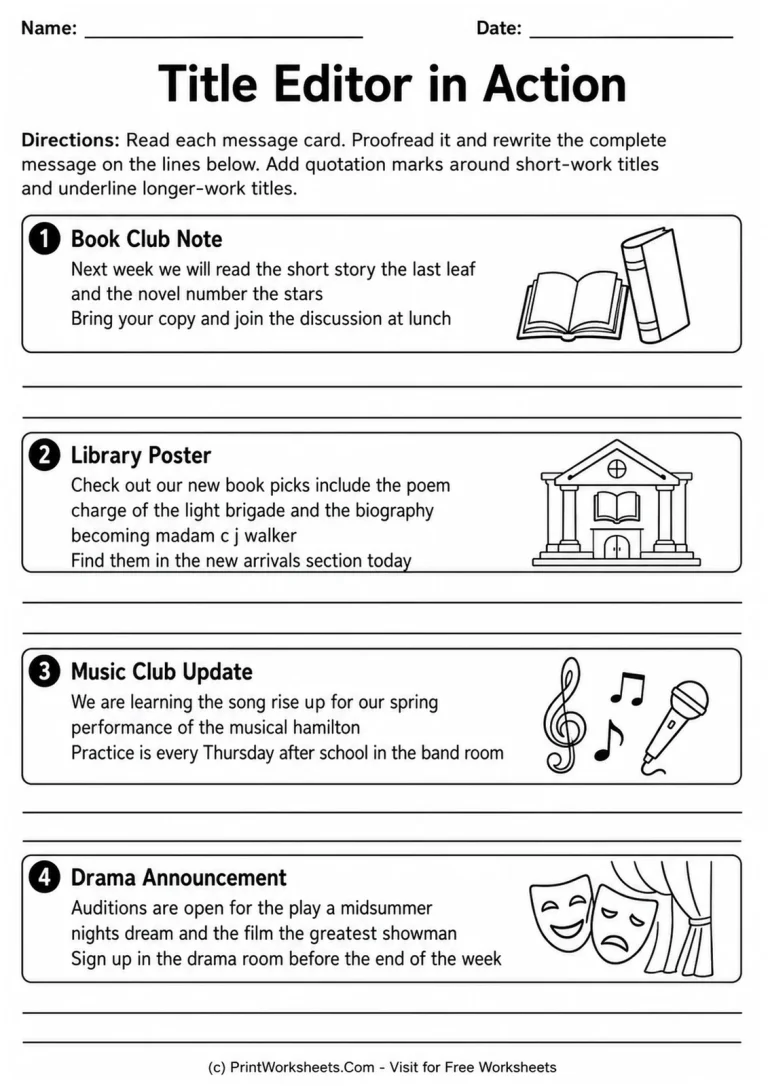
The final approved worksheet, Title Editor in Action, places the same skill inside realistic writing. Students read four message cards, find the title-punctuation problems, and rewrite each complete message correctly. The contexts include a book club message, library poster, music club update, and drama announcement. Students therefore have to notice the title, identify what kind of work it names, choose the correct punctuation, and preserve the rest of the sentence while editing.
This progression makes the set more useful than isolated rule practice. A student who can correctly mark Q or U on the first page may still need practice producing the marks independently. A student who can rewrite an isolated title may then need to transfer the skill into a sentence or announcement. The three worksheets provide those steps in sequence without changing the central learning goal.
A Focused Grade 5 Grammar Skill
Teachers can use the pages in order for a short punctuation mini-unit or select one page based on student need. The sorting activity works well as an introduction or quick check. The rewrite page gives more direct written practice. The proofreading page is suited to students who are ready to apply the convention during editing. Parents can also use the set for targeted review when a student needs more practice distinguishing how different types of titles are written.
Students who need broader punctuation review before working on title conventions can also use these punctuation practice worksheets. That collection provides additional punctuation practice at an earlier grade level, while this Grade 5 set stays focused on marking titles of short and longer works.
Build More Confident Editing Habits
Knowing how to punctuate titles is most useful when students can apply the rule during real writing and editing rather than only repeat it from memory. By moving from classification to rewriting and then to complete-message proofreading, this printable set gives fifth graders several opportunities to make the same punctuation decision in different forms. The result is a compact practice sequence that can support instruction, independent work, homework, or targeted grammar review.