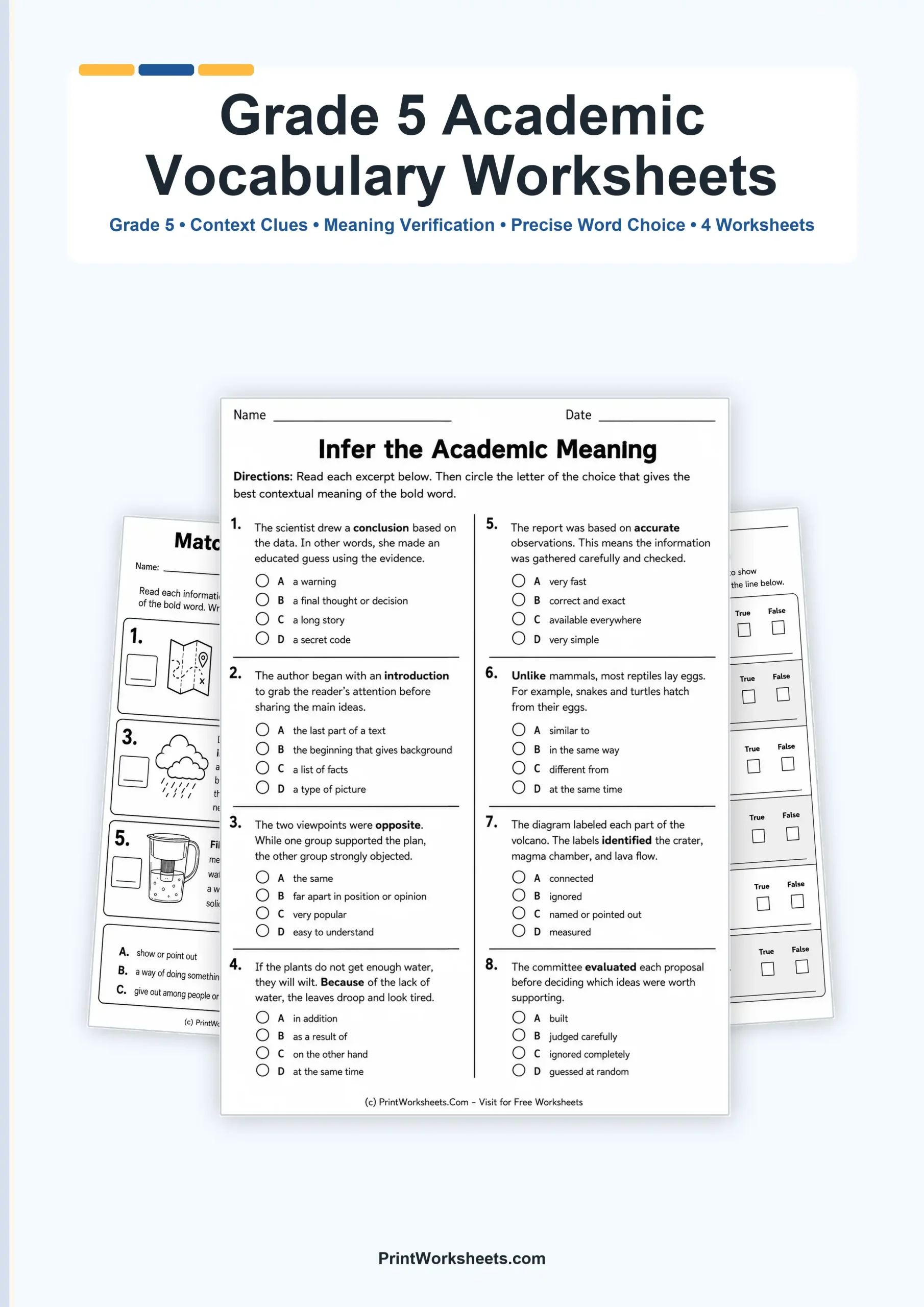
These academic vocabulary worksheets give fifth graders repeated practice figuring out what important school-based words mean inside informational text. Instead of asking students to memorize isolated definitions, the four-page set moves from matching meanings to evidence, to making contextual choices, checking whether proposed meanings are accurate, and finally replacing everyday wording with more precise academic language. The activities use short informational examples that keep the reading load manageable while still requiring students to pay attention to clues in the surrounding sentence.
How These Academic Vocabulary Worksheets Build Meaning from Informational Text
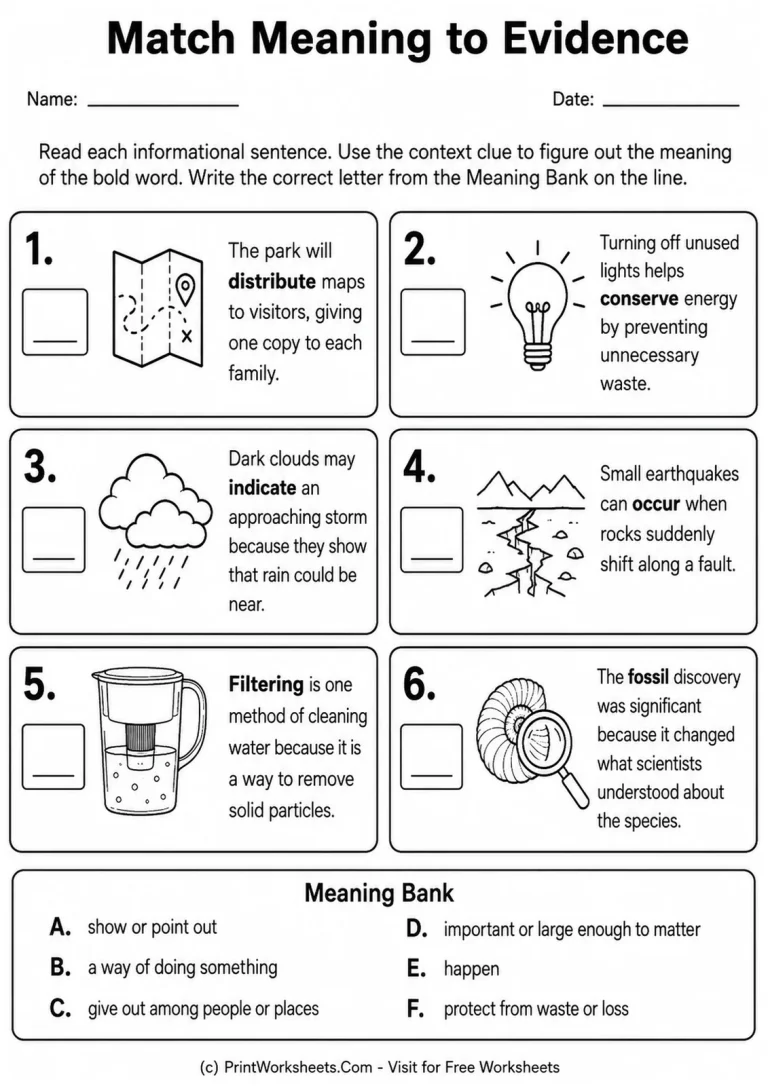
The first worksheet, Match Meaning to Evidence, introduces the skill through a six-choice Meaning Bank. Students read informational sentences containing the words distribute, conserve, indicate, occur, filtering, and significant. They determine what each bold word means from the sentence and match it to the appropriate meaning. This format is useful for helping students connect a definition with textual evidence instead of relying on a familiar-looking word or a guess.
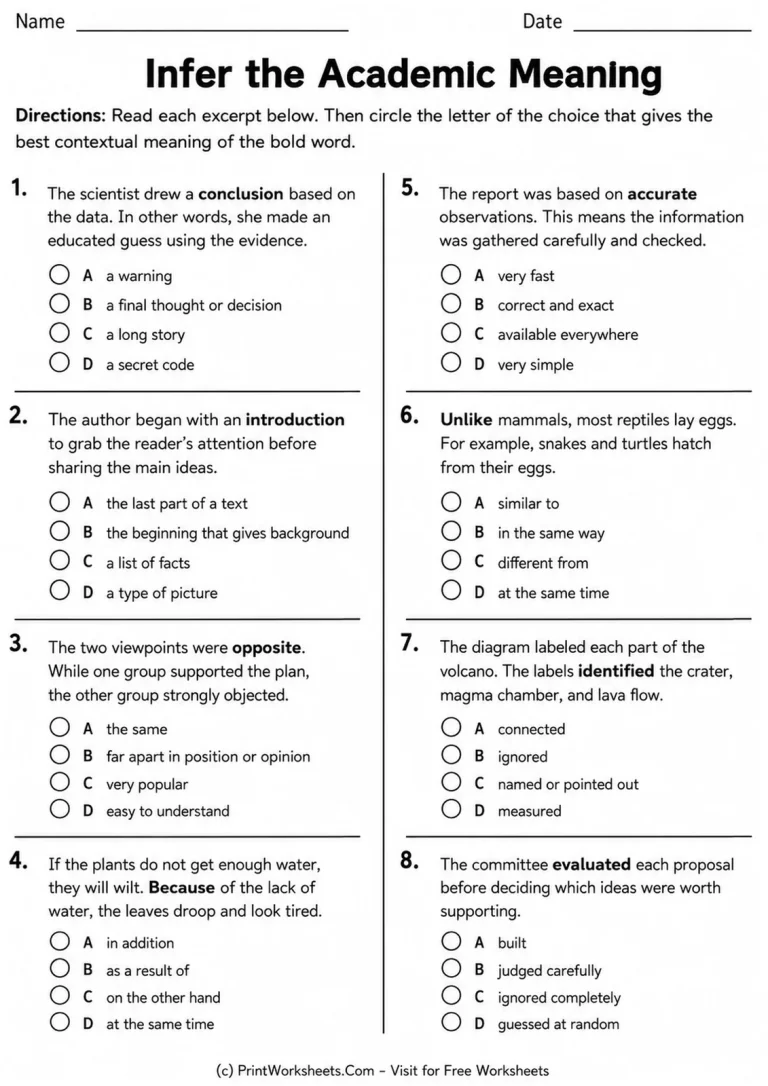
The second page, Infer the Academic Meaning, removes the shared meaning bank and asks students to make eight separate multiple-choice decisions. The vocabulary includes words and phrases such as conclusion, introduction, opposite, because of, accurate, unlike, identified, and evaluated. Each item places the target language inside a short informational context. Students must use that context to decide which of four meanings fits best, making the activity a natural next step after the more supported matching task.
Move from identifying meanings to checking reasoning
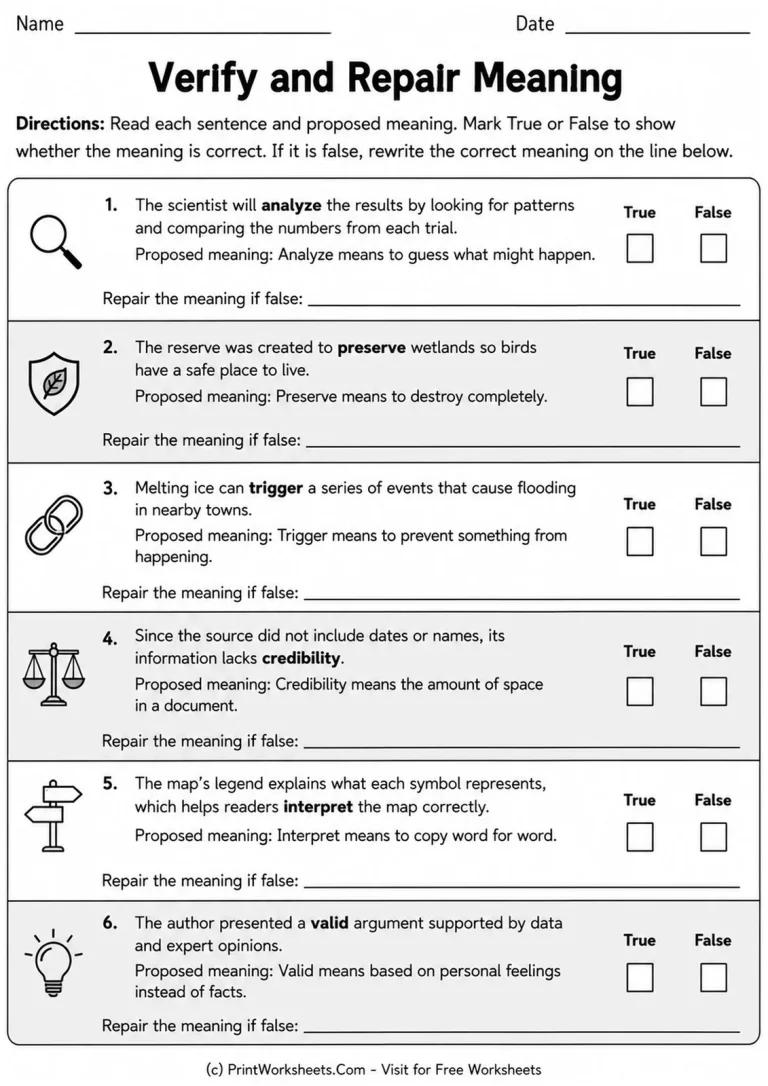
The third worksheet, Verify and Repair Meaning, asks students to do more than select an answer. For words including analyze, preserve, trigger, credibility, interpret, and valid, students are given a proposed meaning and decide whether it is true or false in the context of the sentence. When a meaning is incorrect, they must repair it by writing a better meaning. This structure encourages students to explain vocabulary accurately rather than simply recognize a correct option.
Teachers can use this page to listen for the evidence behind a student’s decision. A learner may know that a definition is wrong but still need prompting to identify which phrase in the sentence proves the intended meaning. Asking students to underline or circle that clue before rewriting the meaning can make their thinking visible and strengthen the connection between vocabulary and close reading.
Practice precise academic word choice across subjects
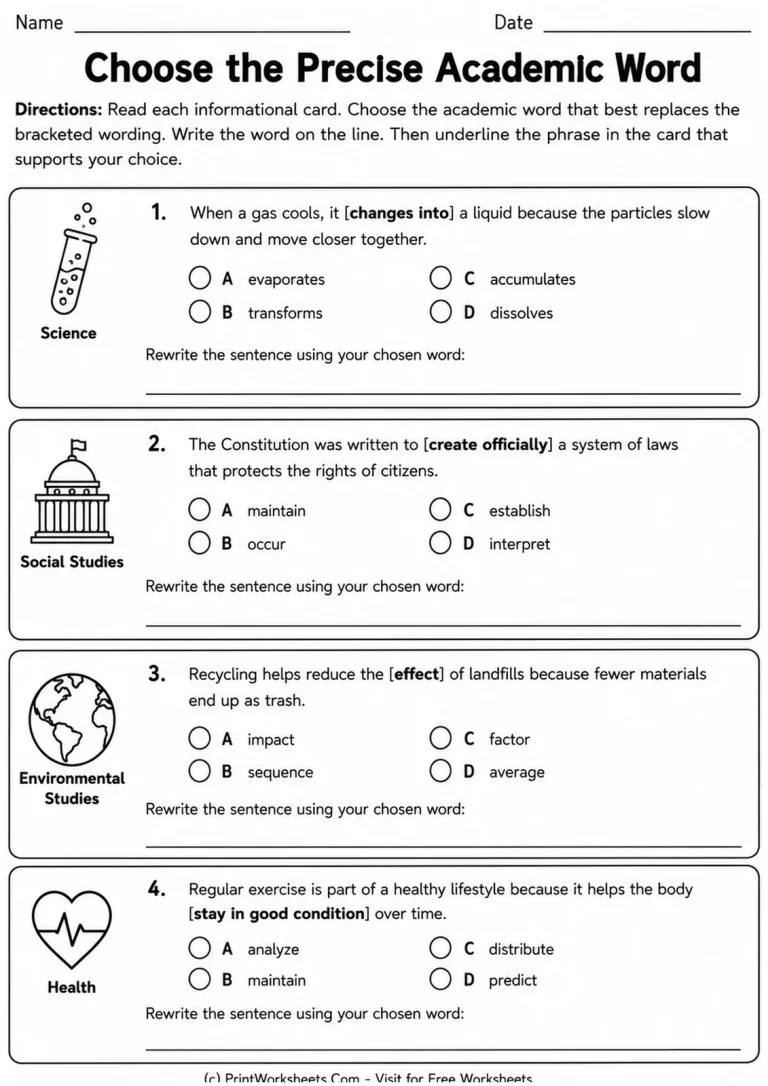
The fourth worksheet, Choose the Precise Academic Word, shifts from interpreting vocabulary to using it. Students work with cards connected to Science, Social Studies, Environmental Studies, and Health. In each context, they replace a less precise everyday expression with a stronger academic word, rewrite the sentence using their choice, and identify the wording that supports the decision. This final task is especially valuable because it connects receptive vocabulary knowledge with academic writing.
The cross-curricular contexts also show students that academic vocabulary is not limited to language arts. Words that communicate analysis, evidence, change, cause, accuracy, or evaluation appear throughout school texts. Practicing precise wording in several subject areas can help fifth graders become more alert to the language they encounter in textbooks, articles, directions, and classroom discussions.
Ways to Use Informational Text Vocabulary Practice in Grade 5
The four worksheets can be taught as a short sequence or used separately for review. For whole-class instruction, model one item and ask students to name the exact context clue that supports the meaning before they answer. During independent work, require students to mark evidence in the sentence so that vocabulary decisions are tied to text rather than intuition. The pages can also work well in a small group where students explain why one meaning is more accurate than another.
For students who need additional support, begin with the Meaning Bank page and discuss one clue at a time. Have students restate the sentence using simpler language before matching the word to its definition. Learners who are ready for more challenge can explain why the distractors on the multiple-choice page do not fit, or write an original informational sentence that demonstrates one of the target words clearly.
Quick checks, extension work, and exit tickets
A simple exit ticket can use one word from the lesson and ask students to write both its meaning and the phrase that helped them determine it. Another option is to provide an incorrect definition and ask students to correct it in the same style as the third worksheet. For extension, students can collect academic words from science or social studies reading and create their own context-clue examples for classmates.
By the end of the set, students have practiced several connected skills: matching academic words with meanings, inferring meaning from context, evaluating definitions, repairing inaccurate interpretations, choosing more precise vocabulary, and rewriting sentences. That progression makes these printable Grade 5 worksheets useful for vocabulary lessons, literacy centers, homework, small-group intervention, or cross-curricular language practice.