
Divide unit fractions by whole numbers worksheets for grade 5 help students understand what happens when one fractional piece is shared equally among several groups. These four printable pages combine visual models, quotient matching, error analysis, and illustrated story problems.
The activities focus specifically on a unit fraction divided by a whole number. Students learn that dividing a fraction such as 1/4 among three equal groups produces smaller pieces, with each group receiving 1/12 of the original whole.
Divide Unit Fractions by Whole Numbers Worksheets for Grade 5
The printable resource includes four approved student worksheets. Each page practices the same division skill through a different activity format.
Students begin with fraction models, continue with direct quotient matching and True or False checks, and then apply the operation to equal-sharing situations involving food, soil, juice, and ribbon.
Build the fraction foundation first: Students who need support identifying equal parts can review the unit fractions on number lines worksheets for Grade 3 before beginning division.
Share Unit Fraction Pieces with Visual Models
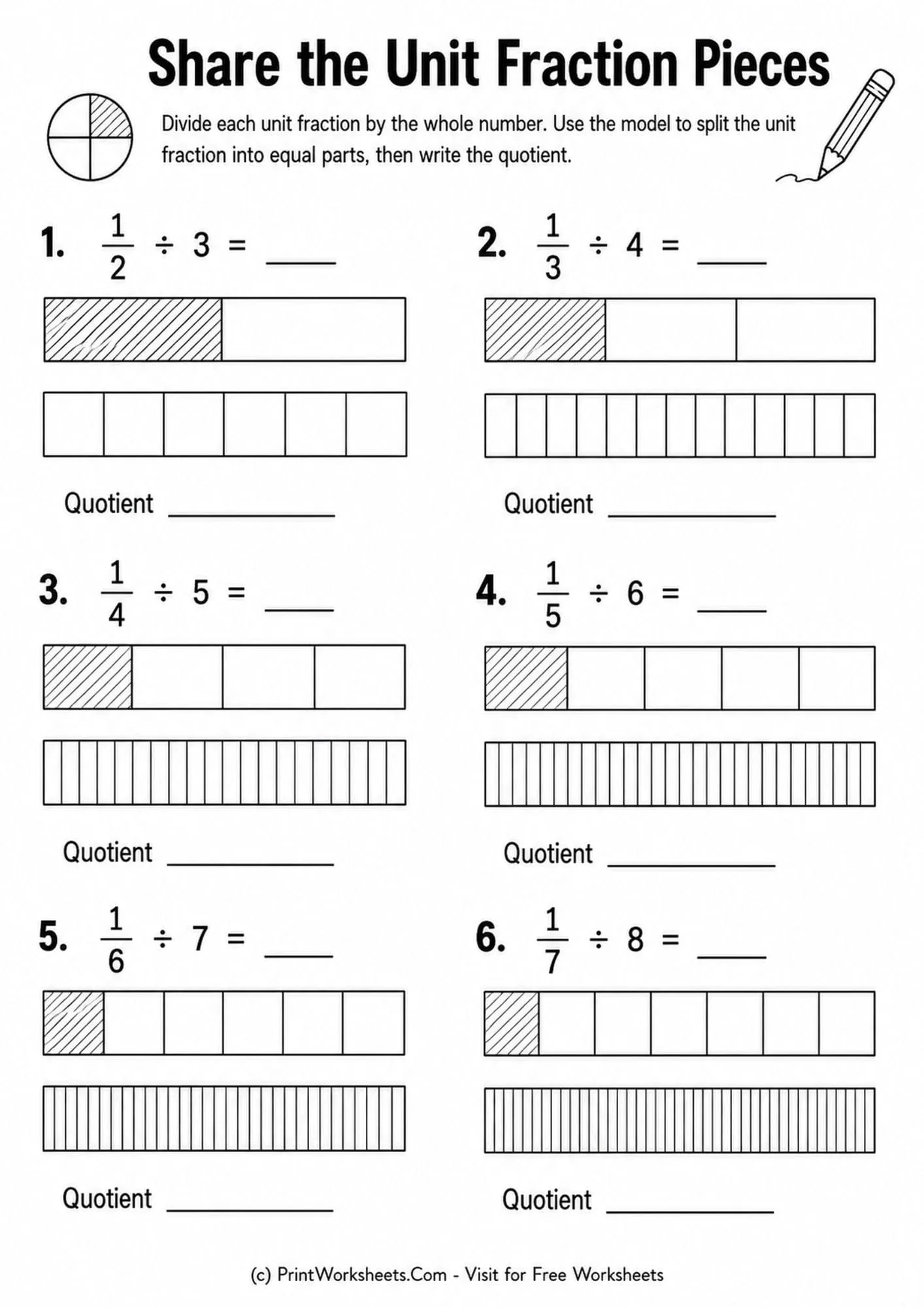
The visual worksheet includes six division equations. Each problem begins with a fraction bar showing one unit fraction, followed by a second bar divided into the smaller equal pieces created by the operation.
For example, when 1/2 is divided among three equal groups, the whole is separated into six equal parts. Each group receives one of those parts, so the quotient is 1/6.
The models make an important relationship visible. The numerator remains one, while the new denominator is found by multiplying the starting denominator by the whole-number divisor.
A Clear Unit Fraction Division Routine
- Identify the unit fraction: Confirm that the numerator is one.
- Identify the number of groups: Read the whole-number divisor.
- Multiply the denominators: Multiply the original denominator by the divisor.
- Keep the numerator: The quotient remains a unit fraction with a numerator of one.
- Check the size: The quotient should be smaller than the starting unit fraction.
Connect multiplication and division: Use the multiply fractions by whole numbers worksheets for Grade 4 to compare how the two operations change a fractional value.
Match Each Division Equation to Its Quotient
The matching worksheet contains eight lettered equations and eight numbered answers. Students divide each unit fraction by a whole number, simplify the quotient, and draw a line to the correct result.
Every equation has one unique answer. The denominators increase steadily across the page, giving students repeated practice with the relationship between the original denominator and the number of equal groups.
The open space between the columns provides room for clear matching lines. Students may also write the denominator multiplication beside each equation before making the match.
Check and Correct Fraction Division
The True or False worksheet presents eight completed division statements. Students calculate the correct quotient and decide whether the printed result is accurate.
When a statement is false, students use the correction line to write the proper unit-fraction quotient. The page alternates correct and incorrect statements, so students cannot follow one predictable answer pattern.
This activity is useful for partner discussion because students must explain why an incorrect denominator does not represent an equal sharing of the original fraction.
Solve Equal-Sharing Story Problems
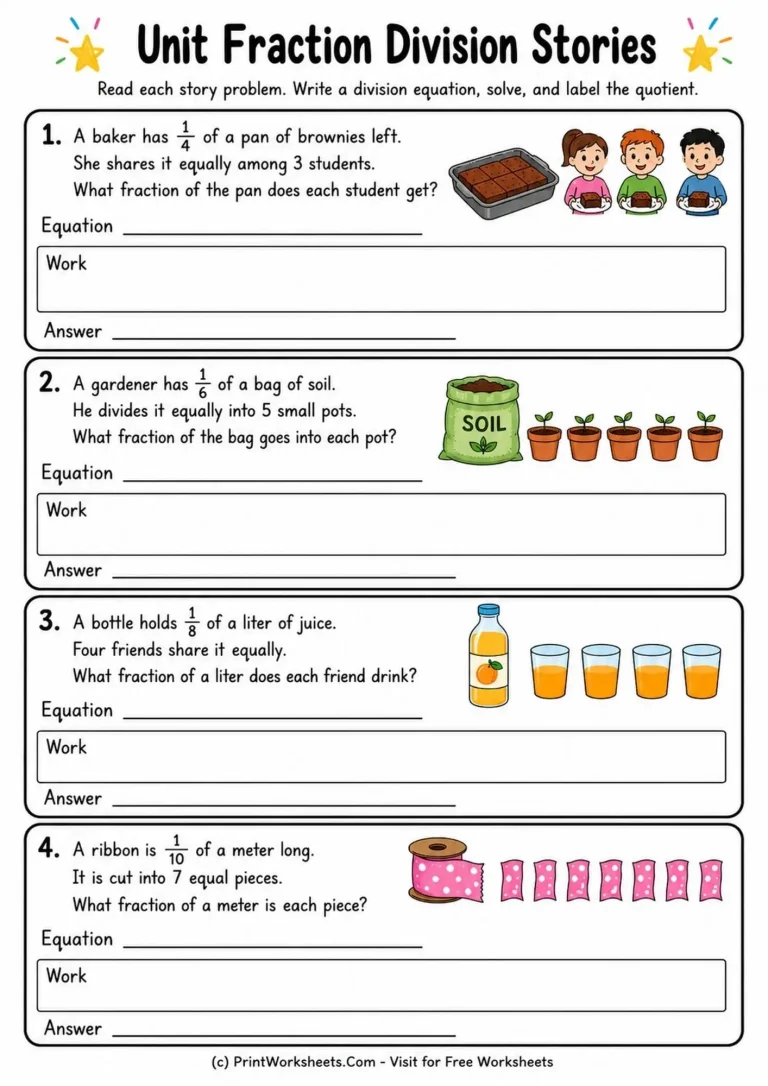
The illustrated story worksheet contains four situations involving brownies, potting soil, juice, and ribbon. In every problem, a unit-fraction amount is divided equally among a whole number of people, containers, or pieces.
Students identify the starting fraction and the number of groups, write a division equation, calculate the quotient, and label the final answer. Separate Equation, Work, and Answer areas help keep each step organized.
The stories also help students understand the meaning of division. Instead of seeing the procedure only as a denominator rule, students interpret the quotient as the amount received by each equal group.
Classroom Uses for the Four Worksheets
- Guided instruction: Begin with the visual fraction-bar page and model one equal-sharing example.
- Independent practice: Use the matching page after students understand the denominator relationship.
- Error analysis: Assign the True or False page and ask students to explain each correction.
- Application assessment: Use the story problems to check whether students can identify division from written information.
Ask Students to Check the Quotient Size
Encourage students to compare the quotient with the starting fraction. When a positive unit fraction is divided among more than one group, each share must be smaller than the original amount.
This size check helps students catch answers that are too large and reinforces the meaning of equal sharing. The visual, computational, analytical, and story-based pages can be used across separate lessons or as a focused Grade 5 fraction-division review.