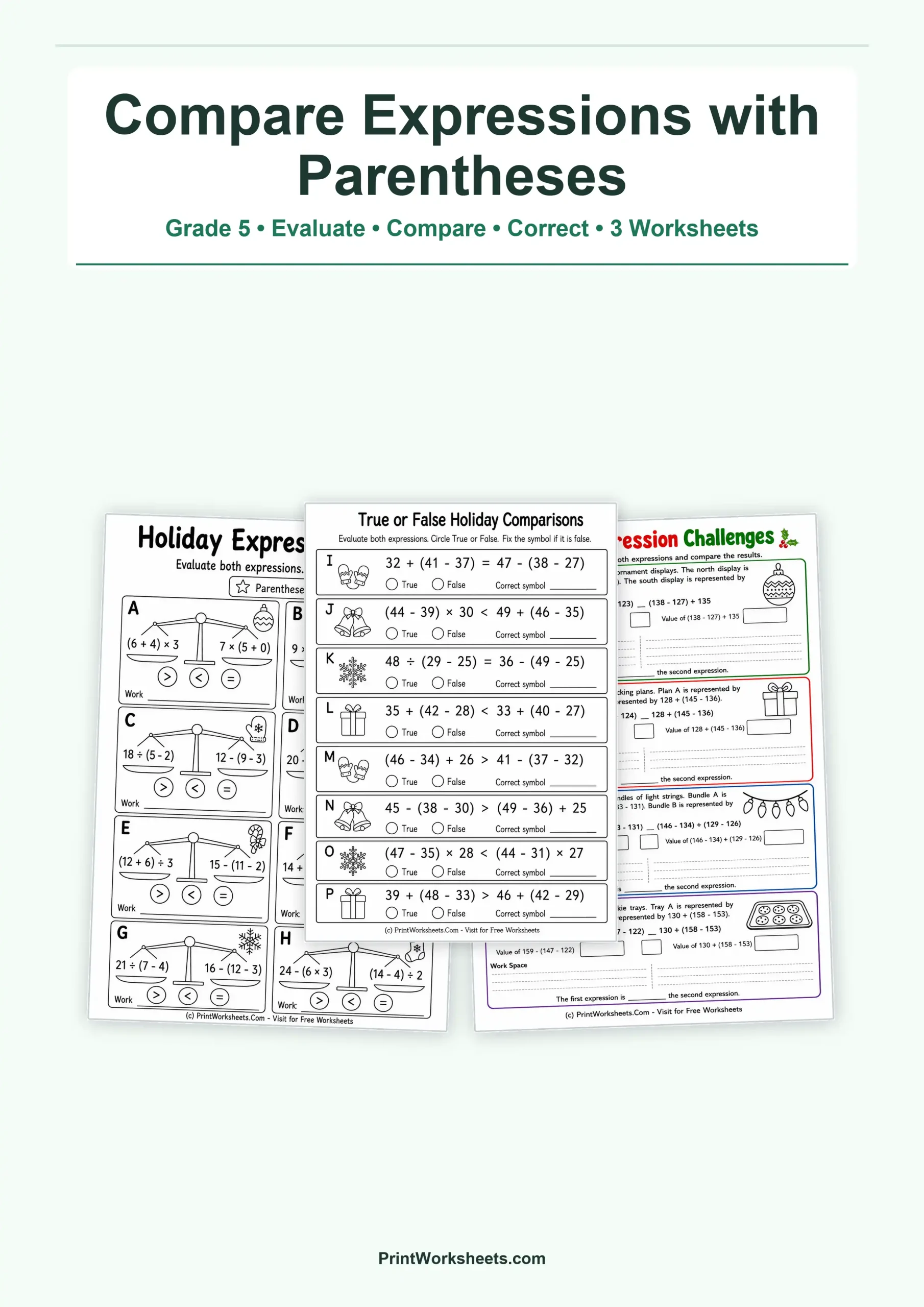
These Grade 5 worksheets help students compare expressions with parentheses by calculating each side carefully and deciding whether the first value is greater than, less than, or equal to the second. Instead of practicing parentheses as an isolated rule, students repeatedly connect order of operations to a clear comparison decision. The three worksheets move from direct side-by-side problems to error analysis and then to holiday-themed situations, giving students several ways to show that they understand both the calculations and the meaning of the comparison symbols.
Compare Expressions with Parentheses Step by Step
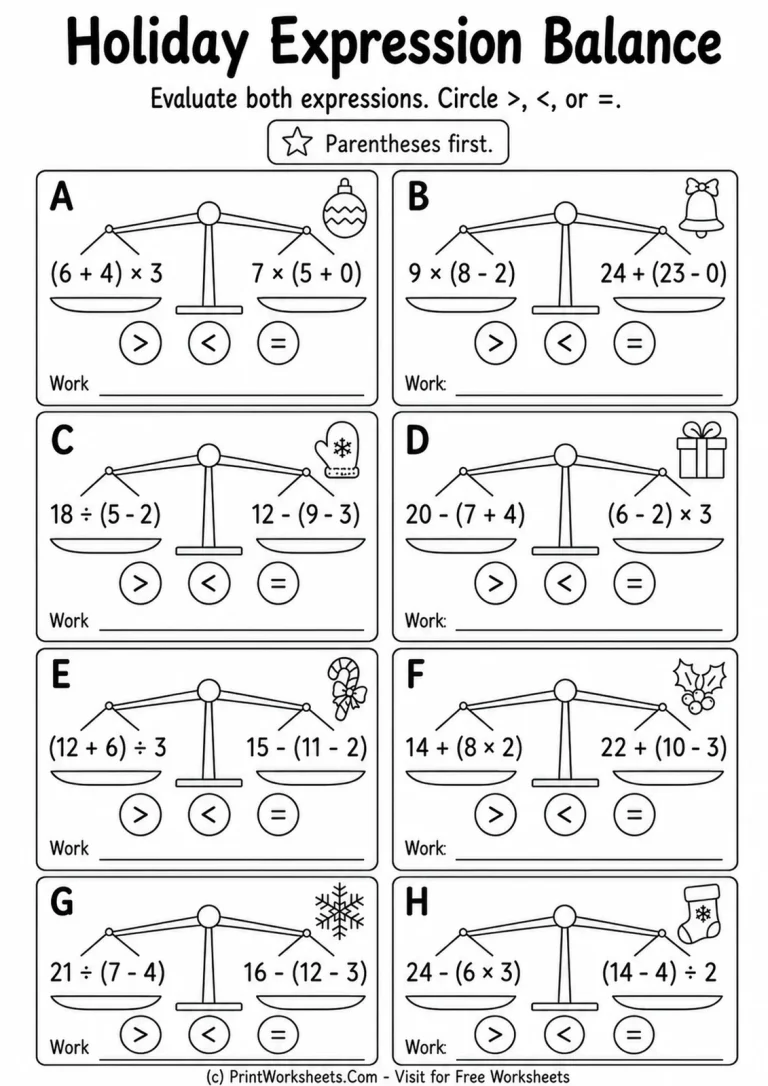
The first worksheet, Holiday Expression Balance, contains eight problems labeled A-H. Each problem presents two numerical expressions that students must evaluate before circling >, <, or =. The page explicitly reminds students to work with parentheses first, which supports the habit they need before comparing final values. The expressions mix addition, subtraction, multiplication, and division around grouped quantities, so students cannot choose a symbol by looking only at the visible numbers or operations.
This format is useful for checking whether students can keep two mathematical tasks connected. First, they must evaluate each expression correctly. Second, they must compare the resulting values accurately. A student who understands one skill but not the other will often reveal that difference clearly on this type of page. Teachers can also ask students to record the value of each side before choosing the comparison symbol, making the reasoning easier to review.
Move Beyond Calculation with True-or-False Comparisons
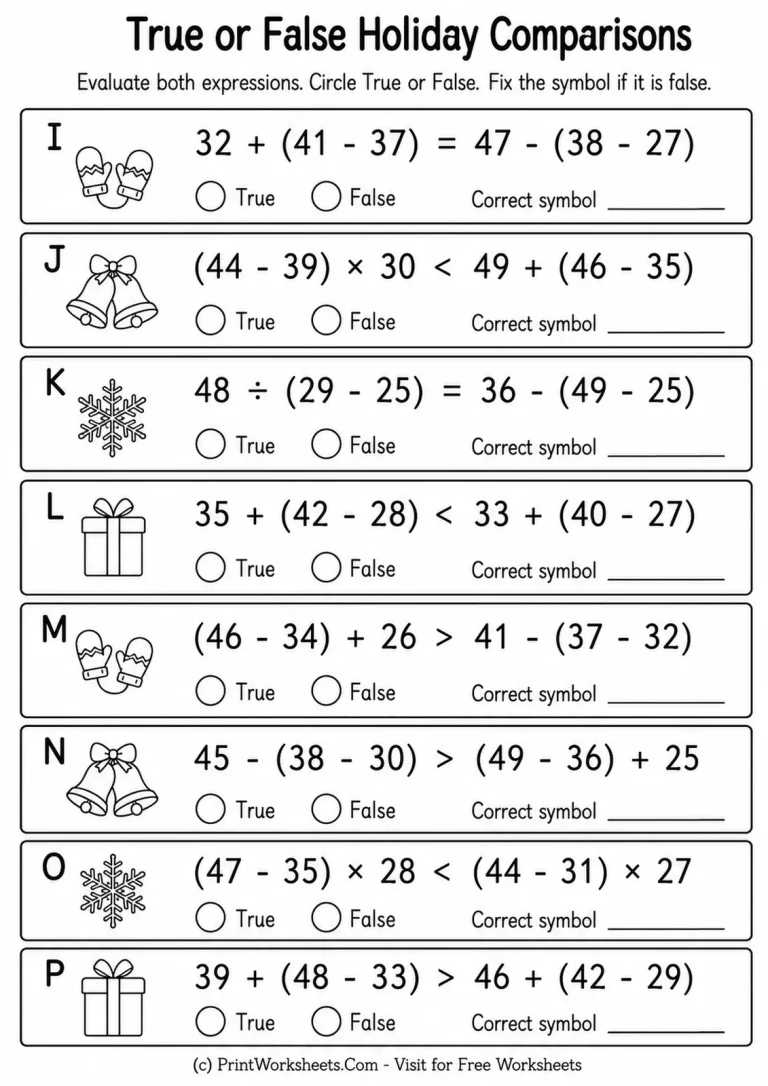
The second worksheet, True or False Holiday Comparisons, changes the task structure. Items I-P give students a completed comparison statement. Students evaluate both expressions, decide whether the comparison is true or false, and then replace the comparison symbol when the statement is incorrect. This adds an error-analysis component that is more demanding than simply choosing a symbol from scratch.
Correcting a false comparison encourages students to explain what the values actually show. For example, a student may calculate both sides correctly but still need to decide whether the relationship should be >, <, or =. Because the page asks for a corrected symbol when necessary, it helps distinguish careful mathematical reasoning from guessing. It can work well as independent practice after an order-of-operations lesson, as a small-group check for common misconceptions, or as a short review before students move into more complex numerical expression work.
Apply the Skill in Holiday Expression Challenges
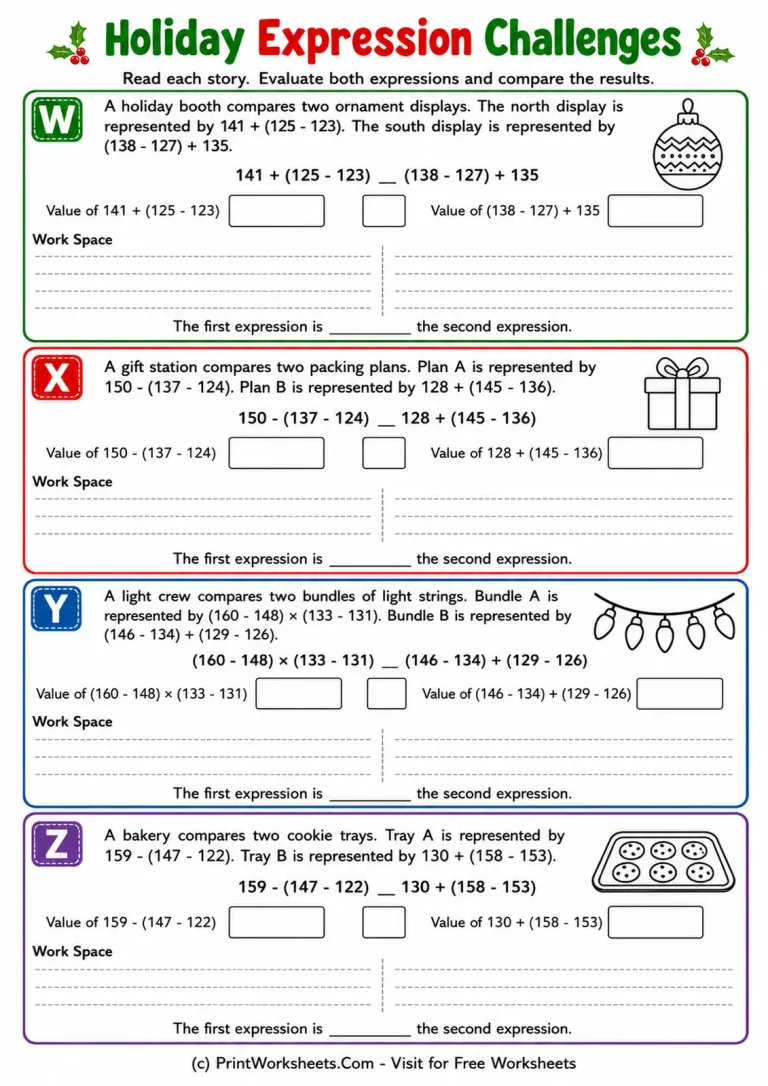
The third worksheet, Holiday Expression Challenges, includes four story-based problems labeled W-Z. Each scenario asks students to evaluate two expressions, record both values, insert the correct comparison symbol, and describe how the first expression compares with the second. The story context makes the comparison meaningful without changing the underlying mathematical goal.
This page is especially useful for students who can perform isolated calculations but need more practice deciding what those calculations mean. The provided value boxes and comparison area organize the work into visible steps: evaluate the first expression, evaluate the second expression, compare the results, and interpret the relationship. The extra workspace also gives students room to show intermediate calculations rather than relying on mental math alone.
Skills Practiced Across the Worksheets
Across the three pages, students practice evaluating grouped expressions, following the correct order of operations, using all four basic operations, comparing numerical values, applying >, <, and = correctly, identifying false comparison statements, and correcting comparison errors. The sequence also strengthens mathematical communication because the final story challenges ask students to state how one expression relates to another after completing the calculations.
The progression makes the collection flexible for classroom use. The balance problems can introduce or reinforce the comparison routine, the True/False page can check whether students recognize and repair mistakes, and the story challenges can serve as a more applied follow-up. Teachers may use the pages on separate days, assign them to different groups according to readiness, or combine them into a focused practice sequence on expressions and comparison.
A Focused Grade 5 Practice Set for Comparing Numerical Expressions
These worksheets are a strong fit when students already know that parentheses are handled before the surrounding operations but still need repeated practice comparing final results. The changing activity formats reduce repetition while keeping the mathematical objective consistent. By the end of the set, students have not only calculated parenthetical expressions but also judged, corrected, and explained the relationships between their values. That makes the collection useful for class practice, independent work, intervention, homework, or a targeted review of numerical expressions before more advanced algebraic thinking.