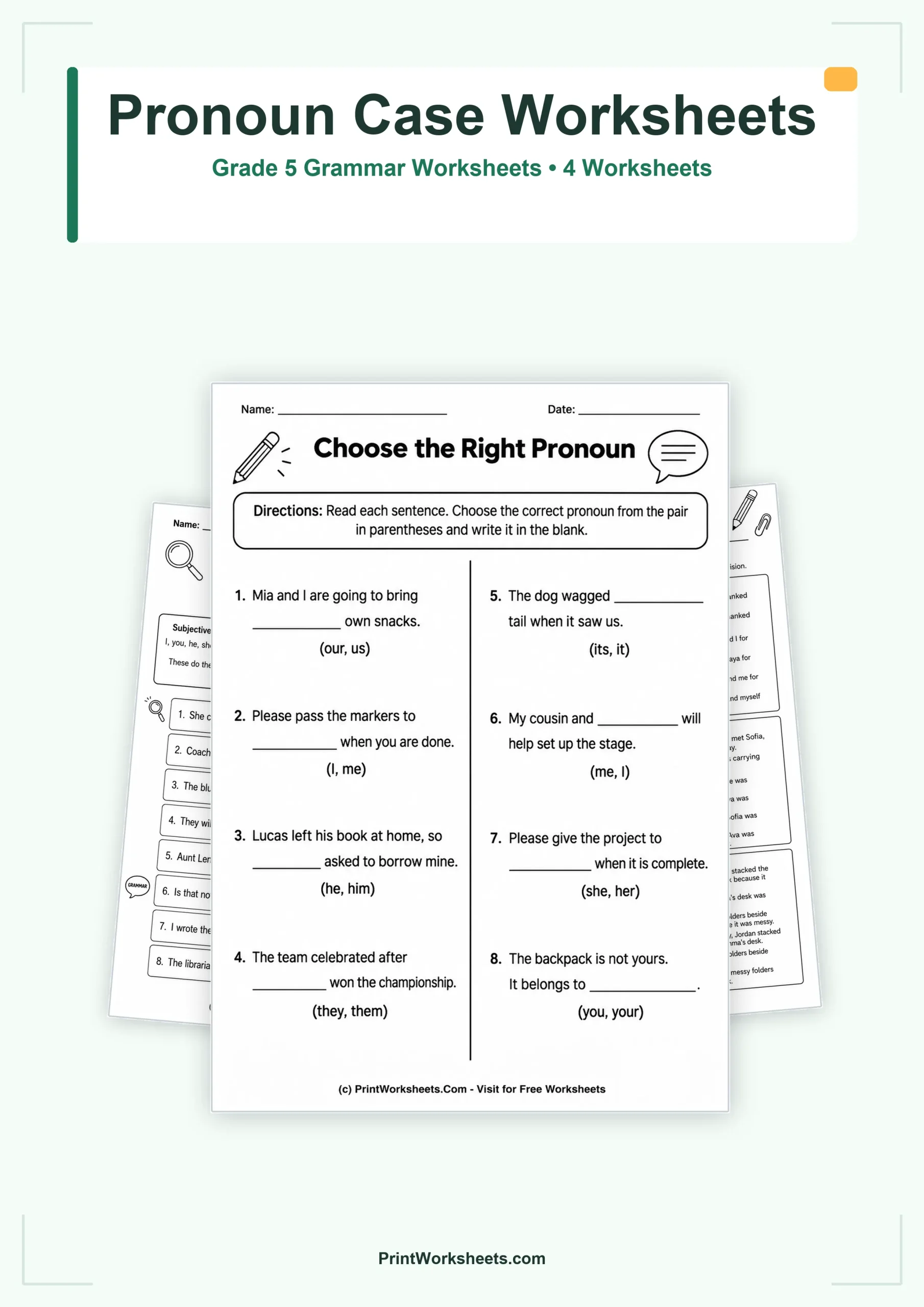
These pronoun case worksheets give fifth-grade students a clear path from recognizing pronoun forms to revising sentences for accurate meaning. The set begins with subject, object, and possessive case, then moves into choosing the correct form in context, fixing unclear references, and rewriting everyday messages. Because students work with both grammar form and sentence meaning, the practice goes beyond isolated identification and helps them make better editing choices in real writing.
Practice Pronoun Case and Clear Reference
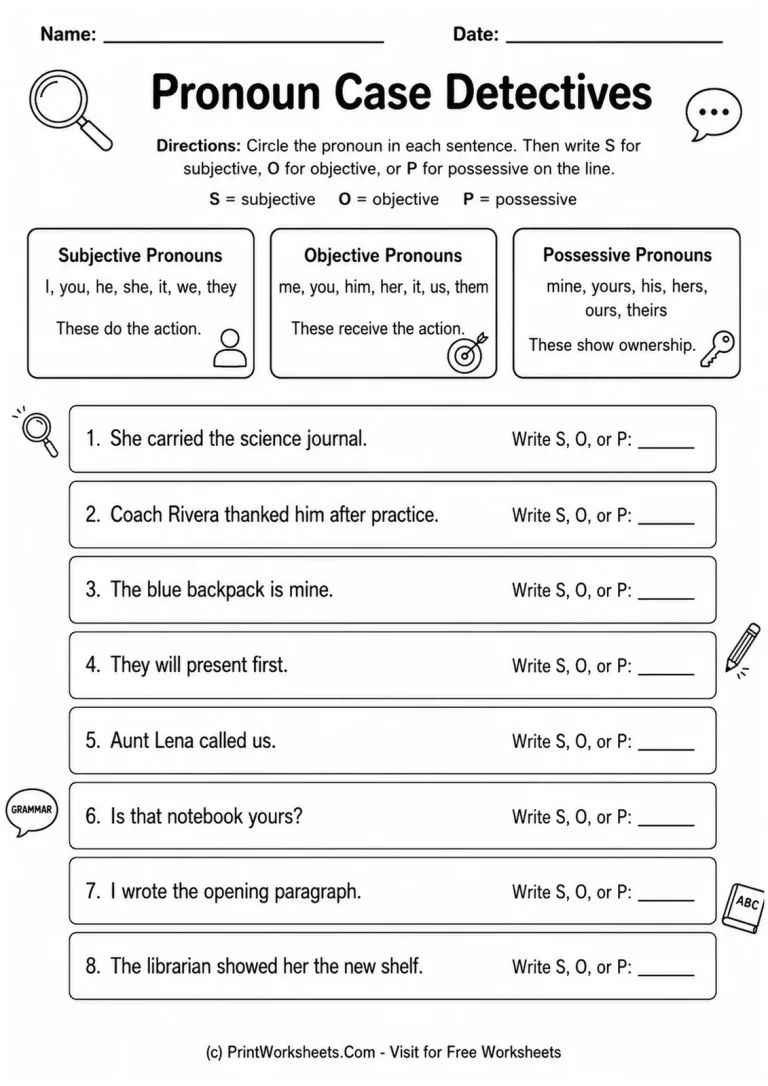
The first worksheet, Pronoun Case Detectives, asks students to find the pronoun in each sentence and classify it as subjective, objective, or possessive. Eight examples provide focused practice with the three major pronoun cases, while short reference boxes give students quick reminders before they begin. This page works well as an introduction, guided practice activity, or review before students move into sentence editing.
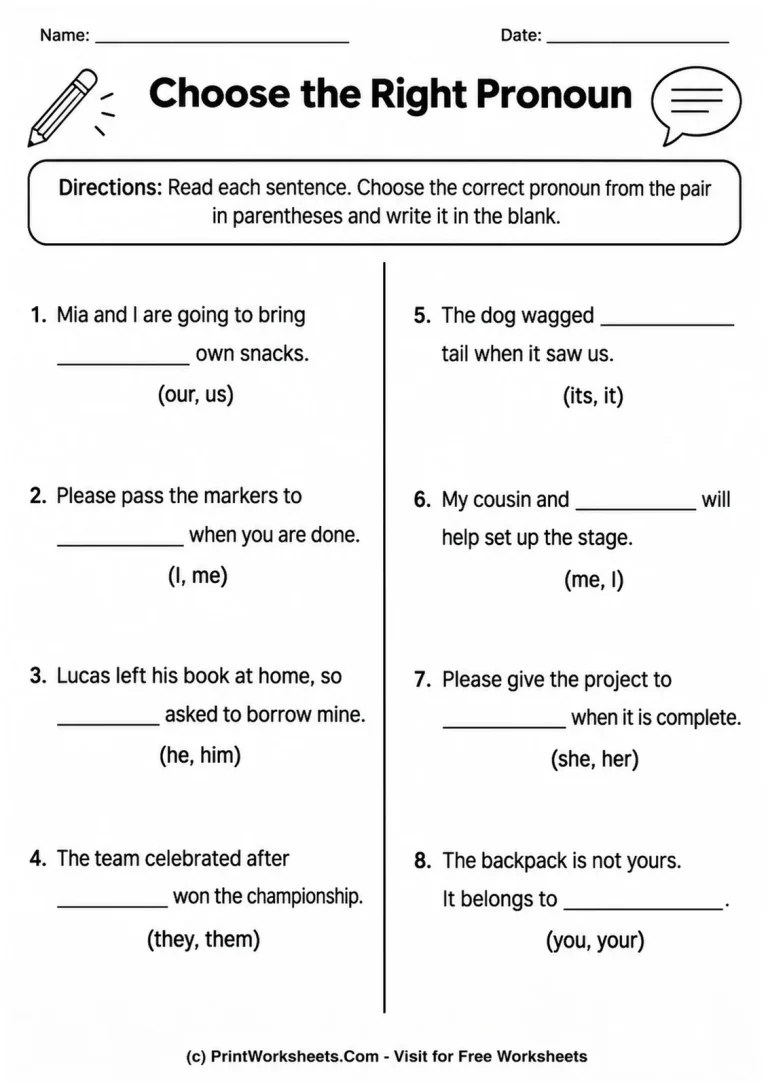
On Choose the Right Pronoun, students select the correct form from paired choices such as I/me, they/them, our/us, and she/her. Each item requires students to look at the pronoun’s job in the sentence rather than rely on what sounds familiar. The mix of subject, object, and possessive forms helps students strengthen the connection between sentence function and correct pronoun case.
Move from Correct Forms to Clear Meaning
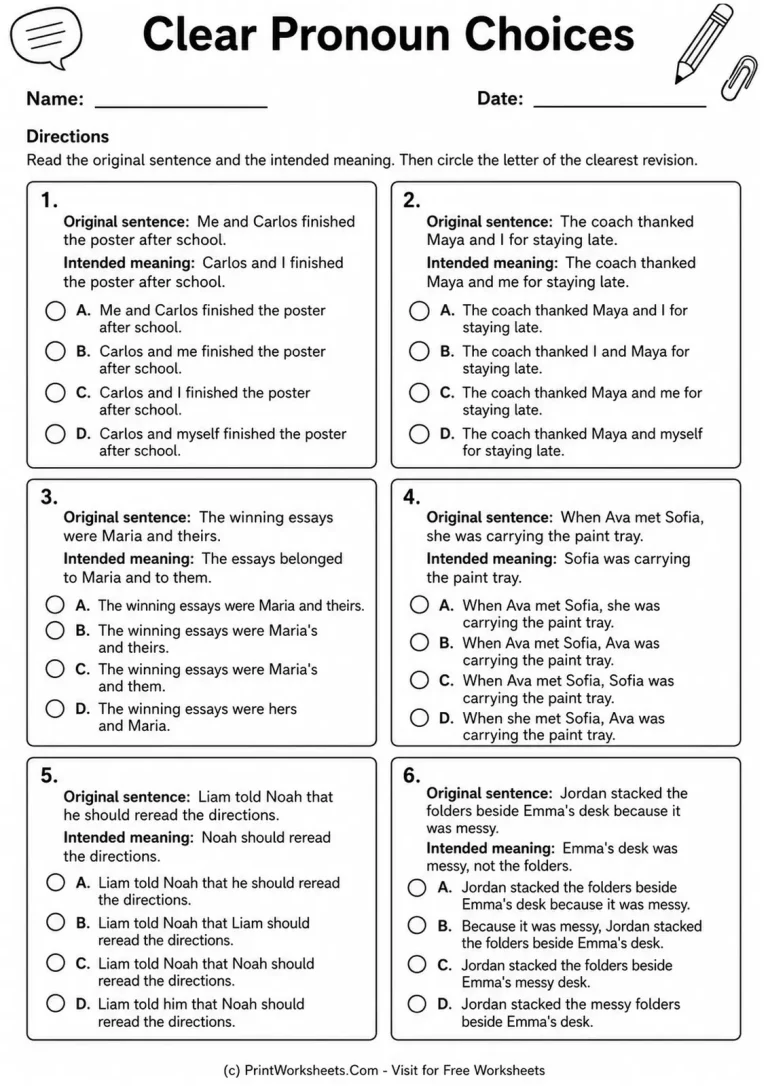
The third worksheet, Clear Pronoun Choices, adds another layer of thinking. Students read an original sentence, consider the intended meaning, and choose the clearest revision from four options. These six problems include errors in subject and object case, possessive forms, and ambiguous pronoun references. The intended-meaning notes give students a specific target, so they must evaluate both grammatical accuracy and clarity.
This type of revision practice is especially useful for Grade 5 because a sentence can contain a grammatically possible pronoun and still be confusing. Students learn to ask two questions at once: Is the pronoun form correct for its role, and is it obvious who or what the pronoun refers to? That combination prepares them for editing paragraphs, emails, reports, and other longer pieces of writing.
Edit Pronouns in Everyday Messages
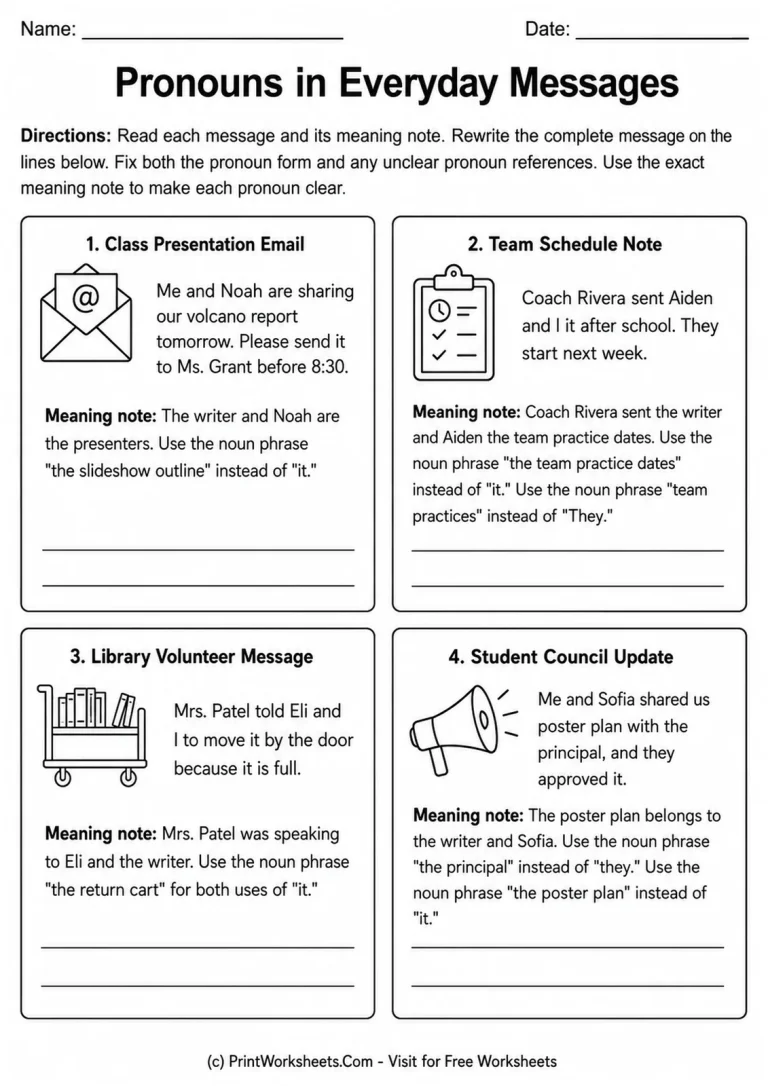
The final student page, Pronouns in Everyday Messages, shifts from selected-response practice to constructed response. Students rewrite four complete messages, correcting pronoun forms and replacing unclear pronouns with specific noun phrases provided in meaning notes. The situations include a class presentation email, a team schedule note, a library volunteer message, and a student council update. These familiar contexts make the editing task feel purposeful while still keeping the grammar goal precise.
Because students must produce complete corrected sentences, this page provides a useful check for independent understanding. A student who can identify a wrong form on an earlier page may still need support when rewriting a full message. Teachers and parents can use the completed rewrites to see whether students can carry pronoun knowledge into authentic communication.
Ways to Use These Grade 5 Pronoun Worksheets
The four-page progression can be used in one lesson sequence or spread across several days. Start with case classification, continue with paired pronoun choices, then introduce revision for clarity, and finish with message editing. The set also works well for small-group instruction, literacy centers, homework, morning work, intervention, or a grammar review before a writing assignment.
For extra discussion, ask students to explain why one pronoun form works and another does not. They can identify the word the pronoun replaces, name whether it functions as a subject, object, or possessive form, and explain how a vague reference changes the reader’s understanding. These short explanations turn the worksheets into a stronger language lesson without requiring additional materials.
What Students Practice
Across the set, students classify subjective, objective, and possessive pronouns; choose correct pronoun forms in sentence context; compare subject-object contrasts such as I/me and they/them; work with possessive contrasts such as our/us and its/it; revise sentences to match an intended meaning; and replace ambiguous references with specific nouns. The sequence keeps the skill focused while gradually increasing the amount of reasoning and writing students must do.
These printable Grade 5 activities are a practical choice when students need more than a single pronoun drill. They combine recognition, selection, revision, and independent rewriting so learners can practice both correct pronoun case and clear pronoun reference in sentences they can understand and use.