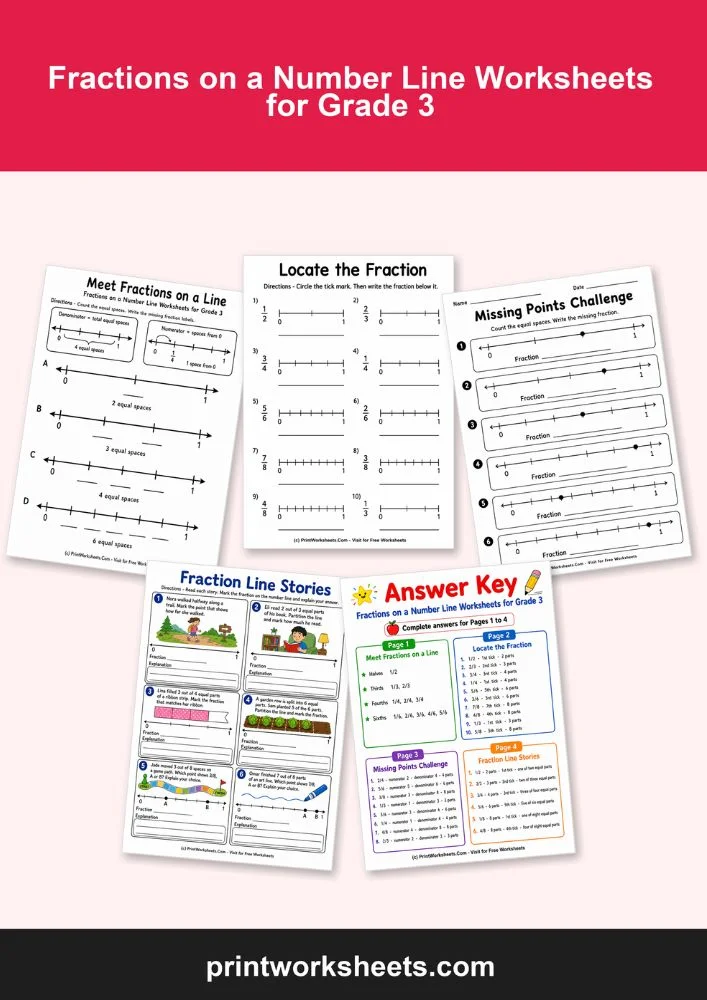
What are fractions on a number line worksheets for grade 3? Fractions on a number line worksheets for grade 3 are highly structured pedagogical math tools designed to help young learners transition from discrete object counting to continuous spatial measurement[cite: 2]. Third-grade educators deploy these specific analytical printables to directly combat the infamous “tick-mark error,” training students to mathematically measure the physical intervals between zero and one rather than incorrectly counting the endpoints[cite: 2]. By systematically working through these visual exercises, children learn to accurately identify the denominator based on the total equal spaces and the numerator based on the specific jumps from zero. You can download this complete fractions on a number line worksheets for grade 3 PDF directly from PrintWorksheets.Com to build rigorous spatial reasoning in your classroom.
To ensure your students do not experience cognitive overload, it is mathematically critical to establish foundational partition concepts first. Before introducing non-unit fractions (like three-fourths or five-sixths), educators should have students master single intervals using our introductory unit fractions on number lines worksheets for grade 3. Once a learner understands that a single space represents the base unit whole, they can confidently stack those units together to locate larger rational numbers.
Inside the 3rd Grade Fractions PDF
This targeted linear measurement practice pack provides a systematic progression of difficulty[cite: 2]. Each printable worksheet shifts the cognitive demand, moving students from basic visual identification to complex, real-world written explanations.
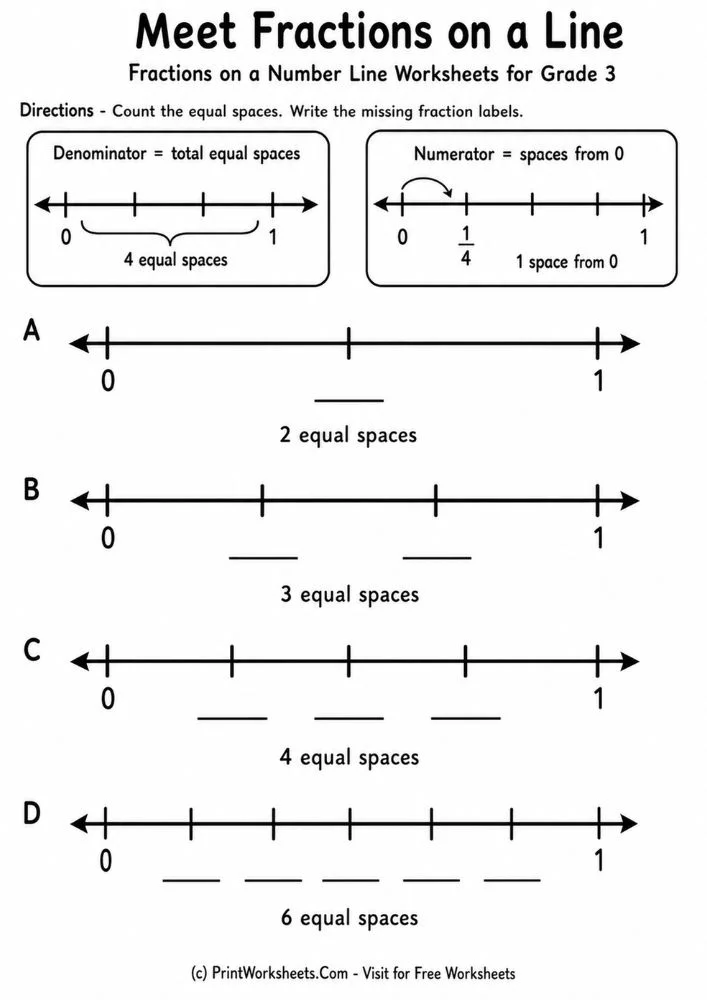
- Meet Fractions on a Line: This introductory worksheet explicitly tackles spatial misconceptions. The top of the page features two clear anchor charts diagramming the difference between the denominator (total equal spaces) and the numerator (spaces from 0). Students then practice this logic by analyzing pre-partitioned axes and filling in the missing fraction labels for halves, thirds, fourths, and sixths.
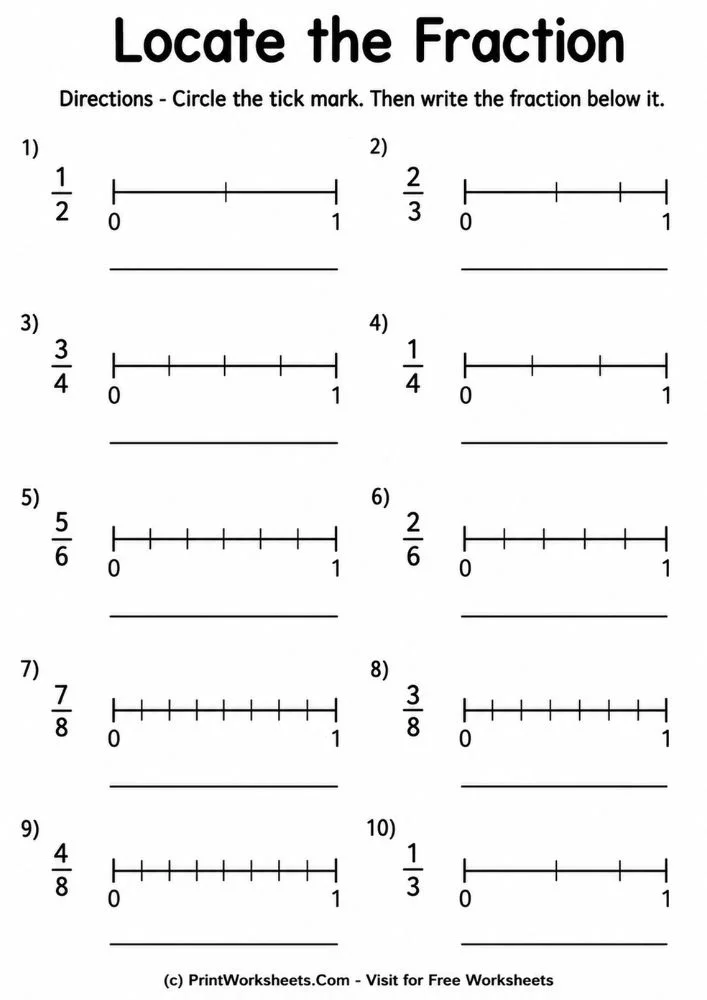
- Locate the Fraction: A dedicated fluency page where students face ten distinct mathematical challenges. They are given a fraction (such as 2/3, 5/6, or 7/8) and must carefully count the intervals to circle the exact tick mark that represents that quantity, reinforcing the relationship between partitions and equal sharing[cite: 2].
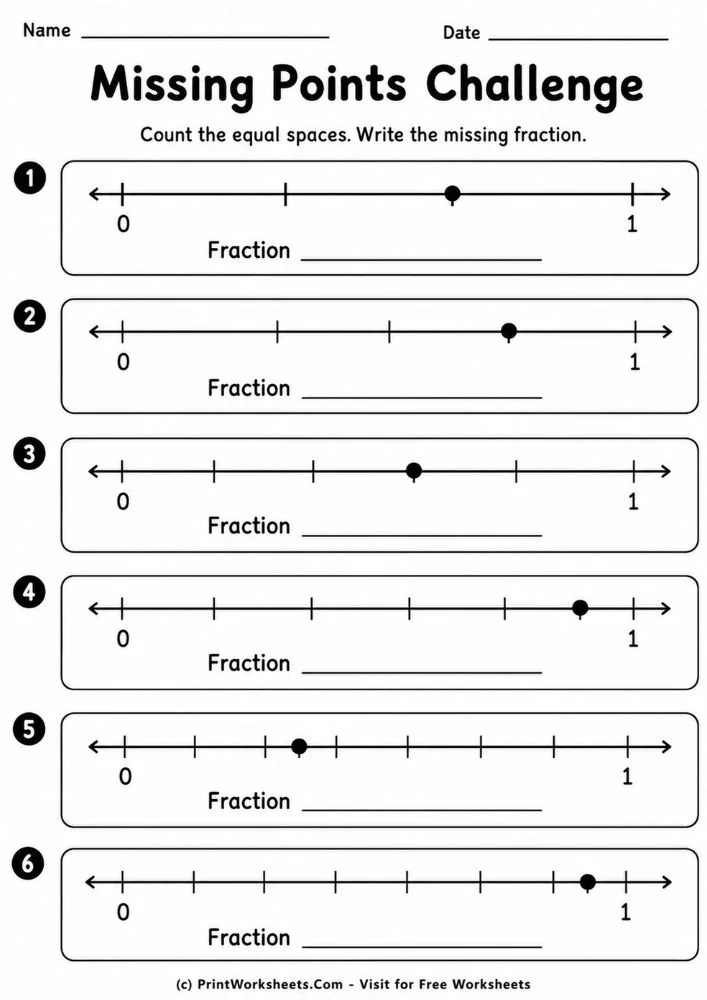
- Missing Points Challenge: This worksheet reverses the cognitive engineering. Students examine six number lines that already possess a designated geometric point (a black dot). Without any given numbers, they must count the total equal spaces to deduce the denominator, locate the numerator, and write the correct hidden fraction.
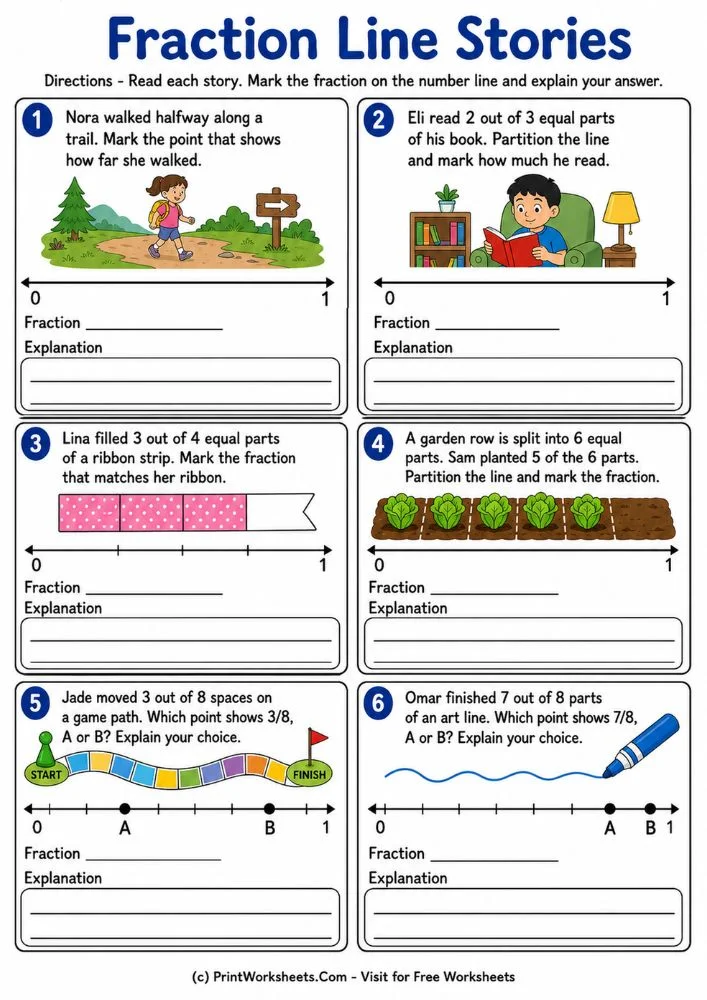
- Fraction Line Stories: A high-level application page integrating mathematical practice with reading comprehension. Students read six real-world scenarios, such as Nora walking halfway along a hiking trail, Sam planting cabbages in five out of six garden sections, or a board game path split into eight spaces. They must mark the correct fraction on the visual model and then write a complete sentence explaining their mathematical reasoning.
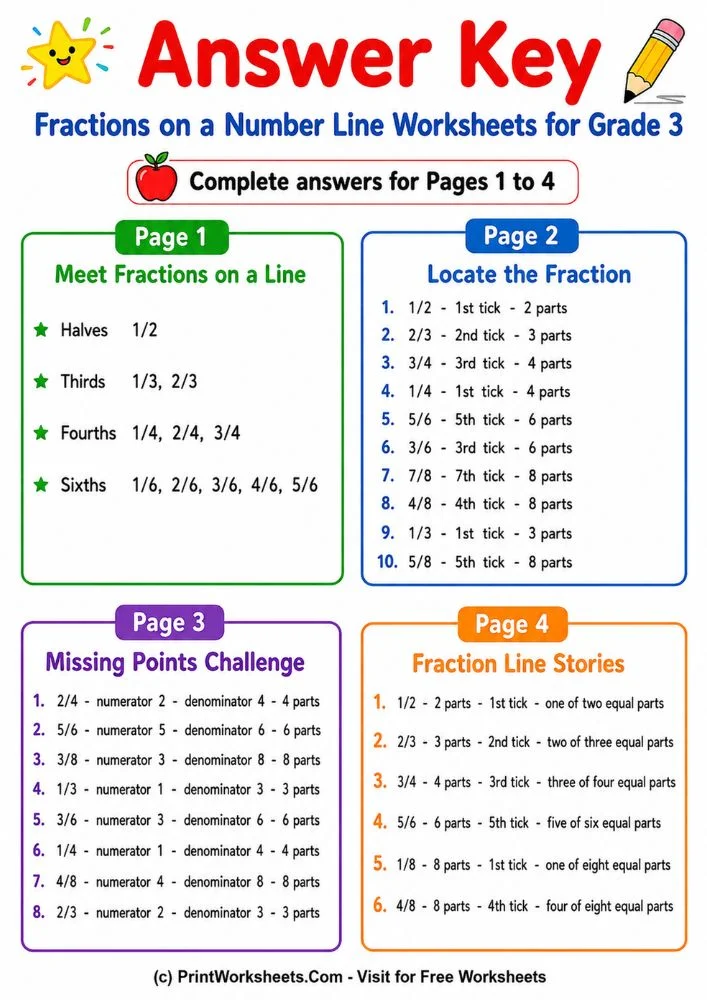
- Comprehensive Answer Key: A teacher-facing reference guide that completely maps out the exact placement and written explanations for every page, allowing for rapid self-correction which is vital for building independence in spatial math tasks[cite: 2].
Differentiation Options for Teachers
To successfully integrate these resources for students struggling to isolate the interval from zero to one as the base unit[cite: 2], provide a small physical manipulative (like a plastic counting bear or an eraser). Instruct the student to physically “jump” the manipulative between the spaces on the paper. This kinesthetic movement prevents the brain from merely counting the vertical lines. For advanced learners ready to stretch their rational number comprehension, draw an open number line ending at the number two on the back of their paper. Challenge them to locate improper fractions (like 5/4 or 7/3) using the exact same equal-sharing logic they practiced on the worksheet.
Targeted Academic Skills
Deploying these visual fraction organizers directly satisfies critical Common Core State Standards (CCSS) for third-grade mathematics. Specifically, these printables target CCSS.MATH.CONTENT.3.NF.A.2.B, requiring students to represent a fraction a/b on a number line diagram by marking off “a” lengths 1/b from zero. Furthermore, the inclusion of the “Fraction Line Stories” worksheet ensures compliance with mathematical practice standards, as students must construct viable arguments and explain their spatial reasoning using proper academic vocabulary.
Frequently Asked Questions
What grade levels use fractions on a number line worksheets?
Fractions on a number line worksheets are explicitly designed for third-grade mathematics classrooms. However, they serve as excellent diagnostic and intervention tools for fourth-grade and special education students who lack foundational spatial reasoning regarding rational numbers.
What specific cognitive obstacles do these printables address?
Curriculum designers identify the primary obstacle as the “tick-mark error,” where learners incorrectly identify the denominator by counting the endpoints[cite: 2]. These printables correct this immediately by utilizing strong visual brackets that force students to measure the physical distance (intervals) rather than isolated points.
Why is the “Fraction Line Stories” worksheet so important?
The fraction line stories worksheet is important because it moves students from abstract computation into concrete reality. By mapping a fraction onto a picture of a hiking trail or a ribbon strip, children realize that rational numbers represent actual physical distances and quantities in the real world.