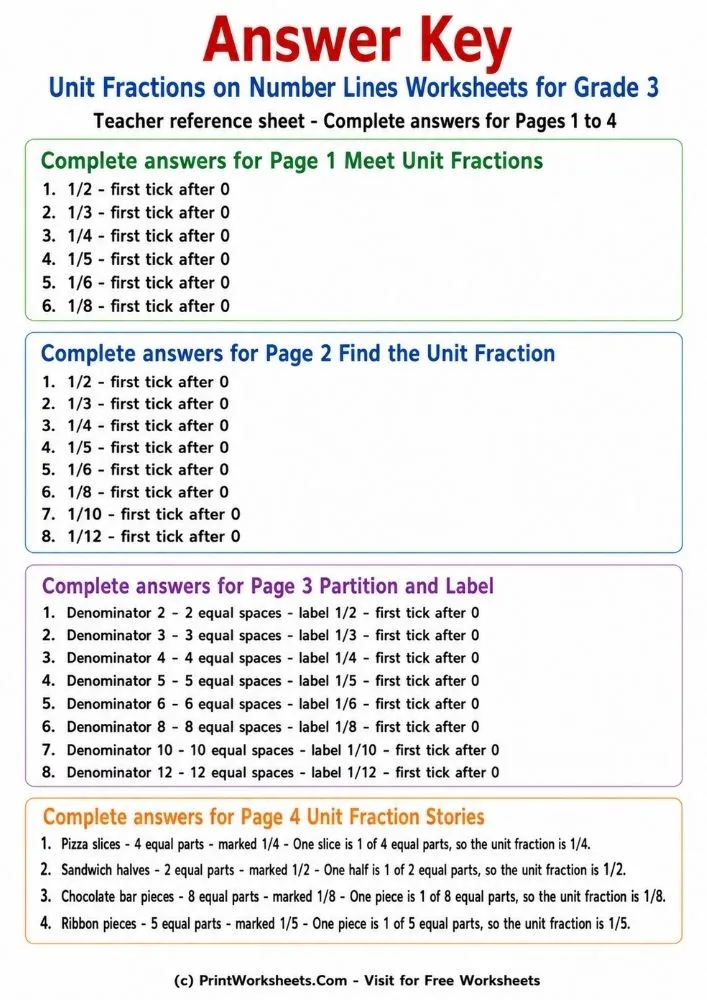
What are unit fractions on number lines worksheets for grade 3? Unit fractions on number lines worksheets for grade 3 are printable mathematical resources designed to help elementary students transition from analyzing physical area models (like pie charts) to understanding fractions as specific, continuous numerical values between zero and one. Third-grade educators utilize these highly structured spatial printables to explicitly teach how the denominator dictates the number of equal intervals, and how the numerator indicates a single physical unit of that specific distance. By completing these guided measurement tasks, students master the cognitive ability to visually partition a whole, laying the absolute groundwork for future operations involving equivalent fractions and decimals. Download this complete unit fractions on number lines worksheets for grade 3 PDF directly from PrintWorksheets.Com to establish rigorous, common core-aligned linear measurement stations in your classroom.
Once students know how to locate a fraction on an axis, they can begin analyzing real-world data using our line plots with fraction measurements printables.
Mastering spatial math concepts requires bridging multiple cognitive models. Just as students must visualize equal groups and structural rows utilizing a 3rd grade multiplication arrays worksheet, they must apply that exact same equal-sharing spatial logic to accurately partition a continuous straight line into precise mathematical segments.
Inside the 3rd Grade Fractions PDF
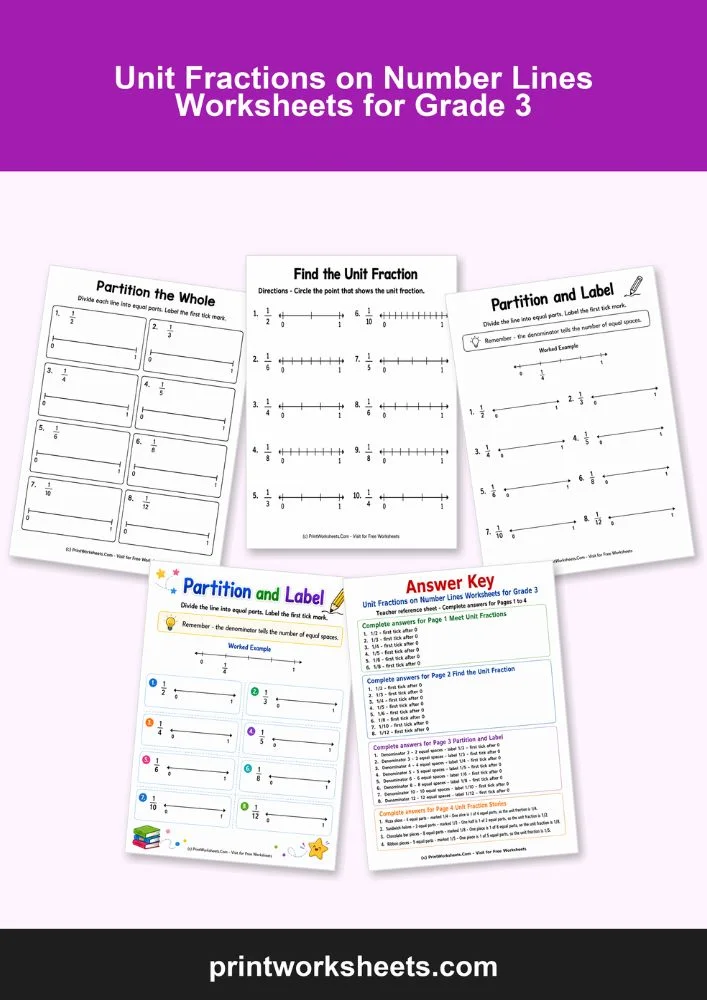
This targeted linear measurement practice pack features carefully constructed graphic organizers designed to prevent the most common third-grade error: counting the vertical tick marks instead of the actual spaces (intervals). Each page isolates a specific spatial skill.
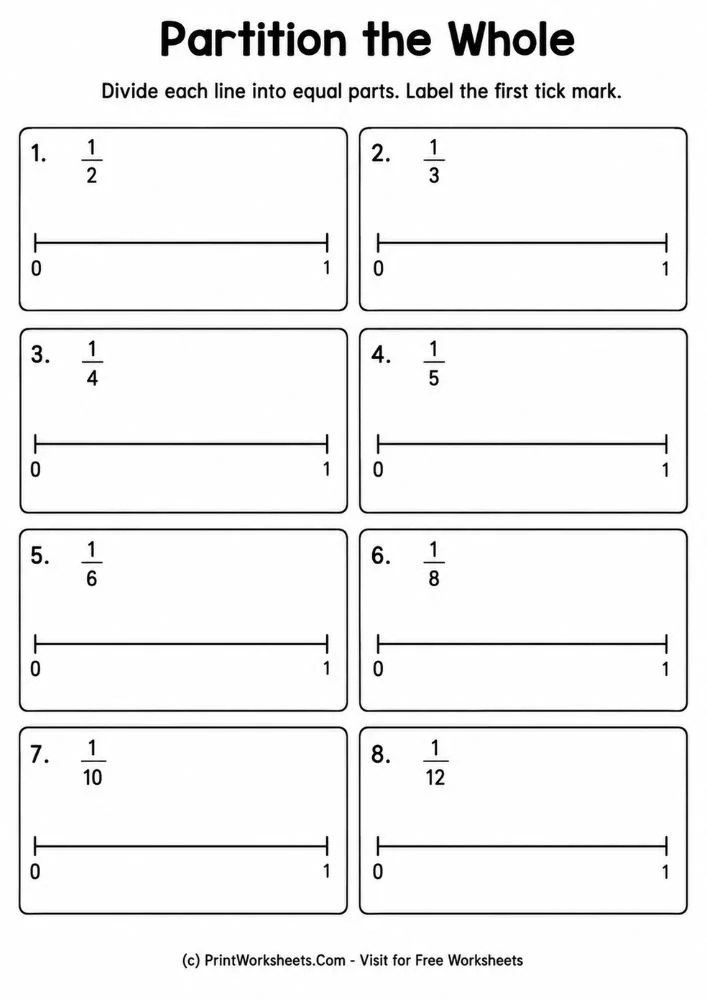
- Partition the Whole: This foundational worksheet forces students to generate their own physical boundaries. Students are presented with eight empty lines, all beginning at zero and ending at one. They must divide the lines into equal parts for highly specific unit fractions ranging from one-half (1/2) all the way to one-twelfth (1/12). Once partitioned, they must label only the very first tick mark, reinforcing the definition of a single “unit” fraction.
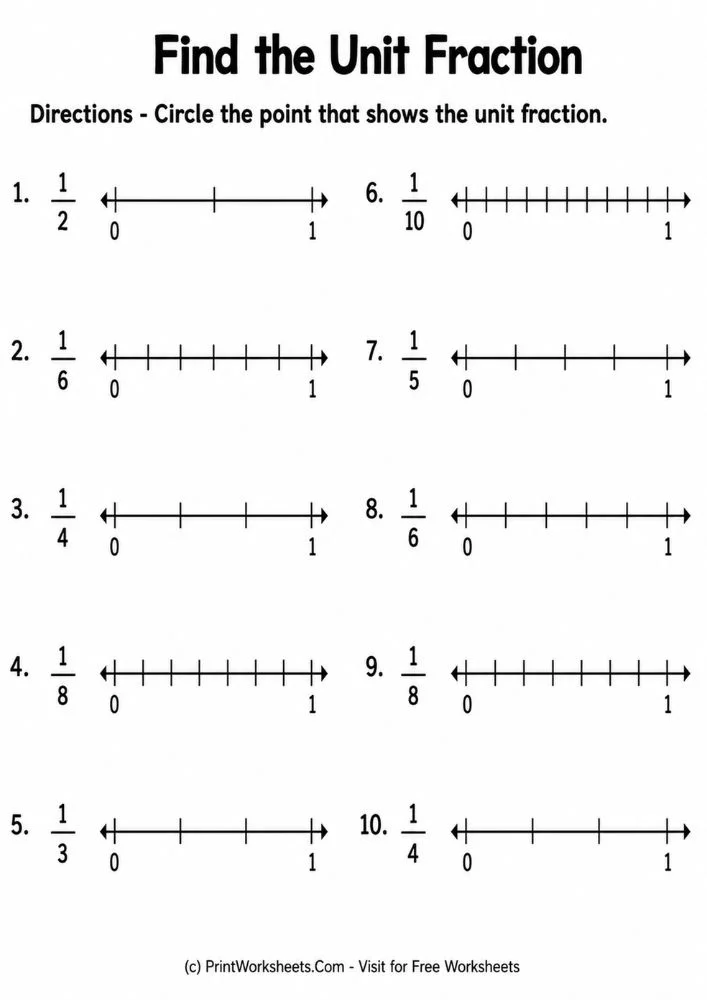
- Find the Unit Fraction: A dedicated analytical page where the partitioning has already been done perfectly. Students must analyze ten distinct number lines and count the pre-drawn intervals to determine the hidden denominator. Once they deduce how many equal spaces exist between zero and one (e.g., 6 spaces for 1/6), they must circle the exact geometric point that represents that specific unit fraction.
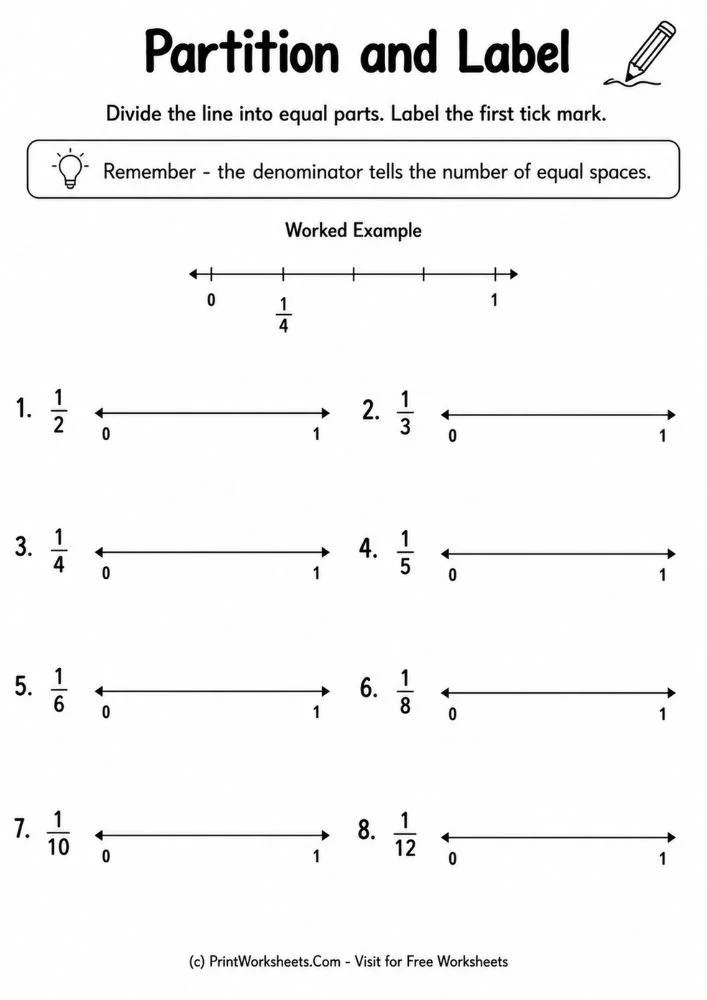
- Partition and Label (With Guided Hint): An advanced independent practice worksheet featuring a vital visual scaffold. The top of the page displays a lightbulb icon with a critical reminder: “The denominator tells the number of equal spaces.” It also provides a fully worked example showing the exact spatial placement of 1/4. Students then proceed to solve eight new spatial challenges independently, mapping fractions like 1/3, 1/5, and 1/10 across blank horizontal axes.
- Comprehensive Answer Key: A teacher-facing reference guide that completely maps out the exact placement for every tick mark across all pages, allowing for rapid desk-side grading and immediate student feedback during small group rotations.
Differentiation Options for Teachers
To successfully integrate these resources into your math block for students who struggle with fine motor skills or spatial estimation, provide them with physical snap cubes or precisely cut paper strips that match the exact width of the printed line on the paper. Have them build the intervals physically first, then use a pencil to mark where the cubes touch the line. For advanced or gifted learners, cut the printed number lines so they no longer end perfectly at the number “one.” Instead, extend the line to “two” and challenge them to label improper fractions (like 4/3 or 5/4) using the exact same unit interval logic they practiced on the worksheet.
Targeted Academic Skills
Deploying these visual fraction organizers directly satisfies critical Common Core State Standards (CCSS) for third-grade mathematics. Specifically, these printables target CCSS.MATH.CONTENT.3.NF.A.2.A, which requires students to represent a fraction 1/b on a number line diagram by defining the interval from 0 to 1 as the whole and partitioning it into “b” equal parts. Furthermore, it enforces the recognition that each of those individual partitioned parts has a distinct size of 1/b, anchoring their understanding of rational numbers to concrete linear measurement.
Frequently Asked Questions
What grade levels use unit fractions on number lines worksheets?
Unit fractions on number lines worksheets are strictly designed for third-grade math classrooms, though they serve as excellent intervention tools for fourth-grade students who lack foundational spatial reasoning regarding rational numbers.
What specific mathematical skills do these printables target?
These math printables explicitly target linear measurement, visual partitioning, interval counting, denominator identification, and understanding fractions as exact continuous quantities rather than just shapes cut into pieces.
Why do students struggle with labeling fractions on a line?
Students struggle with labeling fractions on a line because they incorrectly attempt to count the vertical tick marks (the lines) instead of measuring the actual empty spaces (the intervals) between the marks. Explicitly teaching them to count the “jumps” between zero and one immediately corrects this universal mathematical misconception.