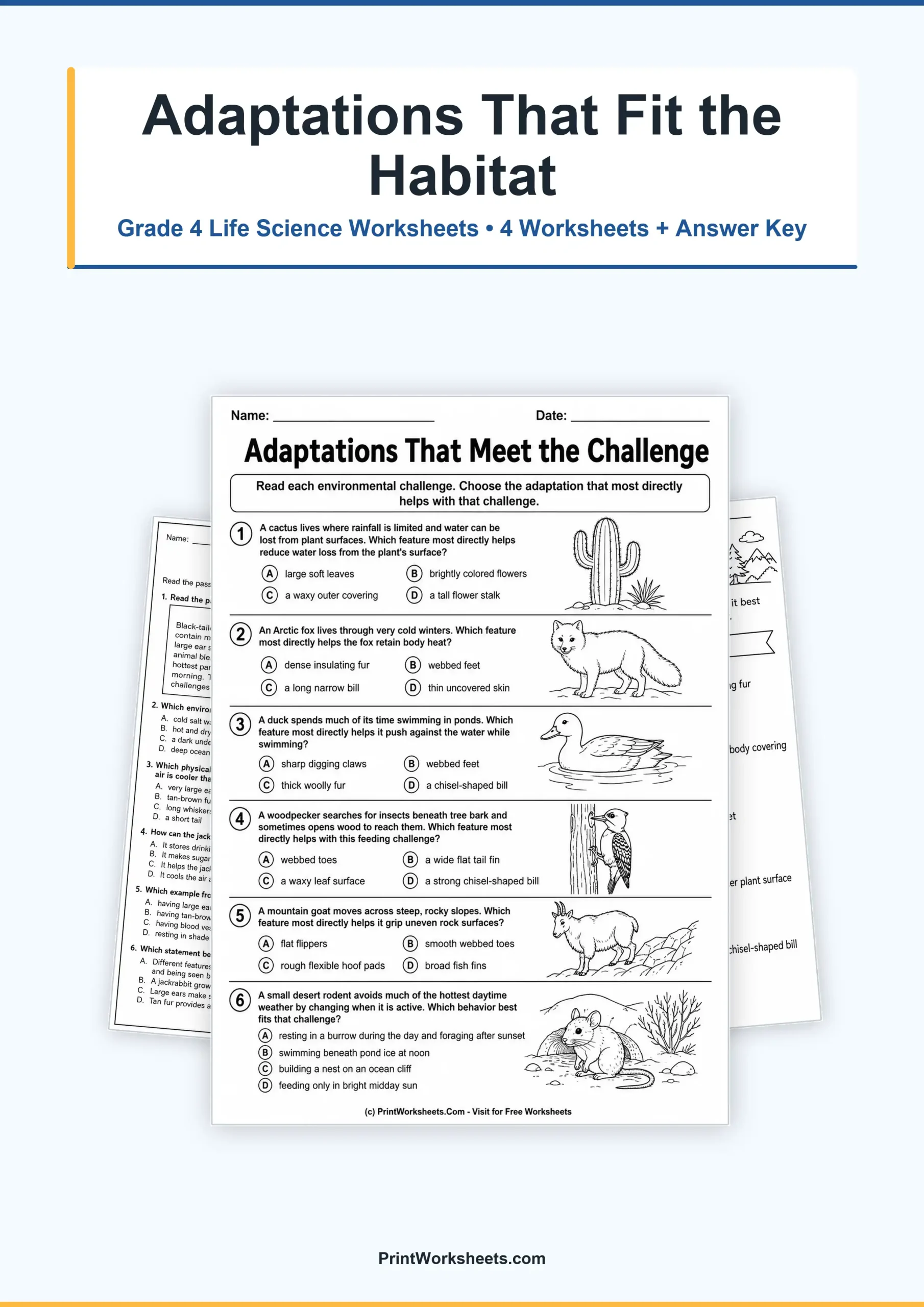
What makes one adaptation useful in one habitat but less useful in another? These adaptations worksheets for Grade 4 ask students to connect environmental challenges with the physical features and behaviors that help organisms survive. Across four student pages, learners read about jackrabbits in hot, dry places, compare adaptations from several plants and animals, match habitat problems with useful traits, and explain why a particular adaptation fits a specific environment.
Adaptations Worksheets Built Around Environment and Function
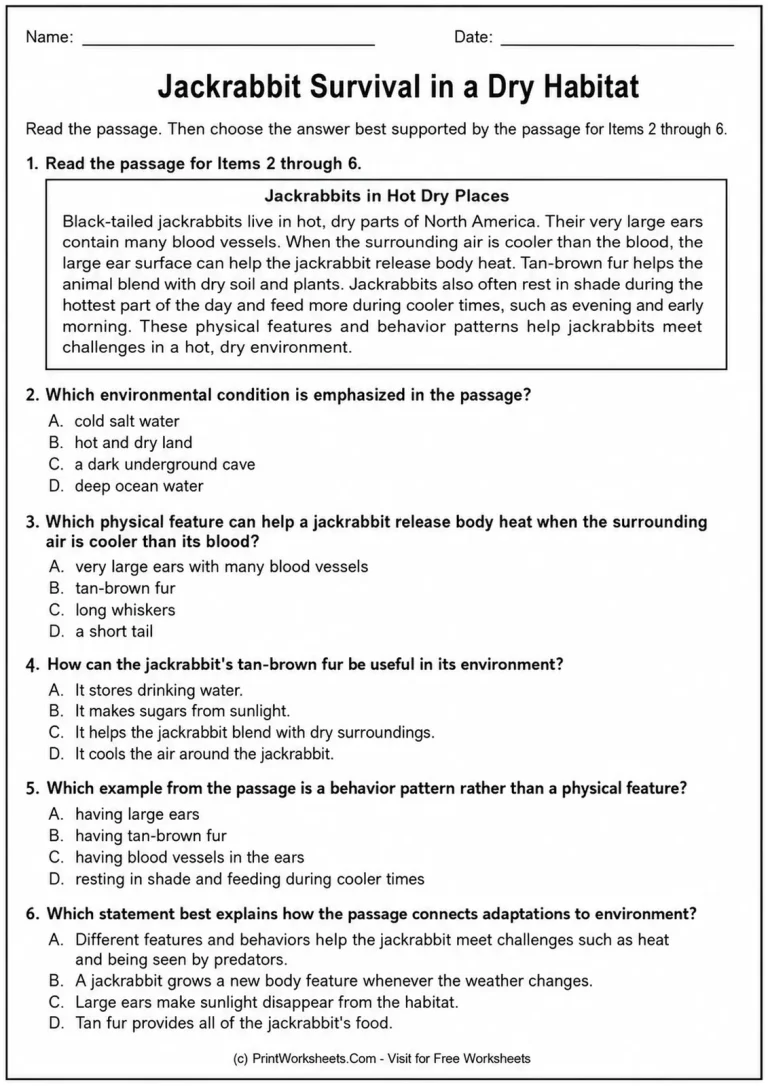
The first worksheet uses a short informational passage about black-tailed jackrabbits. Students learn that very large ears with many blood vessels can help release body heat when the surrounding air is cooler than the animal’s blood. They also see how tan-brown fur can help a jackrabbit blend with dry soil and plants, and how resting in shade during the hottest part of the day and feeding during cooler times can reduce exposure to extreme heat. The follow-up questions ask students to identify the emphasized environmental condition, distinguish physical features from behavior patterns, and connect adaptations to survival challenges.
This page works well when you want science reading practice without separating content knowledge from comprehension. Students must use details from the passage rather than rely on a memorized definition of adaptation.
From Habitat Challenge to Useful Adaptation
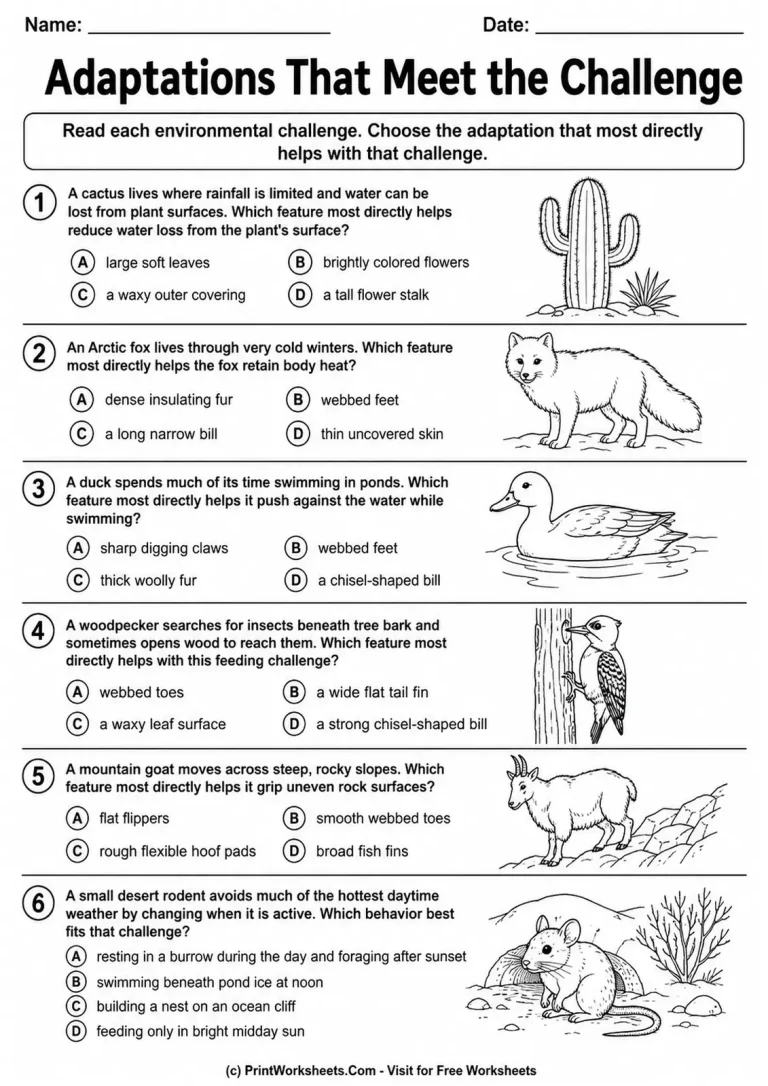
The second worksheet broadens the topic with six short scenarios. A cactus living where rainfall is limited is paired with a waxy outer covering that helps reduce water loss. An Arctic fox is connected with dense insulating fur for retaining body heat. A duck’s webbed feet are considered in relation to swimming, while a woodpecker’s strong chisel-shaped bill is linked to reaching insects beneath bark. Students also examine rough, flexible hoof pads for a mountain goat on rocky slopes and a desert rodent that rests in a burrow during the day and forages after sunset.
Because each question asks which feature or behavior most directly helps with the stated challenge, students practice more than simple recall. They must identify the function of an adaptation and judge which option best fits the environmental demand.
Matching Environmental Challenges and Adaptations
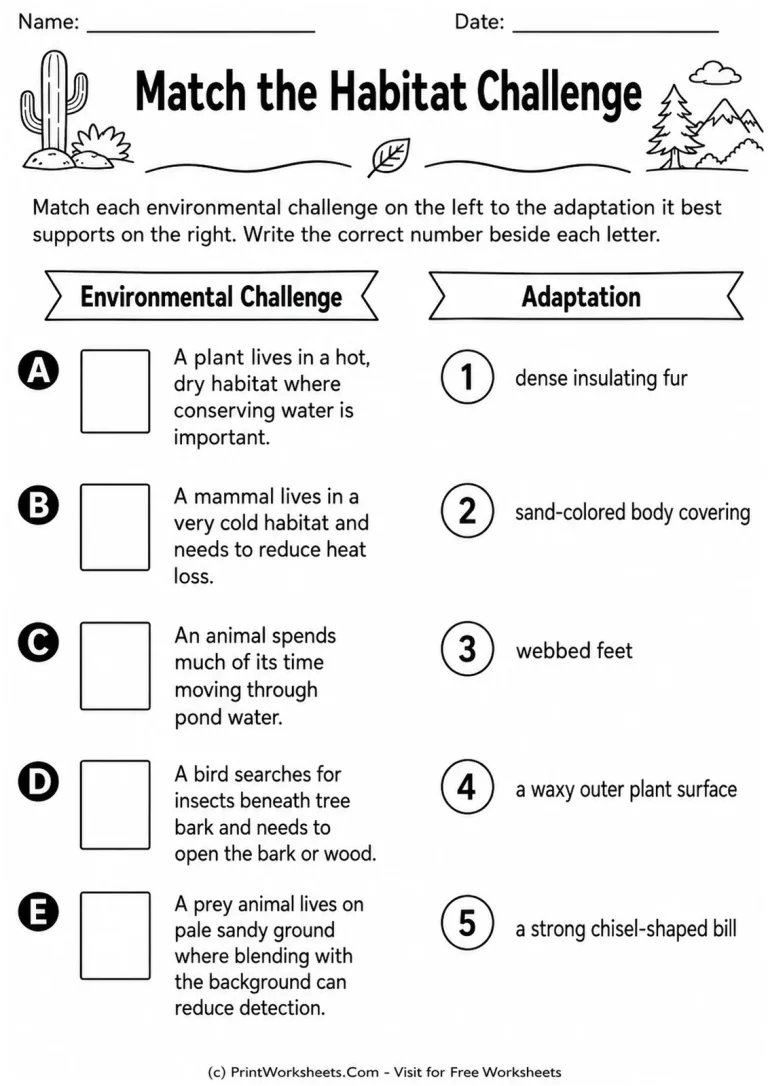
The third worksheet shifts to a matching format. Students connect a hot, dry habitat with a waxy plant surface, a cold habitat with dense insulating fur, pond movement with webbed feet, feeding beneath tree bark with a strong chisel-shaped bill, and pale sandy ground with a sand-colored body covering. This format is useful for checking whether students can recognize the same ideas when the wording and response style change.
The one-to-one matching structure also makes the page useful for independent practice, partner discussion, or a quick review before a quiz. Students can explain each match aloud to strengthen scientific reasoning and vocabulary.
Explaining Why an Adaptation Fits
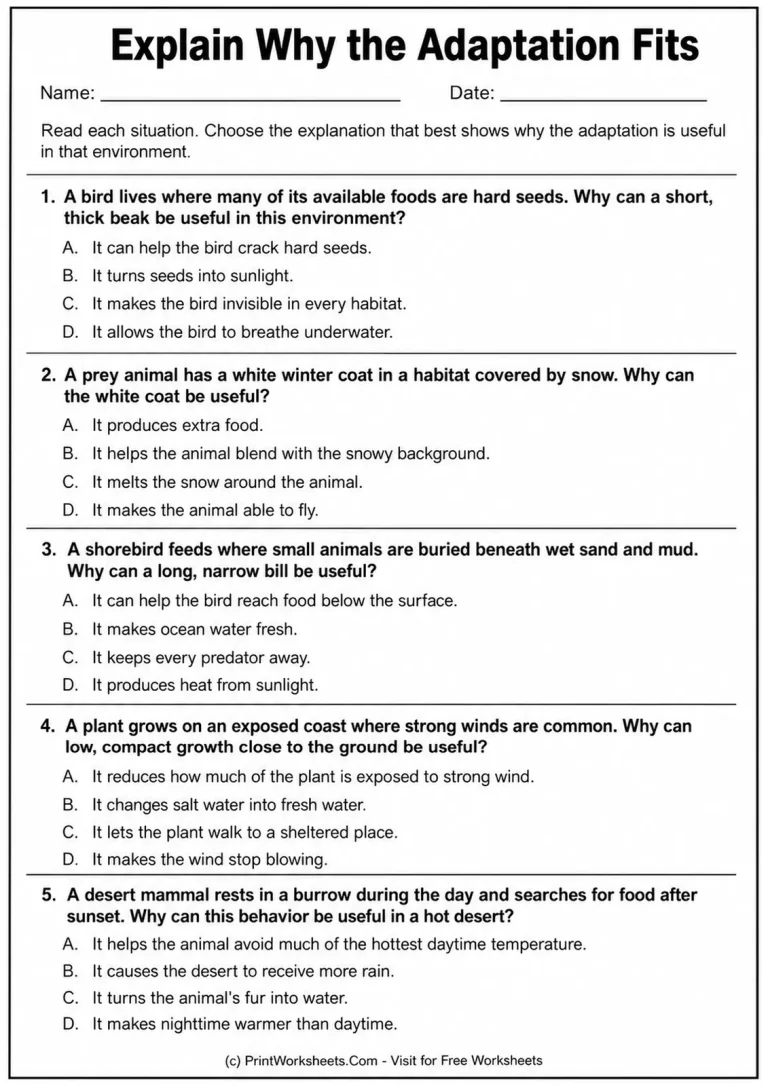
The final student worksheet focuses on cause and effect. Students decide why a short, thick beak can help a bird crack hard seeds, why a white winter coat can help a prey animal blend with snow, and why a long, narrow bill can help a shorebird reach food buried beneath wet sand and mud. They also consider why low, compact plant growth can reduce exposure to strong coastal winds and why a desert mammal benefits from resting in a burrow during the day and searching for food after sunset.
These questions are especially useful for moving students from naming an adaptation to explaining its advantage. The distractors are intentionally unrelated to the environmental challenge, so students must focus on a logical connection between structure or behavior and function.
Ways to Use This Grade 4 Life Science Set
Use the pages as a short adaptations mini-unit, assign one page for science homework, or choose individual activities for review stations. The jackrabbit passage can support close reading, while the multiple-choice and matching pages provide quick checks for understanding. The explanation page works well as a bridge to short written responses: after students select an answer, ask them to rewrite the idea in their own words using because.
For differentiation, let students highlight the environmental challenge in one color and the helpful adaptation in another before answering. Students who need an extension can invent a new habitat challenge and propose a physical feature or behavior that would help an organism meet it. An easy exit ticket is to ask students to name one physical adaptation, one behavioral adaptation, and the environmental problem each one helps solve.
Teacher and Parent Support
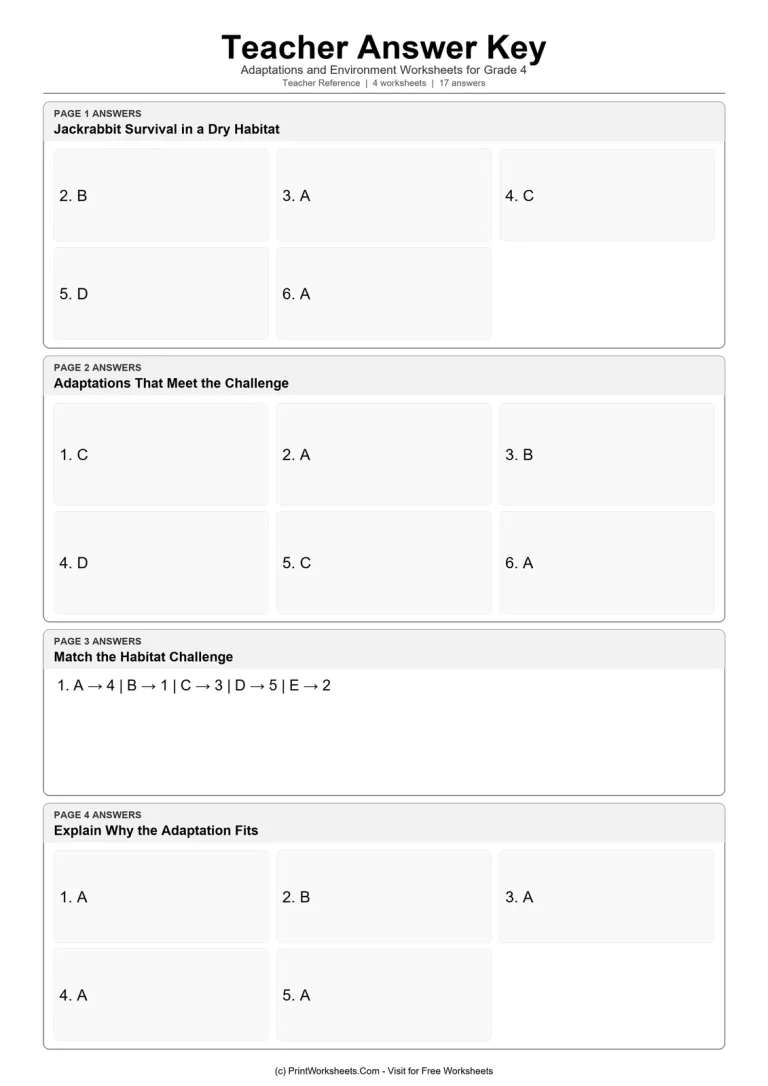
A teacher answer key is included for all four student worksheets, making the set practical for classroom instruction, home learning, review, or independent practice. Together, the activities reinforce a central life science idea: adaptations are useful because they help organisms respond to particular conditions in their environments.