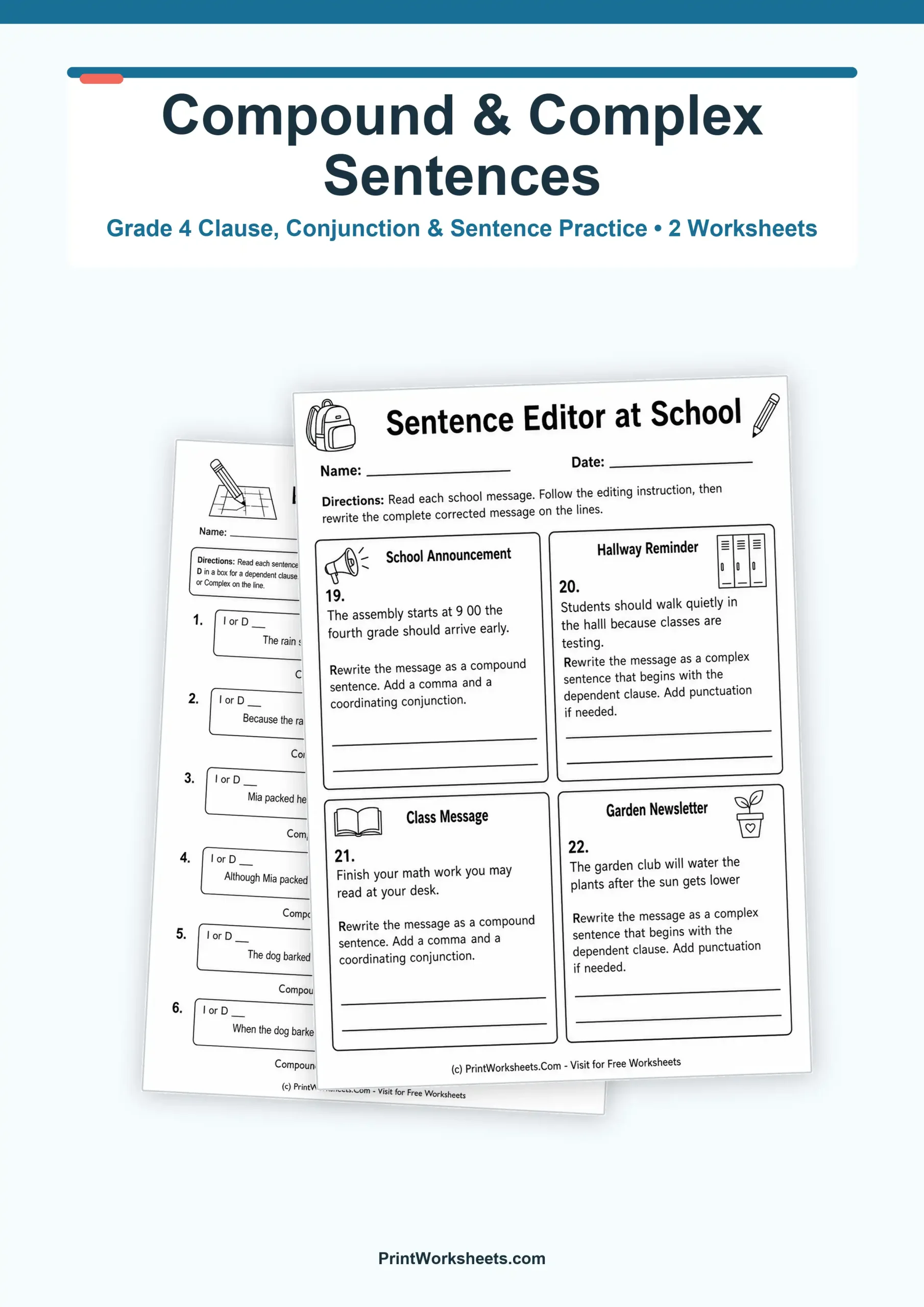
Sentence structure becomes easier to understand when students can see how clauses work together. These compound and complex sentences worksheets for Grade 4 give learners two connected ways to practice that idea: first by analyzing sentence parts and then by rewriting everyday school messages. Students work with independent and dependent clauses, coordinating and subordinating conjunctions, sentence classification, and comma placement while moving from recognition to active editing.
See How Compound and Complex Sentences Are Built
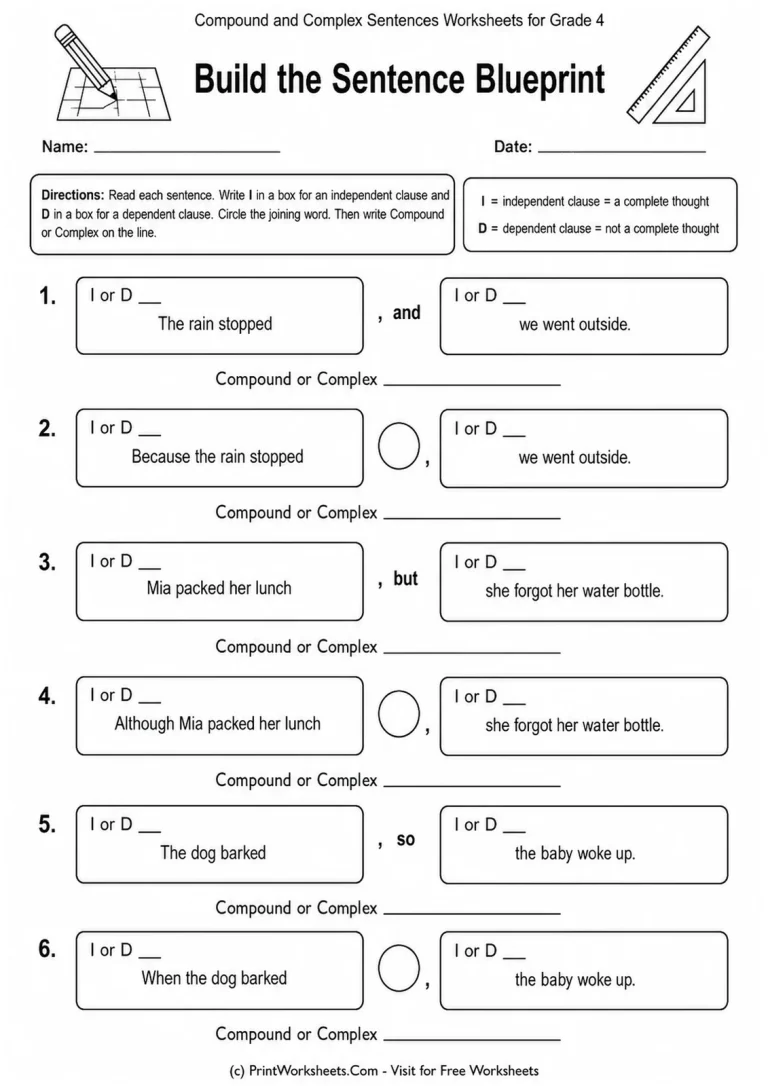
The first worksheet, Build the Sentence Blueprint, treats each sentence as a structure that can be examined piece by piece. Students label clauses with I for independent or D for dependent, identify the word that joins the ideas, and decide whether the completed sentence is compound or complex. This sequence helps students look beyond the length of a sentence and focus instead on how its clauses are connected.
The examples include coordinating conjunctions such as and, but, and so, along with subordinators such as Because, Although, and When. Seeing both types in the same activity encourages students to notice an important structural difference: a compound sentence joins independent ideas, while a complex sentence includes a dependent clause connected to an independent clause.
Use Clause Labels to Make Sentence Patterns Visible
Marking clauses I and D gives students a simple visual routine they can reuse. Instead of guessing whether a sentence is compound or complex, they can identify each clause first and then use that evidence to classify the whole sentence. The joining word becomes another clue. A coordinating conjunction can connect two complete thoughts, while a subordinating word can introduce a dependent idea that needs the rest of the sentence to be complete.
This kind of analysis is useful for Grade 4 grammar because it combines several skills in one task without turning them into unrelated drills. Students read for meaning, identify clause boundaries, recognize conjunctions, and connect those observations to sentence type.
Move from Identification to Sentence Editing
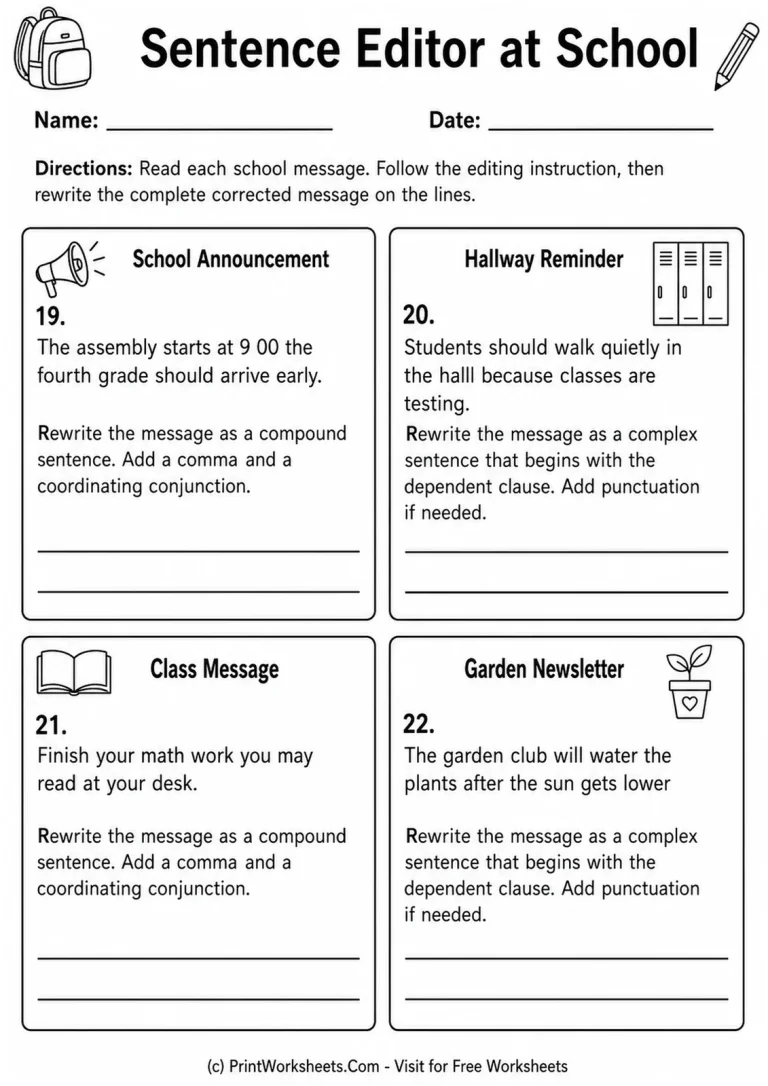
The second approved worksheet, Sentence Editor at School, shifts the focus from identifying structures to creating them. Students rewrite four school-themed messages as compound or complex sentences. The prompts ask them to make deliberate grammar choices rather than simply select an answer from a list.
One task may require a coordinating conjunction and comma to join complete ideas. Another asks students to move a dependent clause to the beginning of the sentence and punctuate it correctly. A hallway reminder and a school announcement provide familiar contexts, so the grammar work feels connected to language students might actually read or write during the school day.
Practice Conjunctions and Commas with a Purpose
These rewriting tasks help students see that conjunction choice affects sentence structure. When two independent clauses are joined, students need to think about both the connecting word and the comma. When a dependent clause is placed first, they must recognize where that introductory clause ends and where punctuation belongs.
Because the editing prompts are open ended, students can produce different correct sentences while still demonstrating the same target skill. That makes the page useful for discussion as well as independent practice: students can compare two valid rewrites and explain why both work.
Skills Practiced Across the Two Worksheets
Together, the pages create a clear progression. Students identify independent and dependent clauses, recognize coordinating and subordinating conjunctions, distinguish compound sentences from complex sentences, and apply comma rules while rewriting. The second activity then asks them to transfer those ideas into their own sentence construction rather than leaving the skill at the identification stage.
Teachers can use the first page as guided practice before moving to the editing page, or assign the two sheets on different days as a short grammar sequence. Parents can also use them for focused review when a child needs more practice telling sentence types apart or combining ideas accurately.
Build Stronger Sentence Choices for Grade 4 Writing
Understanding sentence structure can support more than a single grammar lesson. When students can identify complete and dependent ideas, they are better prepared to vary sentence patterns intentionally in their own writing. These Grade 4 worksheets keep that practice concrete: analyze how a sentence is built, notice the conjunction and punctuation, and then use the same knowledge to revise a message. The result is focused practice with compound and complex sentences that connects grammar analysis to actual sentence writing.