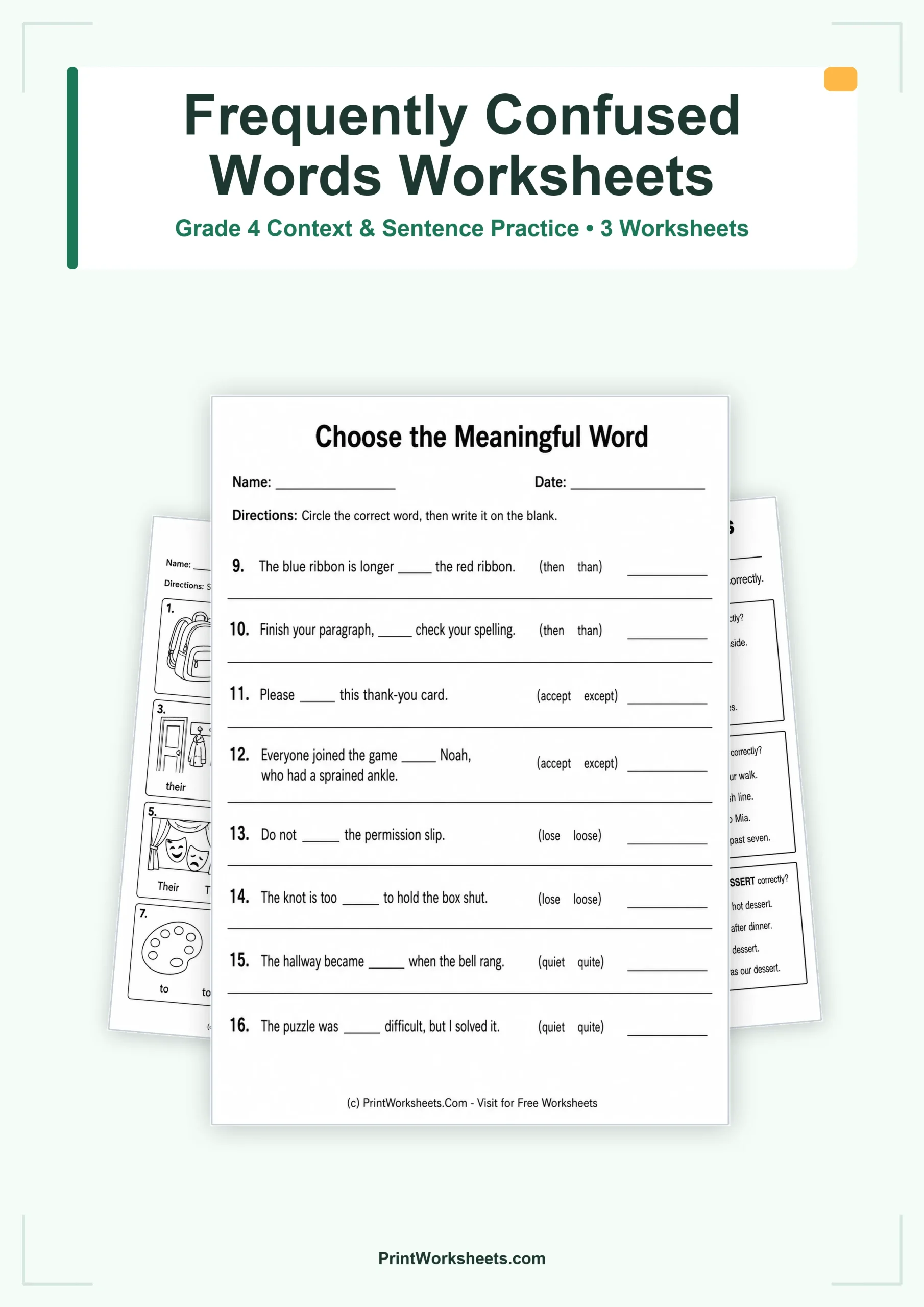
Small changes in word choice can completely change the meaning of a sentence. These frequently confused words worksheets for Grade 4 give students focused practice choosing words by meaning, grammar, and context instead of relying on how a word sounds. Across three printable activities, learners work with familiar problem pairs and groups such as your/you’re, their/there/they’re, to/too/two, its/it’s, then/than, accept/except, lose/loose, and quiet/quite. The activities move from supported context clues to independent sentence analysis, helping students explain why one word fits while another does not.
Frequently Confused Words Practice Through Context
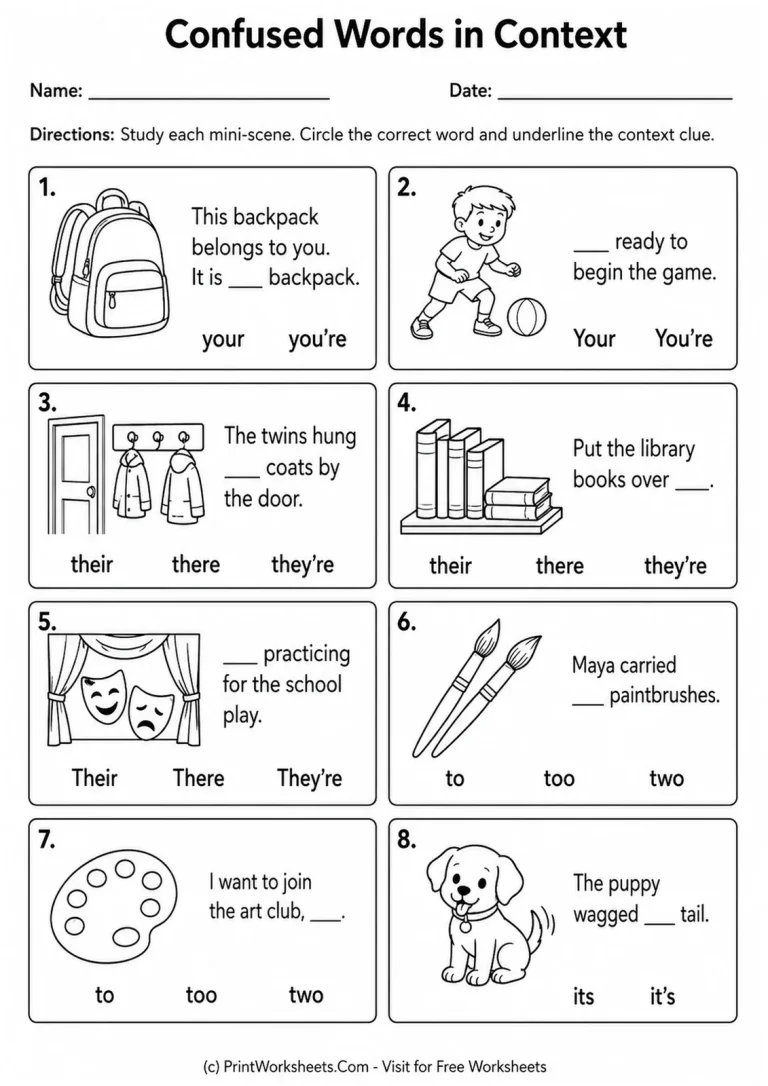
The first worksheet, Confused Words in Context, uses illustrated mini-scenes and short sentences to make meaning visible. Students choose the correct word and then underline a context clue that supports their choice. This extra step matters because it asks learners to connect vocabulary and grammar decisions to evidence in the sentence rather than simply guessing between similar-looking choices.
The page includes several high-frequency distinctions that Grade 4 students regularly meet in reading and writing. For example, students decide between possessive and contraction forms in your/you’re and its/it’s, choose among the location, possession, and contraction meanings in their/there/they’re, and separate the three different uses represented by to/too/two. Because the clues appear inside meaningful situations, students can practice recognizing what each sentence is actually saying.
Choosing the Word That Makes the Sentence Work
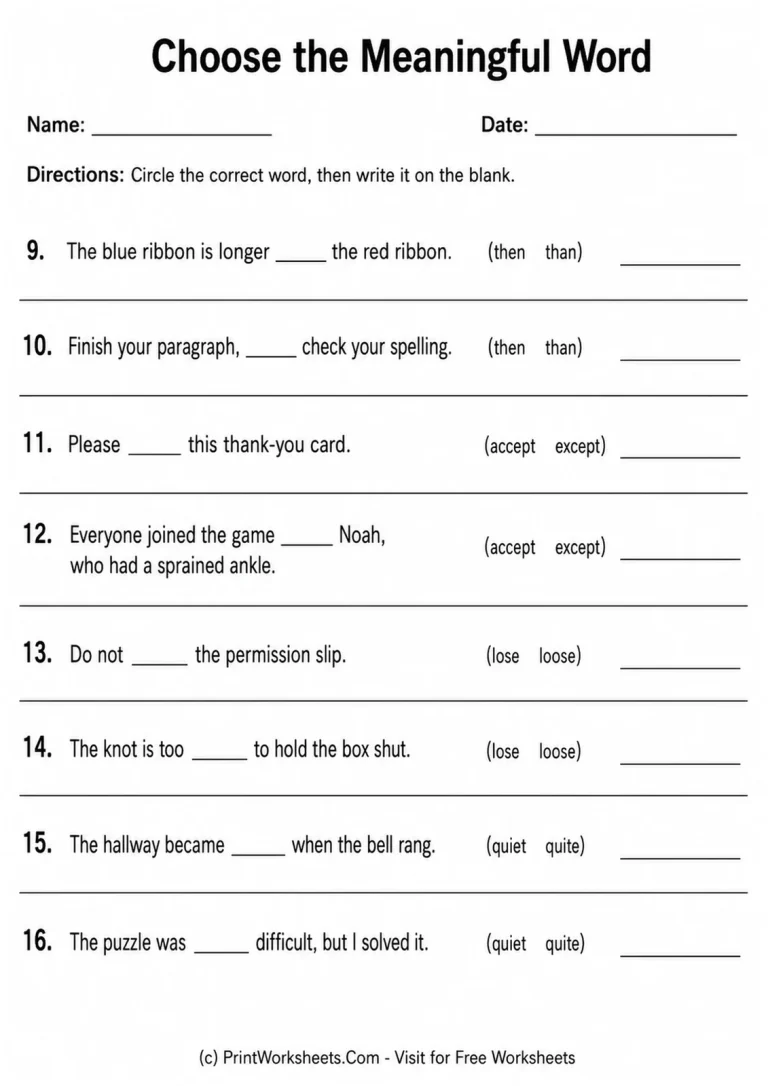
The second printable, Choose the Meaningful Word, shifts the focus from illustrated support to complete sentences. Each item presents a pair of easily confused words. Students circle the correct choice and then write that word on the blank, giving them both a decision task and a short written response.
This page practices then/than, accept/except, lose/loose, and quiet/quite. These pairs are useful for Grade 4 because the words may look or sound similar while serving different meanings or grammatical jobs. A student choosing between then and than, for instance, must notice whether the sentence describes sequence or comparison. Accept and except require attention to whether the sentence means receiving something or excluding something. Lose and loose depend on both spelling and meaning, while quiet and quite require careful reading of the full sentence.
Teachers can use this worksheet after direct instruction on a few word pairs, or assign it independently to check whether students can transfer the meanings into new sentences. Parents can also use one pair at a time for short review rather than completing the whole page in a single session.
From Word Choice to Correct Sentence Usage
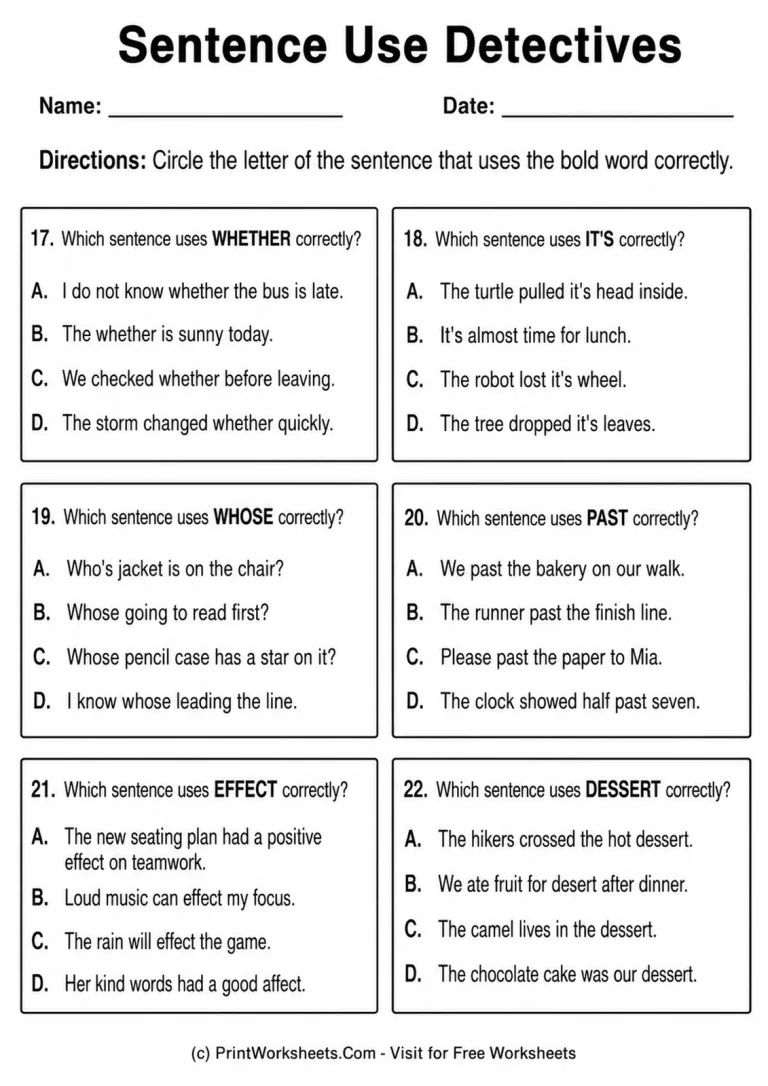
The third worksheet, Sentence Use Detectives, raises the level of reasoning. Instead of filling a blank, students examine multiple complete sentences and identify the one that uses the bold target word correctly. Targets include whether, it’s, whose, past, effect, and dessert.
This format helps students move beyond memorized definitions. They have to evaluate how a word functions inside an entire sentence and reject choices that may look plausible at first glance. The activity is especially useful for distinguishing words that students often confuse because of sound, spelling, or closely related meanings. It also encourages slower, more careful proofreading habits that can transfer to paragraph and story writing.
A Three-Step Skill Progression for Grade 4
Together, the three worksheets create a useful progression. Students begin with visual scenes and explicit context clues, continue with paired choices inside sentences, and finish by judging correct usage across complete sentence options. That progression allows the same broad skill to be practiced in different ways without simply repeating one exercise format.
The set can fit several classroom routines. A teacher might use the first page during a mini-lesson on context clues, the second as independent practice, and the third as a review or quick assessment. Individual pages can also be used for homework, literacy centers, morning work, tutoring, or extra grammar practice. Because each activity focuses on meaning in context, the worksheets support both accurate word choice and stronger sentence comprehension.
Build More Careful Word Choice
Frequently confused words can be difficult because the incorrect option may still look familiar. These Grade 4 worksheets give students repeated opportunities to slow down, inspect the sentence, and choose the word that matches the intended meaning. By working through context clues, paired-word decisions, and correct-usage questions, learners practice a proofreading habit that can help them write clearer sentences in everyday assignments.