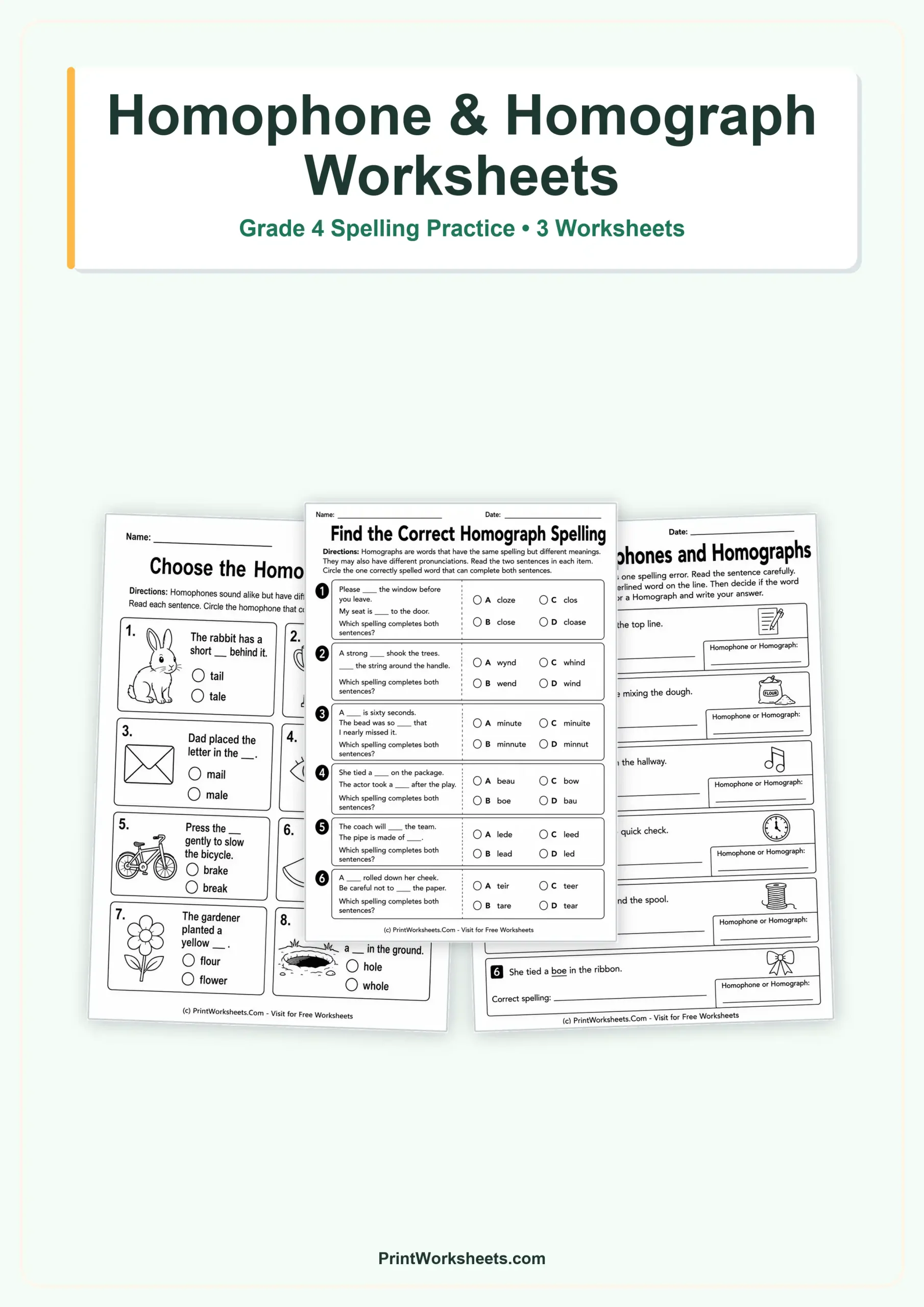
These homophone and homograph worksheets give Grade 4 students a practical way to connect spelling with meaning. Instead of treating similar-sounding or identically spelled words as isolated vocabulary, the activities ask students to use sentence context, compare meanings, notice pronunciation changes, and correct spelling choices. Across the three printable worksheets, students move from choosing the right homophone to identifying homographs and finally proofreading words before deciding which language pattern they represent.
Homophone and Homograph Worksheets for Grade 4
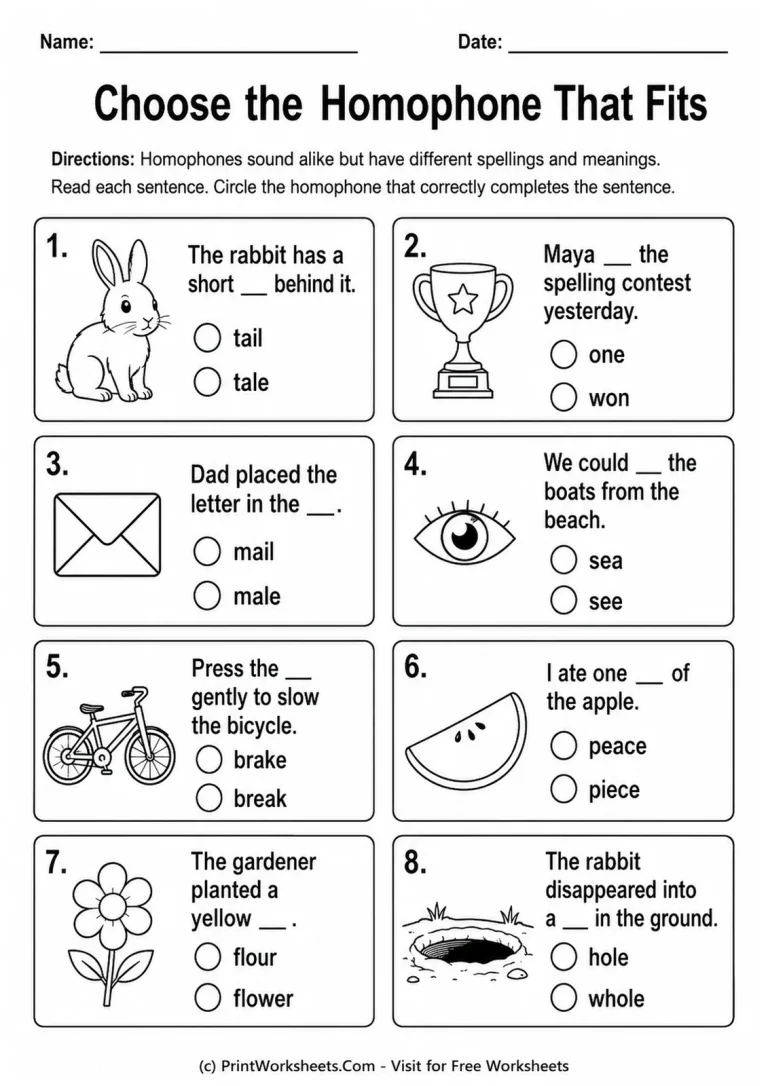
The first activity, Choose the Homophone That Fits, focuses on words that sound the same but have different spellings and meanings. Students read eight sentences and choose the word that makes sense in each context. The pairs include tail/tale, one/won, mail/male, sea/see, brake/break, peace/piece, flour/flower, and hole/whole. Because both options sound alike when spoken, students cannot rely on pronunciation alone. They need to understand what the sentence is saying and select the spelling that matches that meaning.
This format is useful for checking whether students can transfer familiar homophone pairs into real sentence reading. A learner may know that flower and flour are different words, but a sentence-based question shows whether that knowledge is available during actual reading and spelling work. The short-choice structure also makes the page suitable for independent practice, a literacy center, homework, or a quick review before a spelling assessment.
Use Context to Identify Homographs
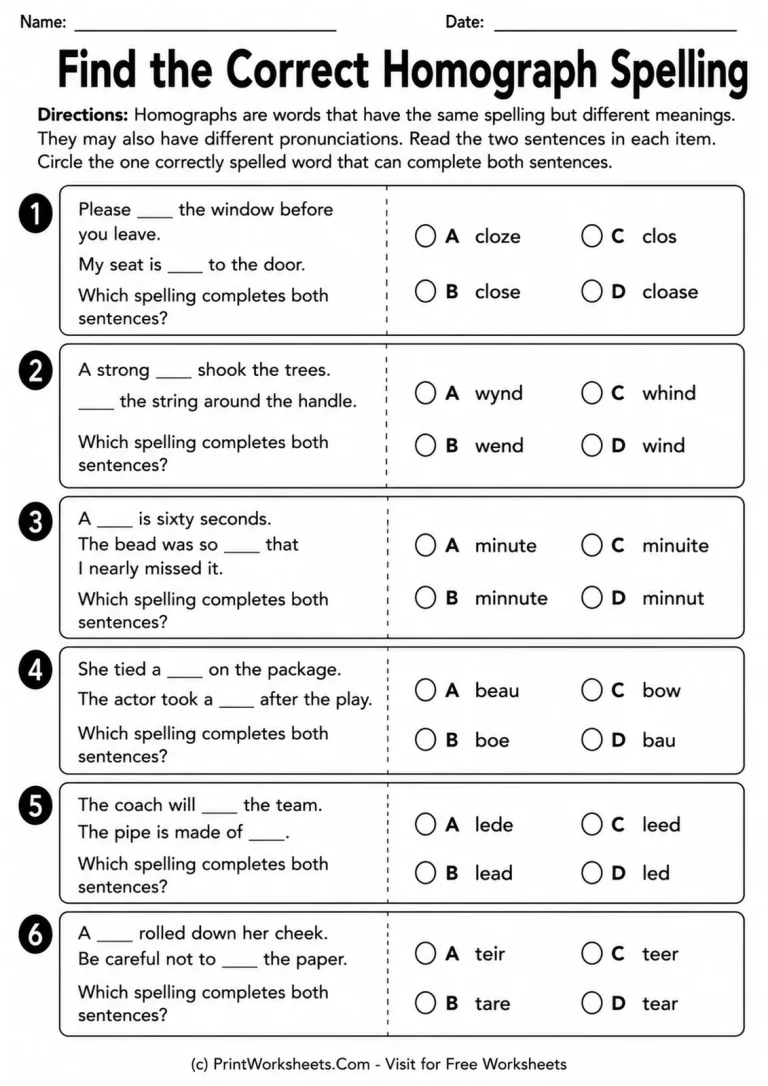
The second worksheet, Find the Correct Homograph Spelling, raises the challenge. Each item presents two different sentence meanings that must be completed with the same written word. Students choose from four spelling options and identify the homograph that works in both sentences. The target words include close, wind, minute, bow, lead, and tear.
These examples help students see that identical spelling does not always signal identical meaning or pronunciation. For example, wind can describe moving air or an action such as winding something. Minute can refer to a unit of time or describe something extremely small. Words such as bow, lead, tear, and close likewise require students to pay attention to the full sentence rather than simply recognizing the printed word.
For Grade 4 learners, this is valuable vocabulary and spelling practice because it encourages flexible word knowledge. Students must coordinate spelling, meaning, and pronunciation while comparing two contexts. Teachers can also use the questions to prompt brief oral explanations such as why the same spelling works in both sentences or how the pronunciation changes with the meaning.
Proofread, Correct, and Classify the Words
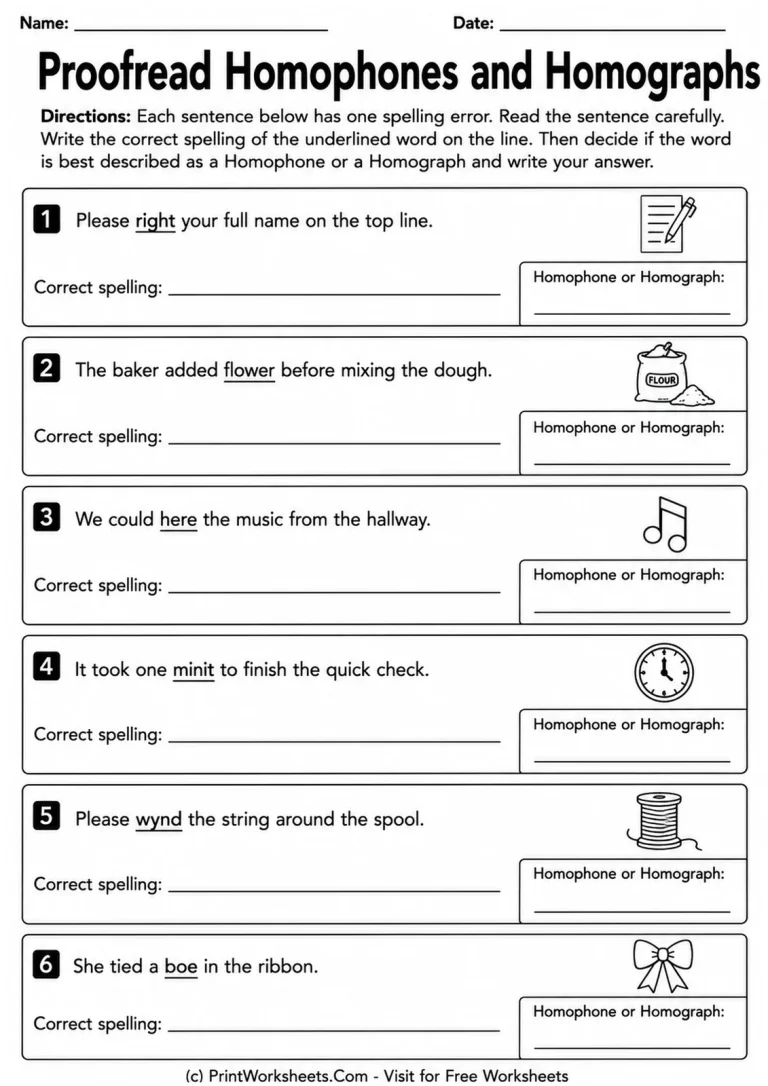
The final activity, Proofread Homophones and Homographs, shifts students from recognition to correction. Each sentence contains an underlined word that needs to be fixed. After writing the correct form, students classify the target as a Homophone or a Homograph. The items include examples connected with right, flower, here, minute, wind, and bow.
This two-step task gives teachers and parents more information than a simple multiple-choice answer. First, students must notice that the written form does not fit the intended word. Next, they must supply the correction. Finally, they identify the type of word relationship involved. That sequence can reveal whether a student understands the meaning distinction even when spelling is not yet automatic.
Ways to Use These Spelling Practice Pages
The worksheets can be used as a short three-part sequence. Begin with the homophone page to review meaning-based spelling choices, continue with the homograph activity to explore multiple meanings and pronunciations, and finish with the proofreading page as an application task. The progression works well for whole-class instruction followed by independent practice, but each worksheet can also stand alone for targeted review.
For additional discussion, ask students to explain the clue in the sentence that helped them make a choice. With pairs such as peace/piece or flour/flower, students can identify the meaning signal that separates the two spellings. With homographs such as lead or tear, they can compare how pronunciation and meaning change while spelling stays the same. These brief explanations strengthen the connection between vocabulary knowledge and accurate spelling.
By combining context clues, multiple-meaning words, proofreading, and classification, this Grade 4 set gives students several ways to demonstrate that they understand more than the appearance of a word on the page. It is designed for focused practice with commonly confusing word relationships while reinforcing careful reading and precise spelling.