Young learners can explore what animals need to stay alive through three activities that move from clear picture clues to simple reasoning. These animal needs worksheets focus on four essential ideas: food, water, air, and a safe place to live. Children first recognize basic needs among familiar objects, then connect each need with a matching picture, and finally decide what is missing in short situations about a puppy, turtle, kitten, and rabbit.
How These Animal Needs Worksheets Build Understanding
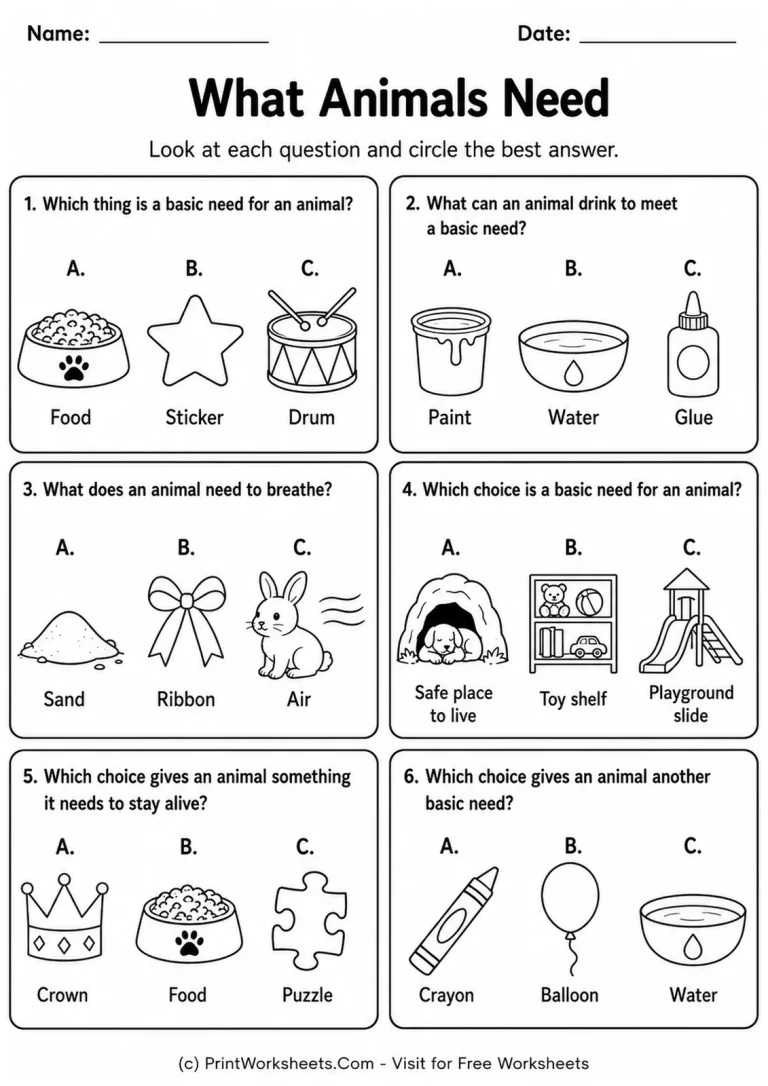
The first worksheet uses six picture-supported multiple-choice questions. Students are asked to circle the best answer while comparing an animal need with objects that are not necessary for survival. For example, food is shown alongside a sticker and a drum, while water is contrasted with paint and glue. Another question asks what an animal needs to breathe, with air presented as the correct choice. The page also introduces the idea of shelter by asking children to identify a safe place to live instead of a toy shelf or playground slide.
This format works well for kindergarten because children do not need to produce long written answers. They can use the pictures, short labels, and familiar objects to show whether they understand the difference between a basic need and something that may simply be fun or useful.
Match Food, Water, Air, and Shelter to Pictures
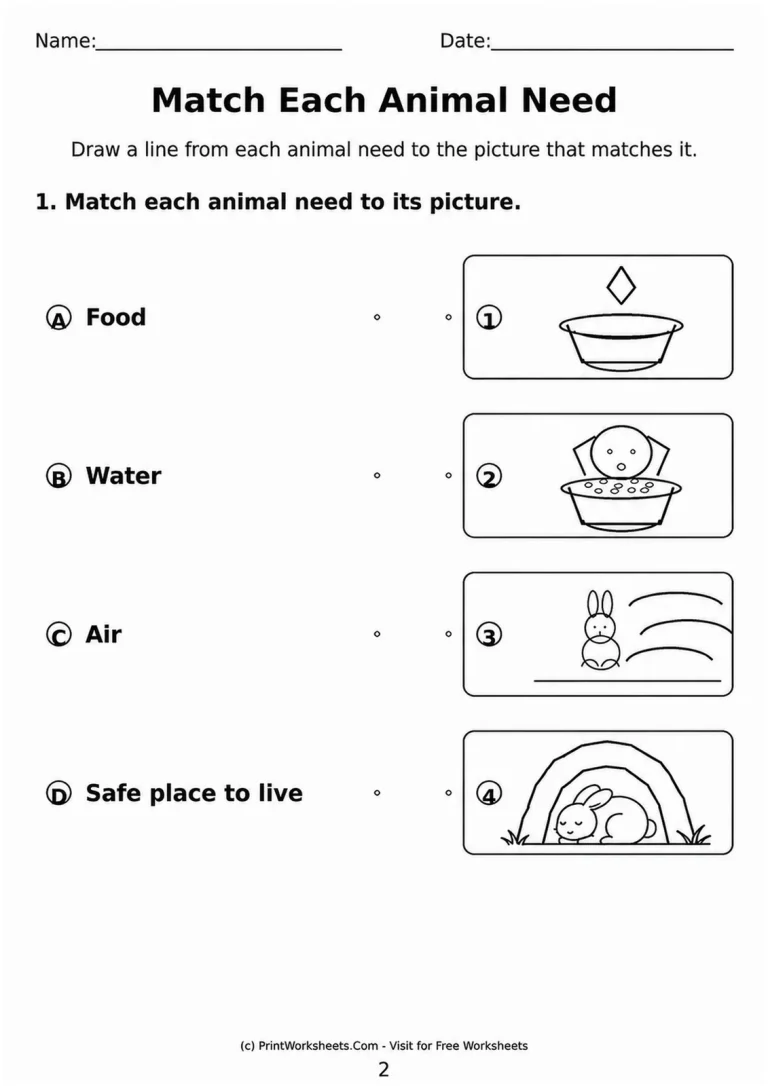
The matching worksheet gives students another way to practice the same four concepts. Food, Water, Air, and Safe place to live appear as labeled choices on one side of the page. On the other side, children see four numbered pictures: a bowl containing food, a bowl representing water, an animal beside flowing air lines, and a rabbit resting inside a protected shelter.
Students draw lines from each need to the picture that represents it. Because the task removes unrelated distractors and asks for direct word-to-picture connections, it is useful after an initial lesson or read-aloud about what animals require for survival. Teachers can also ask students to say each need aloud before drawing the line, adding a simple oral-language component to the activity.
Find the Missing Basic Need in Animal Situations
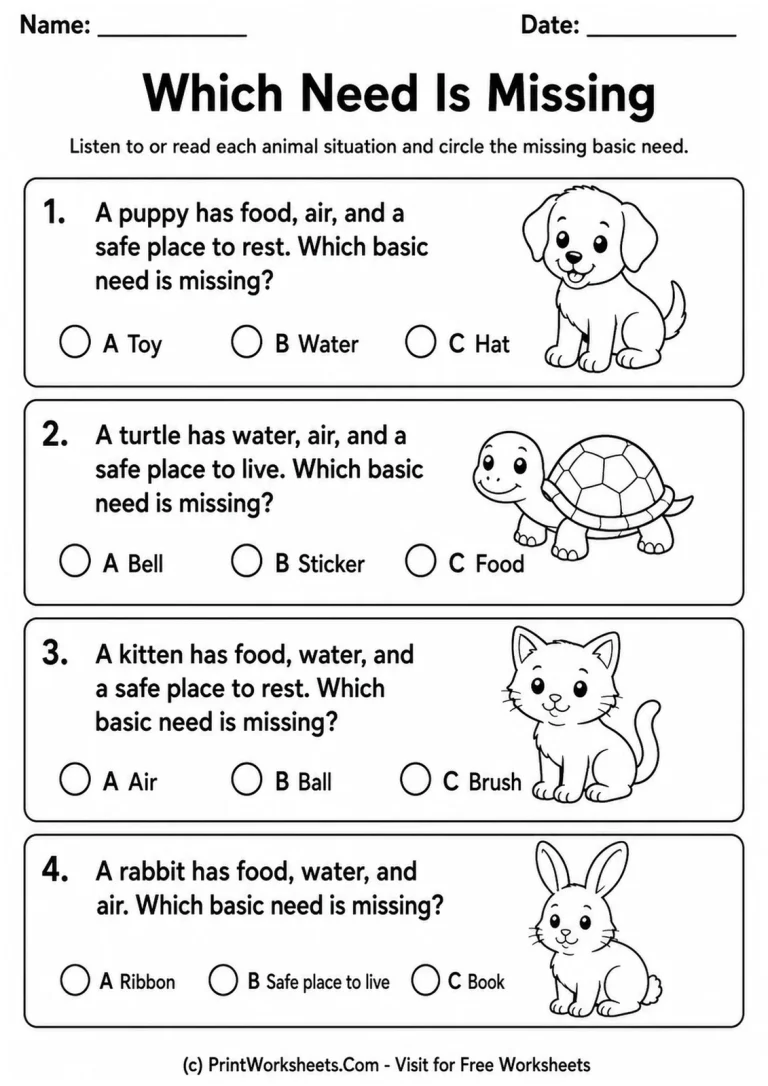
The third worksheet adds a small reasoning step. Each question describes an animal that already has three of the four basic needs, and students must identify the one that is missing. A puppy has food, air, and a safe place to rest, so the missing need is water. A turtle has water, air, and a safe place to live, so it still needs food. A kitten with food, water, and shelter is missing air, while a rabbit with food, water, and air still needs a safe place to live.
These situations help children move beyond simply naming pictures. They must listen to or read the information, remember the complete set of four needs, and compare what is present with what is absent. The incorrect choices, such as a toy, hat, bell, sticker, ball, brush, ribbon, and book, are familiar enough for young learners to evaluate without adding unnecessary difficulty.
Ways to Use the Worksheets in Kindergarten
The three pages can be used in sequence during a life science lesson. Begin with the picture-choice page as a whole-group discussion. Ask students why food or water helps an animal stay alive and why a drum, glue bottle, or playground slide does not meet the same kind of need. Follow with the matching activity for guided or independent practice. Finish with the missing-need situations as a quick check of whether students can apply all four ideas without relying only on identical picture cues.
For students who need extra support, keep a simple four-part reference visible with the words food, water, air, and safe place to live. Children can point to each word as they consider an answer. More confident learners can explain their choices in a complete sentence, such as, “The puppy needs water because it already has food, air, and a safe place.”
Simple Extension and Exit Ticket Ideas
After completing the pages, invite students to choose a familiar animal and name the food, water source, air, and safe place that help it live. They can draw the animal in its habitat and label one or more needs. For a quick exit ticket, say three needs aloud and ask students to identify the missing fourth need. This keeps the lesson focused on the same survival concept while checking recall without another full worksheet.
Together, the activities provide a clear progression from recognition to matching to short scenario-based reasoning. The repeated use of food, water, air, and shelter gives kindergarten students multiple chances to build a dependable understanding of the basic needs animals share.