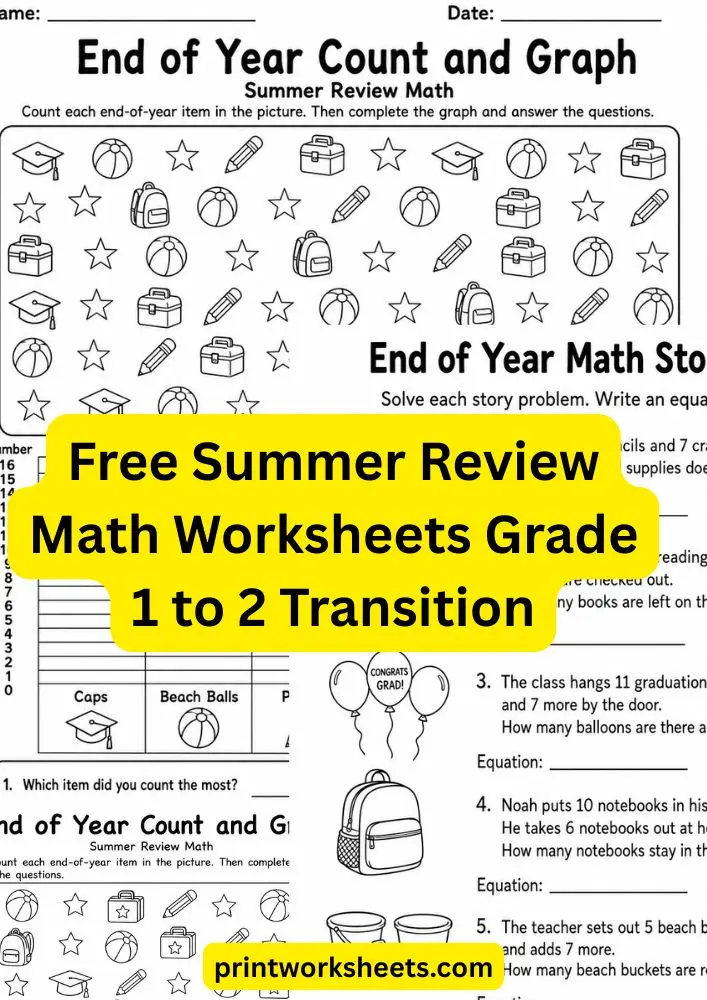
These completely free printable summer review math worksheets grade 1 to 2 transition provide essential academic practice to prevent learning loss during the long break. Often referred to as the “summer slide,” the regression of foundational mathematics skills between May and September is a major challenge for early elementary educators. This targeted PDF packet specifically assesses end-of-year first-grade standards, ensuring that students confidently retain their knowledge of data collection, bar graphing, and foundational addition and subtraction word problems before entering second grade.
Educators and parents can seamlessly integrate this review packet into end-of-year classroom activities or send it home as a dedicated summer homework bundle. If you are building a comprehensive review curriculum for the final weeks of school, you can pair this transition packet with our other summer worksheets, or revisit foundational concepts using our 1st grade math worksheets archive to ensure all academic gaps are closed before the final bell rings.
Inside the Grade 1 to 2 Math Review PDF Packet
This printable bundle deliberately avoids introducing brand-new, complex concepts. Instead, it features intuitive layouts and clear primary text designed to solidify the core math milestones that first graders have been practicing all year long. Each activity page targets a distinct academic review goal:
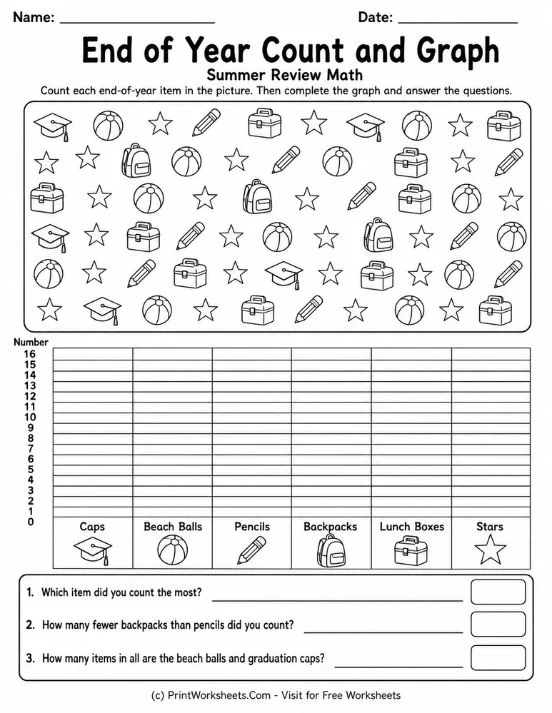
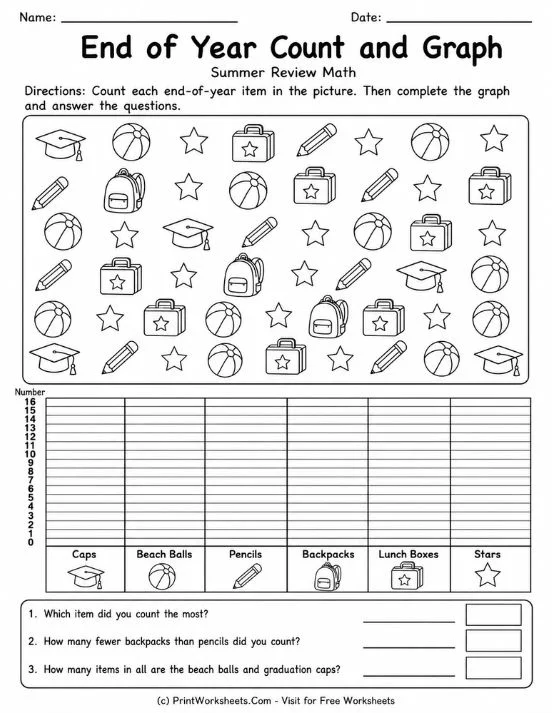
- End of Year Count and Graph: A comprehensive data analysis and visual tracking activity. Students scan a mixed array of summer and school-themed icons (graduation caps, beach balls, pencils, backpacks, lunch boxes, stars). They must accurately count each specific item and shade in the corresponding blocks on a vertical bar graph up to the number 16.
- Graph Data Analysis Questions: Located directly below the bar graph, this section forces students to interpret the data they just plotted. They must answer analytical questions such as identifying which item they counted the most, calculating the difference between two categories (“How many fewer backpacks than pencils?”), and finding the sum of two combined categories.
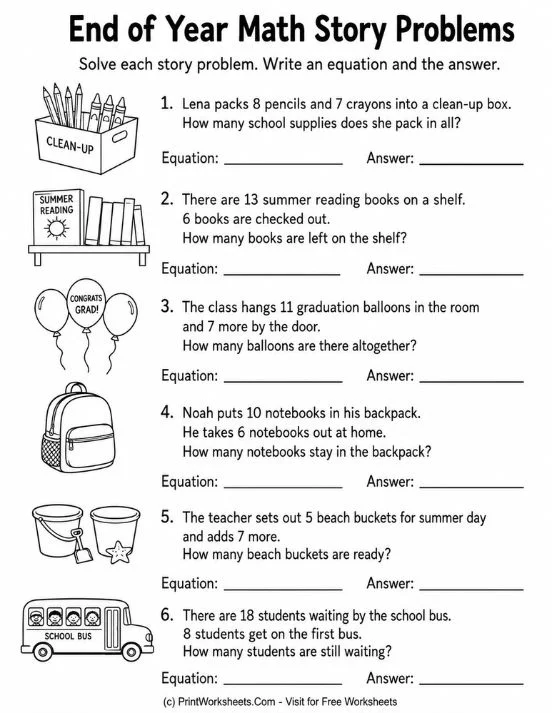
- End of Year Math Story Problems: A rigorous reading comprehension and arithmetic assessment. Students read six different summer-themed word problems (e.g., packing school supplies, checking out summer reading books, counting graduation balloons). They must extract the correct numbers, write the formal mathematical equation (using the correct + or – symbol), and write the final answer.
Practical End of Year Classroom Implementation
Download the high-resolution file and print the packet on standard 8.5″ x 11″ copy paper. Ensure your printer dialogue is set to “fit to printable area” so the lower equations and data questions remain perfectly intact. The “Count and Graph” worksheet operates brilliantly as an independent math center during the chaotic final weeks of May and June. We highly recommend having students use different colored crayons or highlighters for each item they count (e.g., color all the beach balls orange, all the pencils yellow) to prevent counting errors before they fill out the bar graph.
Use the “Math Story Problems” page as a formal end-of-year assessment. It perfectly demonstrates a student’s ability to read independently, deduce whether a scenario requires addition or subtraction, and correctly format a horizontal equation. Alternatively, staple these pages together with a cover sheet and hand them out to parents during final parent-teacher conferences as a highly effective “Summer Math Camp” packet to complete in July.
Frequently Asked Questions
Why is graphing important for the 1st to 2nd-grade transition?
Graphing sits at the crucial intersection of counting, sorting, and early analytical geometry. By asking a transitioning first grader to locate scattered items, count them accurately, and chart them on a grid, you are assessing their visual tracking and organizational skills. Furthermore, answering the “how many more” or “how many fewer” questions at the bottom of the graph is a direct prerequisite for algebraic thinking in second grade.
How can I help a student struggling with the math story problems?
If a student struggles to extract the correct math operation from a written paragraph, introduce them to the CUBES strategy. Have them Circle the numbers (e.g., 8 and 7), Underline the question, Box the math action words (e.g., “in all,” “left,” “altogether”), Evaluate what steps to take, and then Solve. Highlighting words like “left on the shelf” visually cues the student that they need to use a subtraction symbol.
Can this packet be used as a beginning-of-the-year assessment for 2nd grade?
Absolutely. While it functions perfectly as an end-of-year review for first graders, second-grade teachers frequently use these exact types of worksheets during the first week of September. Having incoming students complete the graphing and word problems allows a second-grade teacher to immediately identify which students suffered from the summer slide and who needs immediate arithmetic intervention.
Do I need to print these worksheets in color?
No. The entire packet has been specifically engineered using high-contrast, black-and-white line art. This ensures crisp, clean copies on standard school printers without draining expensive color ink. It also provides an extra layer of engagement, as students can color in the beach balls, backpacks, and graduation balloons themselves once they finish their math equations.