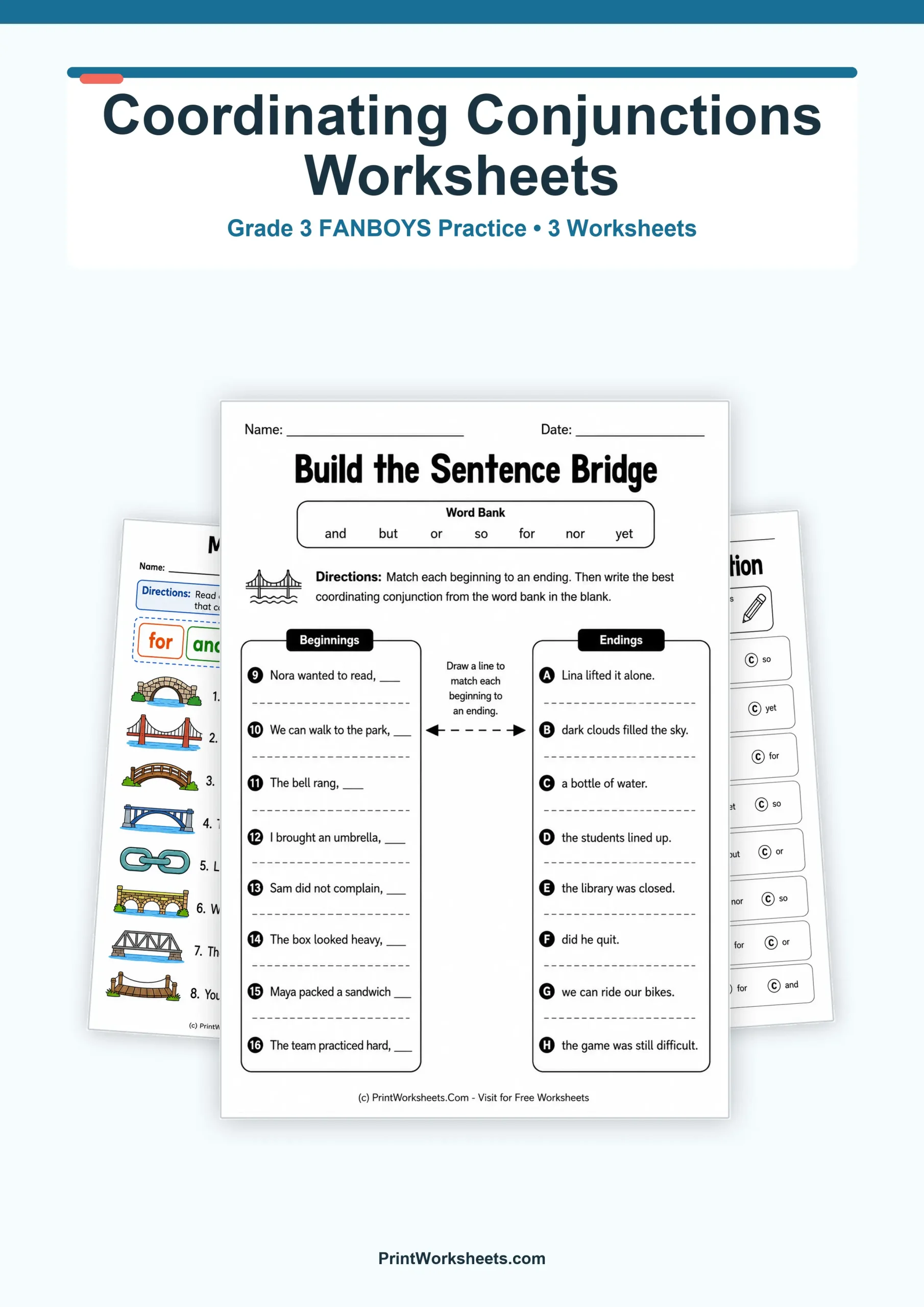
These coordinating conjunctions worksheets give third-grade students focused practice with the seven FANBOYS words: for, and, nor, but, or, yet, and so. Across three printable pages, children work with conjunctions in several ways instead of repeating one exercise format. They first locate conjunctions inside complete sentences, then build connections between sentence parts, and finally choose a conjunction by thinking about the relationship between two ideas. This variety makes the set useful for introducing the skill, checking understanding, or giving extra grammar practice.
Coordinating Conjunctions Worksheets for Grade 3
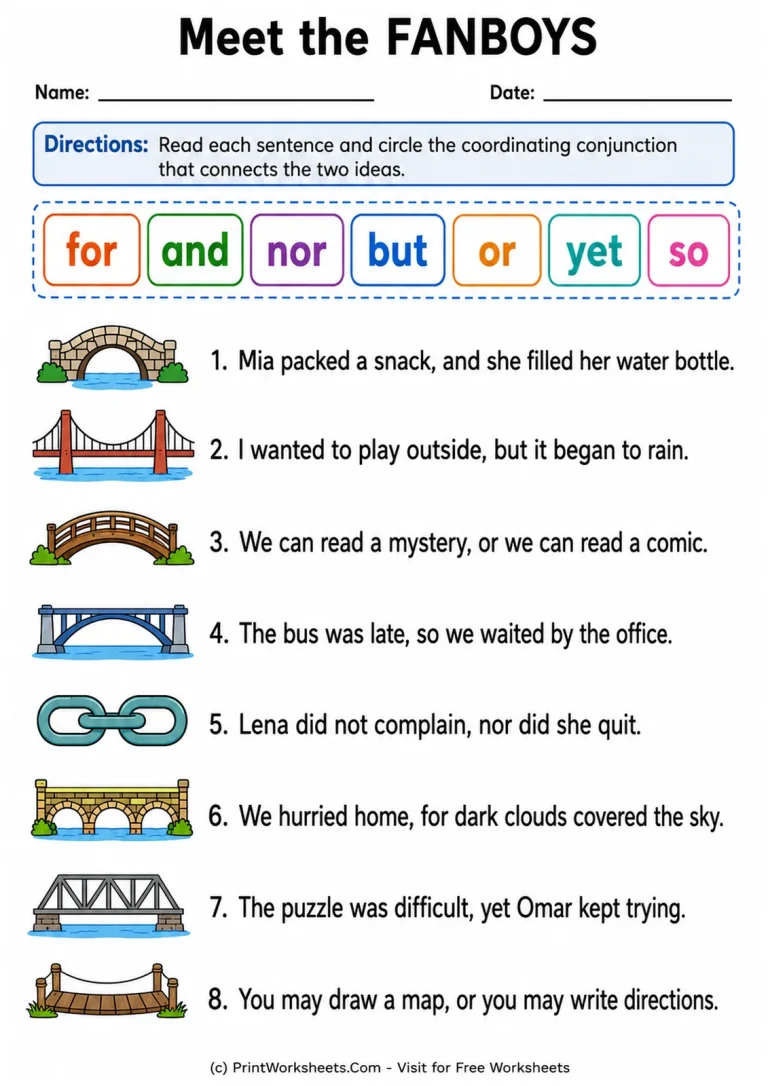
The first worksheet, Meet the FANBOYS, begins with a clear reference to all seven coordinating conjunctions. Students read eight complete sentences and circle the conjunction that connects the ideas. Because the target word appears inside a meaningful sentence, students can see how conjunctions function rather than simply memorizing a list. The examples include different relationships such as addition, contrast, choice, result, reason, and negative pairing.
This page can work well at the beginning of a lesson because students have the FANBOYS words visible while they search each sentence. It can also be used as a quick independent review after the teacher has modeled how words such as and, but, or, and so connect ideas in different ways.
Build Sentences with FANBOYS Conjunctions
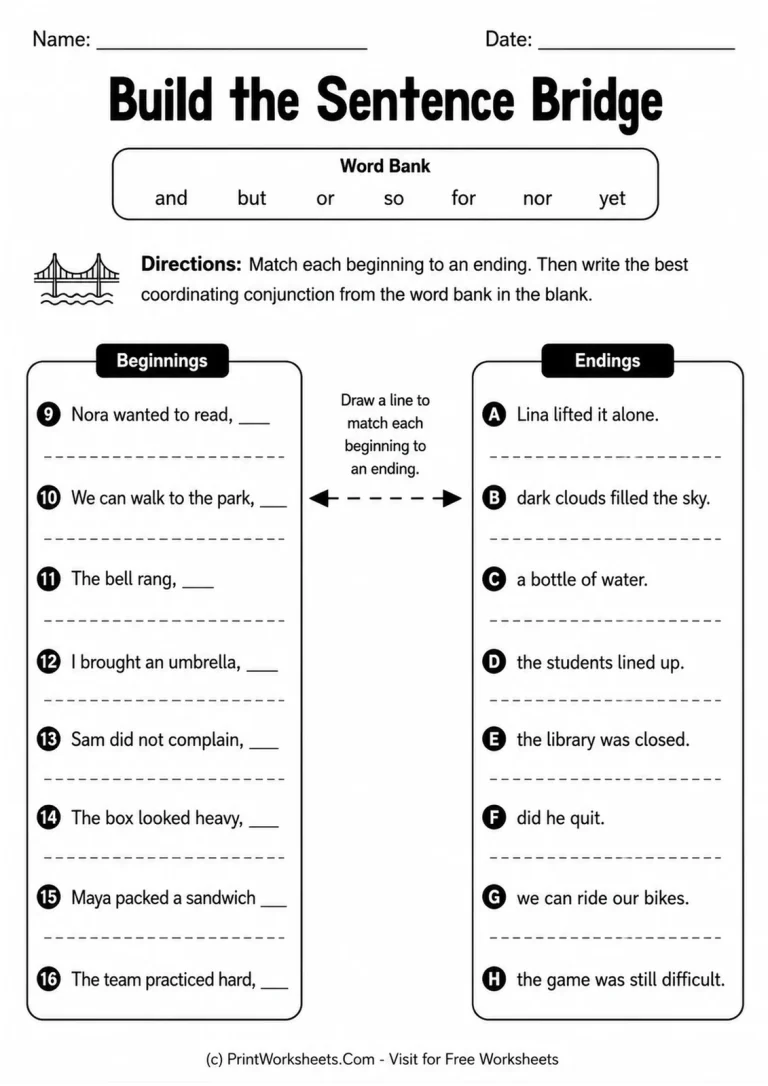
The second worksheet, Build the Sentence Bridge, moves from identifying a conjunction to selecting and writing one. Students work with items 9 through 16 by matching sentence beginnings with appropriate endings. After finding the matching parts, they choose a coordinating conjunction from a word bank containing and, but, or, so, for, nor, and yet.
This activity asks students to pay attention to meaning as well as sentence structure. A sentence that adds a related idea may need and, while a sentence that shows contrast may call for but or yet. A choice can signal or, and a result can point students toward so. By combining matching with conjunction selection, the worksheet gives students more active practice than a simple fill-in-the-blank exercise.
Choose the Best Coordinating Conjunction
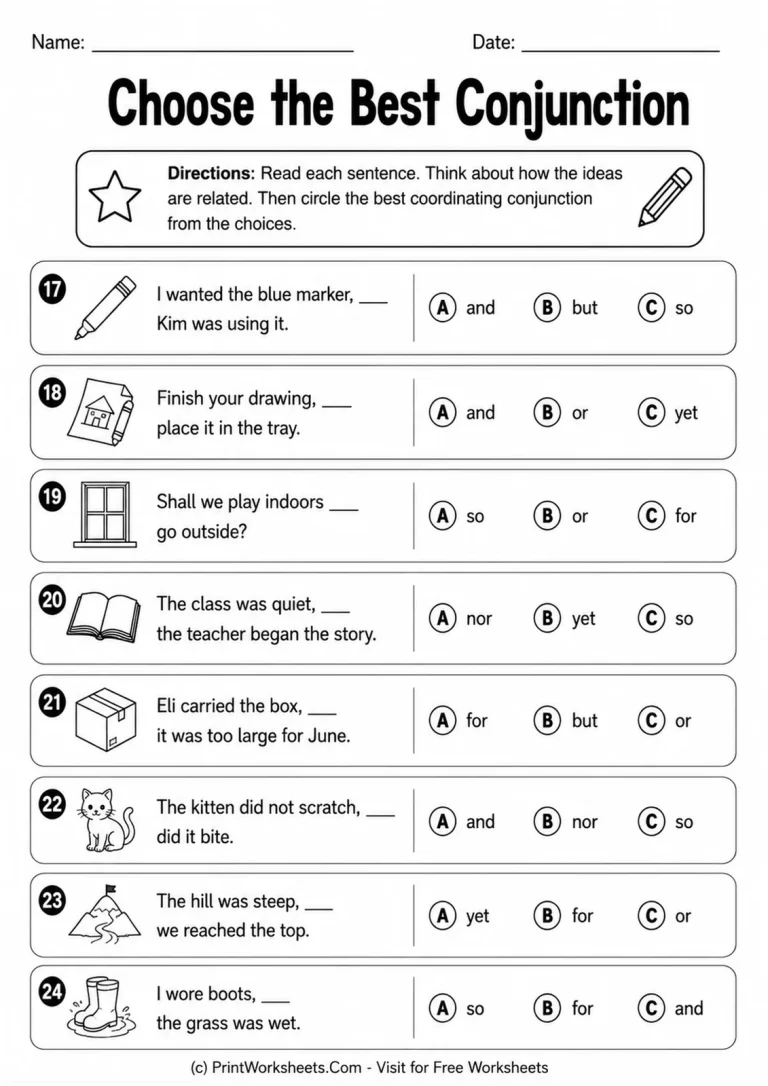
The third printable page, Choose the Best Conjunction, contains eight multiple-choice questions numbered 17 through 24. Each item presents a sentence with three conjunction choices. Students must consider how the two ideas relate before selecting the best word.
The questions cover several common relationships that Grade 3 students encounter when combining ideas, including contrast, addition, choice, result, reason, and negative pairing. This makes the page especially useful after students are familiar with the FANBOYS list and are ready to make decisions based on context. Instead of recognizing a conjunction that is already present, they must determine which one makes the sentence communicate the intended meaning.
Ways to Use These Grammar Worksheets
The three pages can be used together as a short coordinating conjunctions mini-unit or separately depending on student needs. A teacher might use the identification page for guided practice, the sentence-bridge activity for partner or independent work, and the multiple-choice page as a review. Parents can also use the pages for at-home grammar reinforcement because each activity keeps the directions focused and the sentence tasks manageable for third-grade readers.
The set is also suitable for literacy centers, morning work, homework, small-group instruction, or extra practice for students who need repeated exposure to conjunctions in context. Since the response format changes from page to page, students practice the same grammar concept without completing the same type of task repeatedly.
What Students Practice
Students practice recognizing all seven FANBOYS conjunctions, connecting related sentence parts, choosing conjunctions from a word bank, and using meaning clues to decide which conjunction best links two ideas. These skills support stronger sentence construction and help students understand how writers show relationships such as addition, contrast, choice, cause, and result.
Use these printable Grade 3 grammar pages when students are ready to move beyond naming conjunctions and begin thinking about why a particular conjunction fits a sentence. The progression from recognition to completion to contextual choice gives children several opportunities to work with coordinating conjunctions in clear, purposeful sentences.