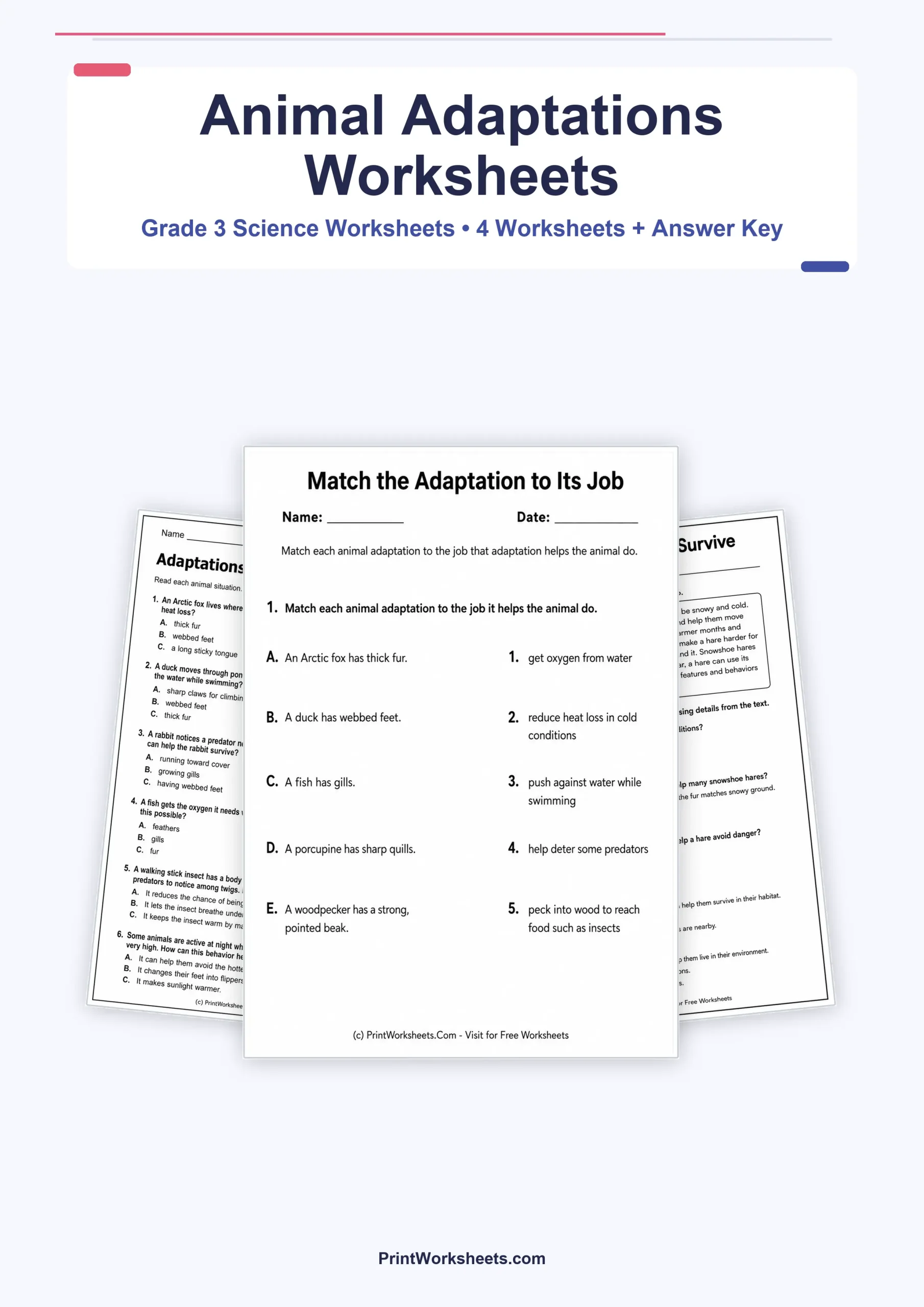
Why does an Arctic fox stay warm in freezing weather while a duck moves efficiently through water? These animal adaptations worksheets give Grade 3 students concrete examples they can use to connect an animal’s body features and behaviors with survival. Across four printable activities, students explain what an adaptation does, match structures to functions, read about snowshoe hares, and sort examples into physical features or behaviors. The set works well after an introductory lesson because each page asks students to apply the idea in a different way rather than simply repeat a definition.
Build Survival Reasoning with Animal Adaptations Worksheets
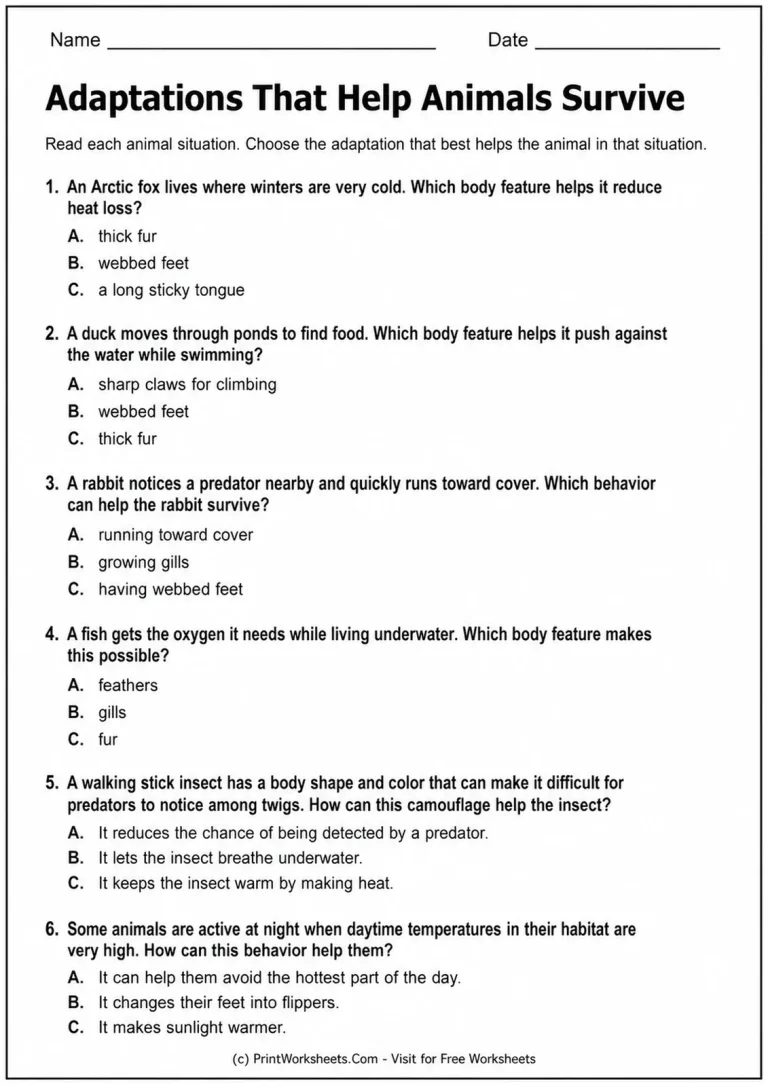
The first worksheet uses six short survival situations. Students decide which adaptation best fits each need, such as thick fur reducing heat loss for an Arctic fox, webbed feet helping a duck push against water, and gills allowing a fish to obtain oxygen underwater. Other questions introduce camouflage, escaping toward cover, and being active at night to avoid extreme daytime heat. These examples help students focus on function: not just naming a feature, but identifying how that feature or behavior improves an animal’s chances of surviving.
Match Body Features to Their Jobs
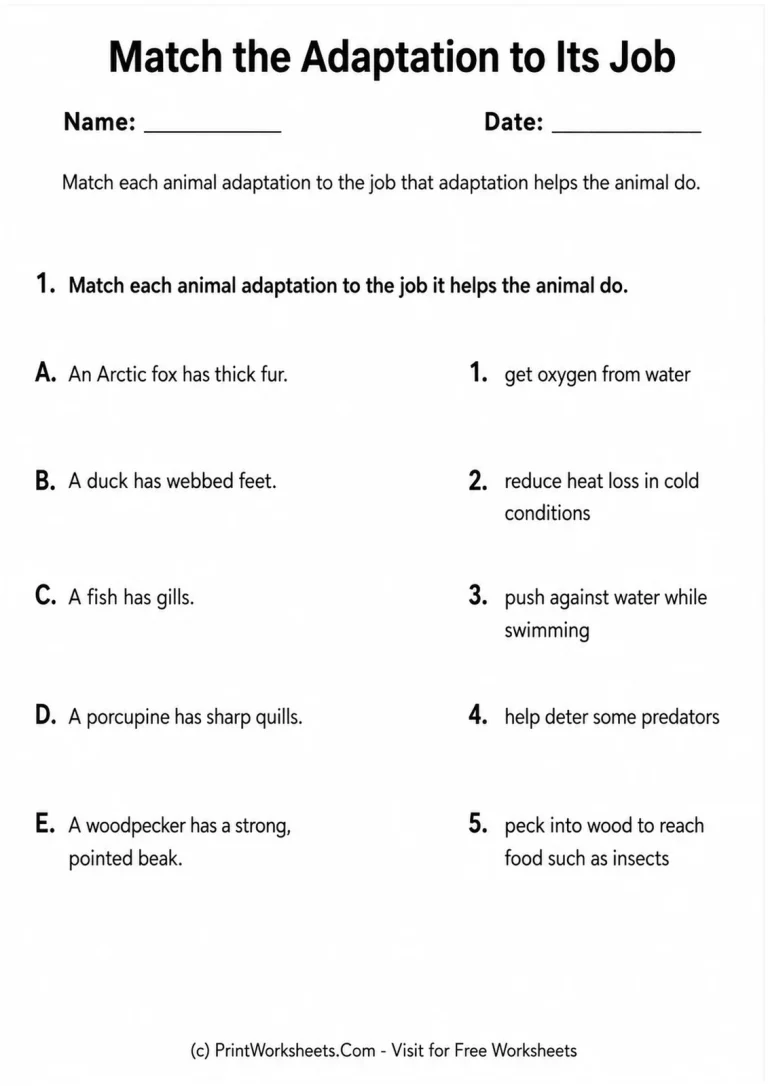
The matching page gives students five clear structure-and-function pairs. They connect Arctic fox fur with reduced heat loss, duck webbed feet with swimming, fish gills with oxygen from water, porcupine quills with deterring predators, and a woodpecker’s pointed beak with reaching food in wood. Because every option has a distinct purpose, the activity can be used for independent practice, a quick science-center task, or a short check for understanding. Teachers can also ask students to explain one match aloud using a sentence frame such as: ‘This adaptation helps the animal because…’
Read About Snowshoe Hare Adaptations
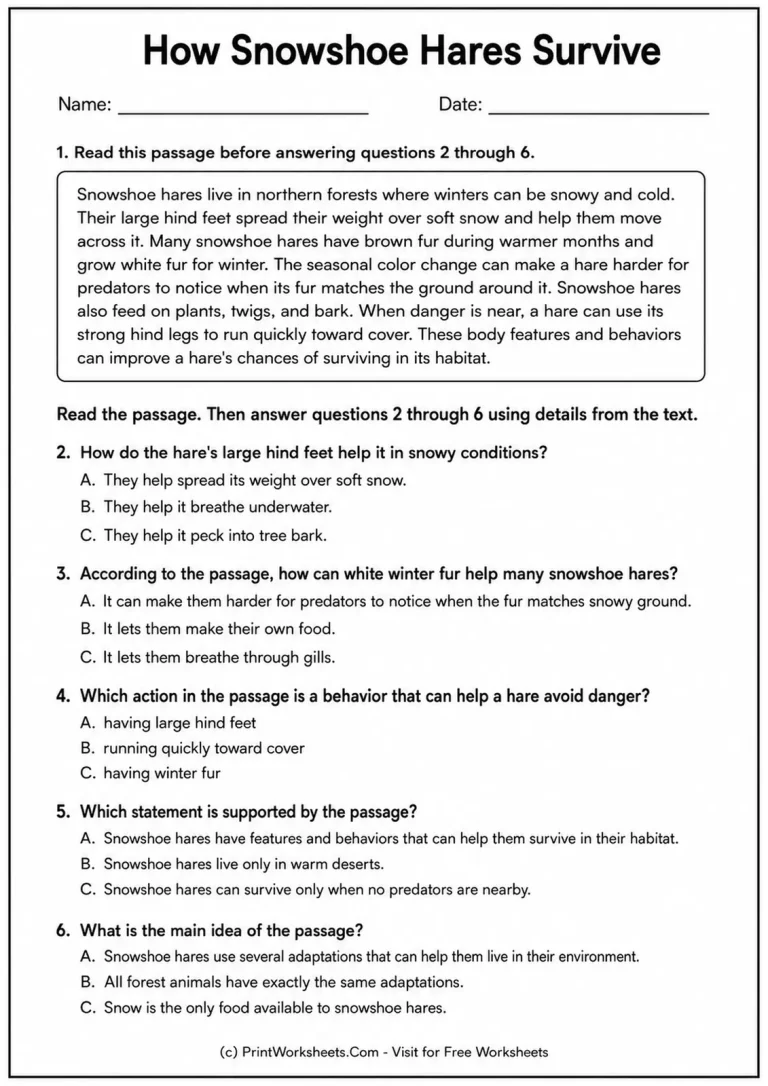
The reading page adds a literacy connection without moving away from the science goal. Students read a short informational passage about snowshoe hares living in snowy northern forests. The passage explains how large hind feet spread weight over soft snow, how seasonal fur color can provide camouflage, what the hares eat, and how strong hind legs help them run quickly toward cover. Five multiple-choice questions ask students to use details from the text, identify a helpful behavior, choose a supported statement, and determine the main idea. This makes the page especially useful when science and reading comprehension are taught together.
Distinguish Body Features from Behaviors
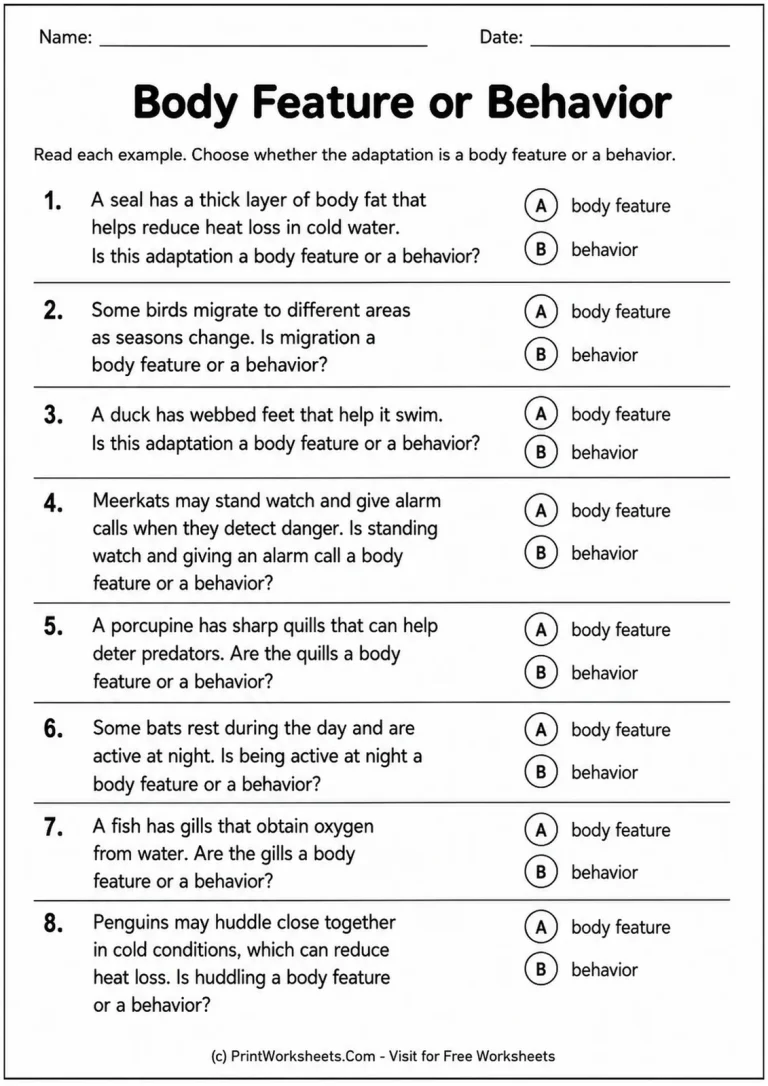
The fourth worksheet asks students to classify eight adaptations as either a body feature or a behavior. Physical examples include a seal’s insulating body fat, a duck’s webbed feet, porcupine quills, and fish gills. Behavioral examples include bird migration, meerkat alarm calls, nighttime activity in bats, and penguins huddling in cold conditions. This contrast helps students move beyond memorizing examples and recognize an important science distinction: some adaptations are structures an animal has, while others are actions an animal performs.
Classroom Uses and Differentiation
For a short lesson sequence, begin with the scenario page, move to the matching activity, then use the snowshoe hare passage for evidence-based reading before finishing with the feature-or-behavior classification. Students who need extra support can work with a partner and underline the survival need in each prompt before choosing an answer. Another helpful strategy is to make two classroom columns labeled ‘body feature’ and ‘behavior’ and have students place examples from the worksheets under the correct heading.
Students who are ready for an extension can choose one animal from the set and write two additional sentences: one naming its adaptation and one explaining the survival advantage. They might compare the Arctic fox’s thick fur with the seal’s body fat, or compare a hare running toward cover with a bird migrating. These comparisons reinforce the idea that different animals can solve similar survival challenges in different ways.
Quick Assessment and Teacher Support
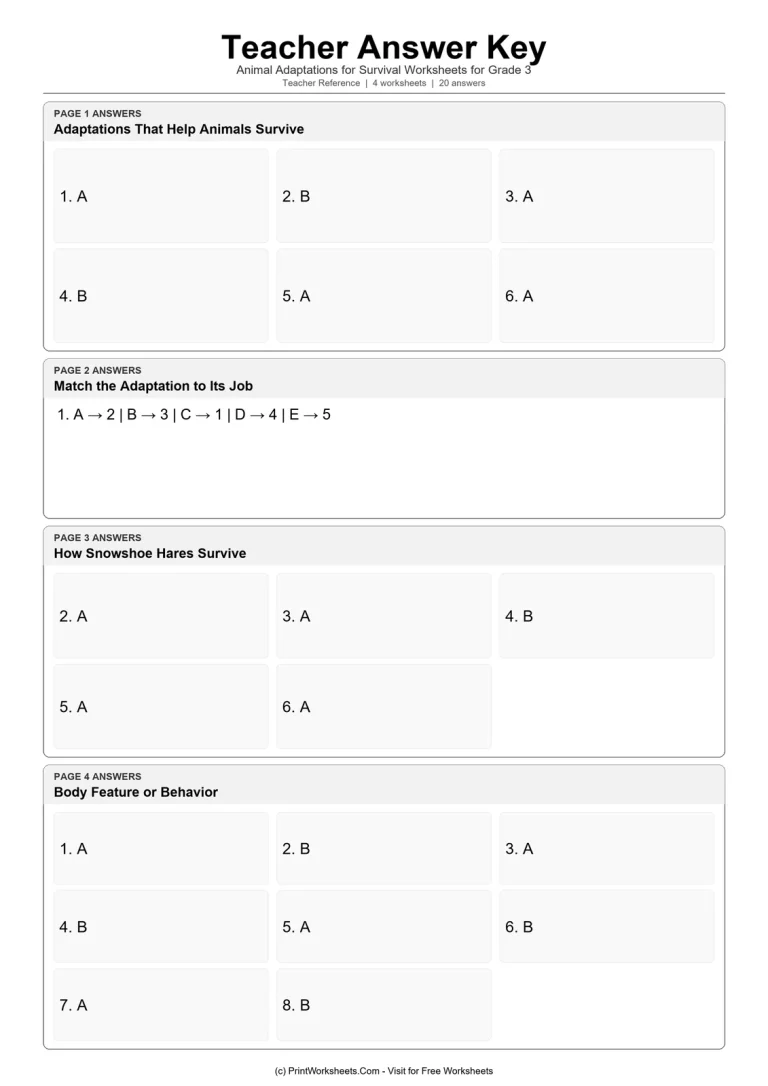
The four pages can be assigned together or used separately for review, homework, science stations, or small-group instruction. A teacher answer key covers all objective items, making it easy to check the six scenario questions, five matching pairs, five snowshoe hare comprehension questions, and eight classification items. For an exit ticket, ask students to name one body feature and one behavior from the worksheets and explain how each helps an animal survive. That final explanation reveals whether students understand the relationship between an adaptation and its job, not just the vocabulary.
These Grade 3 activities provide a focused path from recognizing familiar adaptations to explaining their functions and identifying evidence in a short science text. By the end of the set, students have practiced cold-weather survival, movement, camouflage, breathing, predator avoidance, and behavioral responses through several distinct task formats.