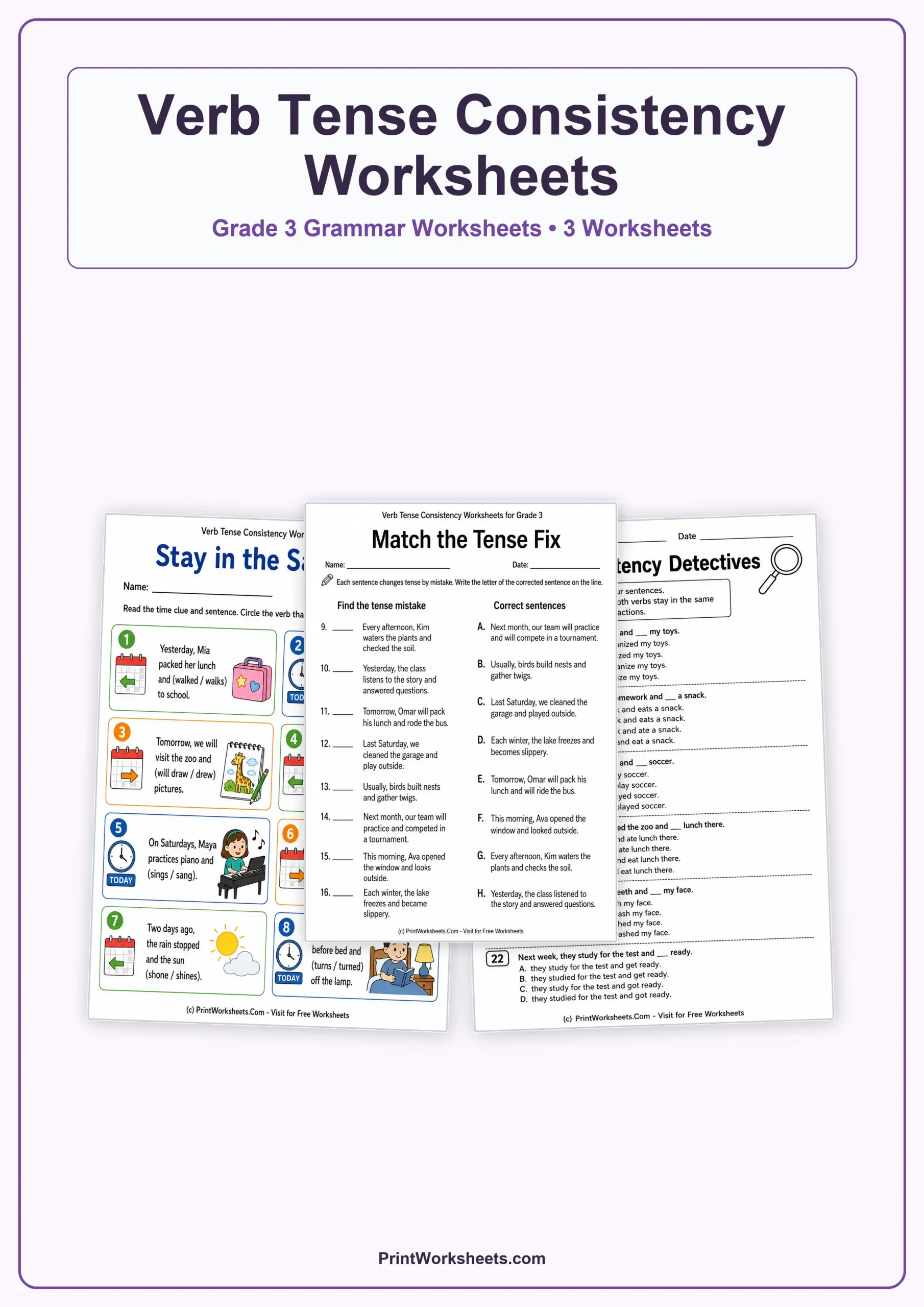
These verb tense consistency worksheets give Grade 3 students focused practice keeping actions in the correct time frame. Instead of treating verb forms as isolated vocabulary, the activities ask children to notice clues such as yesterday, every morning, tomorrow, last night, and next week and then choose verbs that keep the sentence consistent. Across three printable student pages, learners work with simple present, simple past, and future forms through verb choice, matching, and multiple-choice tasks.
Practice Verb Tense Consistency with Clear Time Clues
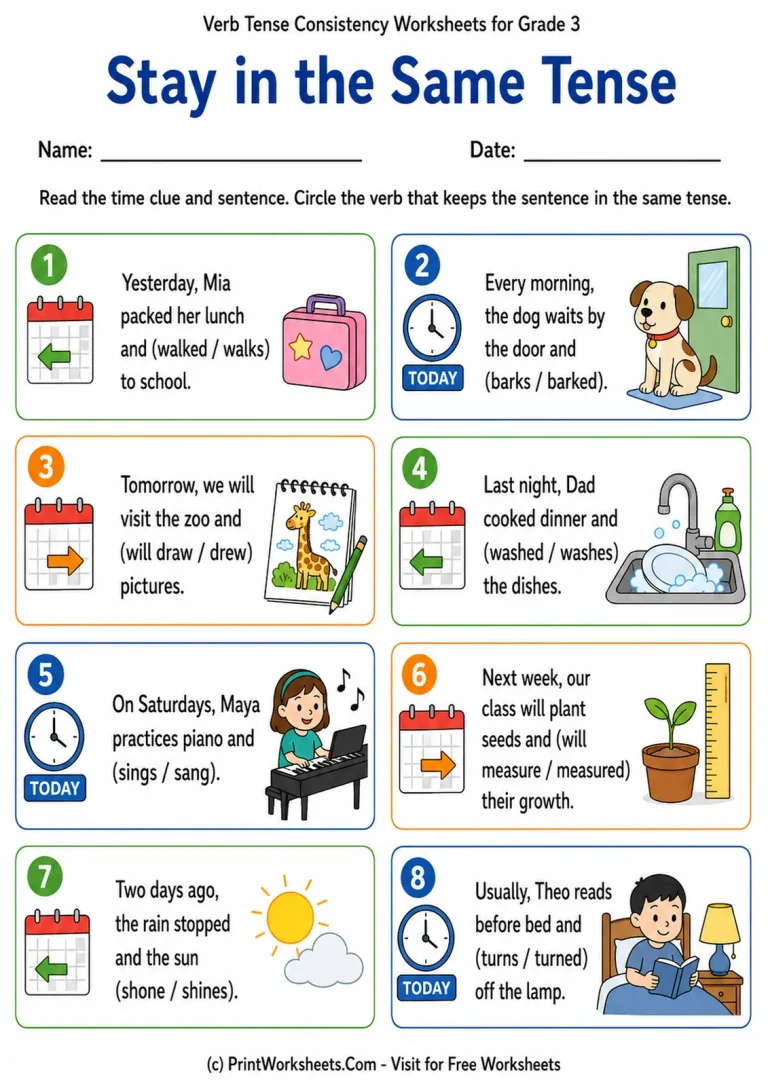
The first worksheet, Stay in the Same Tense, begins with eight short sentences built around familiar time expressions. Students choose between two verb forms and circle the one that agrees with the sentence’s time clue. A sentence referring to something that happened yesterday requires a past-tense form, while a sentence describing what happens every morning calls for a present-tense verb. Future expressions such as tomorrow and next week guide students toward the future form.
This format helps students connect grammatical form with meaning. Comparisons such as walked versus walks, barks versus barked, and will draw versus drew require students to use context rather than simply recognize a verb. Because each item includes an obvious time signal, children can concentrate on the central skill of maintaining the correct tense.
Find and Match Tense Fixes
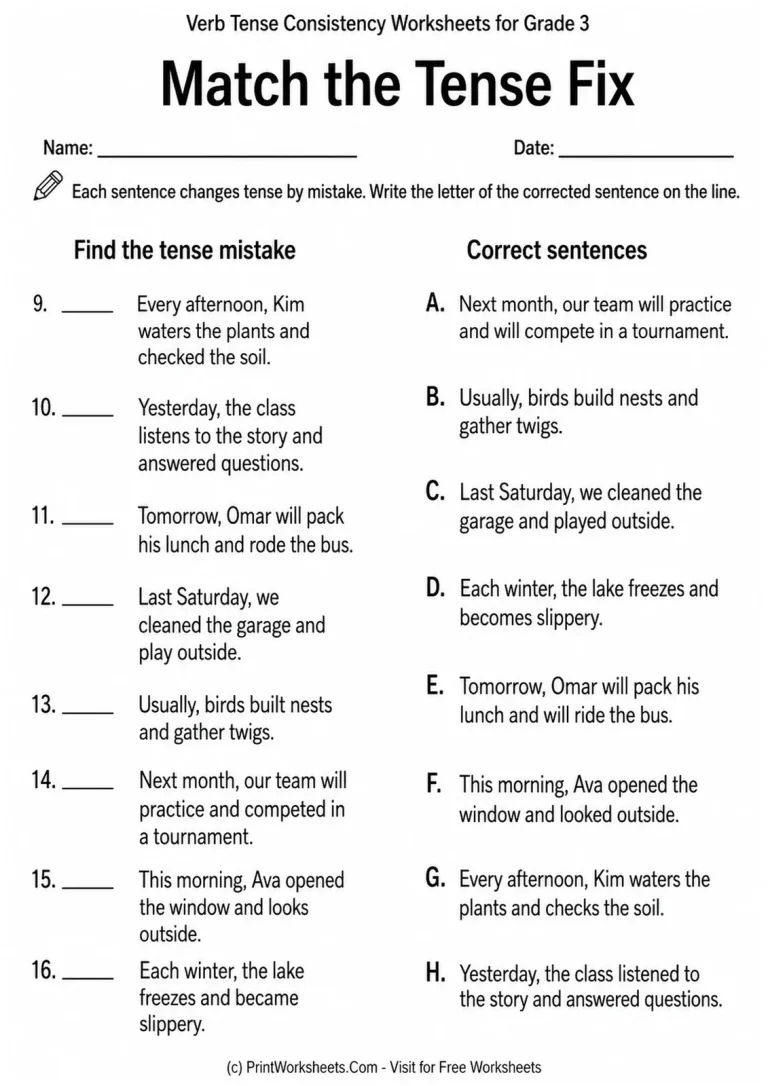
The second worksheet, Match the Tense Fix, changes the task from choosing one verb to recognizing a complete tense correction. Items 9-16 present sentences with an inconsistent shift in time. Students match each sentence to one of the corrected choices labeled A-H.
The examples move through everyday routines, events that already happened, and plans that will happen later. This gives students repeated exposure to the three simple time frames without relying on one repeated question style. Learners must first decide when the action is taking place, notice which verb breaks that time frame, and then identify the corrected sentence that keeps the action consistent.
Matching also provides a useful bridge between basic recognition and more demanding sentence analysis. Students are not asked to write a correction from scratch, but they still have to compare complete sentence options carefully. This makes the page suitable for guided practice after an introductory lesson or for independent work once students understand present, past, and future time clues.
Choose Sentences That Keep Connected Actions in the Same Tense
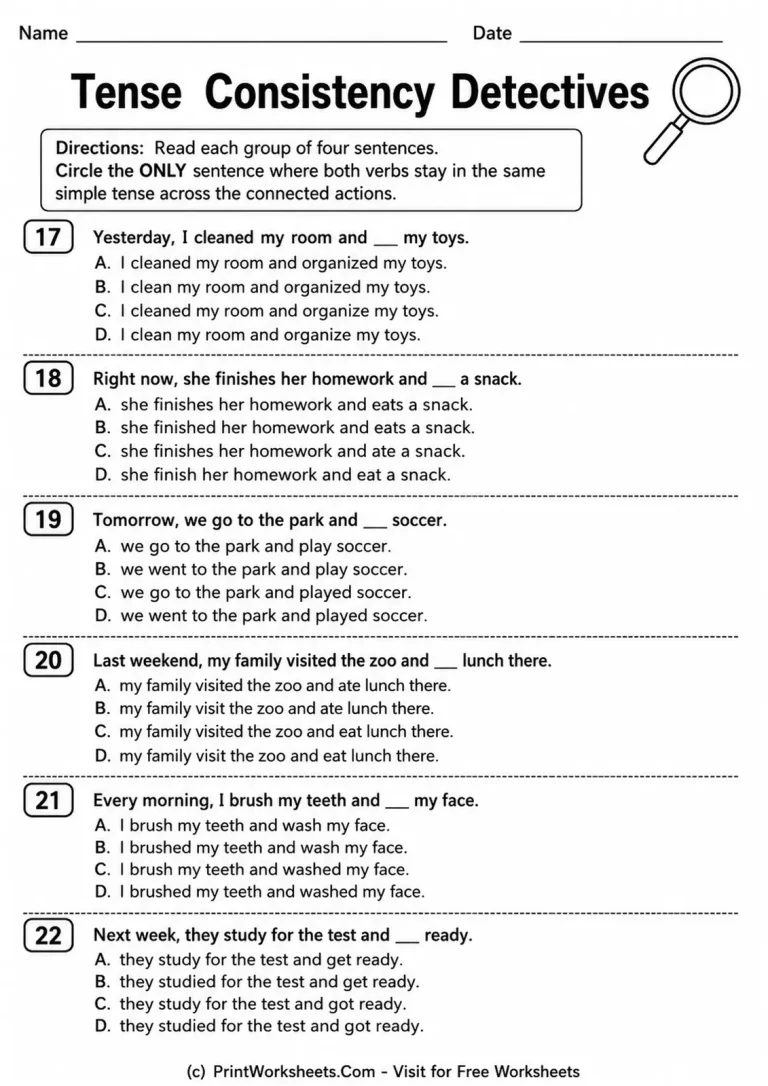
The third worksheet, Tense Consistency Detectives, asks students to apply the skill to connected actions. In items 17-22, each question includes a time clue or sentence beginning and four possible completions. Students choose the option in which both verbs fit the same time frame.
Contexts include yesterday, right now, tomorrow, last weekend, every morning, and next week. Because two related actions must work together, students move beyond identifying a single correct verb form. They must check the whole sentence and decide whether the verbs tell a consistent story about when the actions happen.
A Three-Step Progression for Grade 3 Grammar Practice
The three worksheets can be used in sequence because the level of reasoning increases from page to page. Students begin by selecting the correct verb from two choices, continue by matching incorrect sentences with corrected versions, and finish by evaluating four complete options containing connected actions. That progression makes the set useful for whole-class instruction, literacy centers, homework, independent grammar practice, or a short skills check.
Teachers and parents can also use the time clues as quick discussion prompts. Before a student answers, ask whether the clue points to the past, something that happens regularly, something happening now, or a future plan. Having the learner name the time frame first can make tense choices more deliberate and help reduce random guessing.
Printable Practice for Present, Past, and Future Verb Tenses
These Grade 3 worksheets keep the focus narrow: understanding when actions happen and making sure the verbs stay consistent with that context. The mix of two-choice questions, sentence matching, and multiple-choice detective work gives students several ways to demonstrate the same grammar skill. Print the pages together for a short verb-tense practice sequence or choose individual activities to reinforce the area your students need most.