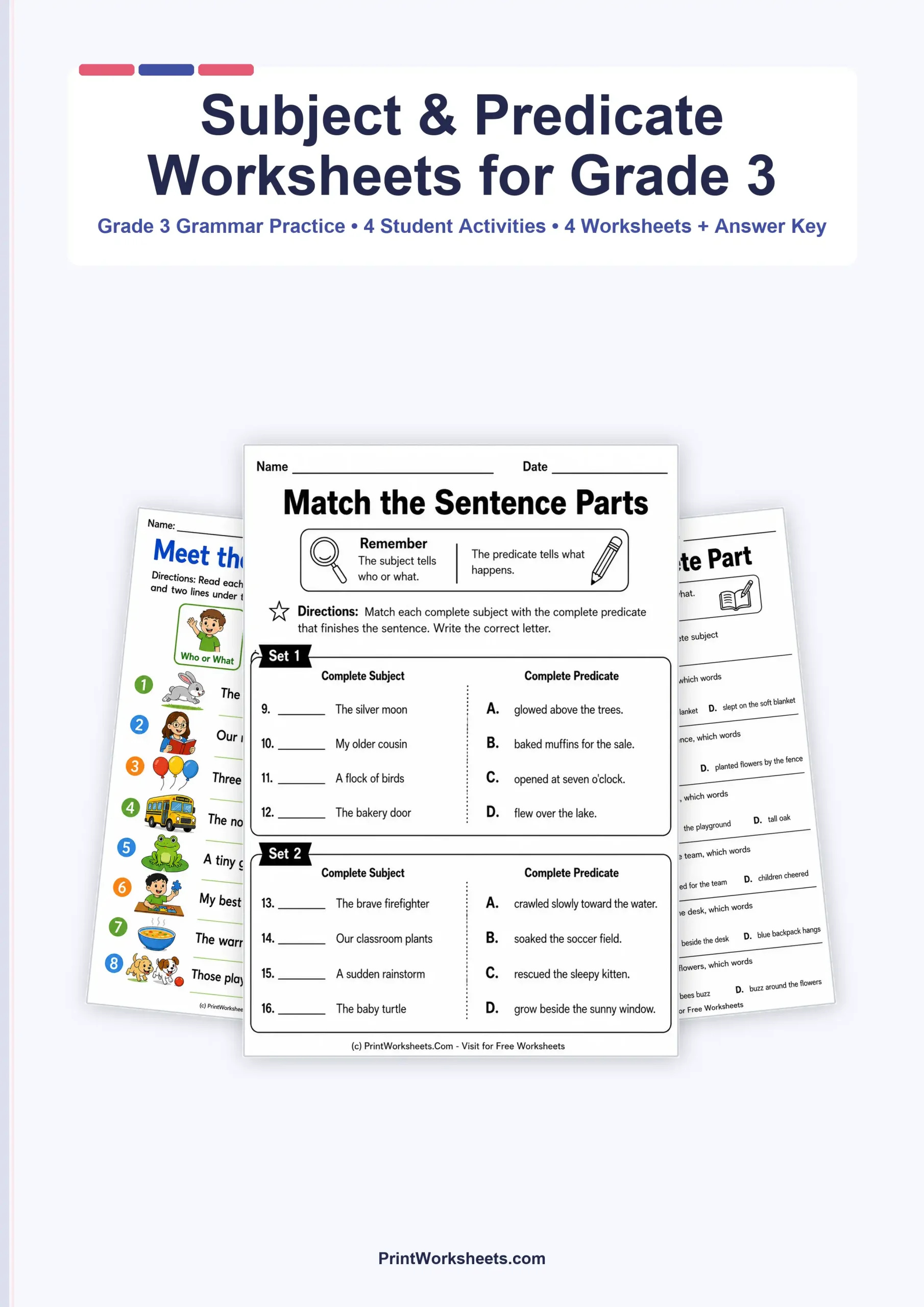
A sentence becomes easier to understand when students can clearly see its two main working parts. These subject and predicate worksheets give third graders repeated practice finding the complete subject and complete predicate in meaningful sentences. Across four student pages, learners move from marking sentence parts directly to matching them, choosing them from multiple-choice options, and finally separating each sentence into its two complete parts. A teacher answer key covers all 26 numbered items for efficient checking.
Subject and Predicate Worksheets for Grade 3
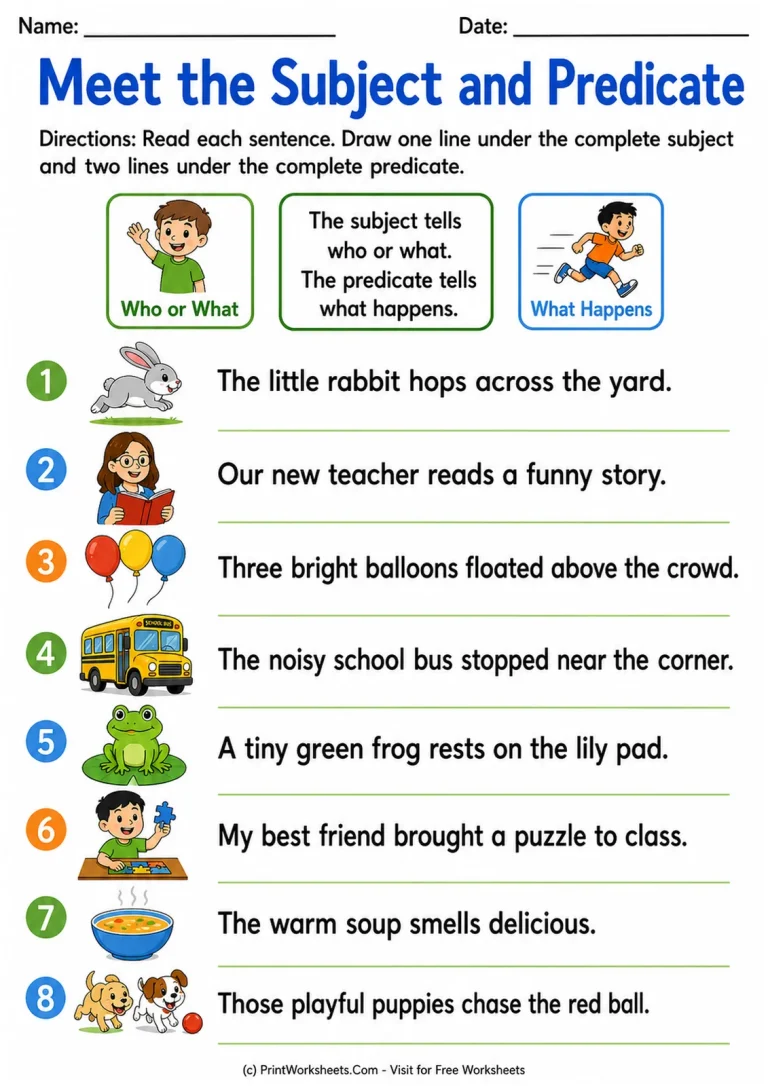
The first worksheet, Meet the Subject and Predicate, introduces the skill through direct sentence analysis. Students read eight complete sentences and underline the complete subject once and the complete predicate twice. Helpful visual reminders connect the subject with the question “Who or What?” and the predicate with “What Happens?” This structure encourages students to look beyond a single noun or verb and recognize the full group of words performing each job in the sentence.
The sentences include expanded subjects and detailed predicates, giving students useful practice with realistic Grade 3 sentence structures. Examples of the kinds of phrases students encounter include expanded complete subjects such as “The striped cat,” “A tall oak tree,” and “My blue backpack.” Predicates may include additional details, such as actions happening near a location or around an object. This helps students understand that the complete subject and complete predicate often contain more than one word.
Build the Skill Through Matching and Multiple Choice
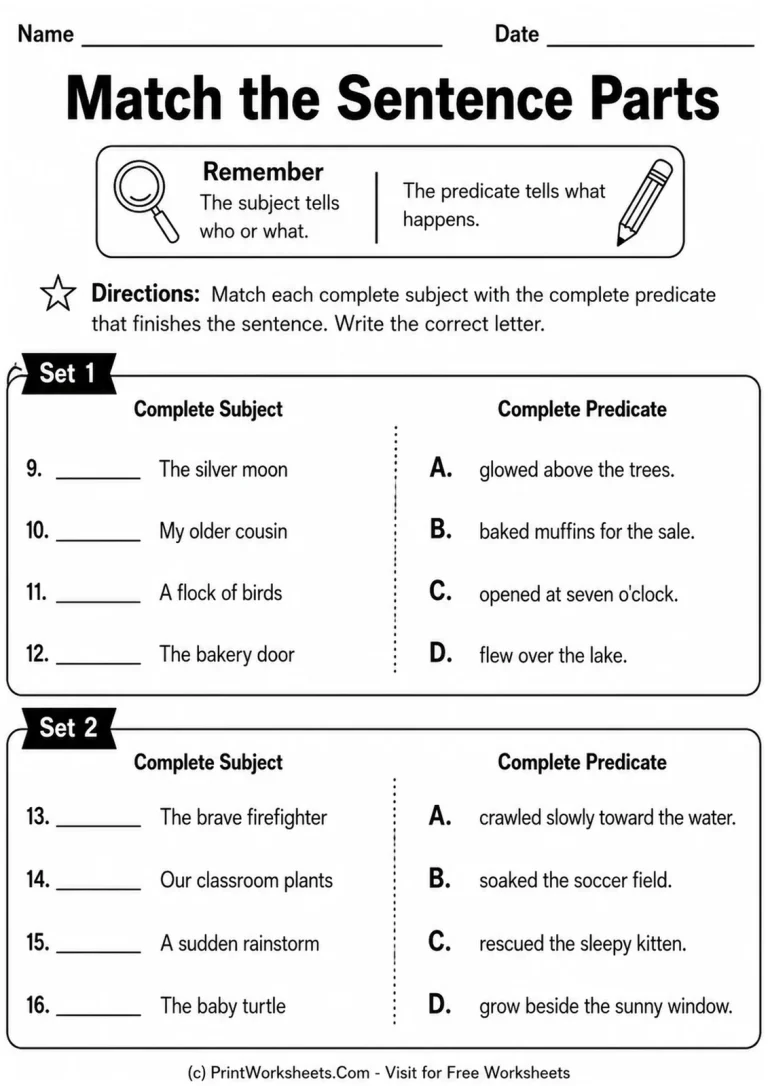
The second page, Match the Sentence Parts, changes the task without changing the grammar target. Students work through two matching sets and connect complete subjects with complete predicates that form sensible, grammatically complete sentences. There are eight matching items in total. Instead of simply locating a boundary in an existing sentence, students must consider meaning and sentence structure at the same time.
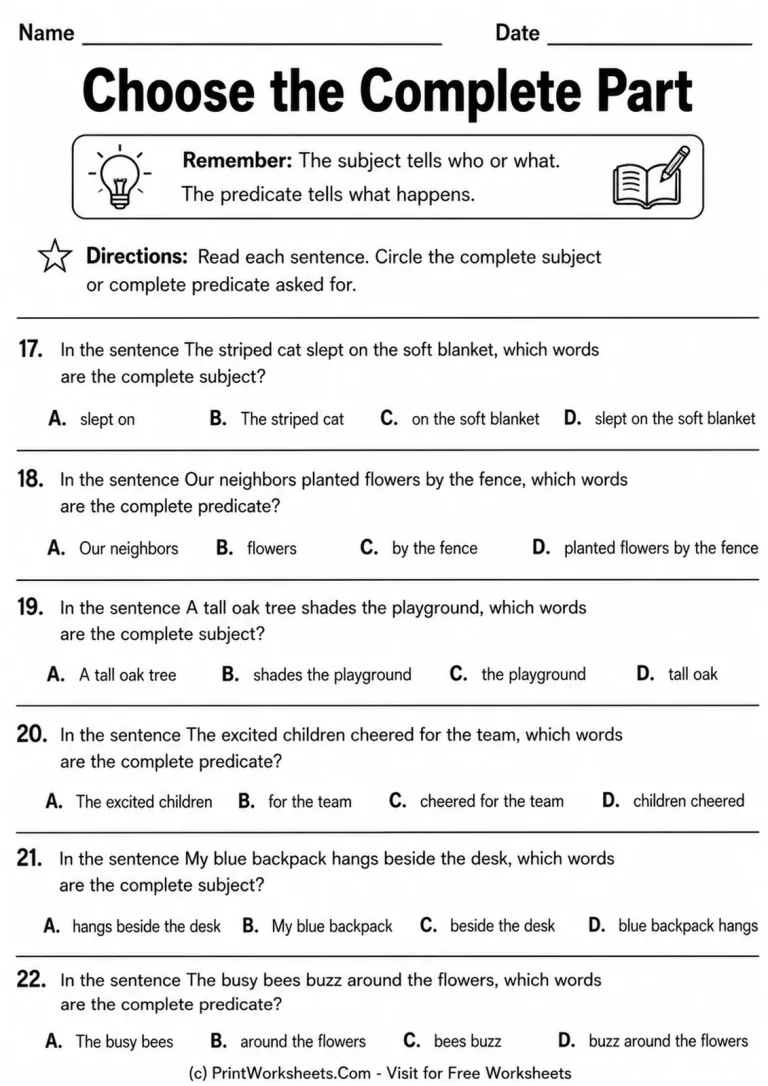
The third worksheet, Choose the Complete Part, uses six multiple-choice questions numbered 17 through 22. The questions alternate between identifying a complete subject and identifying a complete predicate. Each item presents four choices, requiring students to distinguish the full requested sentence part from incomplete or incorrect options. This format works well for independent practice, a quick grammar check, or preparation for classroom assessments that use selected-response questions.
Separate Complete Subjects and Predicates Independently
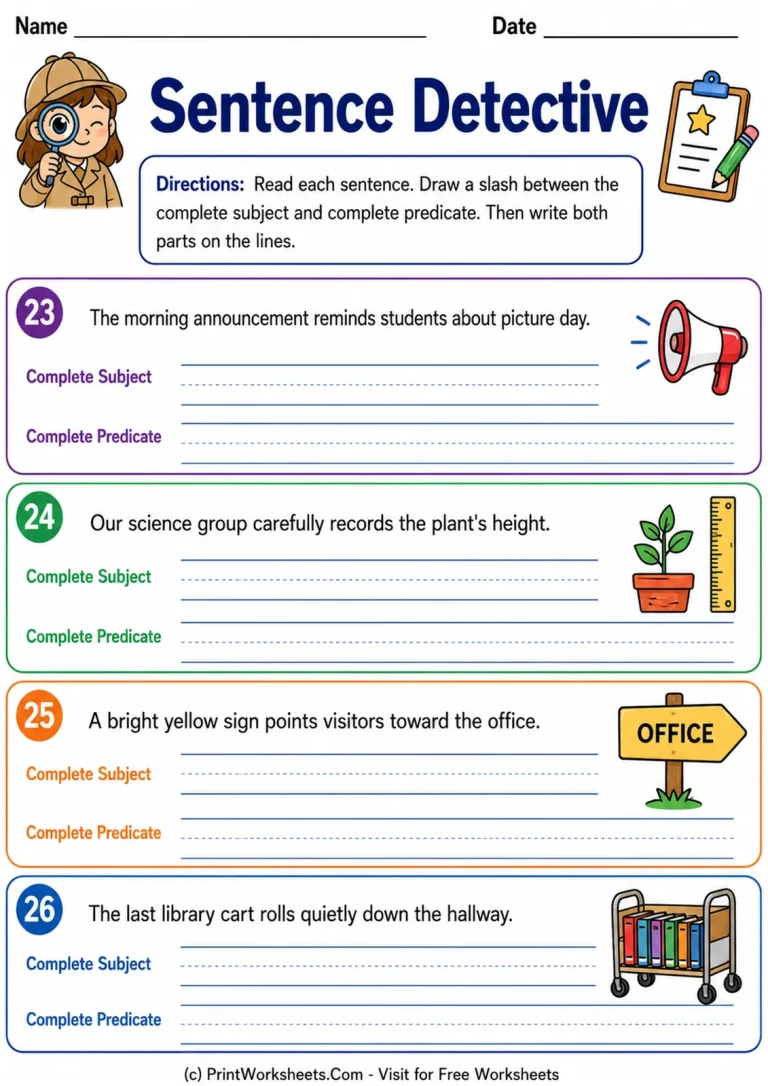
The final student page, Sentence Detective, asks students to apply the concept with less support. For items 23 through 26, students place a slash between the complete subject and complete predicate and then write the two parts separately on provided lines. The sentences use familiar contexts such as a school announcement, a science group, a direction sign, and a library cart. Because students must both locate the sentence boundary and copy each complete part correctly, this page gives teachers a clear view of whether the concept has become independent knowledge.
The four-page sequence creates a useful progression. Students begin by identifying parts directly in complete sentences, then reconstruct sentences by matching subjects and predicates, identify the correct complete part from answer choices, and finish by dividing sentences on their own. The changing activity formats provide repeated exposure to the same core grammar idea without asking students to complete the same type of task four times.
Ways to Use These Complete Subject and Predicate Activities
Teachers can introduce the first page during a grammar lesson and use the remaining worksheets for guided practice, literacy centers, independent work, homework, or a short review. The multiple-choice page can serve as a quick understanding check, while Sentence Detective is especially useful after students have already practiced identifying sentence parts with more support.
Parents can also use the set for extra practice at home. Students can complete one page at a time and then discuss how they decided where the complete subject ended and the complete predicate began. Asking a child to explain who or what the sentence is about and what that subject does can reinforce the same thinking represented by the worksheet cues.
Answer Key for All 26 Items
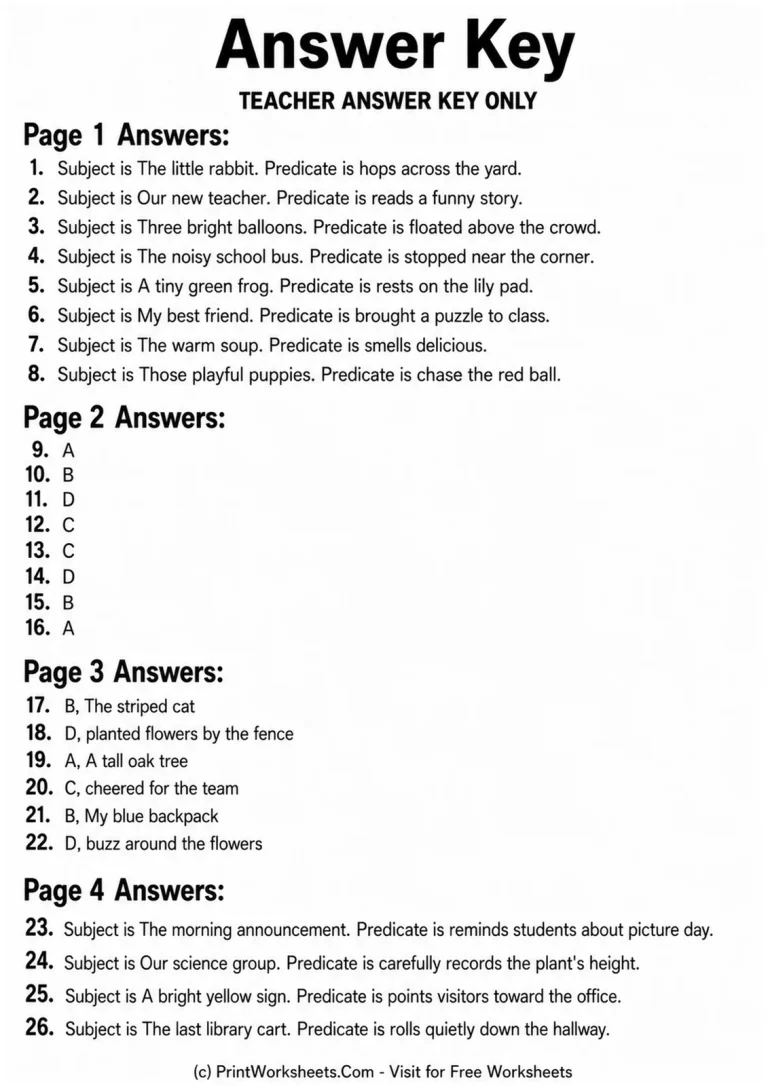
A separate answer key brings together the solutions for all four student worksheets. It includes the complete subject and predicate responses for the sentence-marking and sentence-splitting activities as well as the letter answers for the matching and multiple-choice sections. This makes the set practical for classroom use because teachers can check a full assignment, review selected questions with students, or use the pages at different points in a grammar unit while keeping the answers in one place.
With four distinct student activities and a complete answer key, this printable set provides focused Grade 3 practice with one essential sentence skill: recognizing exactly who or what a sentence is about and identifying everything the sentence tells about that subject.