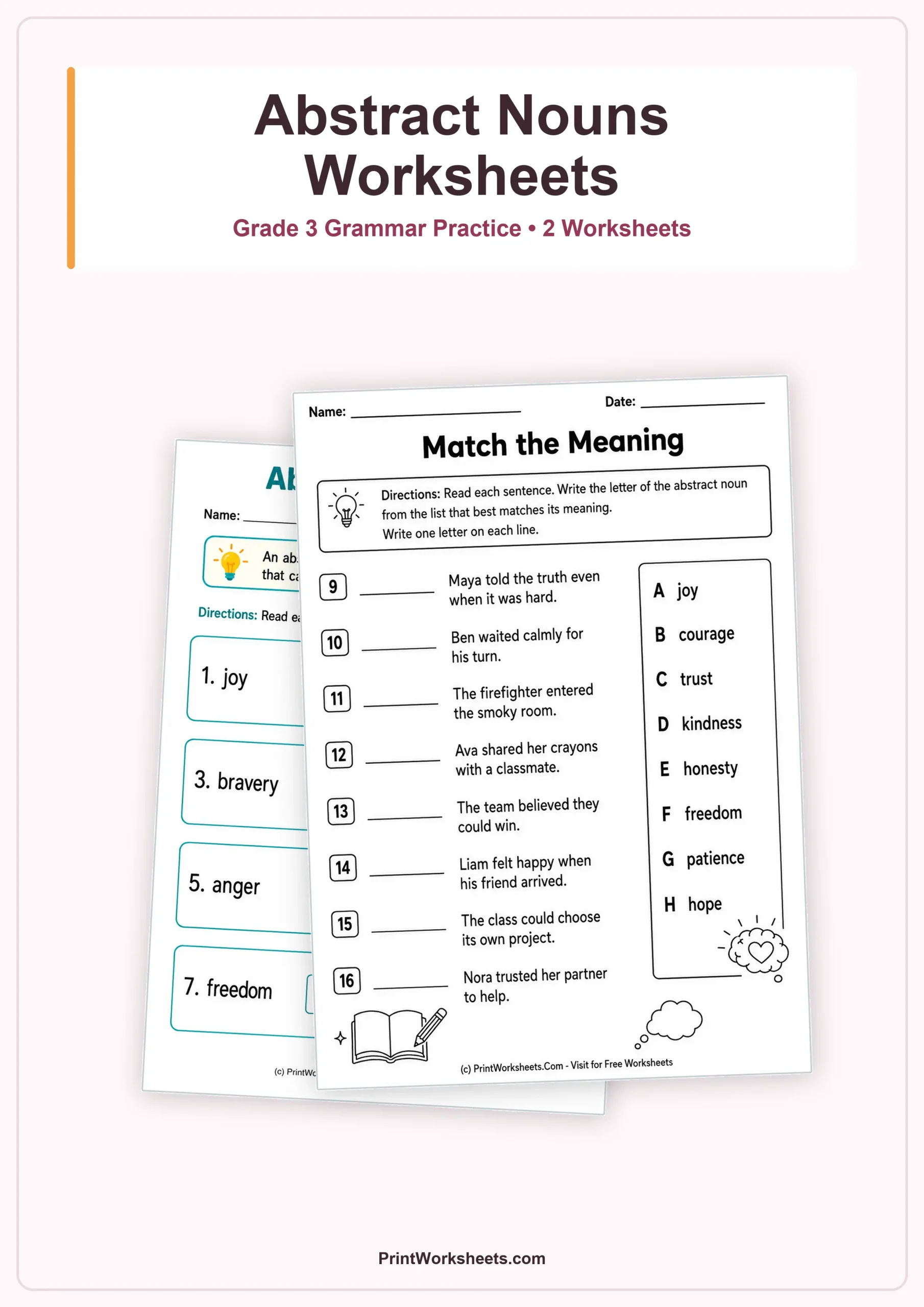
These abstract nouns worksheets give Grade 3 students a focused way to understand the difference between things they can directly sense and ideas, feelings, or qualities they cannot touch. The two printable activities move in a clear sequence. Students begin by sorting individual nouns such as joy, chair, bravery, pencil, anger, apple, freedom, and dog. They then apply that understanding to short sentences where the meaning of an abstract noun must be inferred from context.
How These Abstract Nouns Worksheets Build Understanding
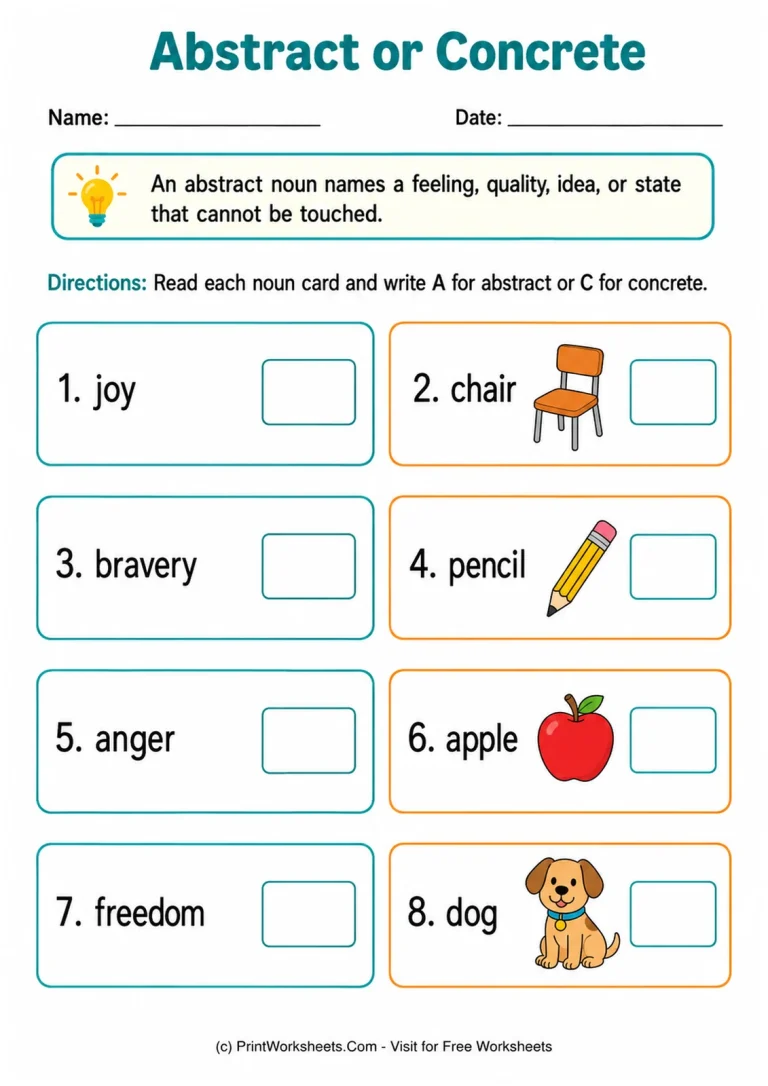
The first worksheet, Abstract or Concrete, concentrates on the basic concept. Students read eight noun cards and write A for an abstract noun or C for a concrete noun. The word choices deliberately mix familiar objects with feelings and qualities. Chair, pencil, apple, and dog provide concrete examples that children can picture or experience through their senses. Joy, bravery, anger, and freedom require students to recognize that a noun can name an idea or feeling even when it is not a physical object.
This direct classification format is useful when introducing the skill because students can focus on one word at a time. It also creates opportunities for discussion. A teacher or parent can ask why apple is concrete but freedom is abstract, or why bravery names a quality rather than a thing that can be held. Explaining the difference aloud can help students move beyond guessing and develop a clearer grammar concept.
From Word Sorting to Context Clues
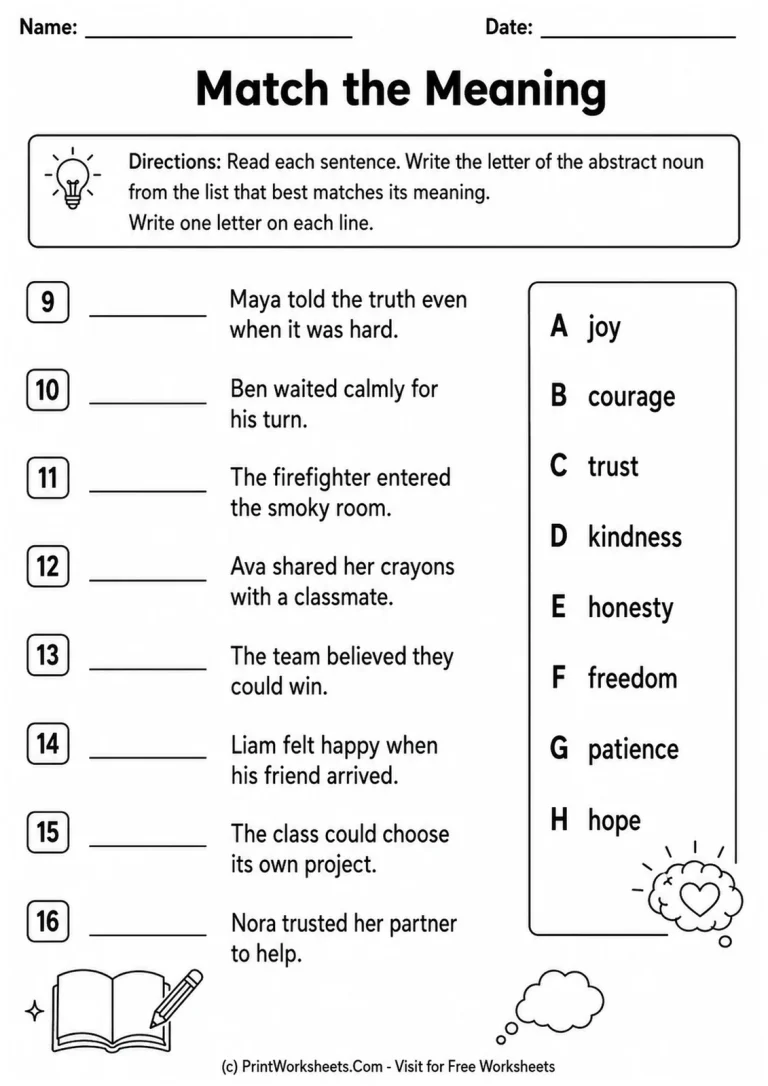
The second worksheet, Match the Meaning, increases the challenge by placing abstract ideas inside short situations. Students work with eight sentences numbered 9 through 16 and choose from the abstract nouns joy, courage, trust, kindness, honesty, freedom, patience, and hope. Instead of seeing only a noun and labeling its type, students must decide which idea is represented by the action or situation described.
Several prompts connect abstract nouns with recognizable behavior. Telling the truth points toward honesty. Waiting calmly supports the meaning of patience. Sharing crayons can show kindness. Entering a smoky room despite danger can represent courage. These examples help children see that abstract nouns are not just vocabulary words to memorize; they name ideas that can be understood through what people do, feel, or experience.
A Two-Step Grammar Practice Sequence
The progression between the pages makes the set practical for a short lesson, homework assignment, literacy center, review session, or independent practice. Page one can be used to check whether students understand the difference between abstract and concrete nouns at the word level. Page two then tests whether they can recognize the meaning of abstract nouns when the answer is not stated directly in the sentence.
This sequence also makes it easier to notice where a learner needs support. A student who struggles with the first page may need more examples of concrete objects versus feelings, qualities, and ideas. A student who succeeds with classification but finds the second page difficult may understand the grammar category while still needing practice with vocabulary and context clues.
What Grade 3 Students Practice
Across the two worksheets, students practice noun classification, vocabulary meaning, reading for context, and connecting actions with abstract concepts. The repeated use of familiar abstract nouns gives learners several ways to think about the same grammar idea without repeating the same task format. The activities are short enough to fit into a focused lesson while still providing sixteen total items across the two pages.
For broader noun practice, students can also work with the identifying nouns and verbs worksheets to review how nouns function alongside verbs before returning to more specific noun categories.
Simple Ways to Extend the Practice
After completing the pages, ask students to generate one concrete noun and one abstract noun of their own. They can also choose an abstract noun such as hope, trust, or kindness and write a short sentence that demonstrates its meaning without directly defining the word. Another useful extension is to have students explain which clue in a sentence helped them select the matching abstract noun.
These Grade 3 worksheets work especially well as a bridge between basic noun identification and more thoughtful grammar work. By moving from visible word-level differences to meaning in context, students get practice recognizing that nouns can name not only people, places, animals, and things, but also emotions, qualities, and ideas.