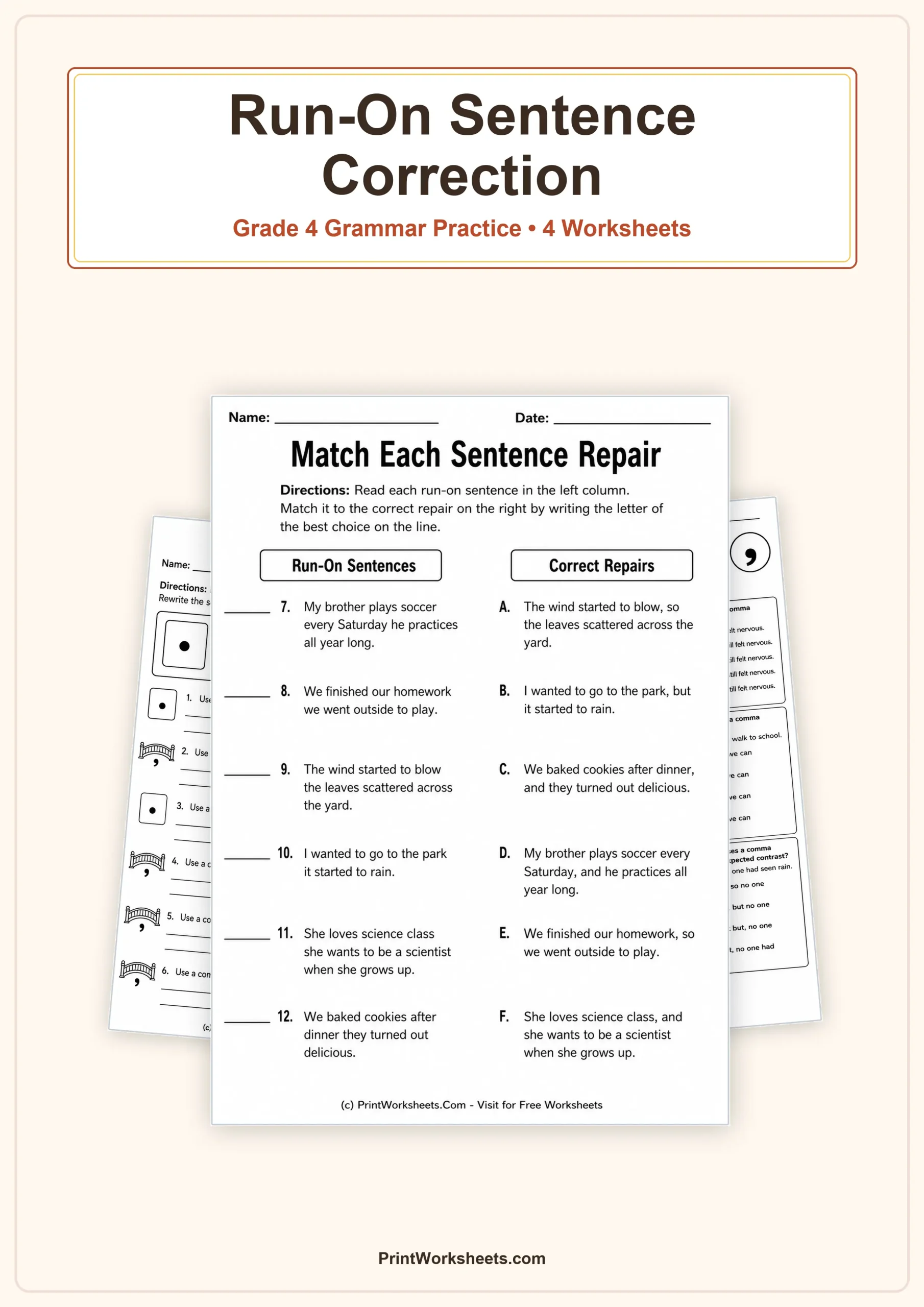
These run-on sentence correction worksheets give fourth-grade students repeated practice fixing sentences that contain two complete thoughts joined incorrectly. Across four printable activities, students learn when to separate ideas with a period and capital letter and when to connect related ideas with a comma plus a coordinating conjunction such as and, but, so, or or. The sequence moves from guided repair strategies to independent editing, helping students see not only where a sentence breaks down but also which correction best fits the meaning.
Run-On Sentence Correction Practice for Grade 4
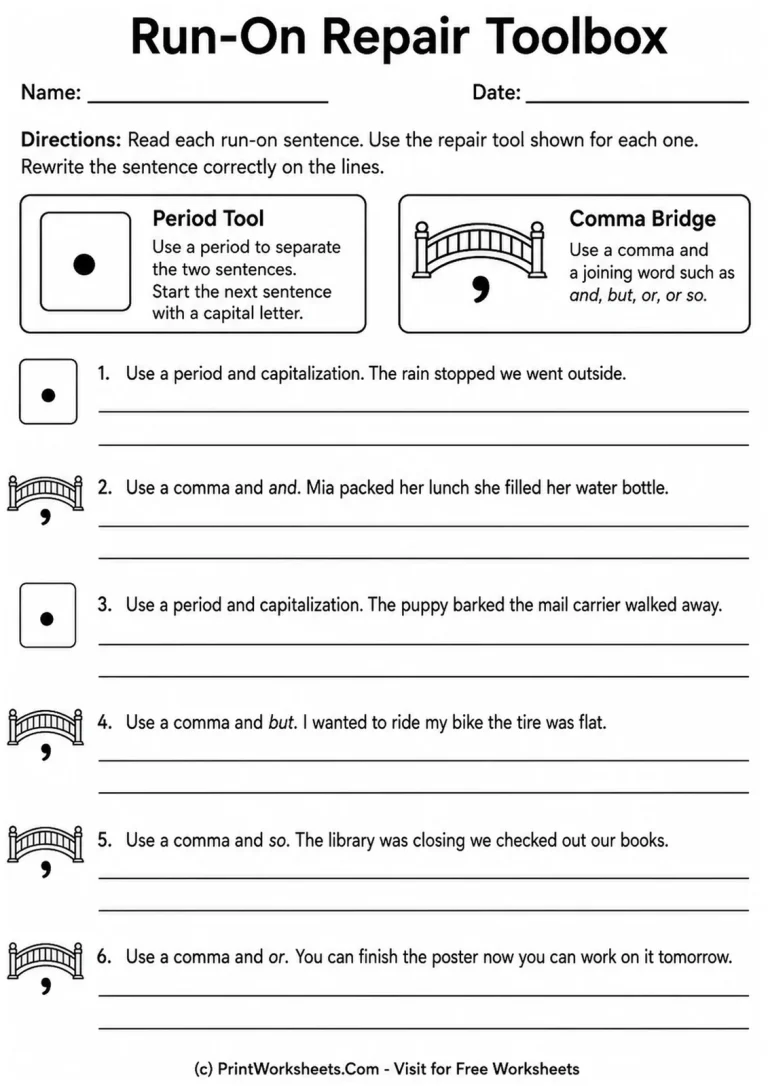
The first worksheet, Run-On Repair Toolbox, introduces two practical ways to repair a run-on sentence. The “Period Tool” shows students how to divide two complete thoughts into separate sentences, while the “Comma Bridge” models how a comma and an appropriate joining word can connect ideas correctly. Students then rewrite six run-on sentences using one of those methods. This guided start is useful because it makes the repair choices visible before students are asked to work more independently.
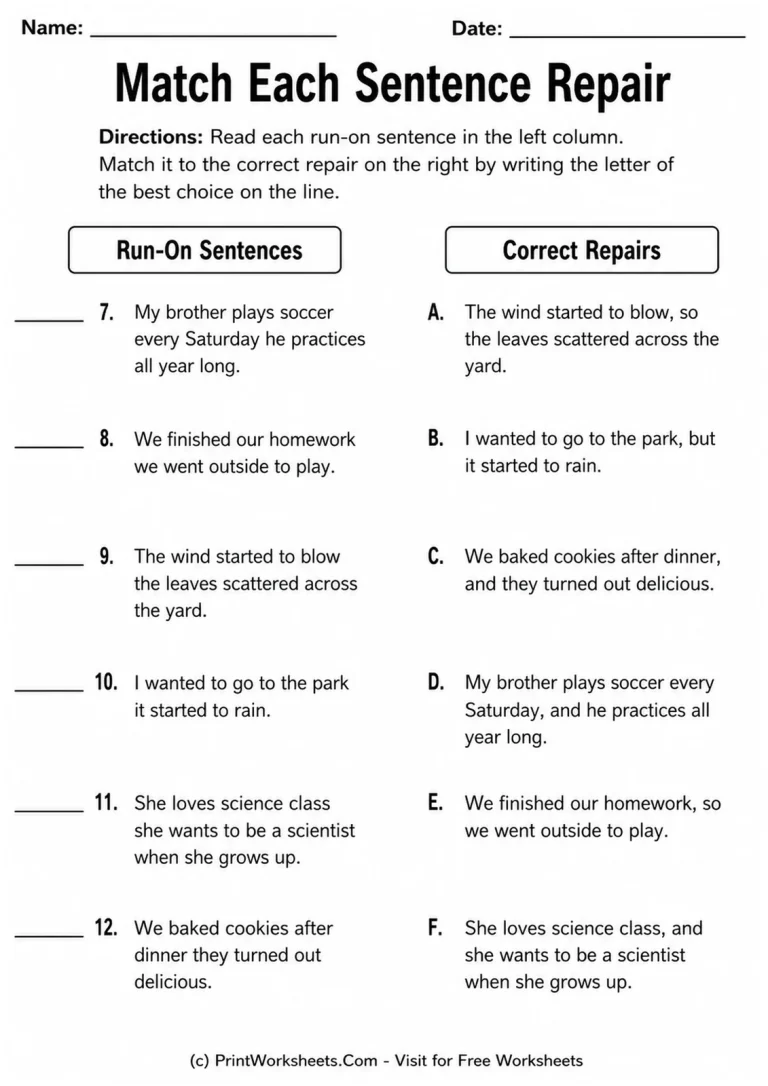
The second worksheet, Match Each Sentence Repair, shifts from rewriting to recognition. Students compare six run-on sentences with six corrected versions and match each sentence to the repair that preserves its meaning while fixing the grammar. This format reinforces the idea that punctuation is not chosen randomly. Students must notice how the two ideas relate and then identify the correction that creates a complete, readable sentence.
Practice with Punctuation and Coordinating Conjunctions
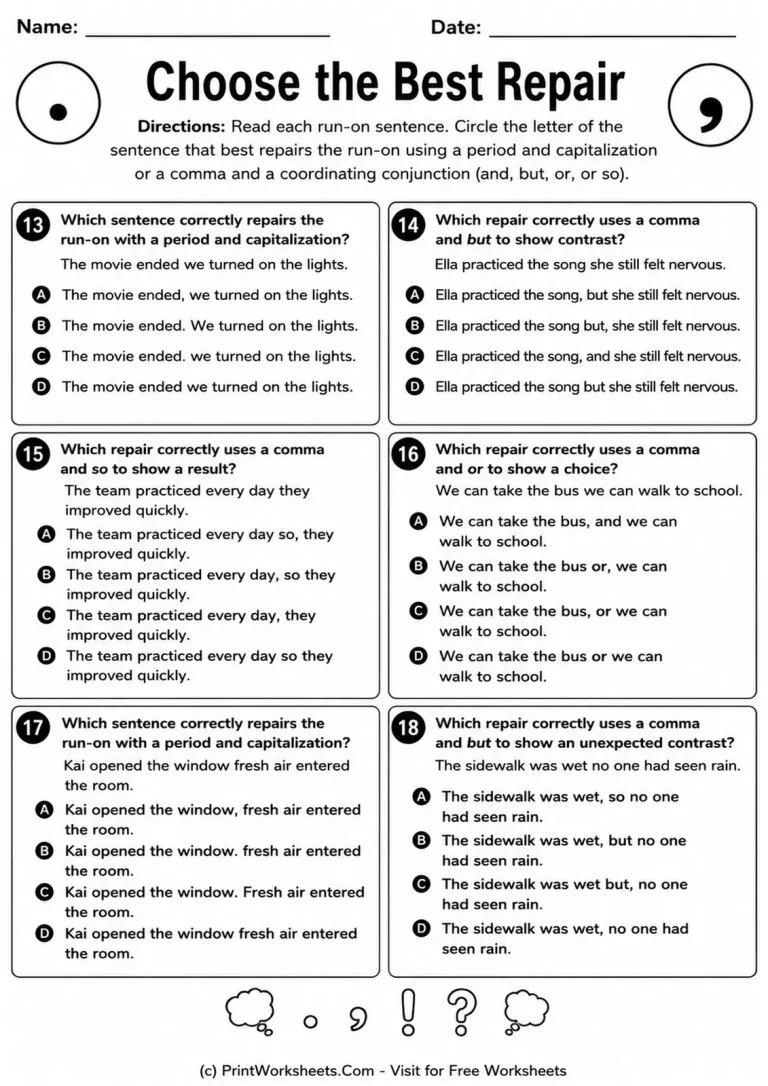
In Choose the Best Repair, students work through multiple-choice questions that focus on selecting the most accurate correction. Some items are best fixed with a period followed by a capital letter. Others require a comma and a coordinating conjunction. The activity gives special attention to meaning relationships, including contrast with but, result with so, and choice with or. This makes the worksheet more than a punctuation drill: students have to think about how the ideas in a sentence connect.
That distinction matters in Grade 4 because students are increasingly expected to revise their own writing, not simply identify a grammar term. A student who understands why a sentence needs but instead of so is making a meaning-based editing decision. The worksheets therefore support both sentence structure and clearer written expression.
Edit Run-On Sentences in Everyday Messages
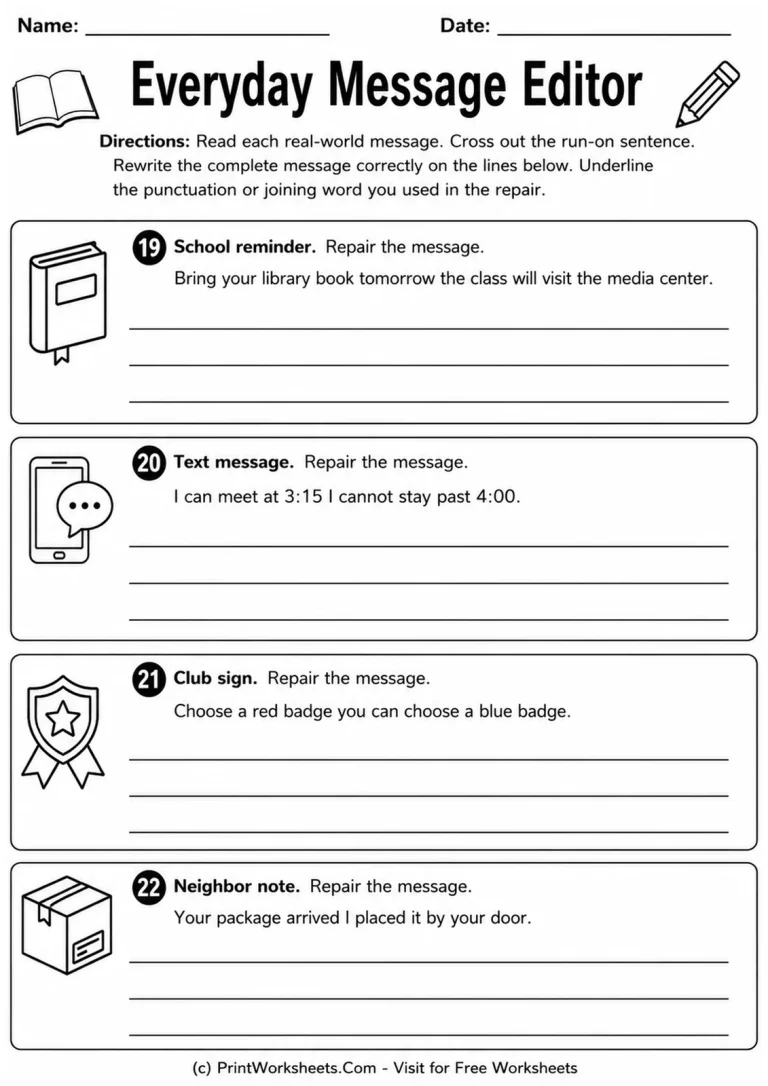
The final activity, Everyday Message Editor, places the skill in familiar contexts. Students correct run-on sentences that appear in a school reminder, a text message, a club sign, and a note to a neighbor. After rewriting each message, they underline the punctuation mark or joining word they used. This added step encourages students to identify the exact feature that repaired the sentence instead of treating the rewrite as a guessing exercise.
The progression across the set is deliberate. Students begin with a visible toolbox and direct rewriting, move to matching incorrect and corrected forms, then choose the best repair from several options, and finally edit short real-life messages on their own. Teachers can use the pages in order for a focused mini-unit or select individual pages for review, centers, homework, or small-group practice. Parents can also use the set to reinforce classroom grammar lessons at home without needing to introduce a new method.
What Students Practice in This Worksheet Set
Students practice identifying where two complete thoughts have been joined incorrectly, separating independent ideas with a period and capitalization, connecting related ideas with a comma and a coordinating conjunction, and choosing a joining word that matches the intended relationship between ideas. They also apply the skill in several response formats: rewriting, matching, multiple choice, and contextual editing. Using different task types helps students show the same understanding in more than one way.
These worksheets are especially useful for students who can recognize that a sentence “sounds too long” but still need a clear method for fixing it. By repeatedly comparing periods, commas, capitalization, and conjunction choices, students build a practical editing routine they can transfer to paragraph writing. Print the full set for sequential practice or use a single page when your lesson focuses on one specific repair strategy.