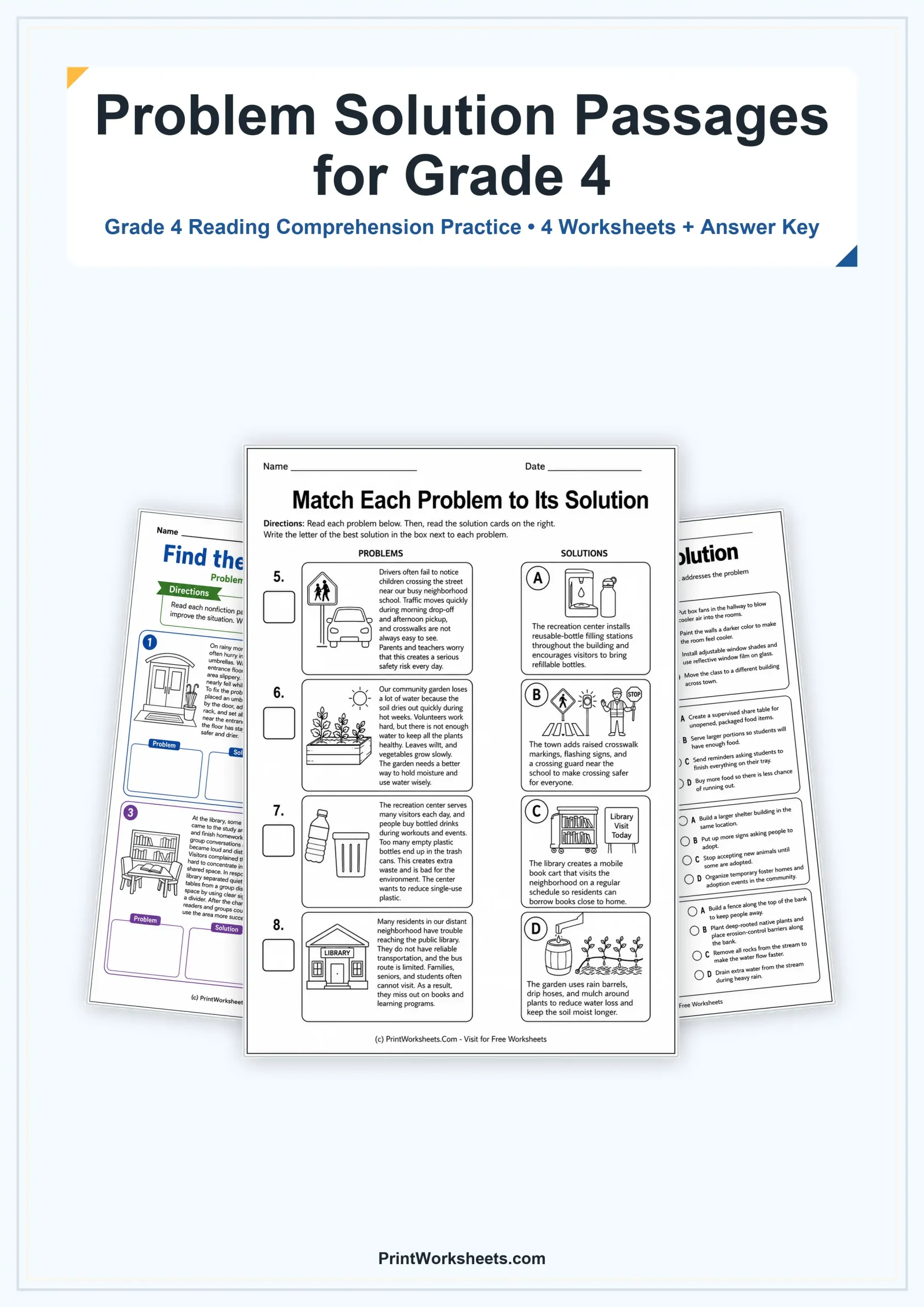
These problem solution passages give fourth-grade readers a structured way to notice what has gone wrong in a nonfiction text, identify the response to that problem, and explain why the response is useful. Across four student worksheets, the work becomes steadily more demanding: students first name problems and solutions directly, then match them, judge which solution works best, and finally support their thinking with evidence from the passage.
How These Problem Solution Passages Build the Skill
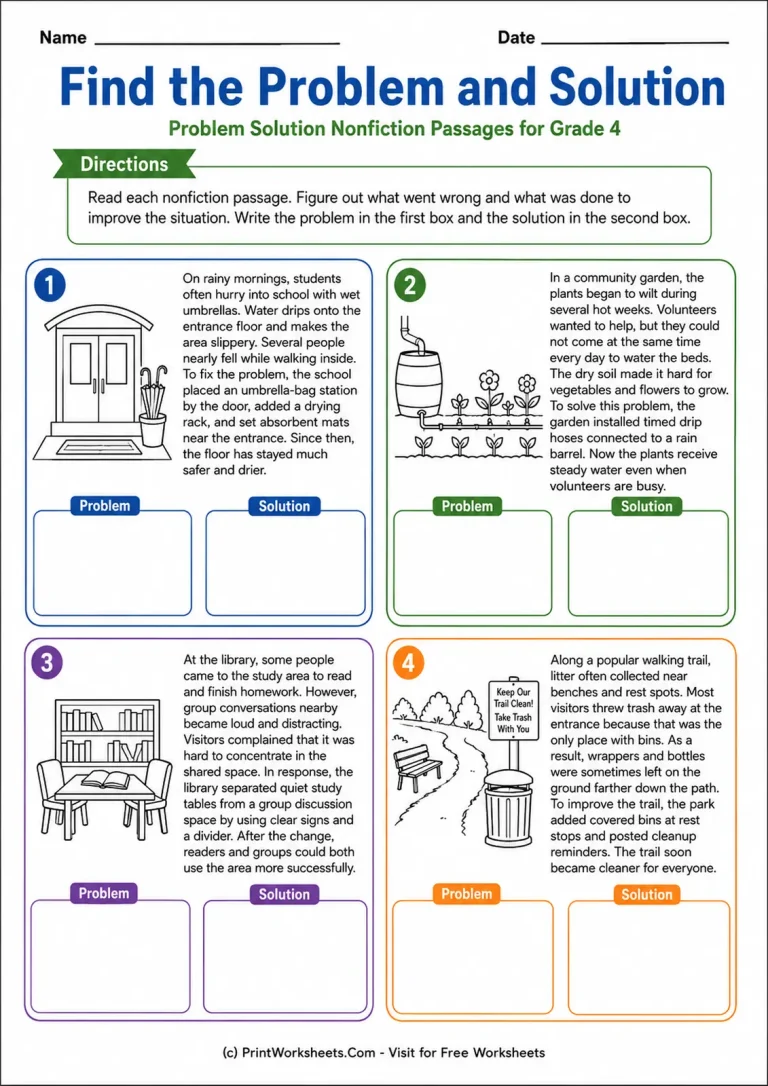
The first worksheet begins with four short nonfiction situations in which the problem and solution are clearly described in the text. Students read about wet umbrellas making a school entrance slippery, community-garden plants wilting during hot weather, distracting conversations in a library study area, and litter collecting along a walking trail. For each passage, they write the problem in one box and the solution in another. This format helps students separate the condition that needs improvement from the action taken to improve it.
The solutions are concrete and easy to trace back to the passage. A school adds an umbrella-bag station, a drying rack, and absorbent mats. A garden installs timed drip hoses connected to a rain barrel. A library separates quiet tables from a group discussion area. A park adds covered trash bins at rest stops and posts cleanup reminders. Because the details are explicit, students can concentrate on recognizing the underlying text relationship rather than guessing.
From Identification to Matching and Evaluation
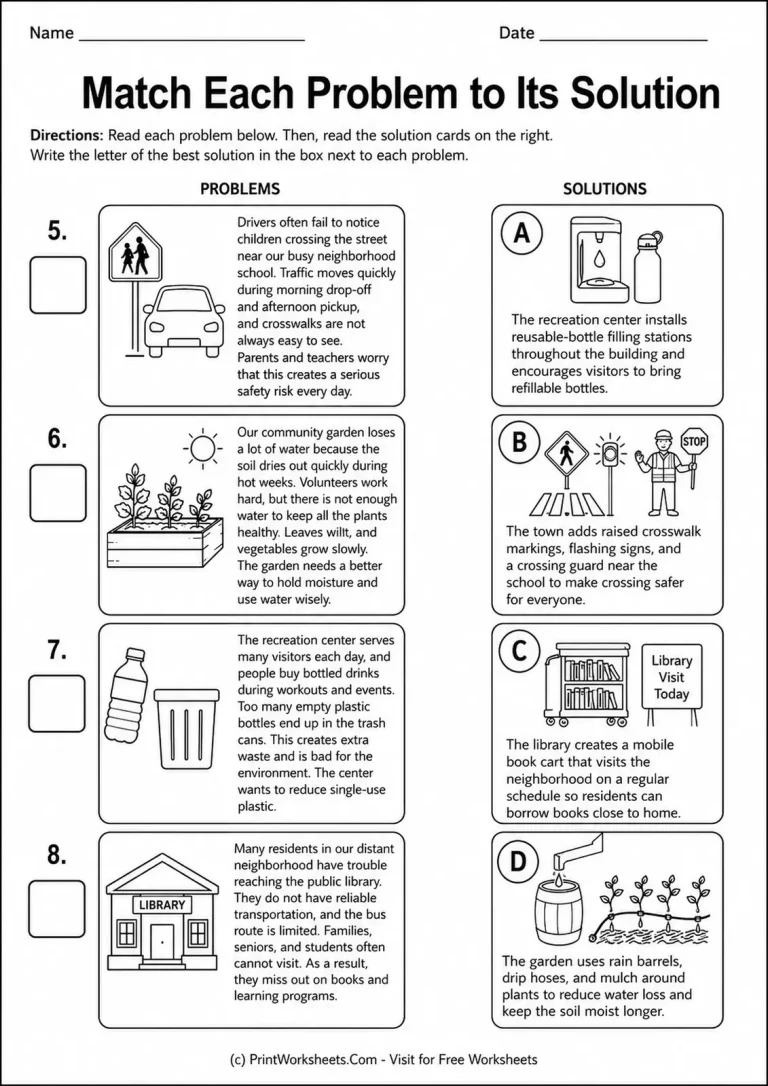
The second worksheet changes the response format. Students read four problem cards and match each one to the best solution card. The situations include an unsafe school crossing, a garden that loses water quickly, excessive use of single-use plastic bottles, and a neighborhood with limited access to a public library. The possible solutions include safer crosswalk features, moisture-saving garden methods, reusable-bottle filling stations, and a mobile library. This activity requires students to compare several choices and decide which response actually addresses each stated need.
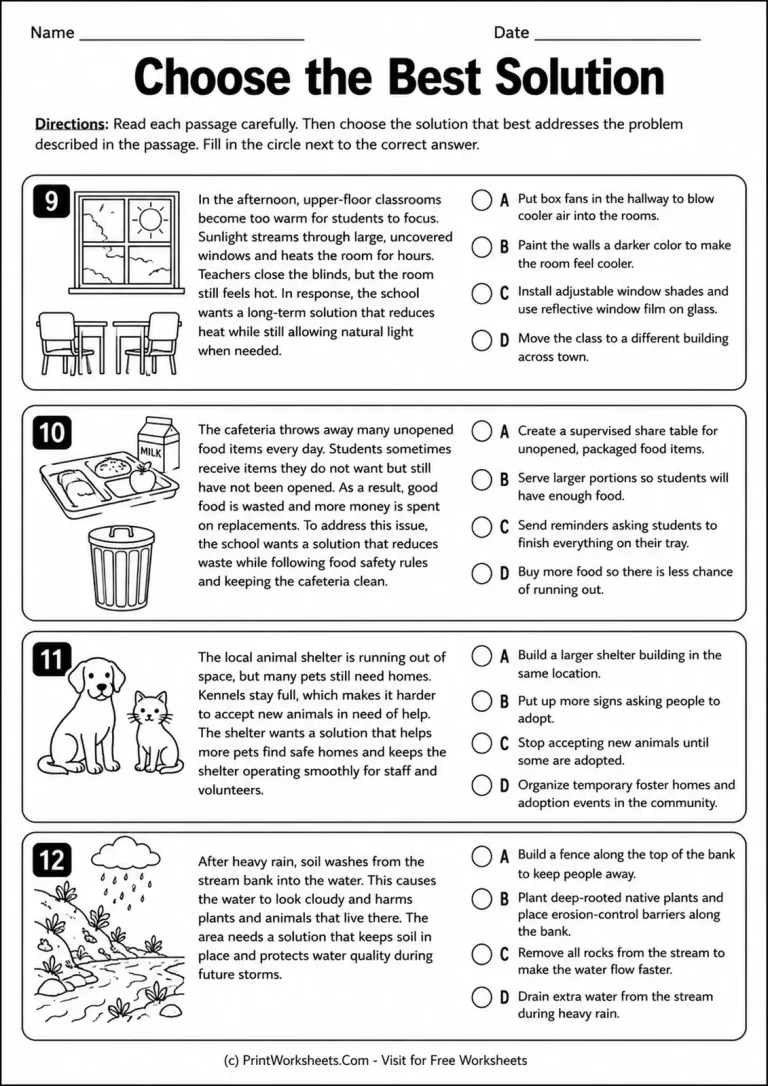
The third worksheet raises the level of reasoning again with multiple-choice passages. Students must choose the solution that best fits both the problem and the conditions described. For example, a classroom needs a long-term way to reduce afternoon heat while still allowing natural light, so adjustable window shades and reflective window film make better sense than unrelated or temporary alternatives. Other items ask students to think through cafeteria food waste, limited space in an animal shelter, and erosion along a stream bank.
Require Evidence, Not Just a Guess
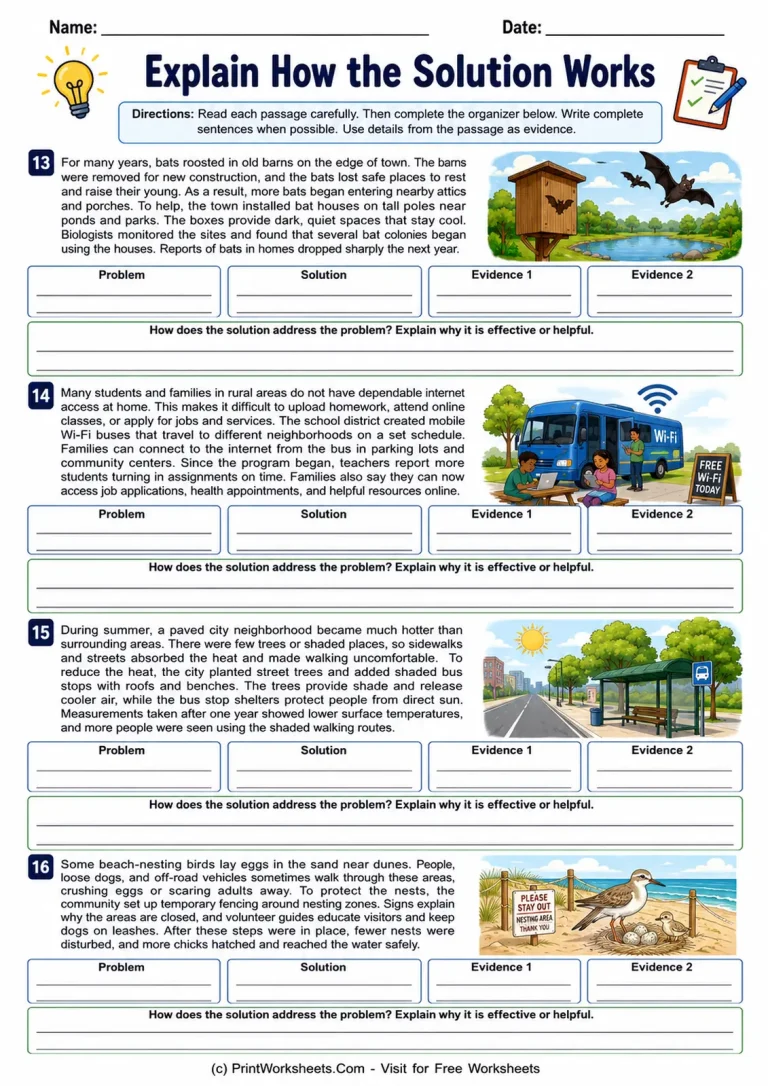
The fourth worksheet asks students to explain how a solution works. Each organizer includes spaces for the problem, the solution, two pieces of evidence, and a written explanation of why the solution is effective or helpful. The passages cover lost bat roosts, unreliable internet access in rural communities, excessive heat in a paved neighborhood, and disturbance of beach-nesting birds.
This page moves students beyond simply locating information. They must connect an action to an outcome. Bat houses provide replacement shelter and are followed by fewer reports of bats entering homes. Mobile Wi-Fi buses bring internet access closer to families and are associated with more timely schoolwork and access to online services. Street trees and shaded bus stops reduce heat exposure, while nesting-zone barriers and visitor guidance reduce disturbance to birds and chicks.
What Fourth Graders Practice Across the Set
The worksheets combine several closely related reading-comprehension skills. Students identify key details, distinguish a problem from its effects, determine which action responds to the problem, compare possible solutions, and cite details that show whether a solution worked. The variety of school, community, environmental, and public-service topics also gives students practice applying the same text structure across different nonfiction contexts.
The sequence can be especially useful when teaching nonfiction text structures because students see that problem and solution may be stated in different ways. A problem might appear as a safety risk, a shortage, an environmental concern, limited access to a service, or an unwanted result. Likewise, a solution might involve adding equipment, changing an environment, organizing a program, or limiting harmful activity.
Ways to Use the Worksheets in Grade 4
Use the first page for teacher modeling or guided practice. Ask students to underline language that describes the problem and circle details that show what was done in response. The matching page works well for partner discussion because students can explain why one solution fits a problem better than the alternatives. The multiple-choice page is suitable for independent practice or a quick comprehension check.
Save the final organizer for students who are ready to write evidence-based explanations. A useful response routine is: name the problem, state the solution, cite two results or supporting details, and explain the connection between them. Students who need support can use sentence starters such as “The problem is…” and “This solution helps because…”. Students who need an extension can compare two passages and explain how different kinds of problems require different kinds of solutions.
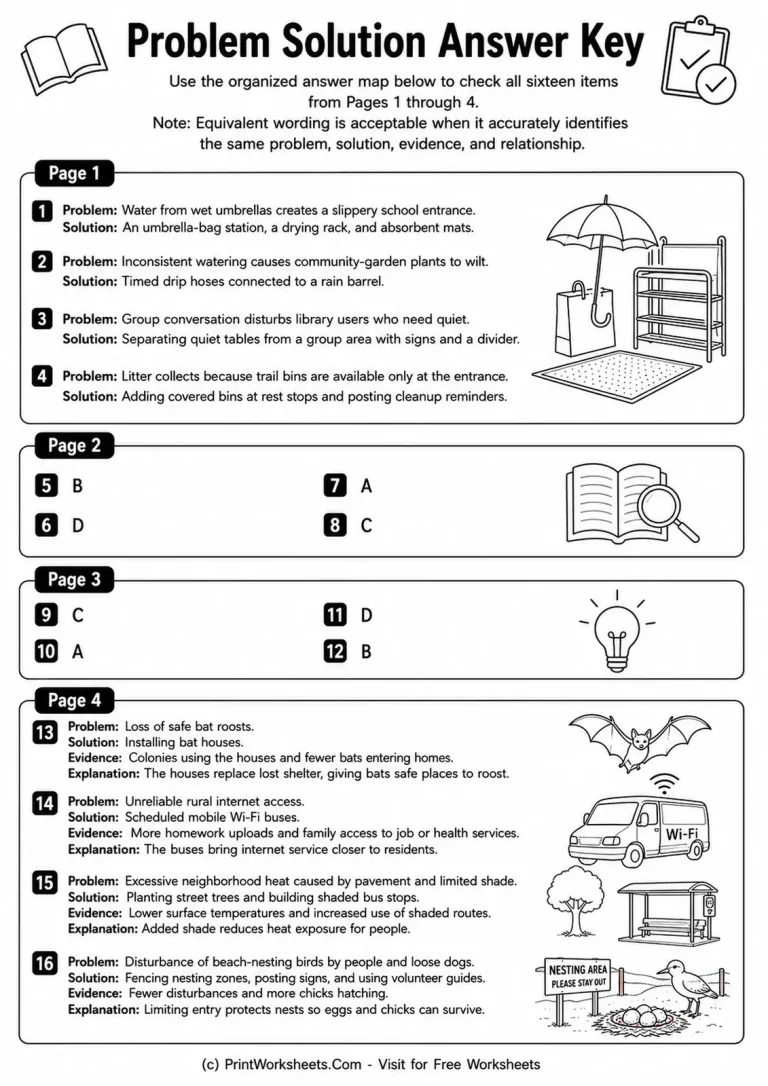
The included answer key supports efficient checking of both objective items and open-ended responses. For constructed responses, equivalent wording can still be accepted when students accurately identify the same problem, solution, evidence, and relationship described in the passage.
A Practical Nonfiction Reading Sequence
By moving from clear identification to explanation with evidence, this set gives Grade 4 students repeated practice with one important nonfiction structure without repeating the same task format. It can be used across several reading lessons, in literacy centers, for homework, or as targeted review before students analyze more complex informational texts.