These Grade 4 inference passages give students repeated practice turning details from a short text into a reasonable conclusion and then proving that conclusion with evidence. Rather than stopping at a guessed answer, the worksheets ask readers to notice what characters do, what changes in a situation, and which details make one inference stronger than the alternatives. Across the set, students move from choosing an answer to matching evidence and finally writing and explaining an inference independently.
Inference Passages That Require Text Evidence
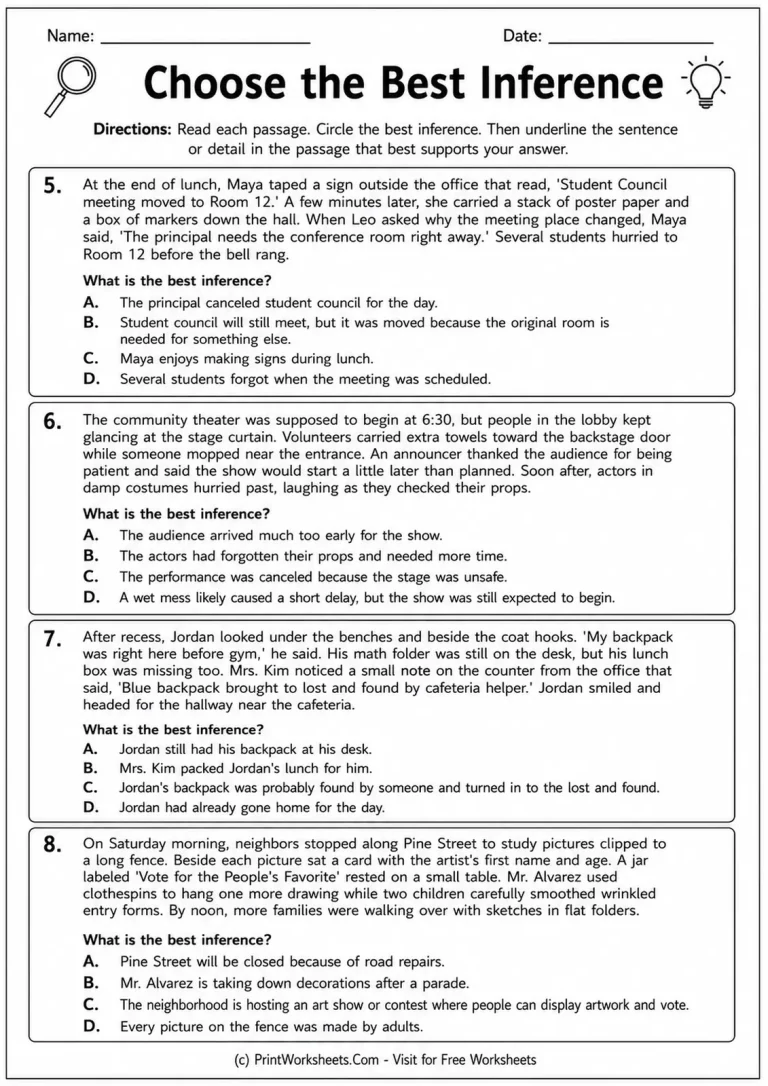
The first activity, Choose the Best Inference, presents four realistic scenarios with multiple-choice answers. Students read each passage, circle the strongest inference, and underline the sentence or detail that best supports it. One passage explains that a student council meeting has been moved to Room 12 because the principal needs the conference room. Another describes a community theater delay through clues such as extra towels, mopping near the entrance, damp costumes, and an announcement that the show will begin a little later than planned.
The other passages on this page continue the same evidence-first approach. A student searches for a missing backpack and lunch box before learning that a blue backpack was turned in near the cafeteria. In another scene, neighbors study artwork clipped to a fence, artist cards identify each picture, and a jar invites visitors to vote for a people’s favorite. These details give fourth graders enough information to infer what is happening without simply repeating a sentence from the passage.
Match Each Inference to the Clues
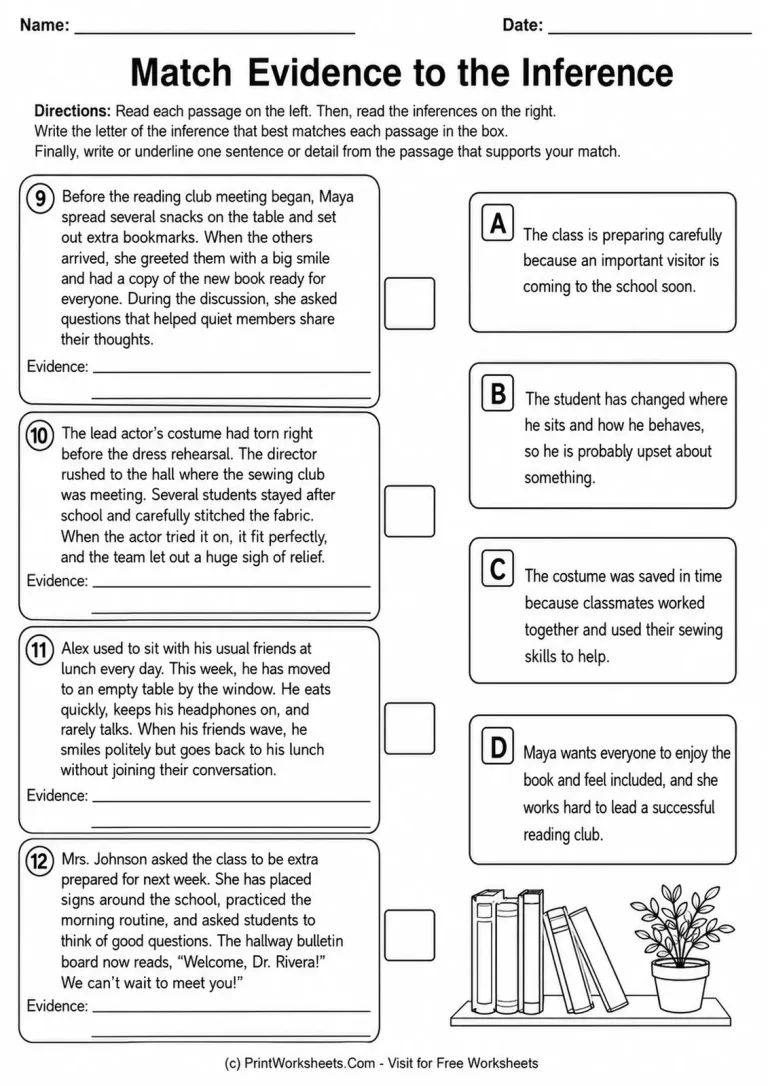
The next worksheet changes the response format with Match Evidence to the Inference. Four short passages appear on the left and four possible inferences appear on the right. Students select the best match and then identify a sentence or detail that justifies the choice. This format helps teachers see whether students can distinguish between an inference that is merely possible and one that is strongly supported by the text.
The situations provide varied reading practice. Maya prepares snacks, extra bookmarks, and copies of a new book before helping quieter members participate in a reading club discussion. A torn theater costume is repaired by classmates before dress rehearsal. Alex changes where he sits at lunch, keeps his headphones on, and stops joining his usual friends’ conversations. A class practices routines, prepares questions, and displays a welcome message for Dr. Rivera. Each passage includes several related clues, encouraging students to combine evidence rather than depend on a single keyword.
Explain an Inference With Two Pieces of Evidence
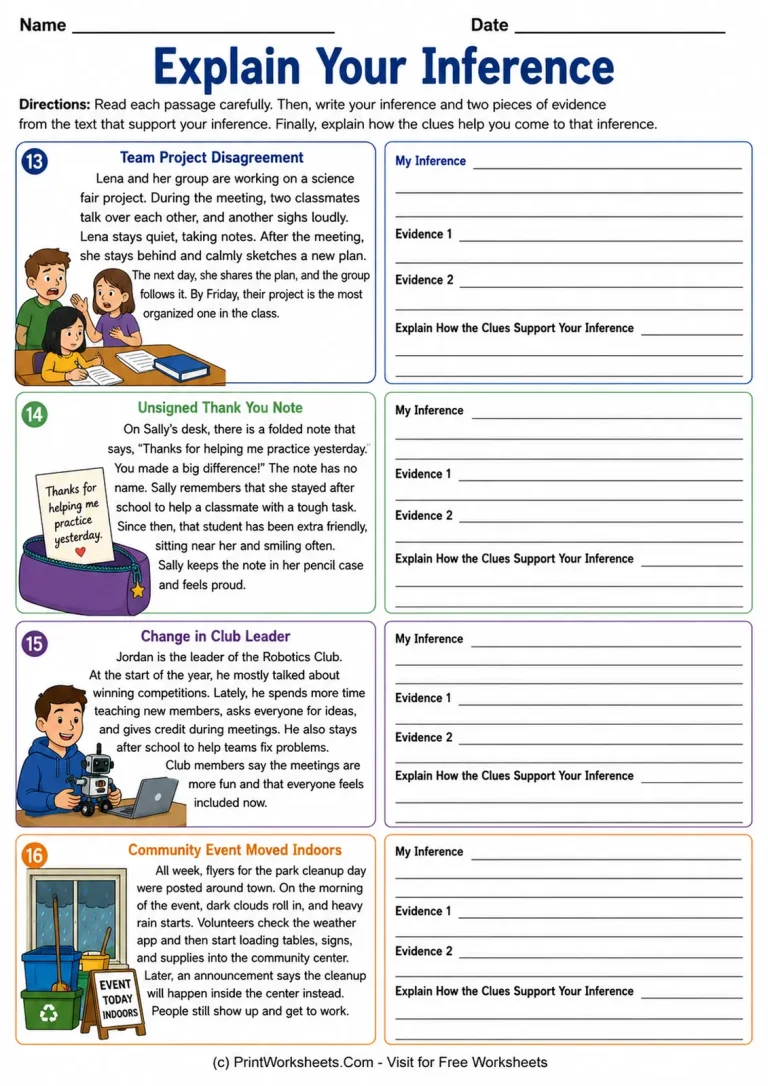
The final page, Explain Your Inference, shifts students into constructed response. For each passage, students write their own inference, record two supporting pieces of evidence, and explain how those clues lead to the conclusion. This progression is especially useful for Grade 4 reading comprehension because it separates three important thinking steps: deciding what the text suggests, locating details that support that idea, and explaining the connection between the evidence and the inference.
The open-ended passages include a science fair group disagreement in which Lena stays calm, develops a new plan, and helps the group become organized; an unsigned thank-you note that Sally connects to a classmate she recently helped; a robotics club leader whose behavior becomes more supportive and inclusive; and a park cleanup that moves indoors after dark clouds and heavy rain arrive. These scenarios allow more than one reasonable wording for an answer while still requiring students to ground their thinking in visible clues.
Ways to Use These Grade 4 Reading Worksheets
Teachers can use the pages as a short inference mini-unit, assign one page at a time for independent practice, or use individual passages during small-group reading. For students who need more support, ask them to underline the clues before choosing or writing an inference. A simple oral prompt such as “What do these details suggest together?” can help students move beyond copying facts. More confident readers can be asked to explain why another possible inference is weaker or unsupported.
The set also works well for evidence-based discussion. After students answer, have them compare which sentence they selected as their strongest evidence and explain why. Because the activities progress from selected response to written reasoning, they provide a practical way to build toward more independent comprehension work while keeping the focus on a central Grade 4 skill: making an inference that can be defended with specific details from the text.