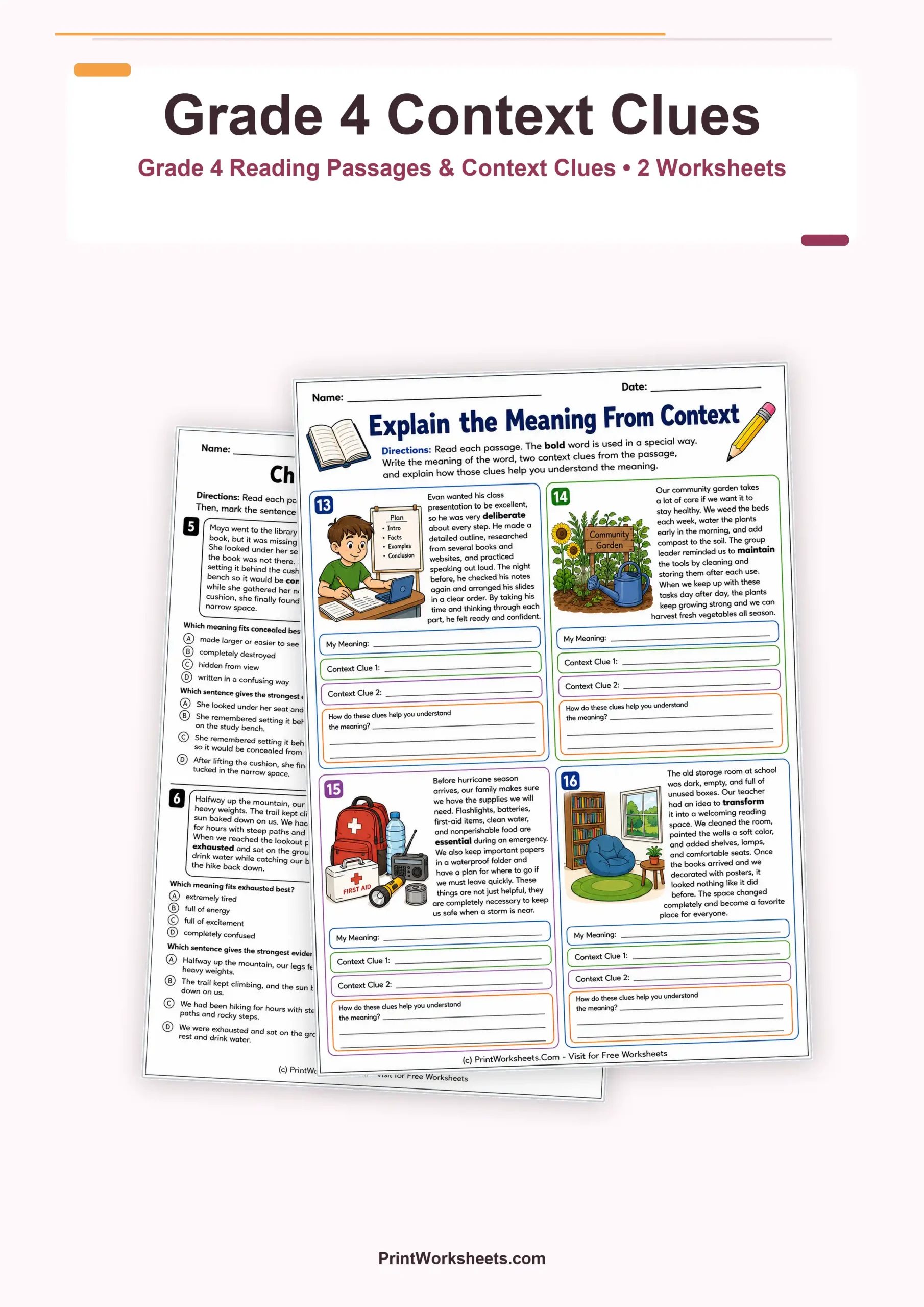
When fourth graders meet an unfamiliar word inside a passage, the most useful habit is not guessing from the word alone but looking at the sentences around it. These vocabulary context clues worksheets give students repeated practice doing exactly that. The printable set combines short reading passages with meaning questions, evidence choices, and written explanations so students learn to connect a word’s meaning to specific details in the text.
Practice Vocabulary Context Clues With Text Evidence
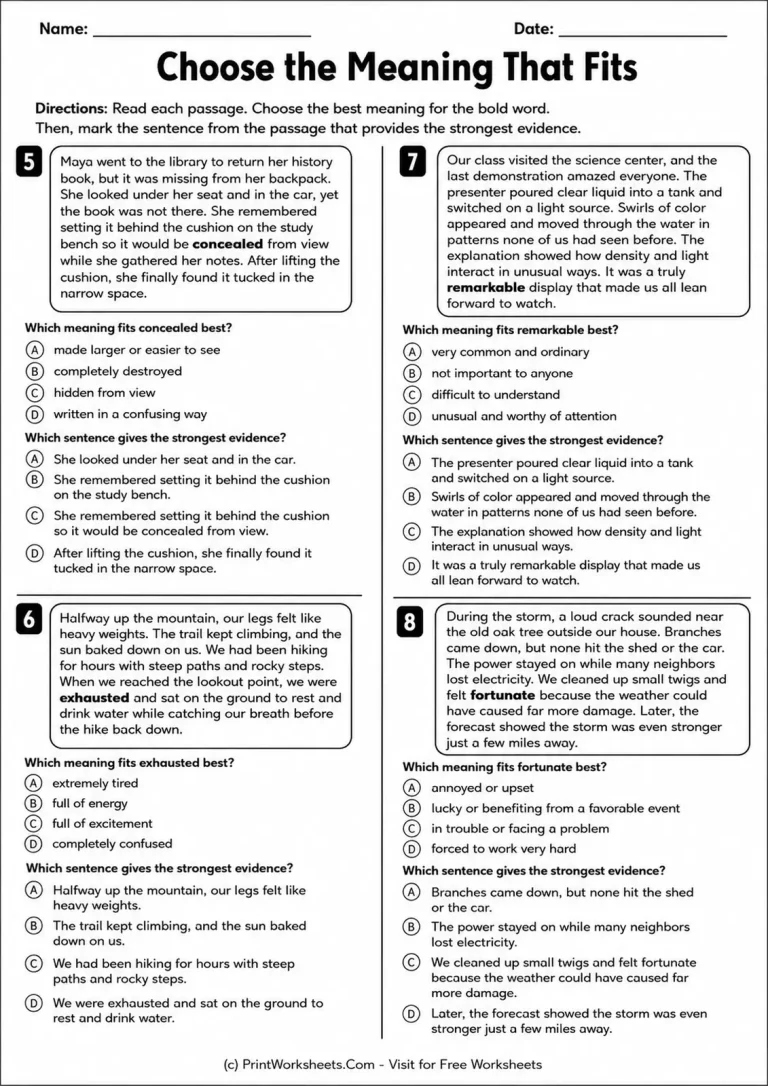
The first approved worksheet uses four compact reading passages built around the words concealed, exhausted, remarkable, and fortunate. Students first decide which meaning fits the bold word best. They then return to the passage and choose the sentence that gives the strongest evidence for that meaning. This second step makes the activity more than a simple vocabulary quiz because students must show which part of the text actually supports their answer.
The concealed passage describes a missing library book that had been placed behind a cushion and later found tucked into a narrow space. Those details point clearly toward the meaning hidden from view. In the exhausted passage, a long mountain hike, steep paths, rocky steps, and the need to sit down and rest help students infer extremely tired. The remarkable passage describes unusual color patterns during a science-center demonstration, while the fortunate passage focuses on a family avoiding serious storm damage even though nearby conditions were worse. Each passage gives students concrete evidence rather than requiring outside knowledge.
Move From Choosing an Answer to Explaining the Reasoning
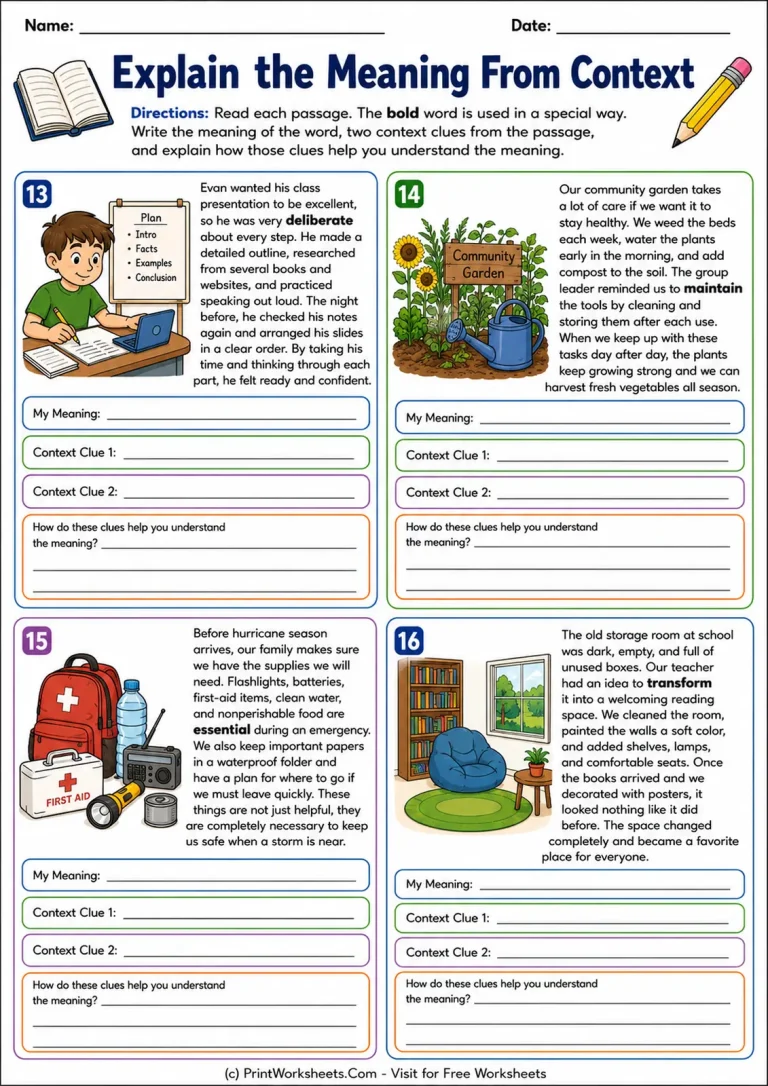
The second worksheet increases the level of independence. Instead of selecting from multiple-choice meanings, students read four new passages featuring deliberate, maintain, essential, and transform. For every word, they write their own meaning, identify two context clues from the passage, and explain how those clues helped them understand the word. This format is especially useful for seeing whether a student can transfer the skill beyond answer choices.
For deliberate, the passage describes a student making a detailed outline, researching from several sources, practicing a presentation, checking notes again, and arranging slides in a clear order. Together, those actions suggest careful and intentional work. Maintain appears in a community-garden passage where students weed beds, water plants, add compost, and clean and store tools. These repeated care routines point toward keeping something in good condition.
The passage for essential connects the word to emergency supplies such as flashlights, batteries, first-aid items, clean water, food, important papers, and an evacuation plan. The text directly emphasizes that these items are completely necessary for safety. Transform is presented through an old storage room that changes into a welcoming reading space after cleaning, painting, adding shelves and lamps, and decorating. The before-and-after description gives students a clear basis for interpreting transform as changing something completely.
How Teachers Can Use These Grade 4 Reading Passages
These pages can work as independent practice, a small-group lesson, homework, literacy-center work, or a quick formative assessment. One useful approach is to have students complete the multiple-choice evidence page first and discuss why one sentence is stronger evidence than another. That conversation can help students distinguish between a detail that merely appears in the passage and a detail that actually explains the target word.
The open-response page works well after that discussion because it requires students to supply their own reasoning. Teachers can ask students to underline the two clues they chose before writing their explanation. Students who need extra support can orally explain the relationship between the clues and the target word before writing. Students ready for a challenge can identify an additional clue, replace the target word with a synonym, or write a new sentence that uses the word with the same meaning.
Support Reading Comprehension and Academic Language Together
Context-clue work supports more than vocabulary growth. Students have to read closely, notice cause-and-effect relationships, compare details, and decide which information is most relevant. The evidence questions encourage careful reading, while the written explanations require students to put their thinking into words. That combination makes the worksheets useful for both vocabulary instruction and broader reading-comprehension practice.
Because the passages cover everyday school, science, community, safety, and reading-room situations, students encounter the target vocabulary in varied contexts. The result is a focused Grade 4 practice set that helps learners move from recognizing a likely meaning to defending that meaning with evidence from the text.