These text structure passages for Grade 4 help students notice how nonfiction writers organize ideas, not just what the passages are about. Across three printable worksheets, learners move from matching short passages to structure labels, to identifying signal words and relationships, and finally to explaining how a structure helps a reader understand information. The set works especially well after students have been introduced to description, chronological order or sequence, compare and contrast, cause and effect, and problem and solution.
Practice Five Common Nonfiction Text Structures
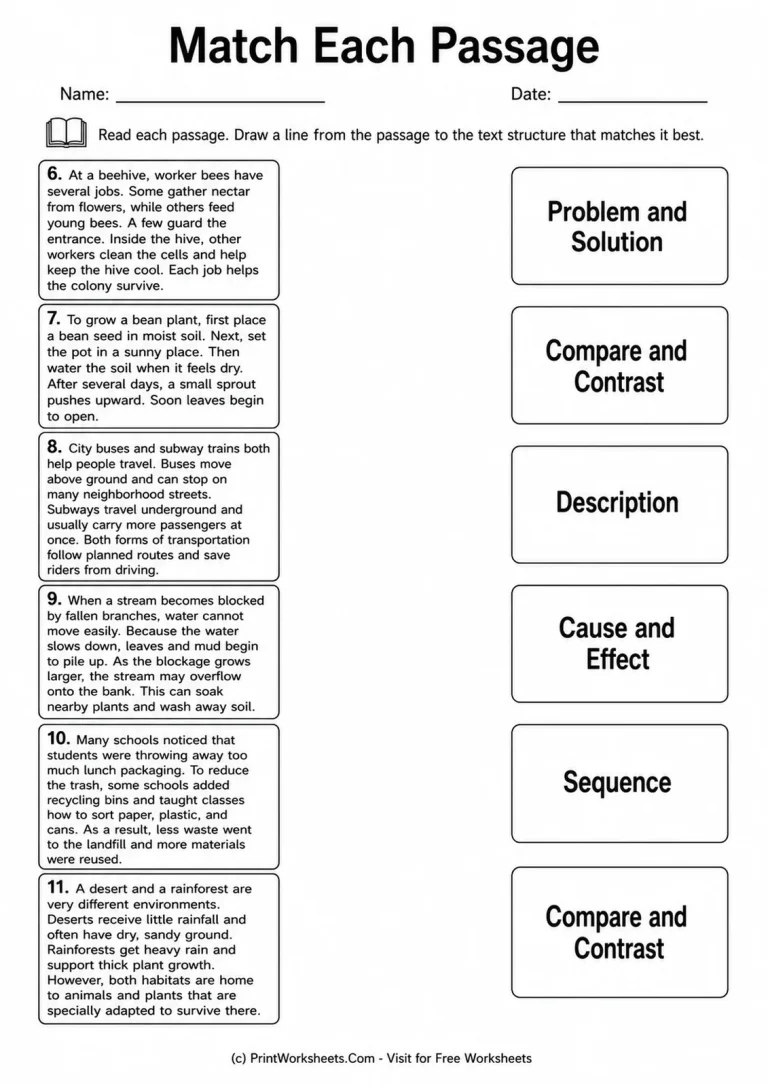
The first worksheet, Match Each Passage, gives students six compact reading selections and asks them to draw a line to the structure that fits best. The topics are varied enough to keep the focus on organization rather than memorizing one subject. A worker-bee passage describes several jobs inside and around a hive. A bean-plant passage uses a clear sequence from planting a seed through sprouting and opening leaves. Another selection compares buses and subway trains, while a stream blocked by fallen branches shows a chain of causes and effects. Students also read about schools reducing lunch-package waste through recycling and compare desert and rainforest environments.
This matching page is useful for quick guided practice because students can discuss the clues they noticed before committing to an answer. Teachers can ask students to underline words such as first, next, both, or because, then explain whether those words are the strongest evidence or whether the overall relationship among ideas matters more.
Move From Identifying Structure to Explaining the Writer’s Plan
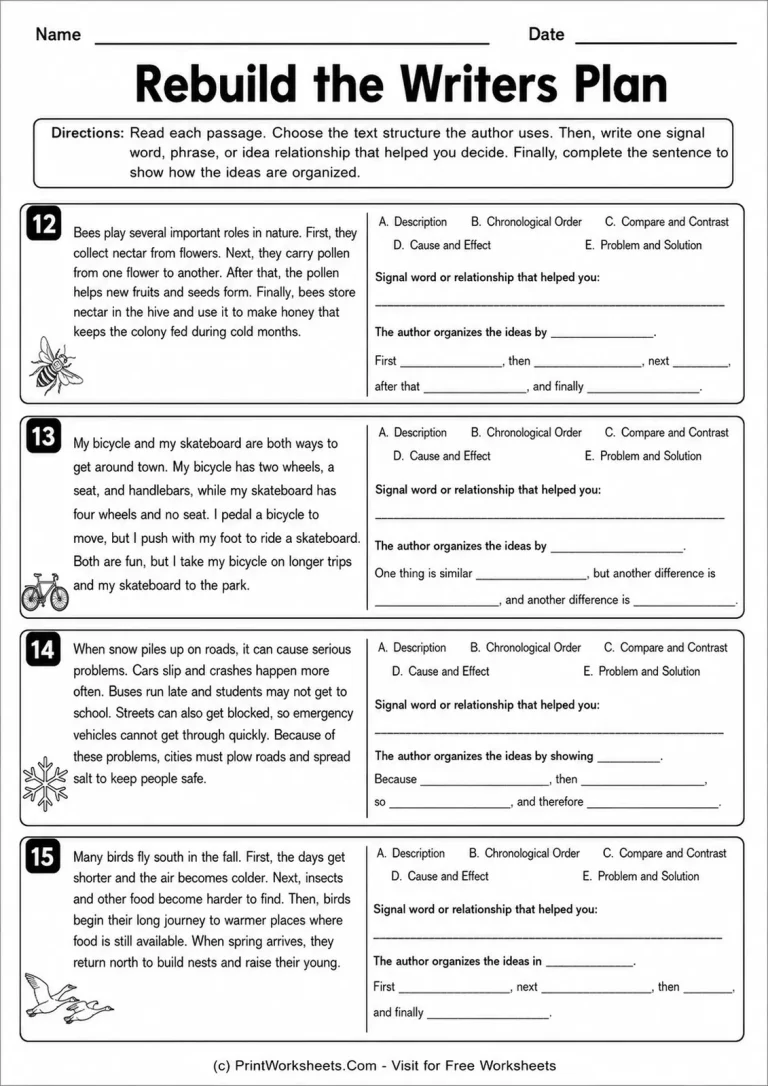
The second worksheet, Rebuild the Writers Plan, raises the level of thinking. Students read four passages and choose from Description, Chronological Order, Compare and Contrast, Cause and Effect, and Problem and Solution. They must also name a signal word, phrase, or idea relationship and complete a sentence frame that describes how the ideas are organized.
The passage about bees uses time-order cues such as First, Next, After that, and Finally. The bicycle-and-skateboard passage gives students a strong compare-and-contrast example through shared features and differences. A snowy-roads passage connects heavy snow with crashes, delays, blocked streets, and city safety responses, giving students practice tracing causes and results. The bird-migration passage organizes events in a seasonal sequence as fall conditions change and birds travel to warmer places before returning in spring.
Use Signal Words as Evidence, Not as a Shortcut
A key strength of these Grade 4 text structure reading passages is that students are asked to justify their choices. Signal words can point toward a structure, but the worksheets also encourage students to notice the relationship among ideas. For example, a passage may include the word because without being mainly organized as cause and effect. Asking students to explain the writer’s plan helps them look beyond one clue and consider the passage as a whole.
Independent Text Structure Analysis With Written Evidence
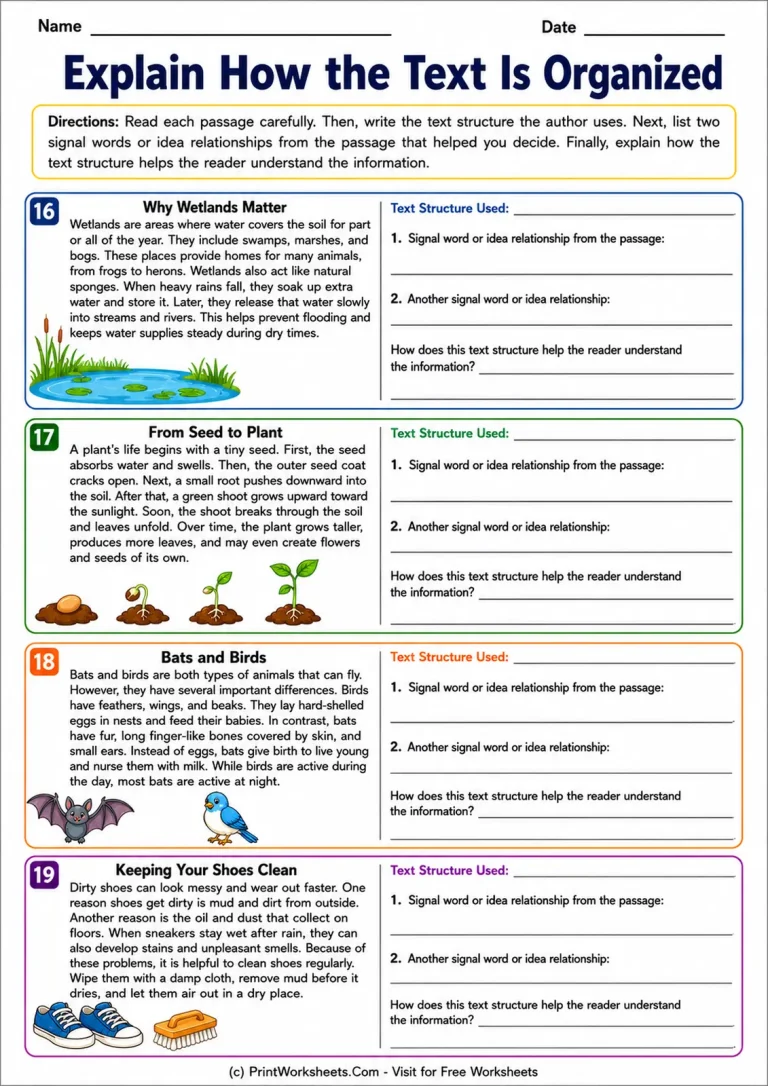
The final worksheet, Explain How the Text Is Organized, removes the multiple-choice support. Students name the structure, list two signal words or idea relationships, and explain how the organization helps them understand the information. The four passages provide distinct contexts for independent practice.
Why Wetlands Matter describes wetlands, the animals they support, and the way they store and release water. From Seed to Plant follows plant growth from a seed absorbing water to roots, shoots, leaves, flowers, and new seeds. Bats and Birds compares two flying animals using similarities and differences such as feathers, eggs, fur, live young, and activity patterns. Keeping Your Shoes Clean presents problems caused by mud, dust, water, stains, and odors, then explains a practical cleaning response.
Ways to Use These Worksheets in Grade 4
For whole-group instruction, model one passage by thinking aloud about the beginning, middle, and end of the author’s organization. In pairs, students can compare the evidence they selected and defend different interpretations using details from the text. For independent practice, assign the final page after students can reliably identify all five structures. The progression also makes the set useful for small-group reteaching: begin with matching, move to sentence frames, and then ask for a full written explanation.
Students who need extra support can create a five-column reference chart with each structure, common clue words, and a simple question such as “Is the author describing, sequencing, comparing, explaining why something happened, or solving a problem?” Students ready for extension can rewrite one passage using a different structure and discuss how the change affects clarity.
For additional lower-grade practice with short informational reading, teachers may also use these summer reading comprehension passages for Grade 2 as a scaffold before returning to the more analytical Grade 4 work. By the end of this set, students are practicing a complete comprehension routine: identify the structure, cite evidence from the passage, and explain how the organization supports meaning.