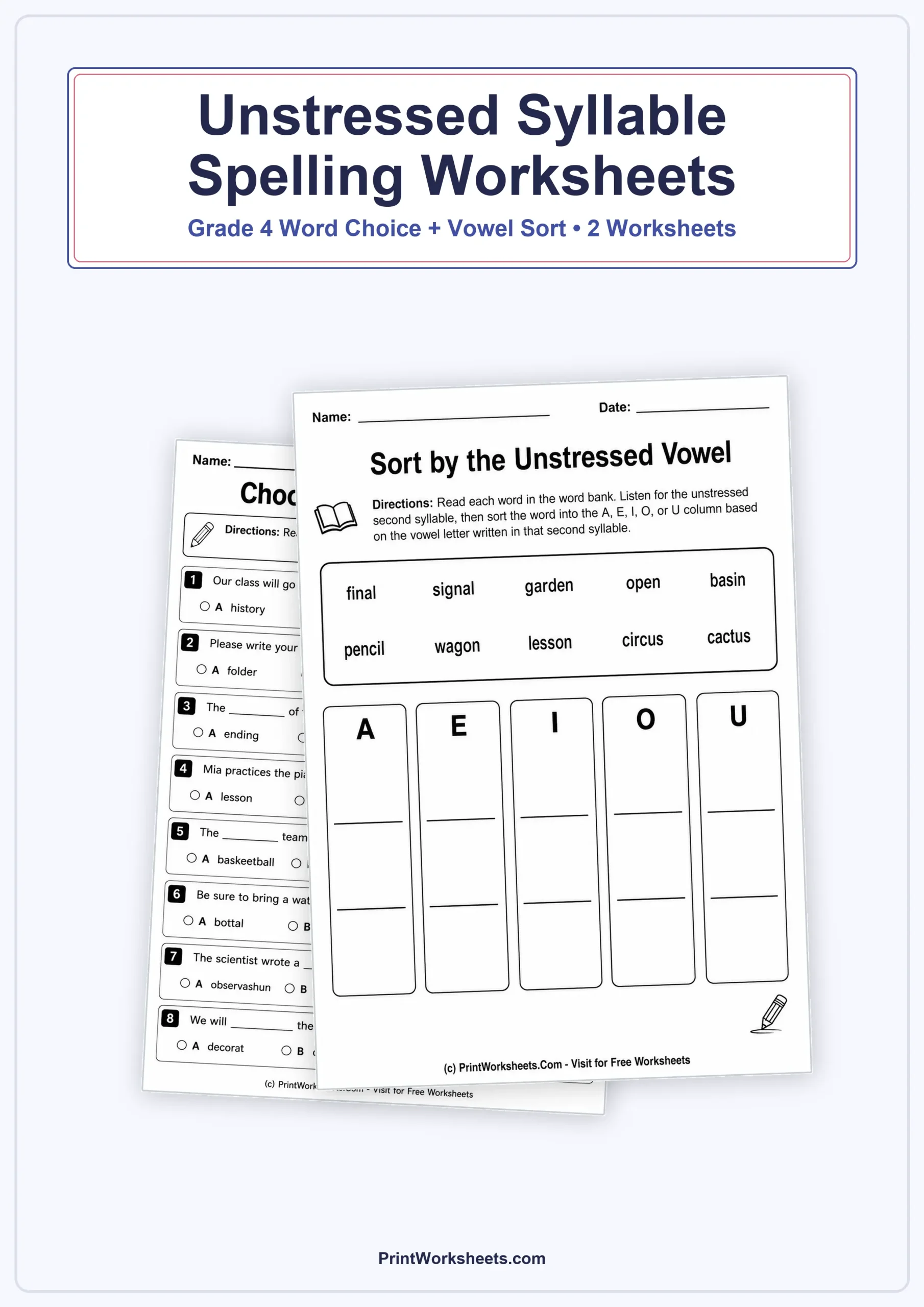
These unstressed syllable spelling worksheets give fourth-grade students two focused ways to examine words whose weaker syllables can make spelling less obvious. Instead of relying only on how a word sounds, students compare complete spellings in sentence context and then look closely at the written vowel inside a second unstressed syllable. The set includes one multiple-choice activity with eight sentences and one word-sorting activity built around ten words. Together, the pages move from recognizing the correct complete word to analyzing the particular vowel letter that appears in an unstressed part of the word.
Practice Unstressed Syllable Spelling in Context
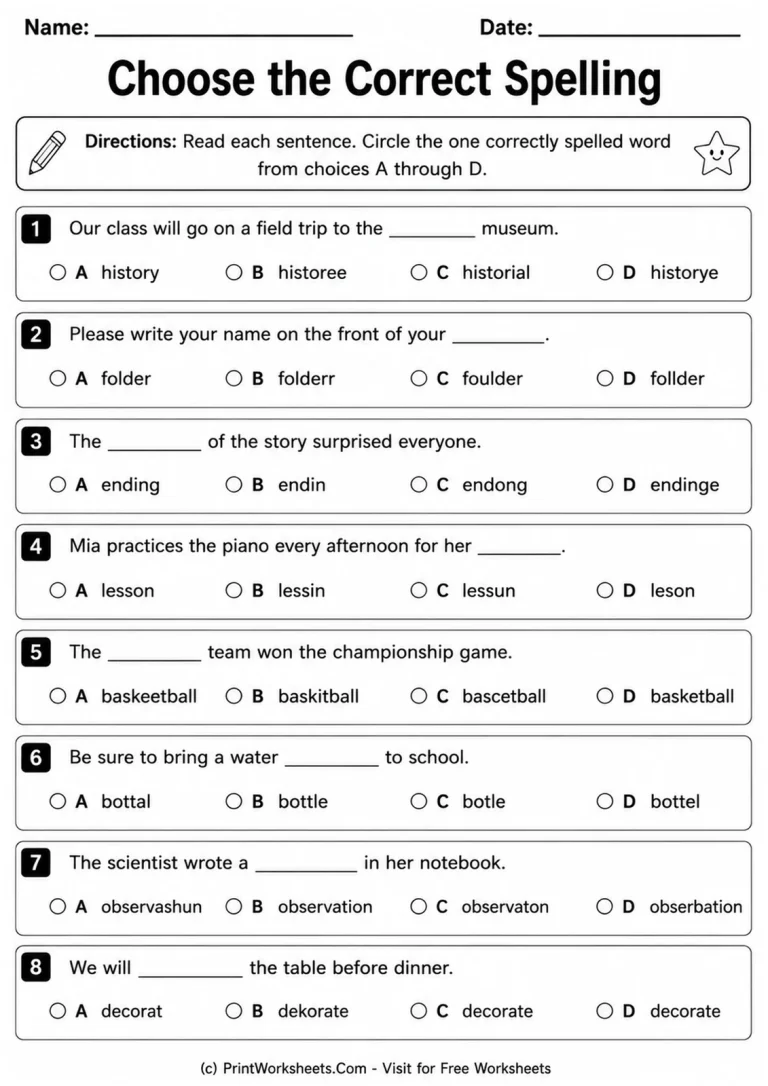
The first worksheet, Choose the Correct Spelling, presents eight sentences with a blank and four spelling choices labeled A through D. Students must use both the meaning of the sentence and their knowledge of conventional spelling to select the word that fits. The target words include history, folder, ending, lesson, basketball, bottle, observation, and decorate.
This format is useful because unstressed syllables are not always easy to spell by sound alone. A vowel in an unstressed syllable may be pronounced weakly, so students need to recognize the full visual pattern of the word rather than simply writing the first vowel they think they hear. The answer choices make those distinctions visible. Students compare several possibilities, reject misspelled forms, and select the standard spelling that works in the sentence.
The range of target words also keeps the exercise from becoming a single-pattern drill. Some words, such as folder, ending, and lesson, are relatively familiar and compact. Others, including basketball, observation, and decorate, require students to keep track of a longer letter sequence. That variety gives teachers and parents a practical way to see whether a learner can carry the same spelling attention from shorter words into more complex ones.
Sort Words by the Written Unstressed Vowel
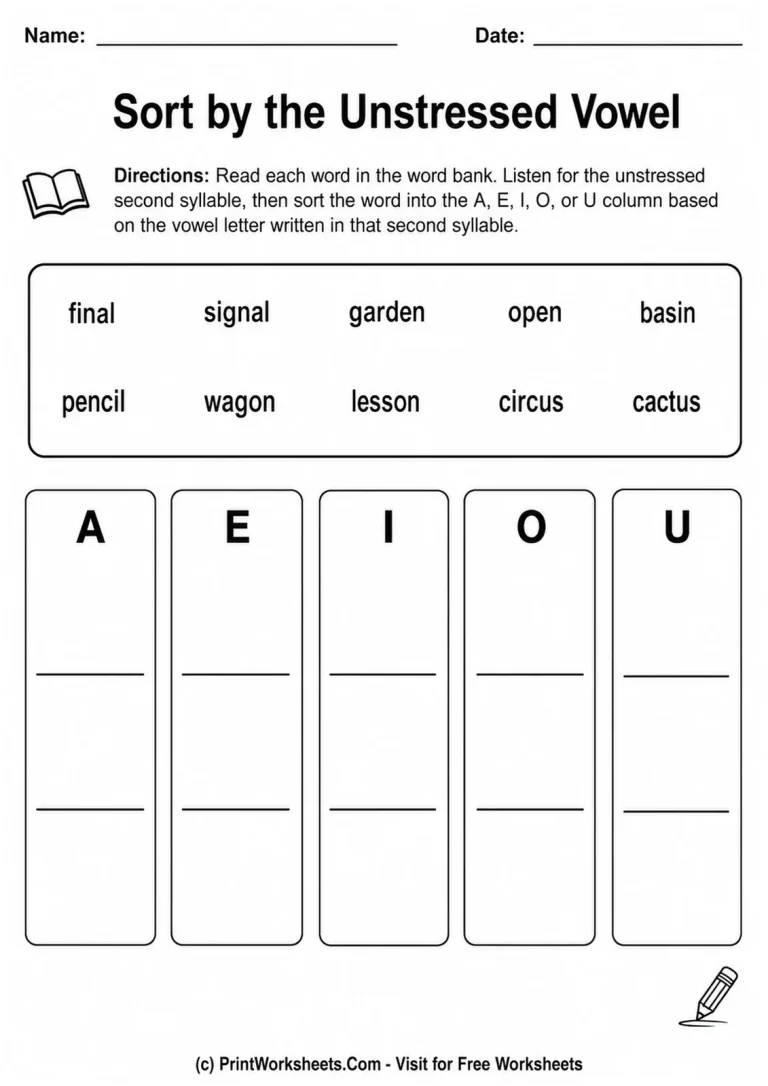
The second worksheet, Sort by the Unstressed Vowel, shifts the task from choosing a whole-word spelling to studying one specific feature inside each word. Students work with a ten-word bank containing final, signal, garden, open, basin, pencil, wagon, lesson, circus, and cactus.
Each word is sorted according to the vowel letter written in its second unstressed syllable. Five columns are provided for A, E, I, O, and U. This makes the spelling feature concrete: students are not asked merely to say that a syllable sounds weak. They must locate the unstressed syllable, inspect the spelling, identify the vowel that is actually written, and place the word into the matching group.
Why the A, E, I, O, and U Sort Matters
When a vowel sound is reduced in ordinary speech, the written letter can be difficult to predict from pronunciation alone. Sorting words by their written vowel helps students separate what they hear from what they see in standard spelling. For example, the activity encourages careful attention to the internal spelling of words such as garden, pencil, wagon, circus, and cactus rather than treating the unstressed syllable as an indistinct ending.
The five-column structure also supports comparison. Once several words are placed together, students can review which spellings share the same written vowel and which words that may sound somewhat similar are written differently. This kind of classification can be especially helpful after the multiple-choice page because the learner moves from recognizing a correct form to explaining a more specific spelling feature.
A Two-Step Grade 4 Spelling Review
These two worksheets work well as a short sequence. Begin with the sentence activity so students encounter complete words in meaningful contexts. After they have selected the correct spellings, use the vowel-sort page to slow the process down and focus attention on the unstressed syllable itself. The shift from whole-word recognition to letter-level analysis gives the set a clear progression without repeating the same task.
Teachers can use the pages during spelling practice, literacy centers, independent work, or a small-group review of multisyllabic words. Parents can also use them for focused home practice when a child tends to spell weak syllables only by sound. With eight contextual spelling decisions followed by ten classification words, the set provides a compact review of how careful visual analysis supports accurate spelling when an unstressed vowel is difficult to hear clearly.