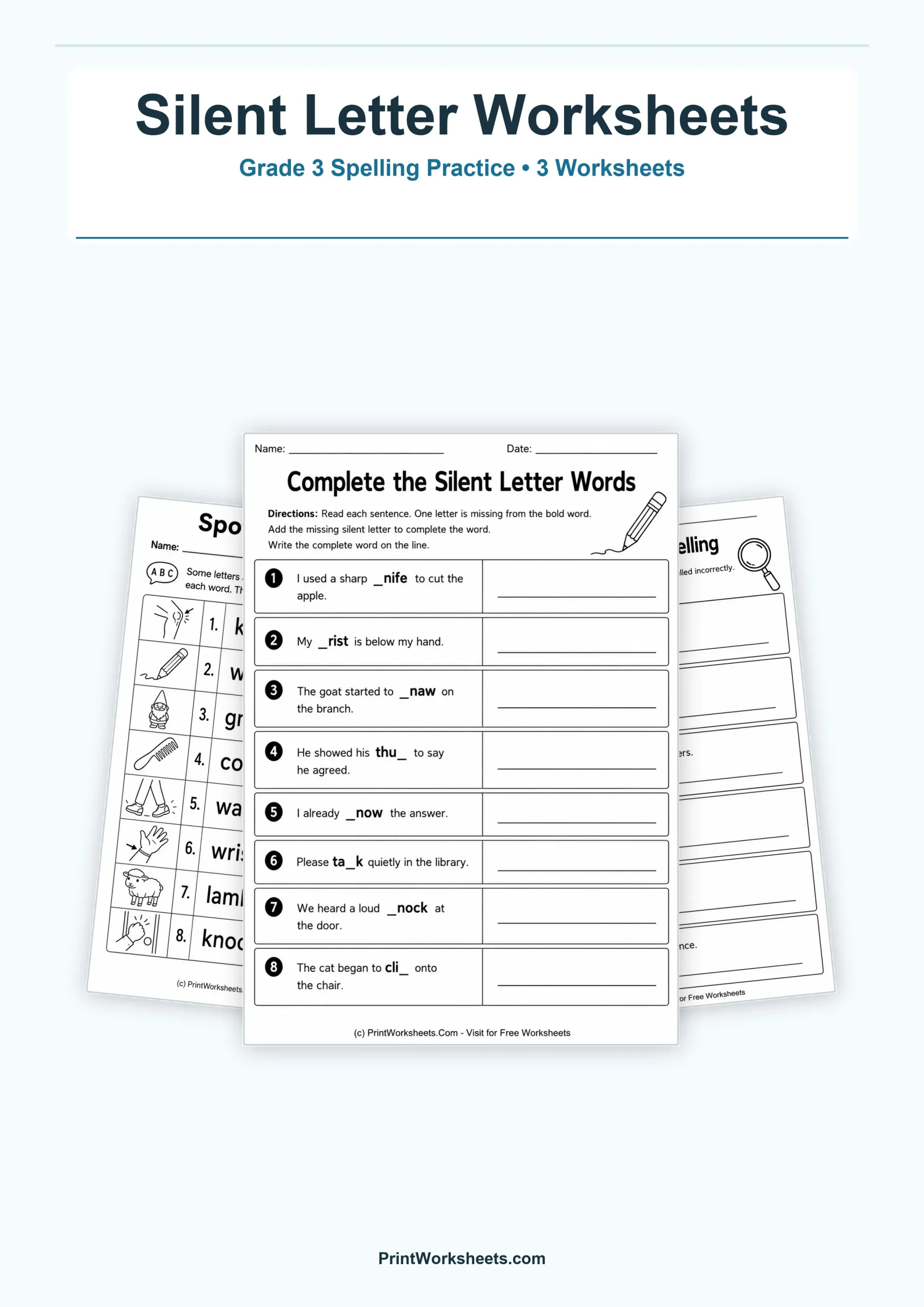
These silent letter worksheets give third-grade students focused spelling practice with words that contain letters they can see but do not hear. Across three printable pages, children work with familiar examples such as knee, write, gnome, comb, walk, wrist, lamb, knock, knife, thumb, know, talk, and climb. The activities move in a clear sequence: first students notice the silent letter in a complete word, then they restore a missing silent letter in sentence context, and finally they correct a misspelled silent-letter word.
Silent Letter Worksheets for Grade 3
Silent letters can make spelling difficult because the written form of a word does not always match what students hear when they say it aloud. This set helps students slow down and pay attention to the full spelling pattern. Instead of practicing every word in the same way, the worksheets ask students to recognize, complete, and correct silent-letter spellings through different tasks.
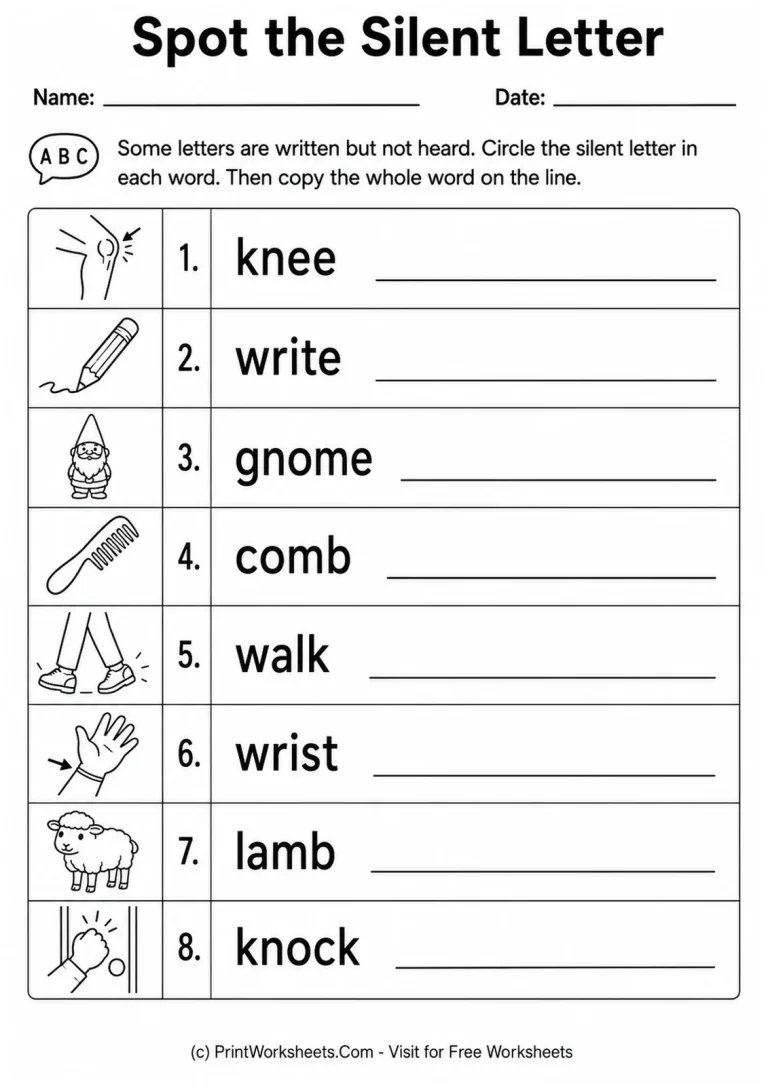
On the first worksheet, Spot the Silent Letter, students examine eight complete words, circle the silent letter, and copy each word. Picture cues support the vocabulary so students can connect the written word with a familiar object or action. The target words are knee, write, gnome, comb, walk, wrist, lamb, and knock. This page works well as an introduction because students can focus on noticing the unexpected letter before they have to produce the spelling independently.
Build Accuracy with Sentence Context
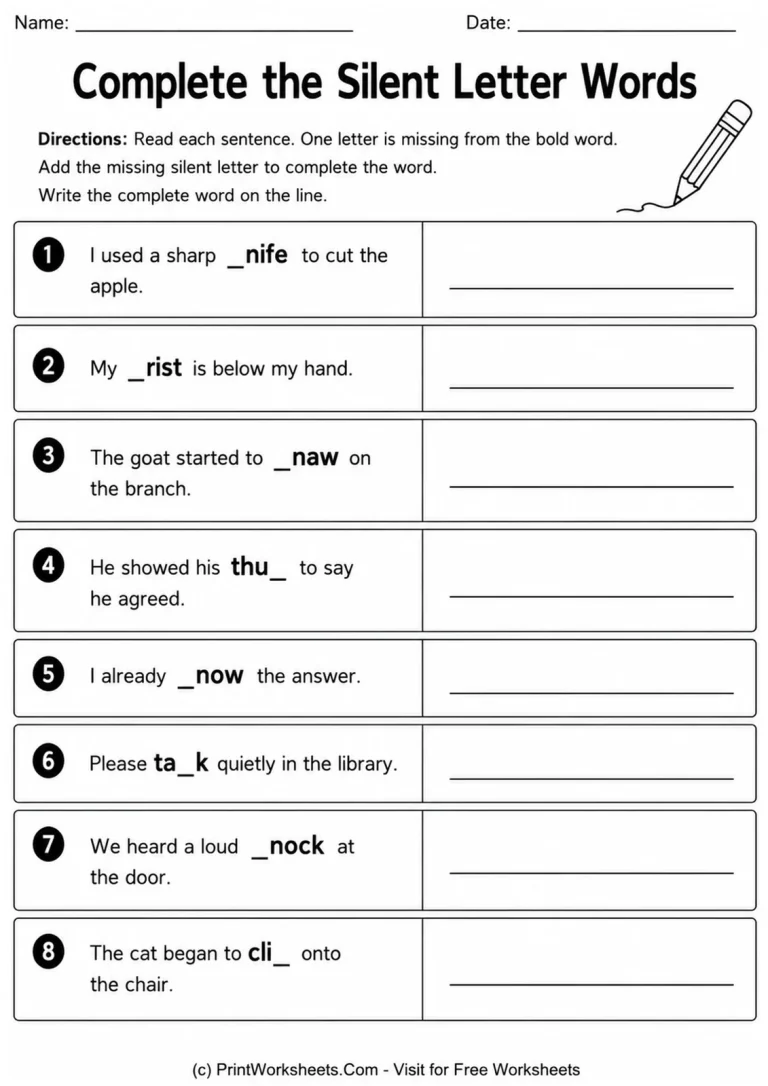
The next activity, Complete the Silent Letter Words, adds a stronger spelling challenge. Each sentence contains one bold word with a single missing silent letter. Students use the sentence meaning and the visible letters to decide which letter is missing, then write the complete word. The practice includes knife, wrist, gnaw, thumb, know, talk, knock, and climb.
Sentence context is useful here because students are not only recalling a spelling pattern in isolation. They also have to confirm that the completed word makes sense in the sentence. That combination supports careful word reading, vocabulary recognition, and more accurate spelling. Teachers can use the page for independent practice, a literacy center, partner checking, or a short review after teaching common silent-letter patterns.
Correct Common Silent-Letter Misspellings
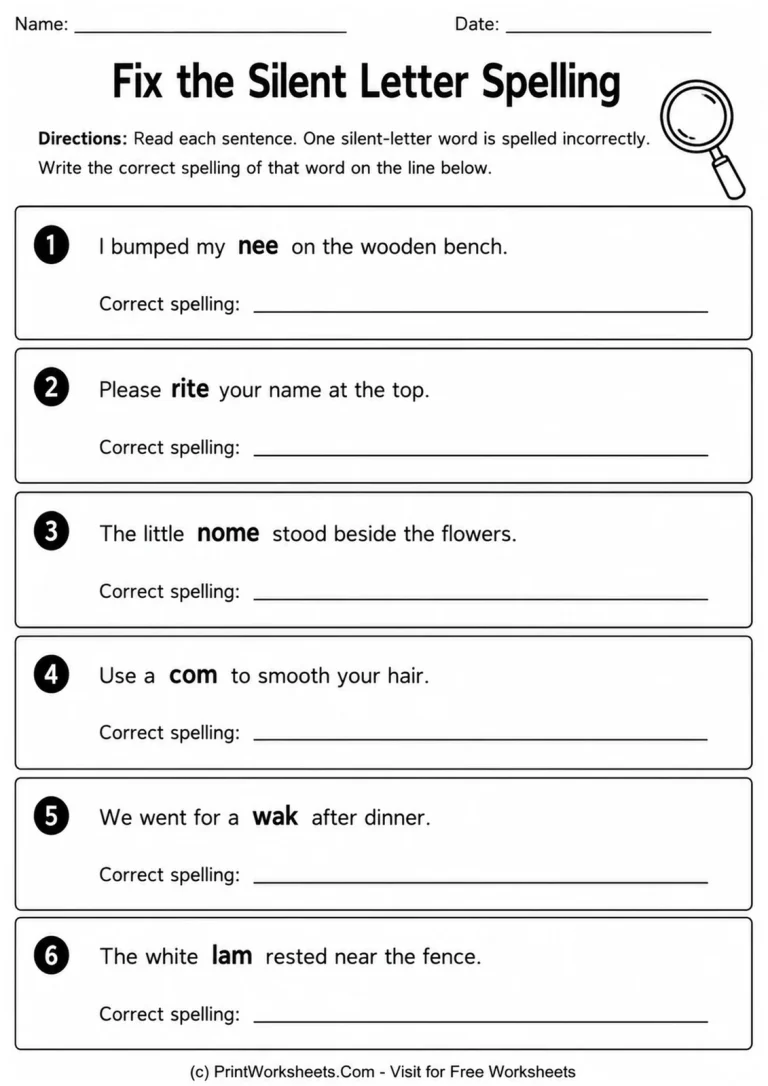
The third worksheet, Fix the Silent Letter Spelling, asks students to identify and repair incorrect spellings inside sentences. The bold words omit the silent letter, creating forms such as nee, rite, nome, com, wak, and lam. Students write the correct spellings: knee, write, gnome, comb, walk, and lamb.
Error correction changes the thinking task. Rather than simply copying a correct model, students must notice what is wrong, recall the missing letter, and rewrite the word accurately. This makes the page especially useful after students have already met the target words. It can also be used as a quick check for whether students are beginning to remember the written form without relying on a picture cue.
How to Use This Printable Set
The three pages can be taught as a short progression or used separately. Begin with the identification page when students are still learning that some letters are written but not pronounced. Move to the sentence-completion page when students are ready to supply the missing letter themselves. Finish with the correction page when you want students to proofread spelling and apply what they know.
For classroom use, these worksheets can fit into a spelling lesson, morning work, small-group instruction, literacy centers, intervention practice, or homework. Parents can also use one page at a time for extra practice at home. Because several words repeat across the set, students get another chance to strengthen memory for difficult spellings without repeating the exact same activity.
Silent-Letter Words Practiced
Students meet several common patterns, including silent k in knee, knife, know, and knock; silent w in write and wrist; silent g in gnome and gnaw; and other familiar examples such as comb, lamb, thumb, walk, talk, and climb. Seeing these words in different formats helps students notice that silent letters occur at the beginning, middle, or end of words.
A simple follow-up is to ask students to sort the practiced words by silent letter or to use selected words in original sentences. They can also create a personal list of silent-letter words that are still difficult for them. This extends the printable practice into a useful spelling reference and makes future review more targeted.
Use these Grade 3 silent letter worksheets when students need structured practice that goes beyond memorizing a list. The set keeps the skill narrow, but the tasks change enough to require attention at each stage: identify the hidden spelling feature, complete it in context, and correct it when it is missing.