

These animal writing worksheets give first graders a concrete way to move from reading simple facts to writing clear informative sentences. Animals provide an accessible subject for young writers because children can connect visible features, habitats, foods, and behaviors with short factual statements. Across the three printable activities, students sort information, decide which statements are trustworthy facts, and then use brief notes to construct their own complete sentences.
Animal Writing Worksheets That Build Fact-Based Writing Skills
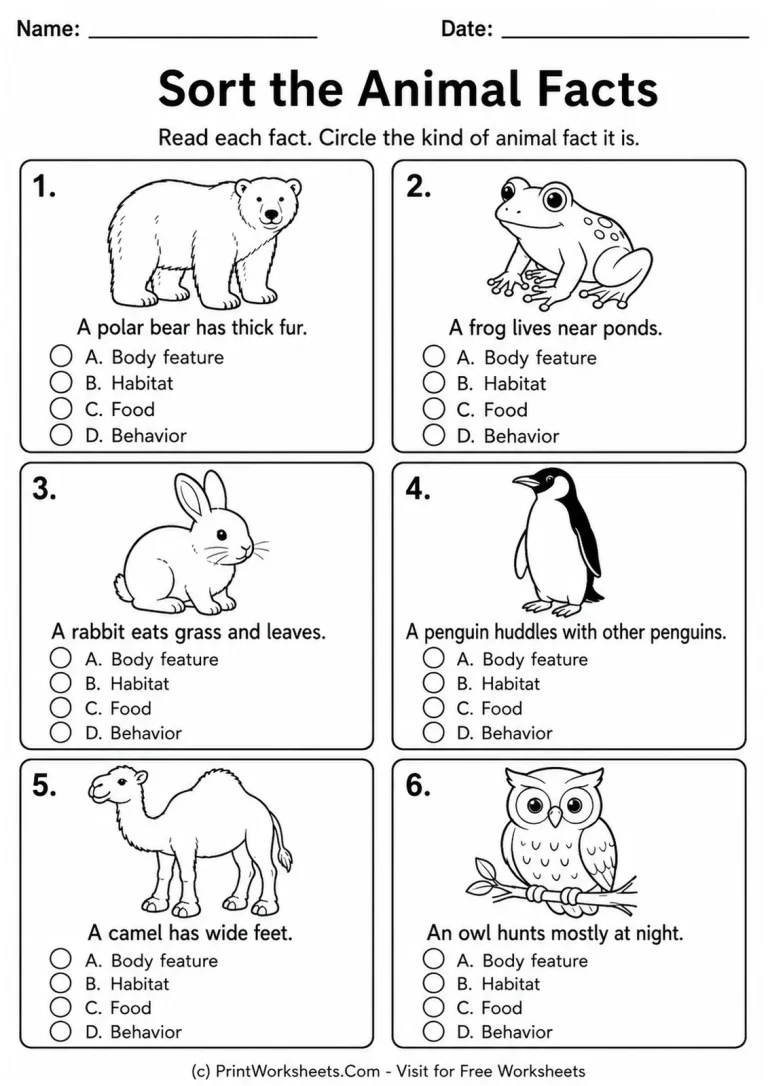
The set begins with a sorting activity titled Sort the Animal Facts. Students read six short statements about familiar animals and decide whether each fact describes a body feature, habitat, food, or behavior. For example, a polar bear’s thick fur is classified as a body feature, a frog living near ponds represents habitat, and a rabbit eating grass and leaves belongs in the food category. Students also identify a penguin huddling with other penguins and an owl hunting mostly at night as behaviors.
This categorization step is useful preparation for informative writing because it shows children that factual details can serve different purposes. Instead of treating every animal fact as the same kind of information, students begin organizing ideas into meaningful categories. Teachers can use the four labels as oral prompts before writing: What does the animal look like? Where does it live? What does it eat? What does it do?
Choosing Accurate and Useful Animal Facts
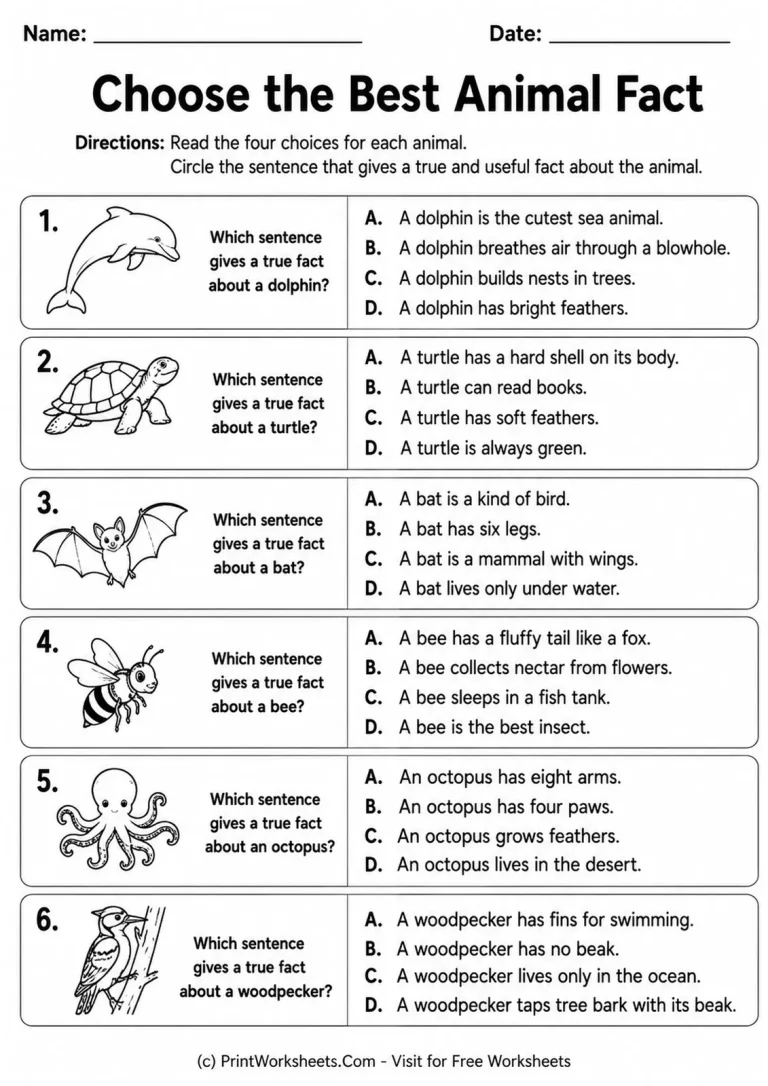
The second activity, Choose the Best Animal Fact, asks students to select one true and useful statement from four choices for each animal. The examples include a dolphin breathing air through a blowhole, a turtle having a hard shell, a bat being a mammal with wings, a bee collecting nectar from flowers, an octopus having eight arms, and a woodpecker tapping tree bark with its beak.
The distractors are deliberately easy for developing readers to evaluate. Children encounter statements that are clearly incorrect, such as a turtle reading books or an octopus having four paws, as well as subjective wording such as calling an animal the cutest or best. That contrast supports an important early informational-writing habit: writers should use verifiable facts rather than opinions when their purpose is to teach a reader about a topic.
From Animal Facts to Complete Informative Sentences
The final approved worksheet shifts from recognition to written production. In Build Animal Fact Sentences, students receive three short notes for each of six animals: sea turtle, giraffe, penguin, beaver, owl, and elephant. Each box also provides a sentence starter, such as “A sea turtle,” “A giraffe,” or “An owl,” followed by handwriting space for the student to finish the thought.
The notes give children enough information to create meaningful sentences without requiring outside research. A sea turtle is identified as a reptile that lives in the ocean and uses flippers to swim. A giraffe is described as a mammal that lives in the savanna and has a long neck. Students can also write about a penguin swimming even though it cannot fly, a beaver building dams near water, an owl hunting at night, or an elephant using its trunk.
A reminder at the top of the page tells students to begin with a capital letter and finish with a period. This keeps the writing task manageable for Grade 1 while reinforcing basic sentence conventions. Because several accurate facts are available for each animal, children can create different correct sentences rather than simply copying one predetermined answer.
Ways to Use These Grade 1 Informative Writing Activities
The three pages work well as a short sequence over several lessons. Begin with the sorting page during a whole-group or partner lesson so students become comfortable with the categories of animal information. Follow with the multiple-choice fact activity to practice distinguishing factual, useful information from statements that are inaccurate or based on opinion. Finish with the sentence-building page as an independent writing task or small-group lesson.
For students who need extra support, read the animal facts aloud and ask them to explain their choice before marking an answer. You can also let students orally complete a sentence starter before writing it. More confident writers can combine two provided notes into one longer sentence, such as explaining both where an animal lives and what it does.
Quick Assessment and Extension Ideas
Use one animal from the sentence-building page as a quick exit ticket. Ask the student to state one accurate fact orally and then write it as a complete sentence with a capital letter and period. For an extension, invite students to choose another familiar animal and generate one fact for two or three categories such as habitat, food, body feature, or behavior.
These activities keep the emphasis on evidence-based information while giving young learners repeated practice with reading, organizing, and writing facts. By the end of the set, students have moved from identifying categories of information to evaluating factual statements and finally producing their own informative animal sentences.