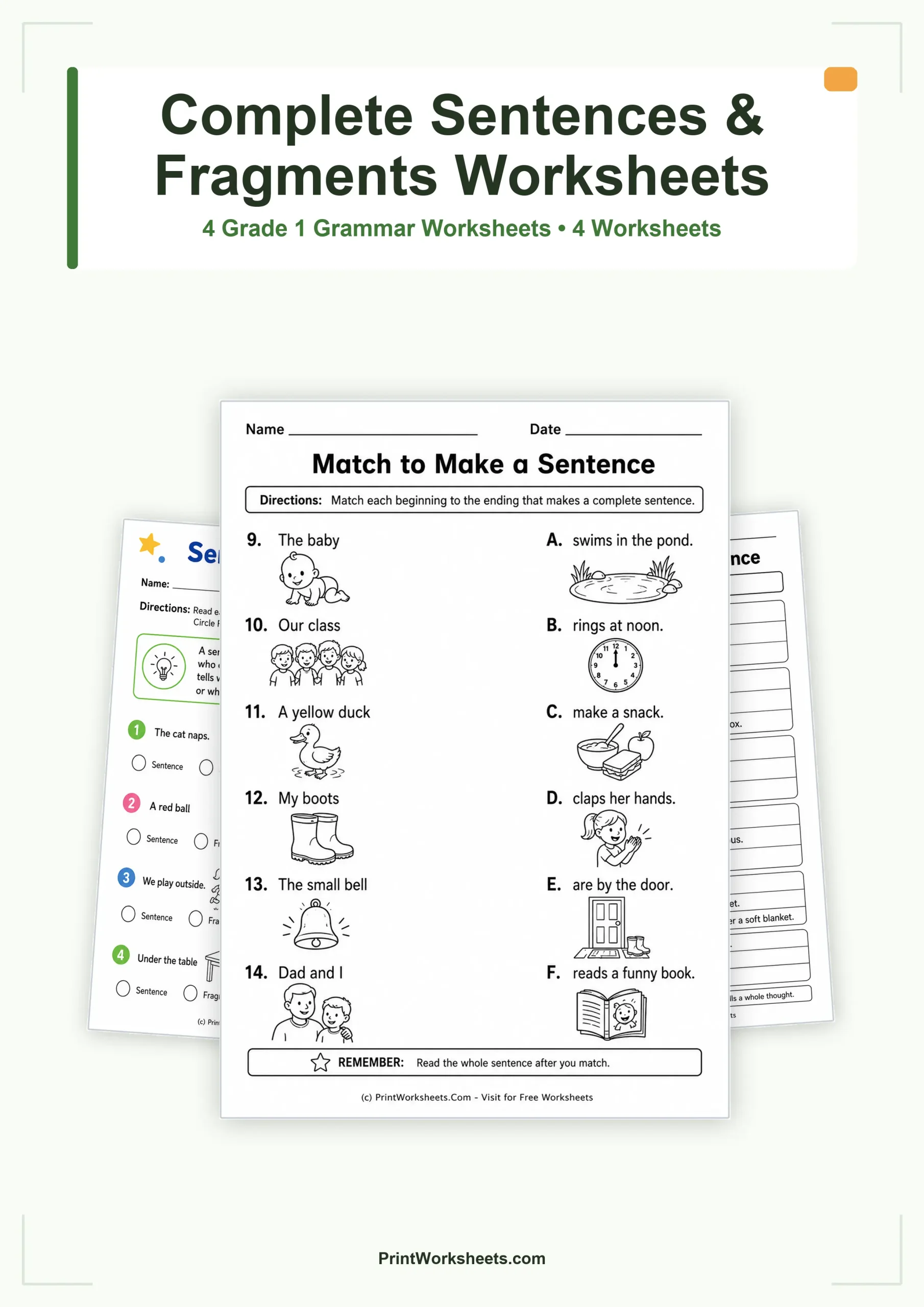
These sentence fragments worksheets give first graders several clear ways to decide whether a group of words expresses a complete thought. Instead of repeating the same question format, the four-page set moves from simple recognition to matching, multiple-choice identification, and finally sentence repair. Short examples, familiar subjects, and limited choices keep the grammar work accessible while helping students notice that a complete sentence needs both a naming part and a telling part.
Sentence Fragments Worksheets for Grade 1 Practice
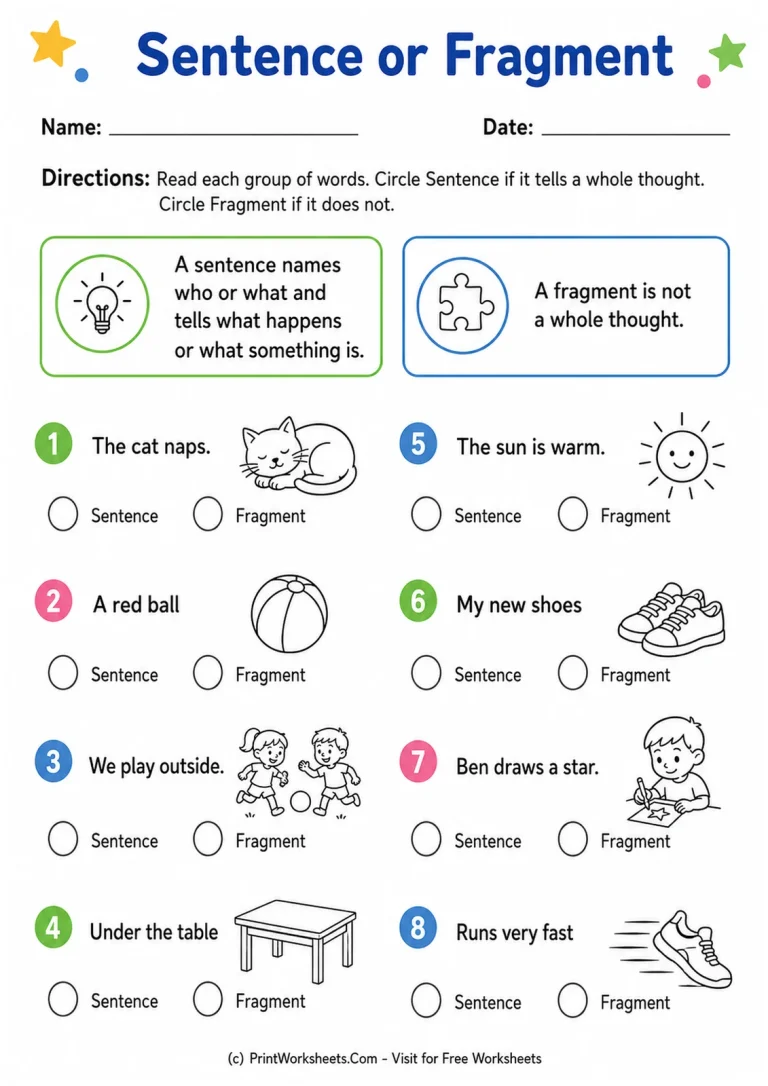
Young learners often recognize that a sentence sounds finished before they can explain why. The first worksheet makes that idea concrete. Students read eight short word groups and circle either Sentence or Fragment. Complete examples include simple thoughts such as “The cat naps.” and “The sun is warm.” Fragments such as “A red ball” and “Runs very fast” show two common ways a thought can be incomplete.
The page also gives students a useful test: a sentence names who or what and tells what happens or what something is. That simple language gives Grade 1 students a practical way to check their answers instead of relying only on punctuation or sentence length.
Four Ways to Practice Complete Sentences and Fragments
1. Classify Sentences and Fragments
The opening activity works well as a quick introduction, warm-up, or informal check. Because the examples are short, students can focus on meaning and sentence completeness without having to decode long passages. The mix of complete thoughts and incomplete word groups helps reveal whether students understand the difference between a subject-only phrase, a predicate-only phrase, and a full sentence.
2. Match Sentence Beginnings and Endings
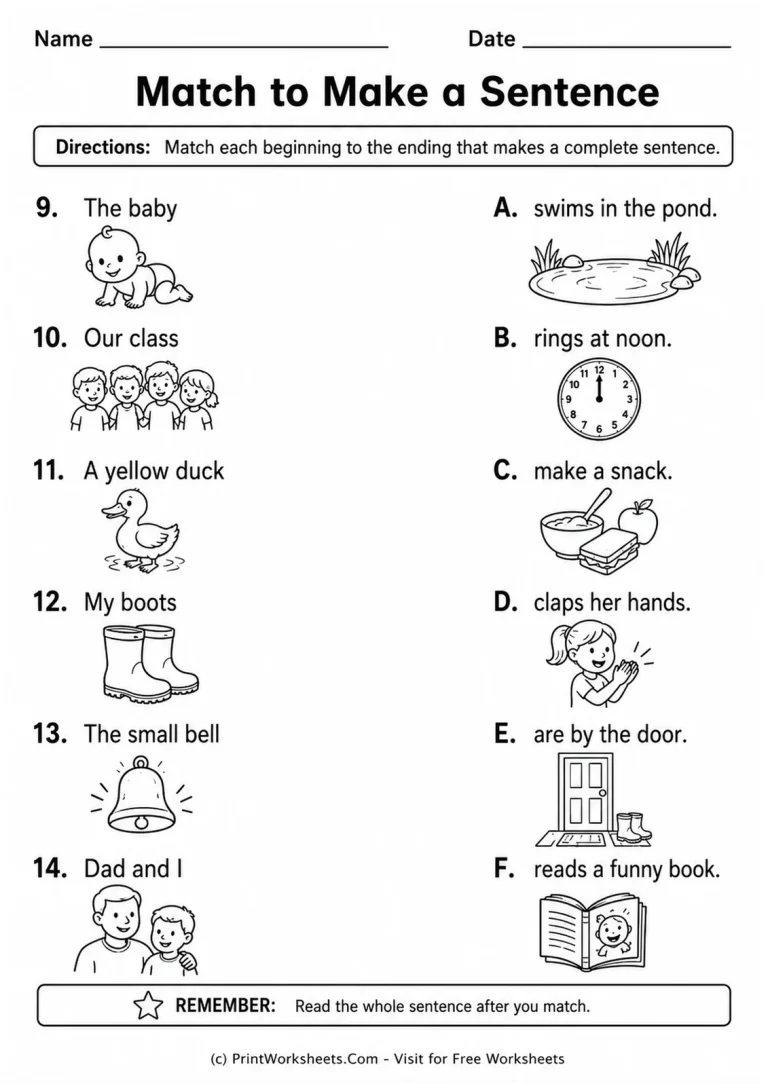
The second worksheet changes the task from identifying sentences to building them. Students match six sentence beginnings with six endings to create complete thoughts. Familiar beginnings such as “The baby,” “Our class,” “A yellow duck,” “My boots,” “The small bell,” and “Dad and I” help keep attention on grammar rather than difficult vocabulary.
After matching, students are reminded to read the whole sentence. This encourages them to check both grammar and meaning. It also makes the relationship between the naming part and the telling part easier to see because students physically connect the two pieces.
3. Choose the One Complete Sentence
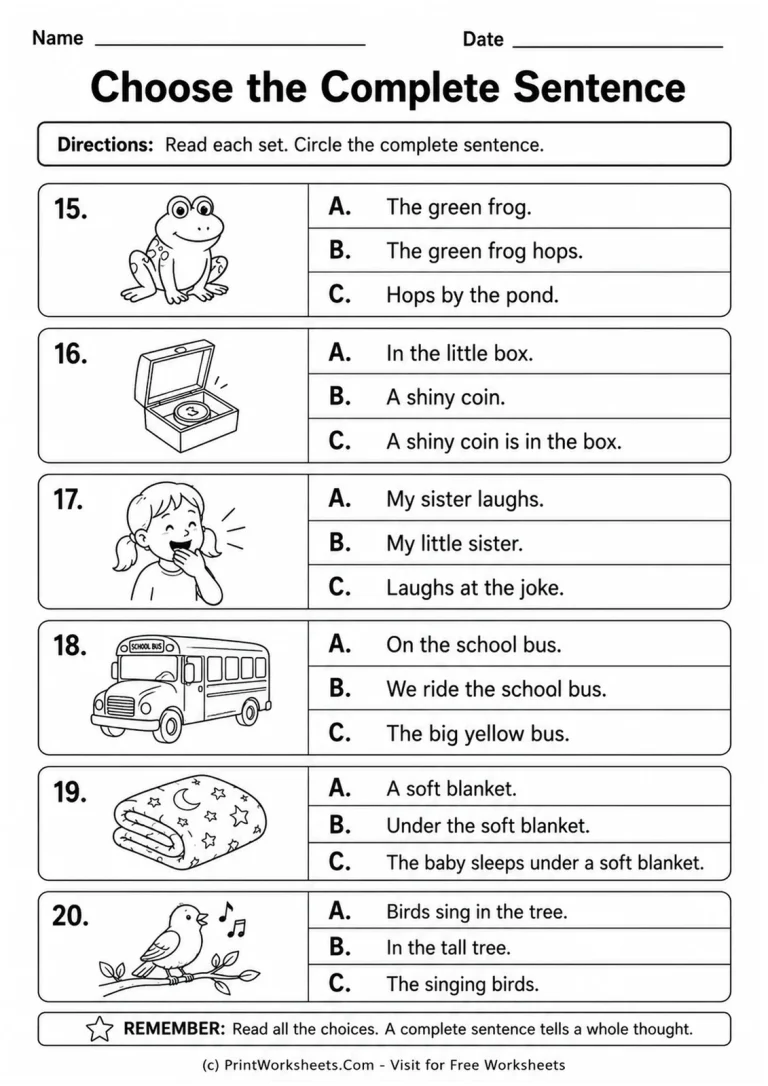
On the third page, students work through six multiple-choice sets. Each set includes one complete sentence and two incomplete choices. The distractors include noun phrases, prepositional phrases, and groups of words that have a telling part but no clear naming part.
Contexts such as a frog, a coin in a box, a laughing sister, a school bus, a blanket, and birds in a tree keep the examples concrete. Students must read for a whole thought instead of simply picking the longest option. This makes the page useful for independent practice after the skill has been introduced.
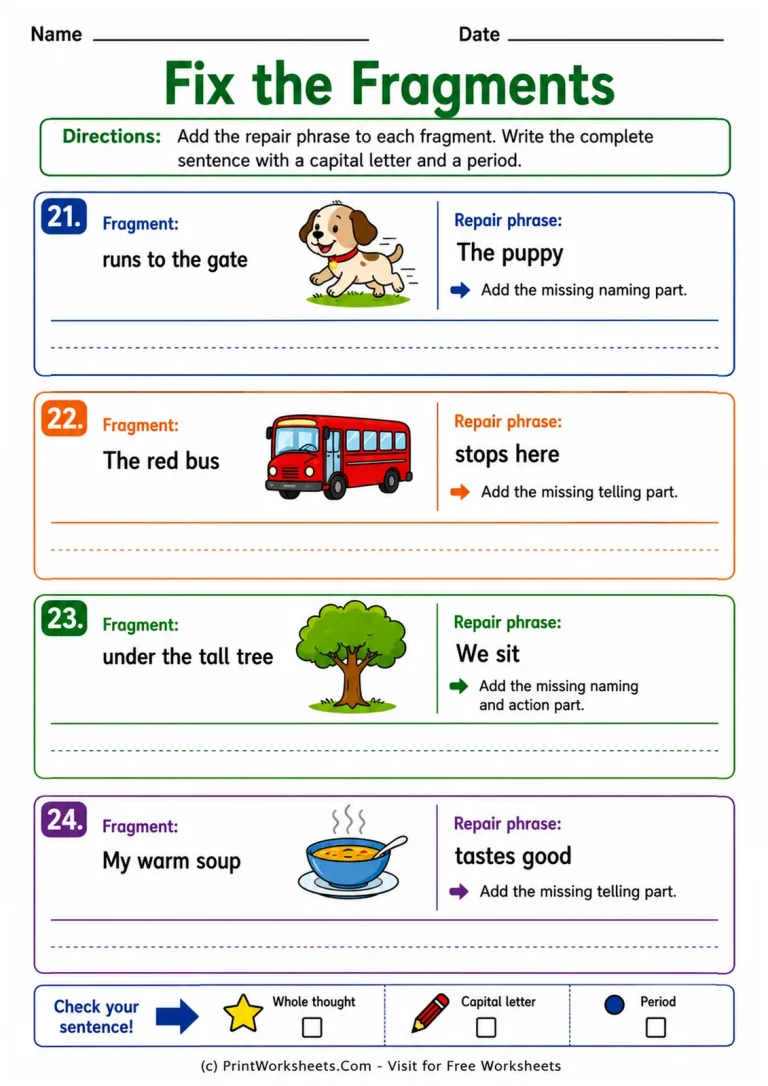
4. Fix the Fragments
The final student worksheet moves from recognition to writing. Students repair four fragments by combining each one with a supplied phrase. Some prompts are missing the naming part, others are missing the telling part, and students use the added information to create a complete sentence.
They then write the finished sentence with a capital letter and a period. This final step connects sentence completeness with basic writing conventions and gives students a chance to produce complete sentences rather than only identify them.
How to Use These Grade 1 Grammar Worksheets
The four activities can be taught in order as a short sentence unit, but each page can also stand on its own. The classification page is useful for a lesson opener or quick skill check. The matching activity works well during guided practice or a literacy center because students must think about which sentence parts logically belong together.
The multiple-choice page provides a straightforward independent check, while the fragment-repair activity is well suited to follow-up writing practice, homework, or a short assessment. Teachers and parents can also spread the pages across several days so students revisit the same concept through different kinds of thinking.
From Recognizing a Sentence to Building One
The strongest feature of this set is its progression. Students first decide whether a thought is complete, then connect two parts to make a sentence, identify the one complete option among distractors, and finally repair incomplete thoughts themselves. That sequence helps move Grade 1 learners from noticing sentence structure to using it in their own writing.
For students who are still developing early grammar skills, this variety can make complete sentences and fragments easier to understand. Each page asks a different question about the same central idea: does this group of words name who or what and tell a complete thought? By the end of the set, students have practiced answering that question in four different ways.