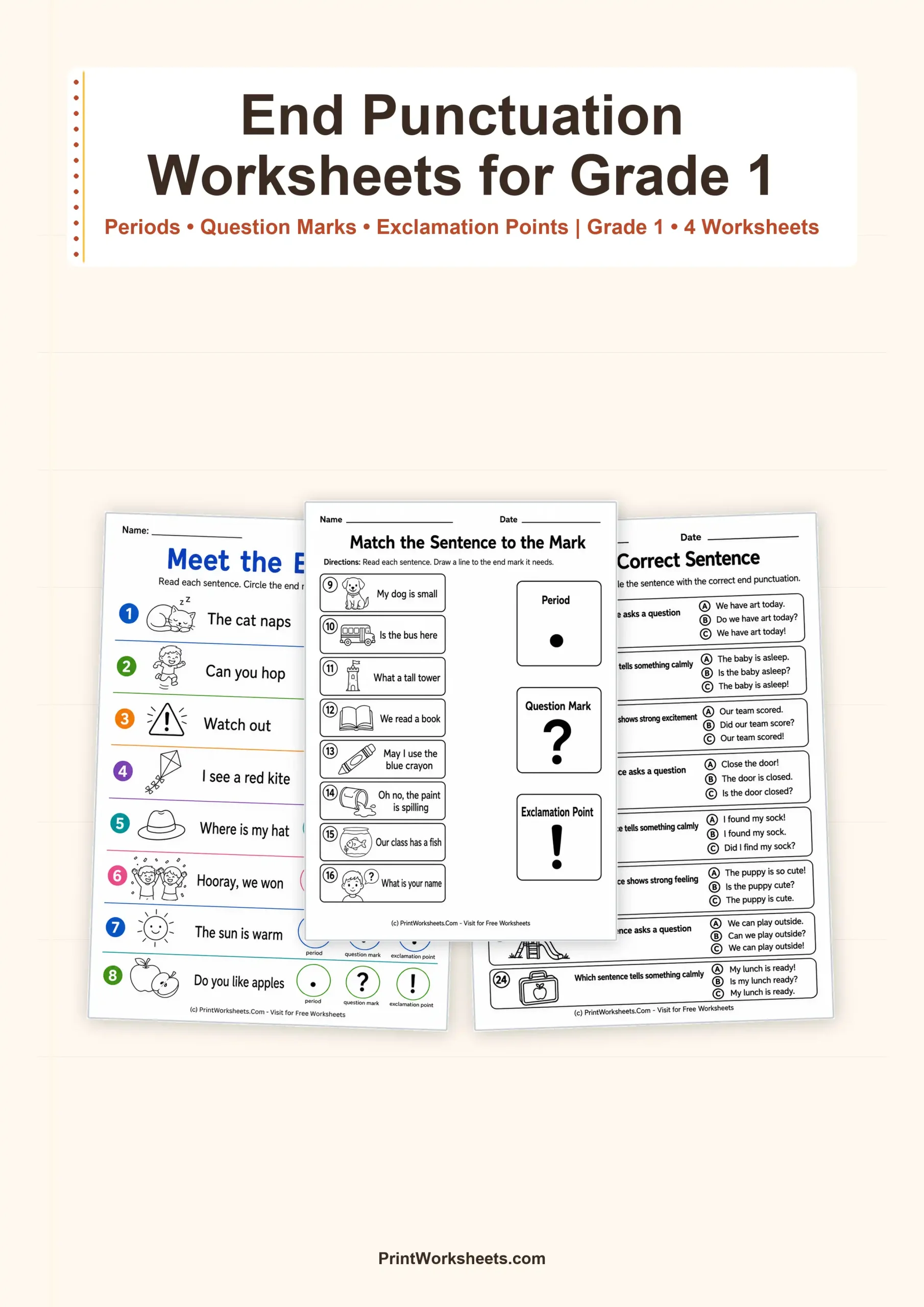
These end punctuation worksheets give first graders focused practice with the three marks they see most often at the ends of sentences: the period, question mark, and exclamation point. Across four printable activities, children read short, accessible sentences and decide whether each one tells something, asks something, or expresses a strong feeling. The tasks change from page to page, so students practice the same core skill without simply repeating one worksheet format.
End Punctuation Worksheets for Periods, Questions, and Exclamations
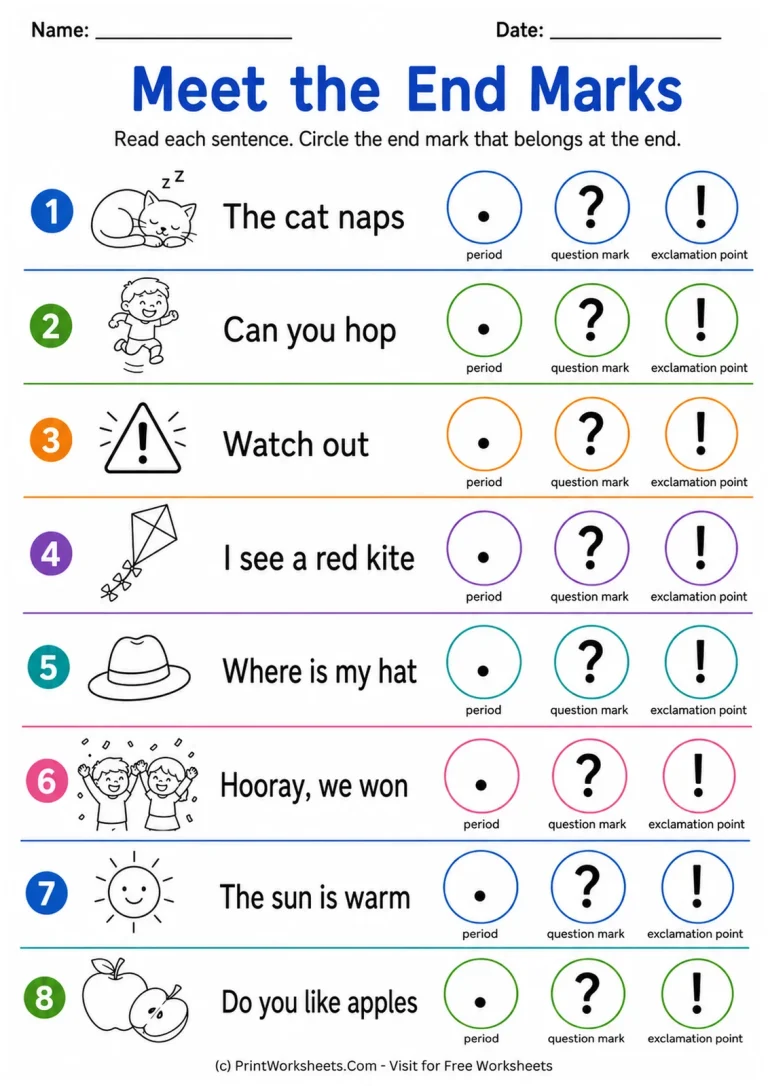
The first worksheet, Meet the End Marks, begins with direct recognition. Students read eight short sentences and circle the correct ending from a period, question mark, or exclamation point. This format works well for early practice because all three choices are visible beside each sentence. Children can focus on meaning first and then connect that meaning to the correct punctuation mark.
The examples represent the three sentence purposes clearly. A question such as “Do we have art today?” needs a question mark because it asks for information. A calm statement such as “The baby is asleep.” ends with a period. A sentence such as “Our team scored!” communicates excitement and calls for an exclamation point. These contrasts help young learners understand that end marks are connected to what a sentence is doing, not just how it looks.
Practice the Same Skill in Different Ways
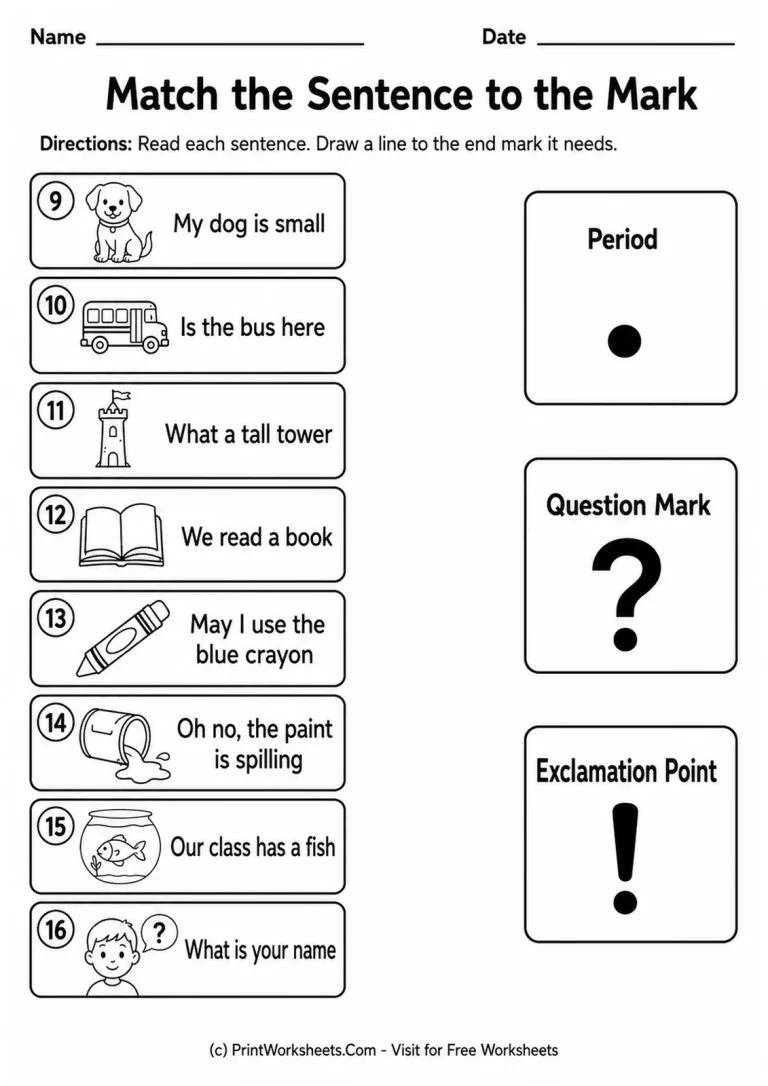
The second worksheet, Match the Sentence to the Mark, changes the task from choosing to classifying. Students read eight more sentences and match each one to a box labeled Period, Question Mark, or Exclamation Point. Instead of selecting from punctuation symbols beside every sentence, children must decide which punctuation category fits the sentence and connect it to the correct label.
This page can be especially useful after students know the names of the three marks. It reinforces punctuation vocabulary while also checking whether children can distinguish statements, questions, and strong feelings. Examples such as “Can we play outside?”, “My lunch is ready.”, and “The puppy is so cute!” give students concrete sentence types to compare.
Choose the Correctly Punctuated Sentence
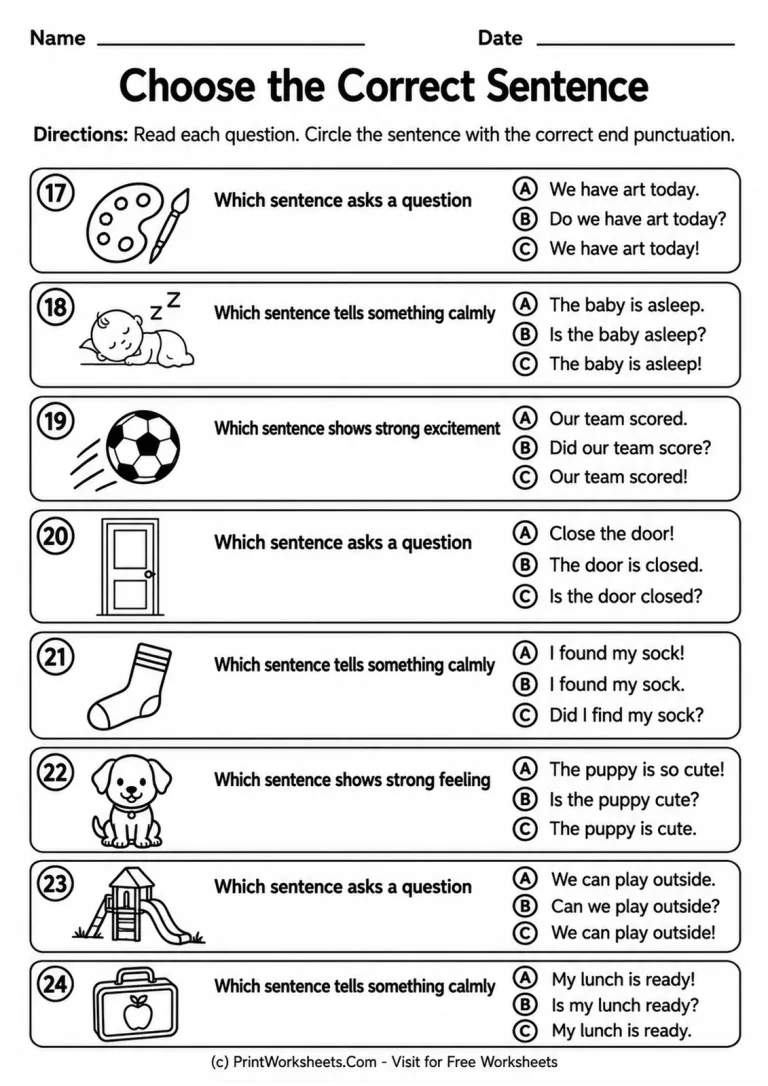
On the third page, Choose the Correct Sentence, students move into multiple-choice comparison. Each item presents a sentence purpose and three A, B, or C choices with different end punctuation. Students choose the version that matches the intended meaning. This requires more than identifying a punctuation symbol by itself. Children must compare complete sentence choices and notice how the ending changes whether the sentence reads as a question, a calm statement, or an excited expression.
This step is useful for building editing awareness. Students begin to see that a sentence can contain familiar words and still be punctuated incorrectly. That kind of comparison supports later writing work because children learn to check whether the mark at the end matches the message they want the sentence to communicate.
Apply End Punctuation in Simple Conversations
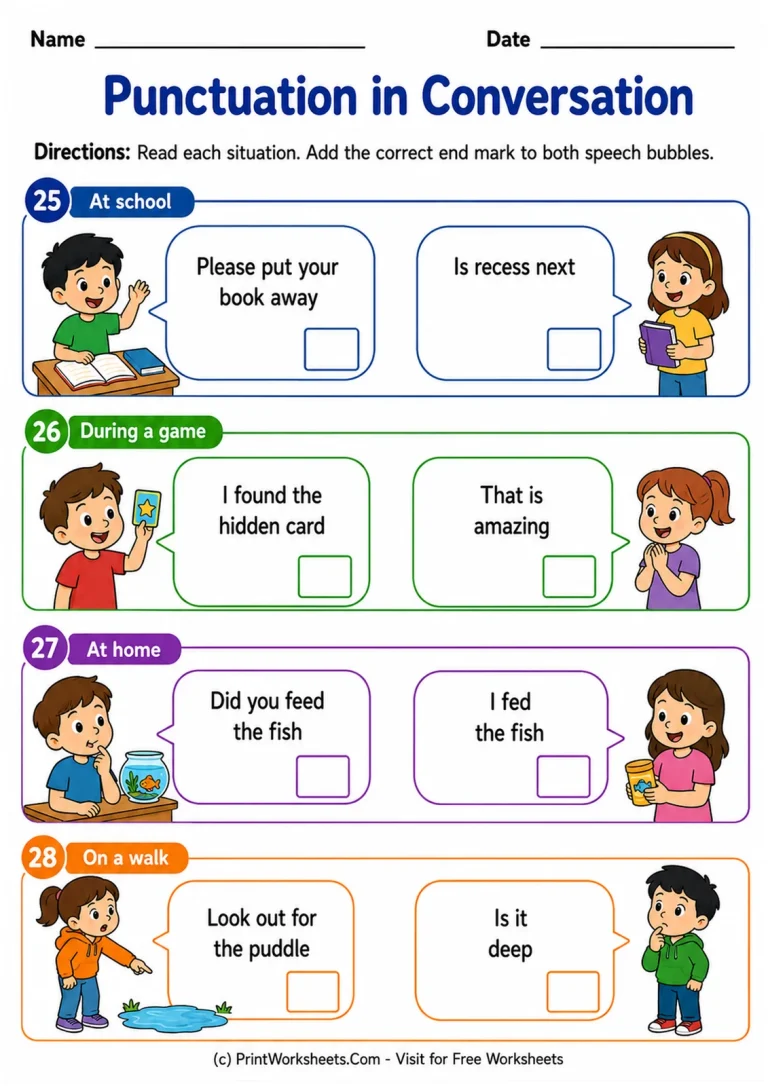
The final worksheet, Punctuation in Conversation, gives students a more independent application task. Four everyday situations include pairs of speech bubbles, and students add the appropriate punctuation at the end of each spoken sentence. The scenes use familiar settings such as school, play, home, and a walk, allowing children to consider how punctuation works in natural exchanges instead of isolated examples.
This page makes a useful follow-up after the earlier recognition activities because the punctuation choice is no longer supplied beside every sentence. Students must interpret the speaker’s purpose and add the mark themselves. Teachers can use the page for independent work, a small-group lesson, or a quick check after direct instruction on sentence endings.
Ways to Use These Grade 1 Grammar Worksheets
The four pages can be used in sequence as a short punctuation unit or selected individually for targeted practice. The first page supports initial identification, the second strengthens classification, the third develops comparison and editing skills, and the fourth asks students to apply punctuation in context. This progression makes the set practical for whole-class lessons, literacy centers, small groups, homework, or extra review.
Students who need broader practice with punctuation can also continue with our punctuation practice worksheets, which cover a wider Grade 1 and Grade 2 practice range. For a focused lesson on choosing periods, question marks, and exclamation points at the ends of simple sentences, this four-page set keeps the skill clear, concrete, and manageable for beginning writers.