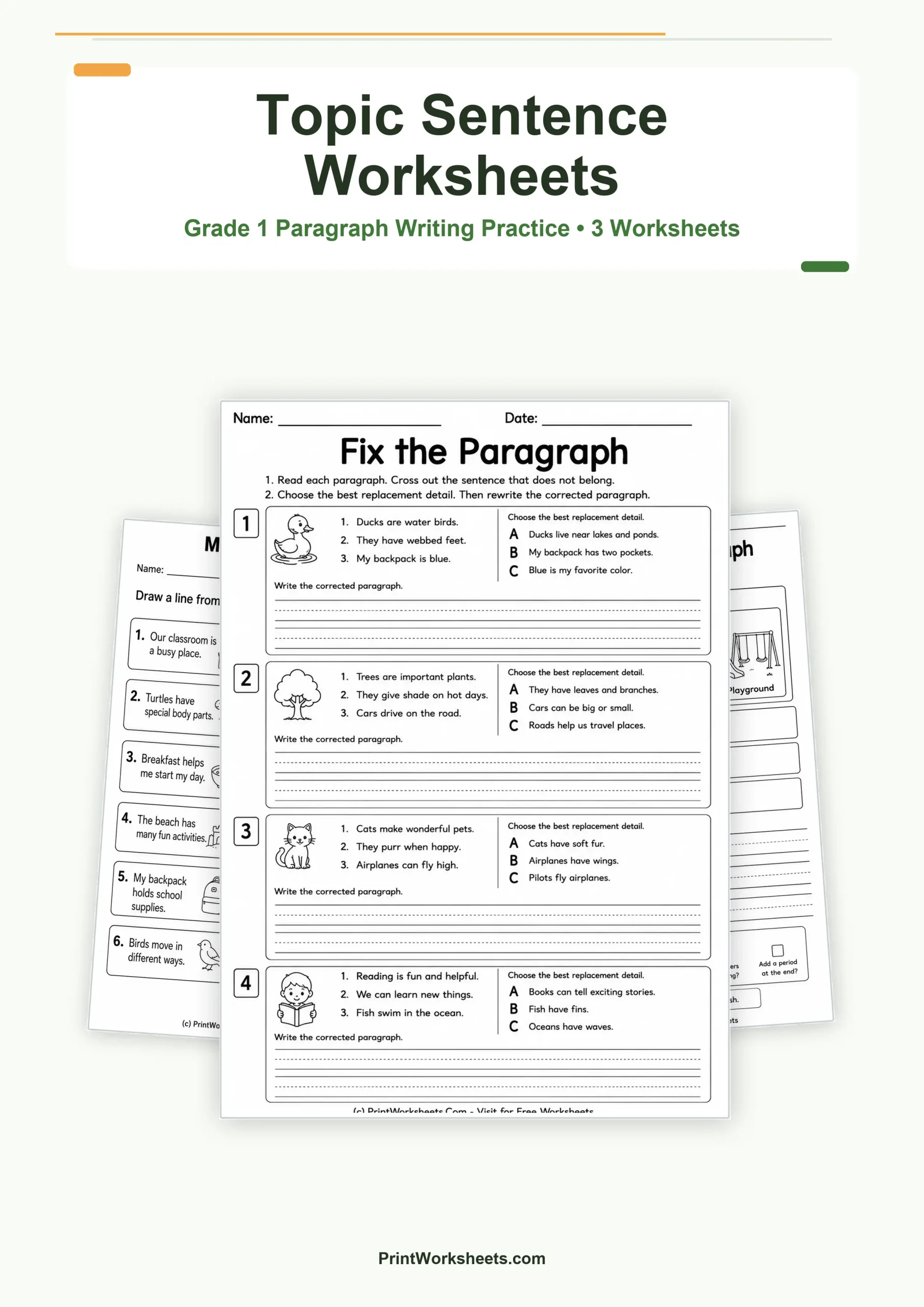
Topic sentence worksheets give first graders a concrete way to see how one main idea holds a short paragraph together. This set moves beyond simply naming a topic: students connect a topic sentence to a matching detail, repair paragraphs that wander off topic, and then plan and write their own focused three-sentence paragraph. The progression is especially useful for children who can write individual sentences but still need practice deciding which ideas belong together.
Build Paragraph Focus with Topic Sentence Worksheets
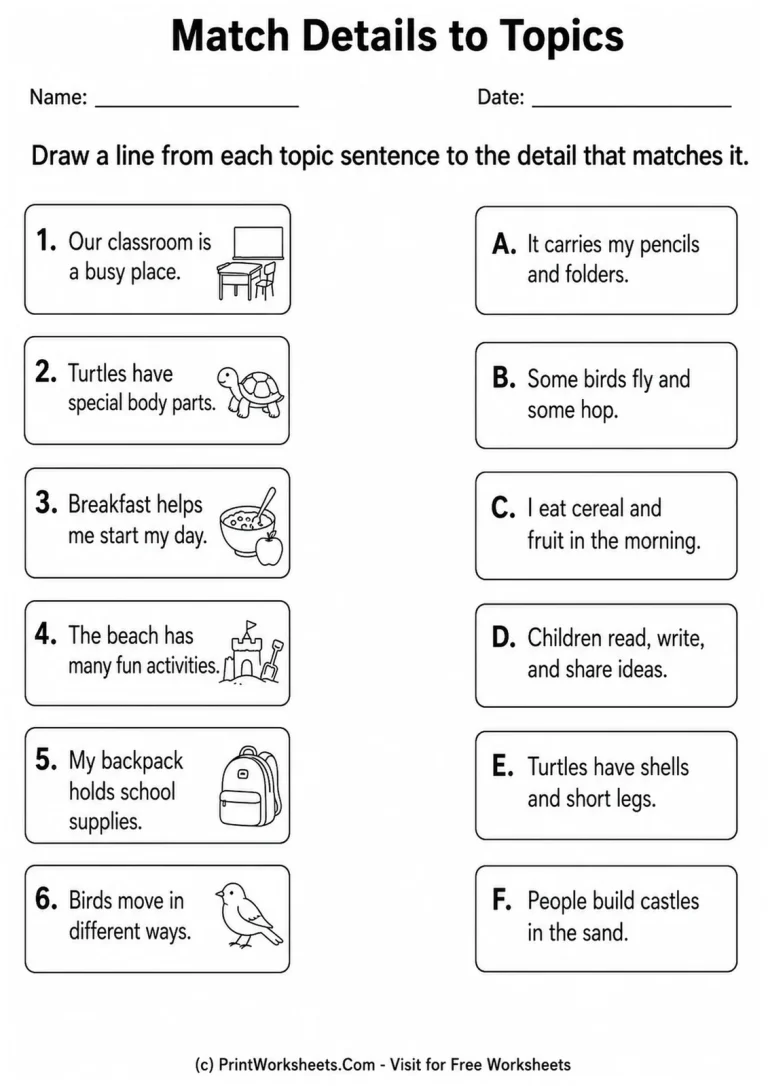
The first approved activity, “Match Details to Topics,” asks students to draw a line from each topic sentence to the detail that supports it. The six examples use familiar subjects—classroom routines, turtles, breakfast, the beach, a backpack, and birds—so the thinking stays centered on paragraph structure rather than difficult background knowledge. A sentence such as “Our classroom is a busy place” connects naturally to the detail about children reading, writing, and sharing ideas. Likewise, “My backpack holds school supplies” is supported by the detail explaining that it carries pencils and folders.
This matching format is a useful bridge between reading and writing. Students must decide not only whether two sentences are about the same general subject, but whether the second sentence actually gives information that supports the first. Teachers can ask students to explain each match aloud before drawing the line. That quick oral step encourages children to use language such as “This detail belongs because…” and makes the relationship between main idea and evidence more visible.
Practice Staying on One Topic
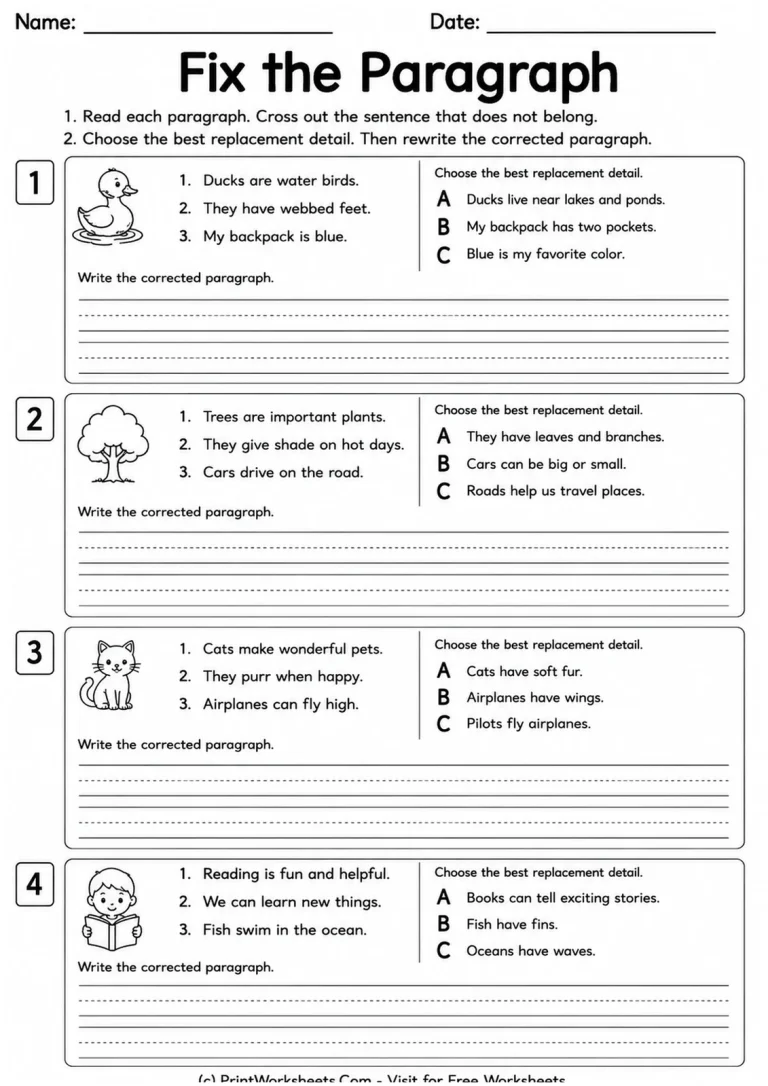
The “Fix the Paragraph” worksheet adds a stronger editing challenge. Each short paragraph contains one sentence that does not belong. Students cross out the unrelated sentence, choose the best replacement detail, and rewrite the corrected paragraph. The four topics—ducks, trees, cats, and reading—keep the task accessible while requiring careful attention to coherence.
For example, the duck paragraph begins with “Ducks are water birds” and “They have webbed feet,” but then shifts to a sentence about a blue backpack. Students replace that off-topic idea with a detail about ducks living near lakes and ponds. Similar tasks ask them to remove a sentence about cars from a tree paragraph, an airplane sentence from a cat paragraph, and a fish sentence from a paragraph about reading. Because students rewrite the corrected paragraph, they practice paragraph focus and sentence-level handwriting at the same time.
Use the Editing Page for Small-Group Instruction
When a child chooses an incorrect replacement, ask two questions: “What is this paragraph mostly about?” and “Does this new sentence teach us more about that same idea?” That routine helps students separate a sentence that is merely true from one that is relevant. It also prepares them for later writing tasks in which they must select details independently instead of choosing from options.
Move from Planning to a Focused Three-Sentence Paragraph
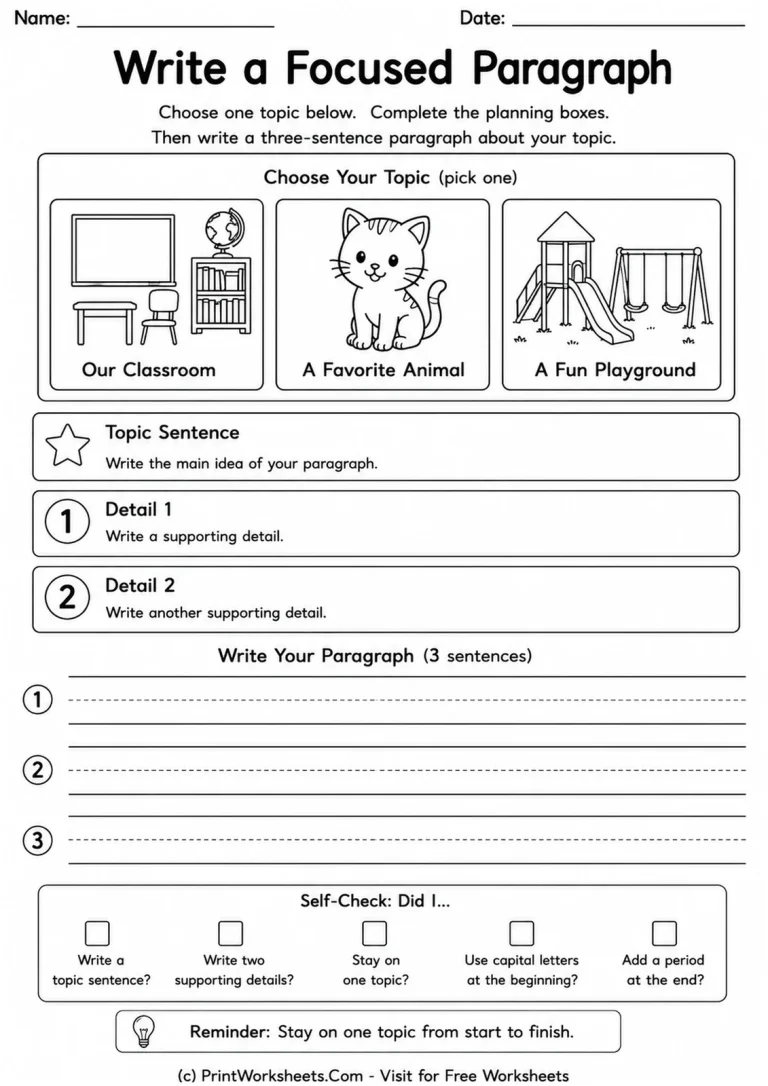
The final worksheet, “Write a Focused Paragraph,” turns the skill into original writing. Students choose one of three illustrated topics: Our Classroom, A Favorite Animal, or A Fun Playground. They first write a topic sentence, then plan Detail 1 and Detail 2, and finally use those ideas to write a three-sentence paragraph.
The page includes a self-check that asks whether the writer included a topic sentence, wrote two supporting details, stayed on one topic, used a capital letter at the beginning, and added a period at the end. This checklist makes the writing expectations visible to young learners and gives teachers a simple conference tool. Instead of correcting everything at once, an adult can point to one checklist item and ask the student to reread the paragraph with that goal in mind.
Differentiation, Extension, and Exit Ticket Ideas
For students who need support, complete the planning boxes orally before asking them to write. A teacher might model a topic sentence such as “Our classroom is a great place to learn,” then invite the child to supply two details that explain why. Students ready for more independence can add a fourth sentence while keeping every idea connected to the same topic.
As an exit ticket, give students one topic sentence and ask them to write a single matching detail on a sticky note or half sheet. Another option is to read three details aloud and have students identify which one does not belong. For seasonal follow-up writing, the live collection of fall writing prompts for kindergarten to Grade 2 can provide additional chances to apply the same planning habit to new topics.
A Clear Path from Recognizing Details to Writing Paragraphs
These worksheets work well as a short sequence across several lessons: match topic sentences and details first, edit off-topic sentences next, and finish with independent planning and paragraph writing. The activities let first graders see paragraph organization from three angles—recognizing relationships, revising weak focus, and creating their own connected ideas. By the end, students are not just identifying a main idea; they are using a topic sentence and two supporting details to build a complete, focused paragraph.