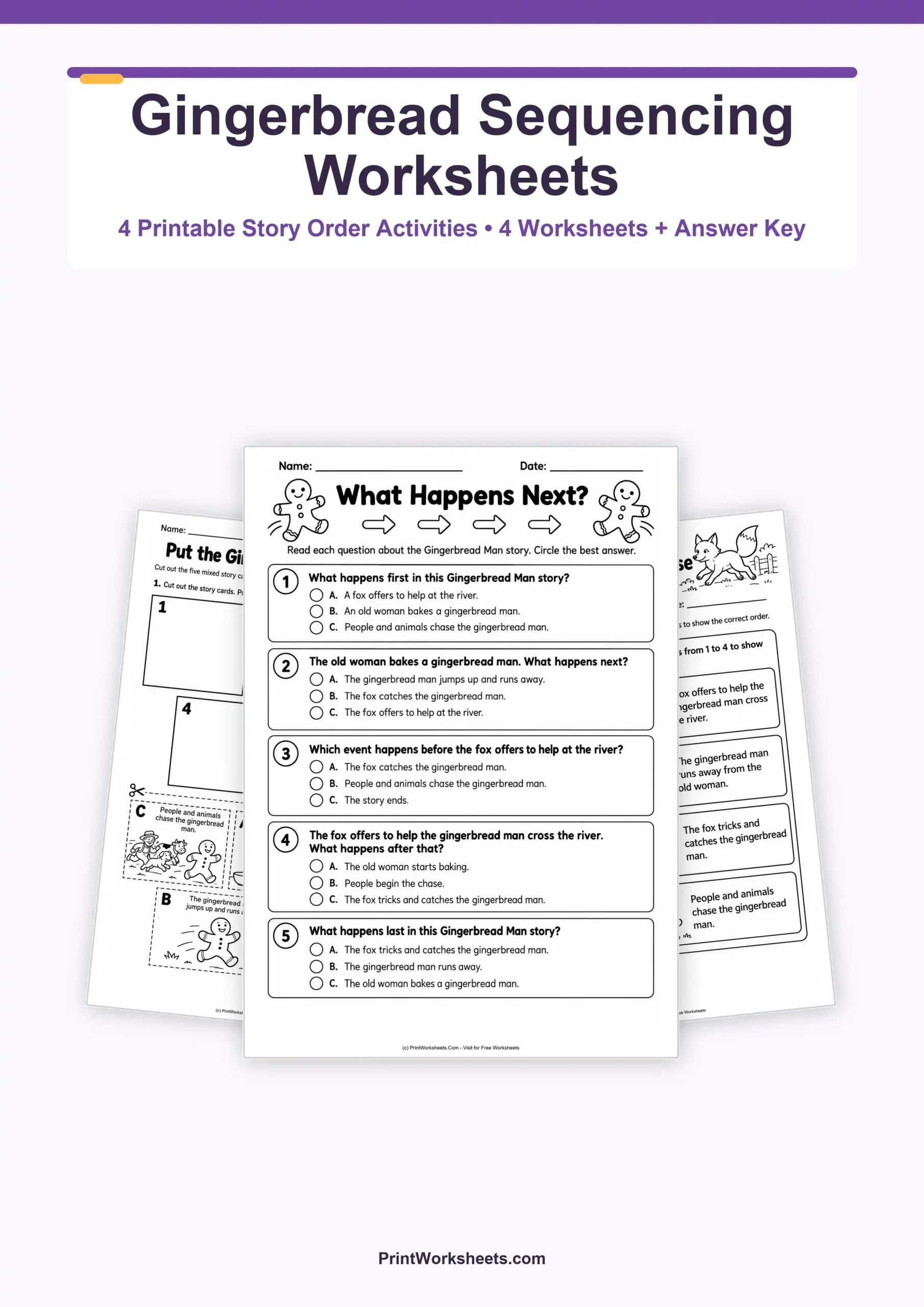
These gingerbread sequencing worksheets give young readers four different ways to practice putting familiar story events in order. Across the set, students follow the Gingerbread Man from the moment an old woman bakes him through his escape, the chase, the fox’s offer to help at the river, and the final trick that ends the sequence. Because the same core events return in several activity formats, children can focus on understanding what happened first, what came next, and how each event connects to the one before and after it.
Gingerbread Sequencing Worksheets for Story Order Practice
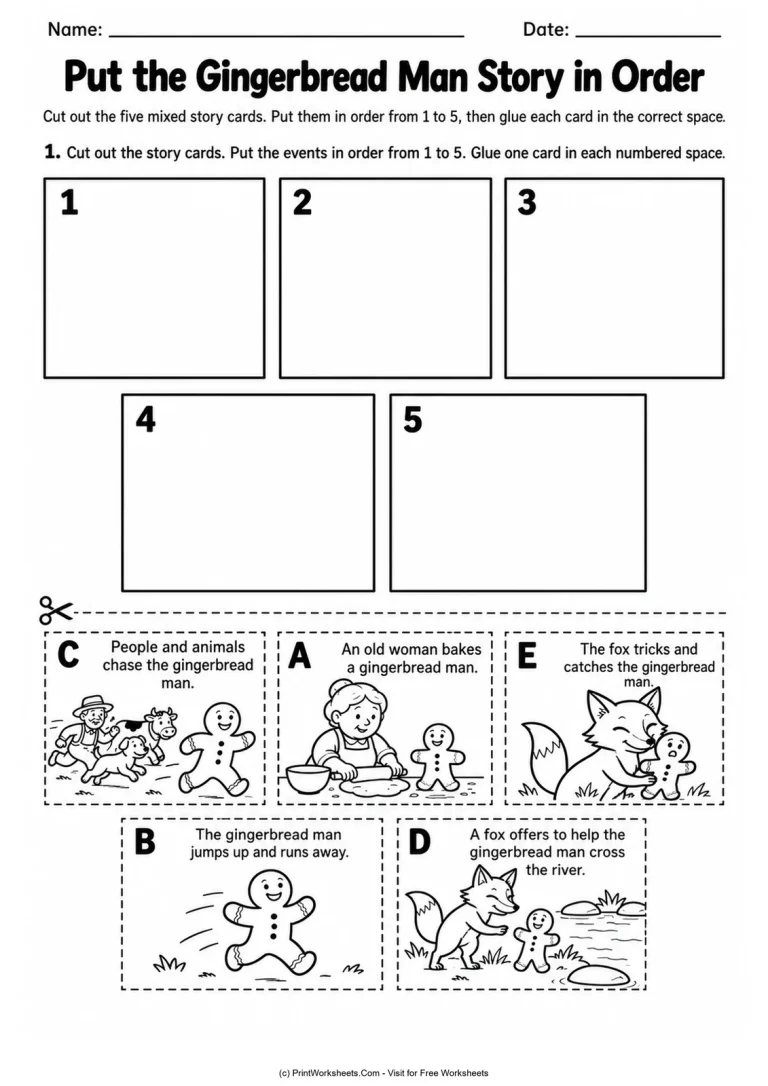
The first worksheet is a hands-on cut-and-paste activity. Five illustrated story cards are mixed at the bottom of the page, and students cut them apart before placing them into numbered spaces from 1 to 5. The cards show the old woman baking a gingerbread man, the Gingerbread Man jumping up and running away, people and animals chasing him, a fox offering to help him cross the river, and the fox tricking and catching him. This format works well for students who benefit from physically moving events before committing to an answer.
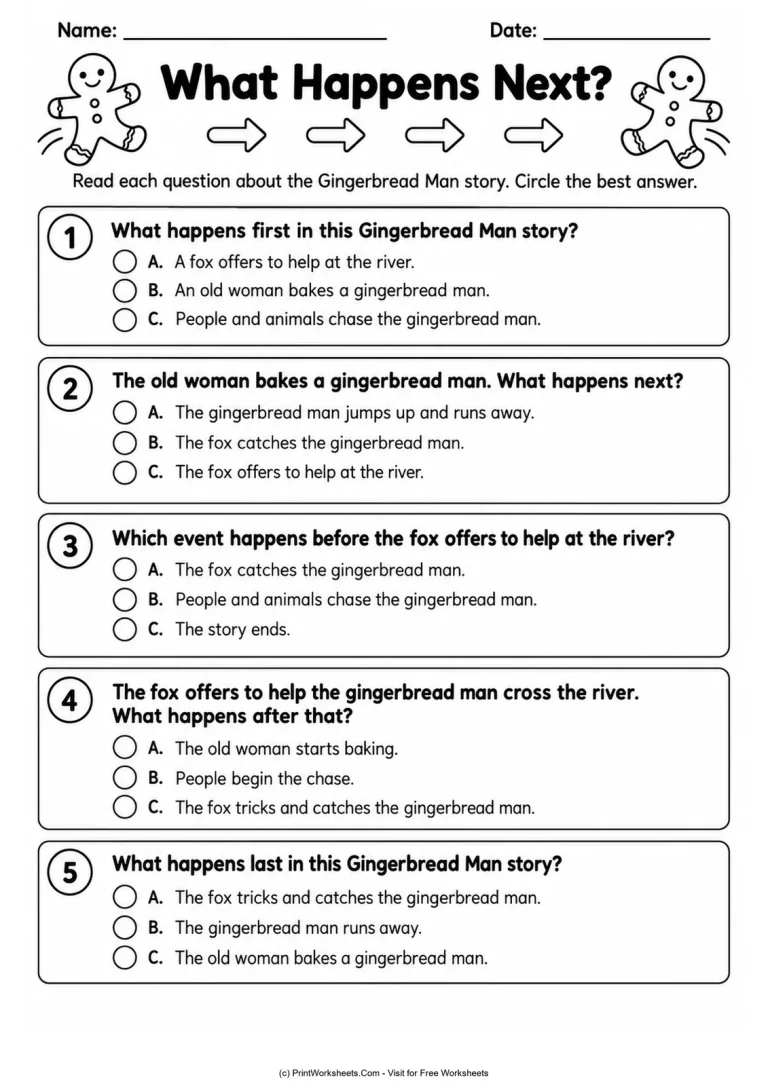
The second page changes the task from arranging cards to answering sequencing questions. Students respond to five multiple-choice prompts about what happens first, what happens next, what occurs before another event, what happens after the fox offers help, and what happens last. The repeated use of words such as first, next, before, after, and last helps strengthen the language children need when retelling stories and explaining event order.
Four Different Ways to Work With the Same Story
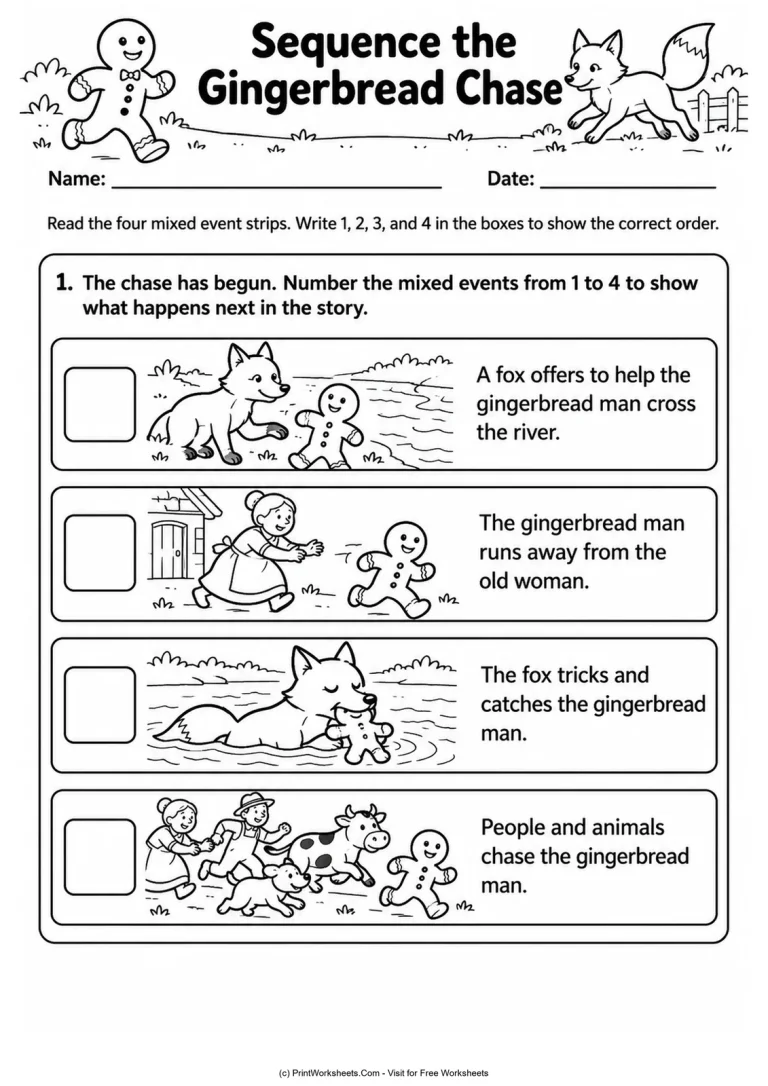
The third worksheet narrows the sequence to four major events in the chase. Students write 1, 2, 3, and 4 in boxes beside mixed event strips. The illustrations provide helpful context while the text asks children to distinguish between the Gingerbread Man running from the old woman, people and animals joining the chase, the fox appearing at the river, and the fox catching him. This page is useful after the cut-and-paste activity because it asks students to produce the order without physically moving the pieces.
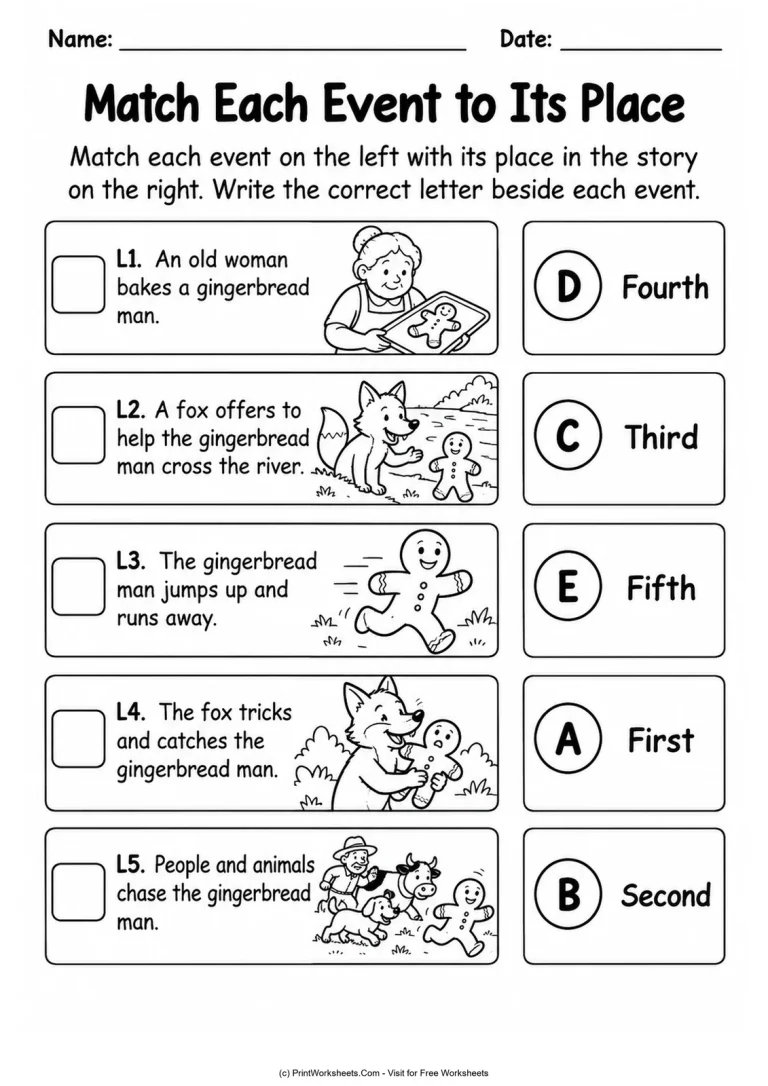
On the fourth worksheet, students match each story event to an ordinal position. The left side lists five events, while the right side provides First, Second, Third, Fourth, and Fifth with letter labels. Children write the correct letter beside each event. This adds another layer to sequencing practice by connecting narrative order with ordinal vocabulary rather than simply numbering a row of pictures.
Skills Practiced in This Printable Set
These pages can support several early reading and language goals at the same time. Students practice recognizing chronological order, recalling a familiar narrative, using temporal vocabulary, comparing events, and identifying beginning, middle, and ending information. The combination of pictures and short sentences makes the activities especially approachable for first- and second-grade readers, including students who still rely on visual support when retelling a story.
The activities can be used independently or as a short progression. A teacher might begin with the cut-and-paste page during a whole-group read-aloud, use the multiple-choice page for guided practice, assign the four-event chase sequence for independent work, and finish with the ordinal matching page as a review. The set can also be split across literacy centers, morning work, homework, or a seasonal reading station.
Using the Gingerbread Man Sequence in Class or at Home
Before students begin, briefly review the five main events aloud and ask children to listen for transition words such as first, next, then, and finally. For younger learners, invite them to point to each illustration while retelling the story orally. More independent readers can complete a page first and then explain why one event must come before another.
For an additional speaking activity, have students use the completed sequence as a retelling guide. They can describe each event in their own words rather than simply rereading the printed sentences. This turns the worksheet into a bridge between reading comprehension and oral language. Partners can also compare their sequences and explain any differences before checking their work.
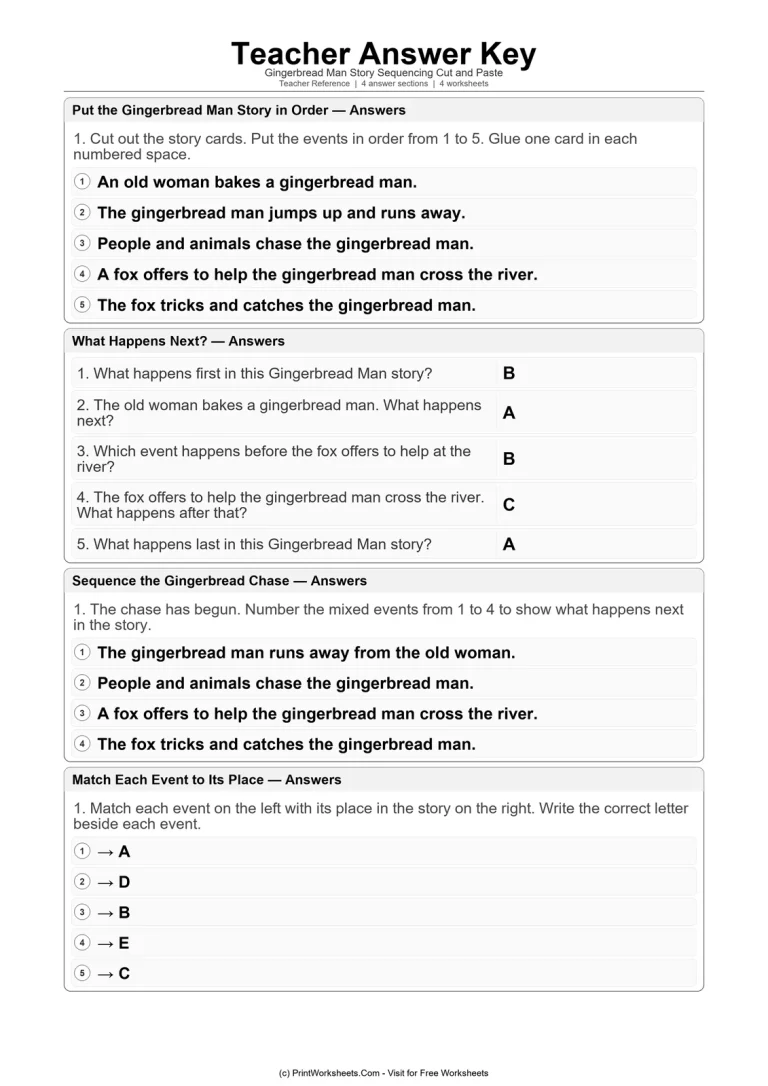
A teacher answer key is included for all four activities, making it easy to review the five-event cut-and-paste order, the multiple-choice responses, the four-part chase sequence, and the ordinal matching activity. With several formats built around one clear story line, this printable set provides focused practice without asking children to learn a completely new task on every page.