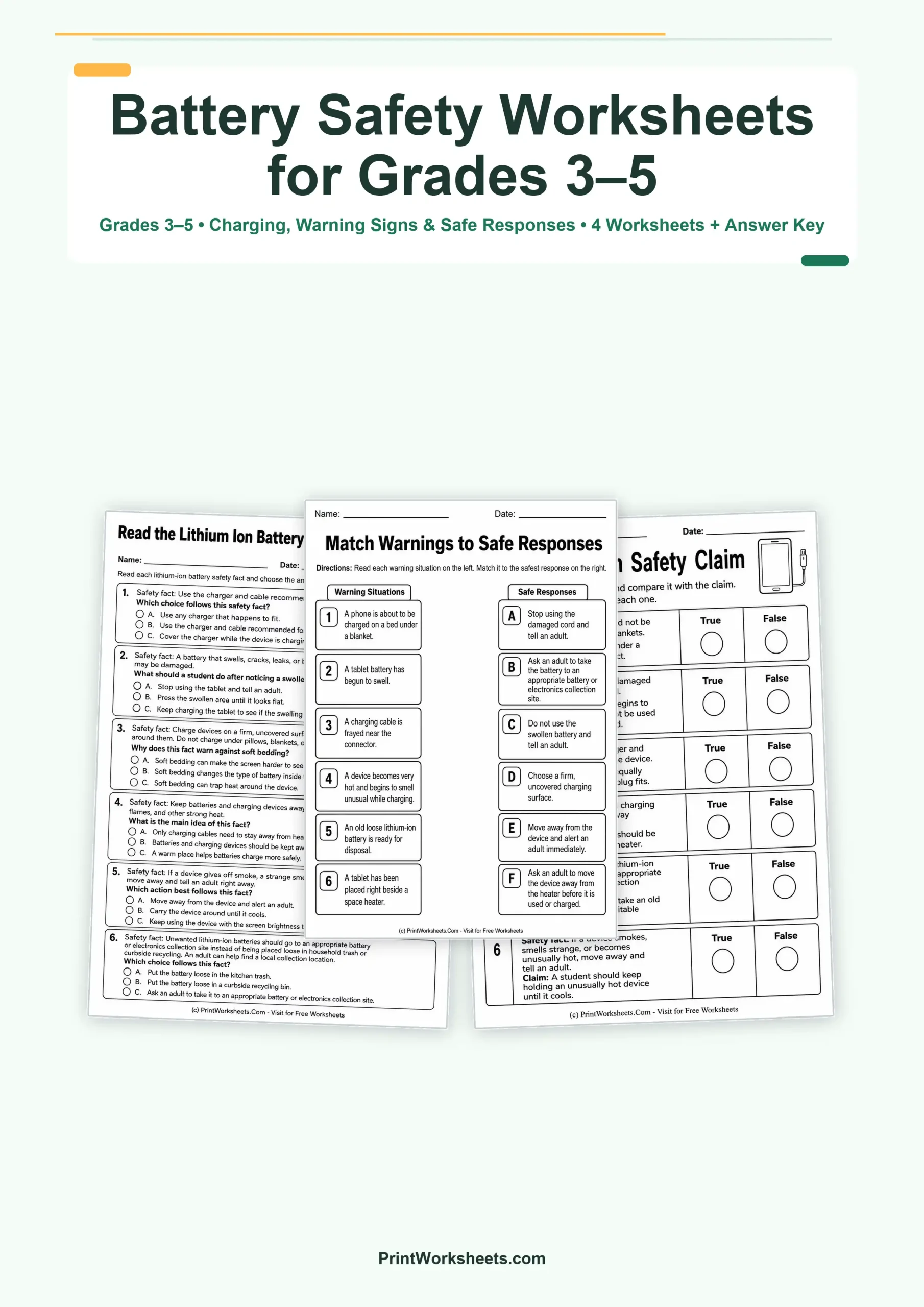
These lithium ion battery safety worksheets help students in Grades 3 to 5 practice making safer choices around rechargeable devices, charging cables, damaged batteries, heat, and battery disposal. Instead of asking students to memorize isolated rules, the set repeatedly asks them to connect a visible warning sign or safety fact with the safest response. Across four student worksheets, learners read short facts, match situations to actions, evaluate claims, and apply safety information to realistic scenarios.
Lithium Ion Battery Safety Worksheets for Real-World Decisions
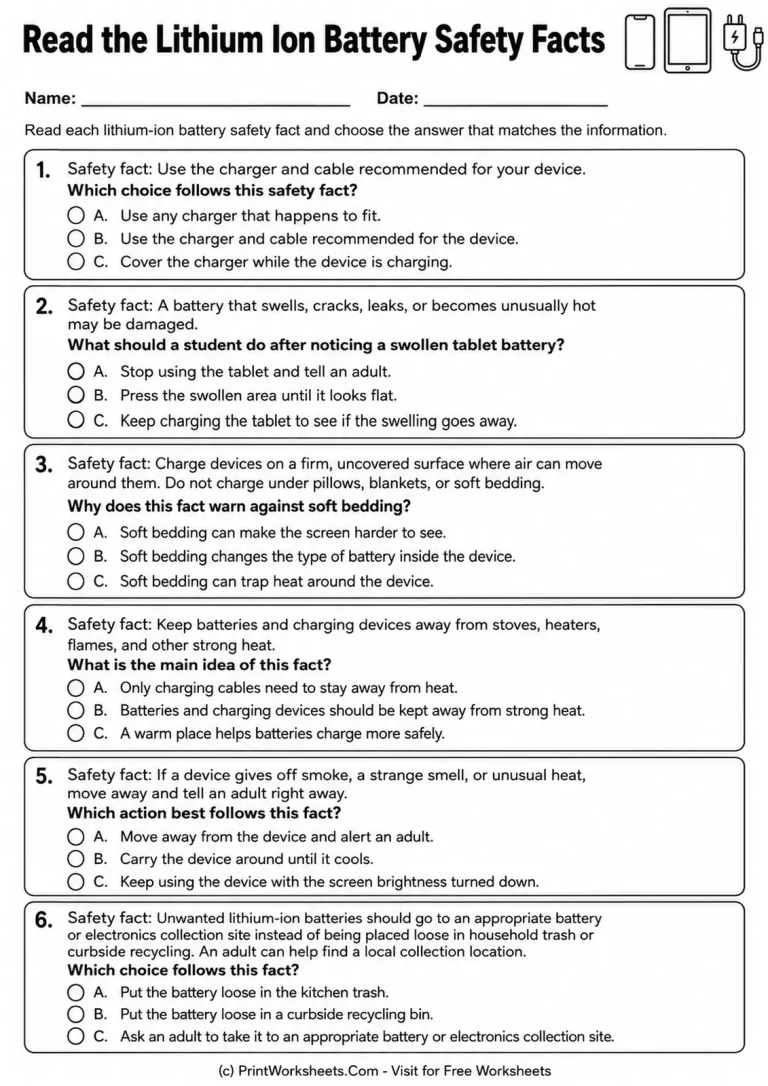
The first worksheet introduces six clear safety facts and asks students to choose the response that follows each one. Students consider why a device should use the recommended charger and cable, what to do when a tablet battery swells, why a phone should not charge under pillows or blankets, and why batteries and charging devices need to stay away from strong heat. The page also covers an important emergency response: moving away from a device that gives off smoke, a strange smell, or unusual heat and telling an adult immediately.
Battery disposal is included as part of the same safety routine. Students learn that an unwanted lithium-ion battery should not be placed loose in household trash or curbside recycling. Instead, an adult can help take it to an appropriate battery or electronics collection site.
What Students Practice Across the Set
Reading a safety fact and choosing the matching action
The opening activity builds careful reading skills. Each question gives students a fact first and then asks them to identify the choice that follows it. This structure encourages students to use evidence from the statement instead of guessing from a picture or key word. The six questions cover charger choice, damaged batteries, safe charging surfaces, heat exposure, warning signs such as smoke or unusual smell, and responsible disposal.
Matching warning situations to safe responses
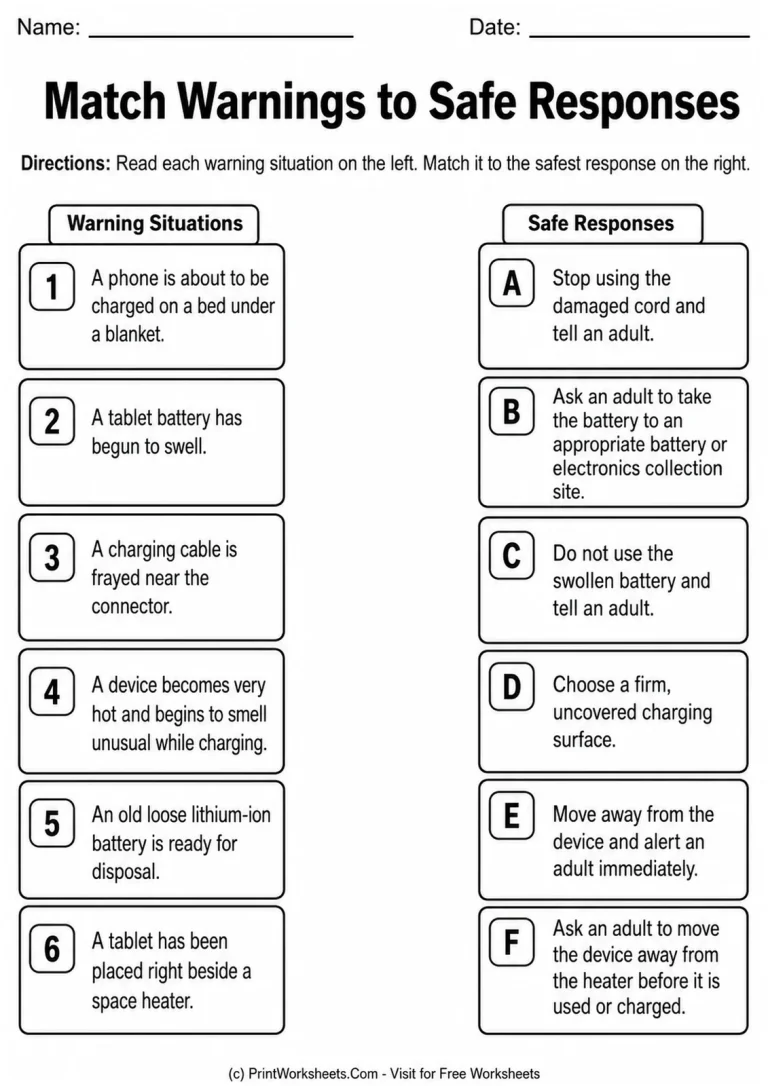
The second worksheet changes the task from multiple choice to matching. Students connect six warning situations with six specific responses. Examples include a phone about to be charged on a bed under a blanket, a swollen tablet battery, a frayed charging cable, a device that becomes very hot and smells unusual, an old loose battery ready for disposal, and a tablet placed beside a space heater. Because each response is different, students must distinguish between moving a device, stopping use, asking for adult help, and choosing a safer charging location.
Checking safety claims with True or False reasoning
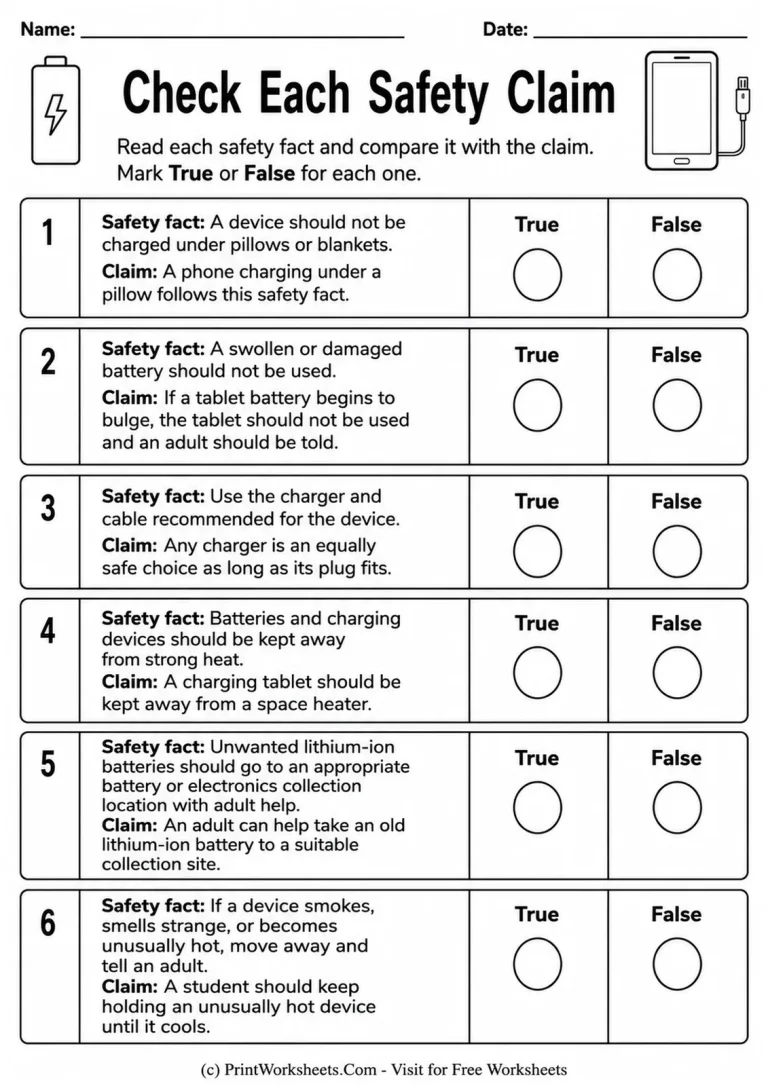
The third page asks students to compare a stated safety fact with a claim and mark True or False. A claim that a phone charging under a pillow follows safe practice is false, while a claim that a charging tablet should be kept away from a space heater is true. Other items revisit swollen batteries, recommended chargers, collection locations, and what to do with an unusually hot device. This format is useful for checking whether students can detect unsafe statements even when they sound plausible at first.
Applying the rules to short scenarios
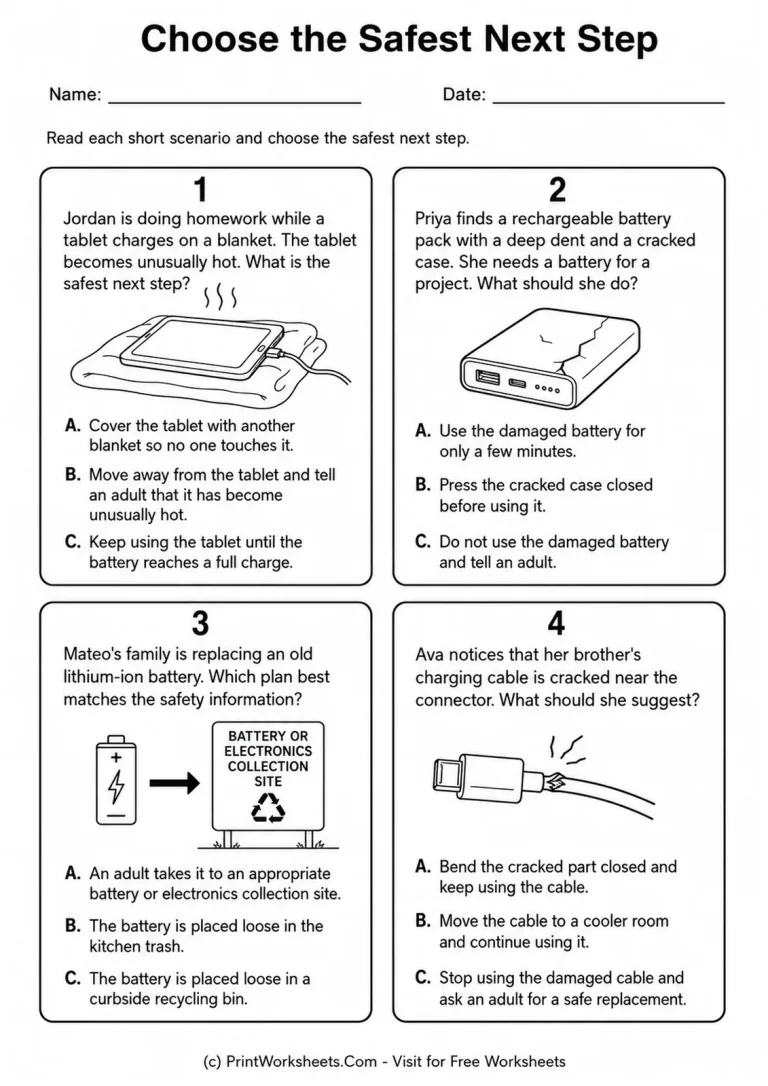
The final student worksheet presents four illustrated situations that require a safest-next-step decision. One student is near a tablet charging on a blanket that has become unusually hot. Another finds a rechargeable battery pack with a deep dent and cracked case. Students also decide how an old lithium-ion battery should be handled and what to suggest when a charging cable is cracked near the connector. These questions move beyond recognition and ask students to apply the same safety principles in context.
Safety Topics Included
The set focuses on practical situations students may see at home or school: using the recommended charger and cable, keeping charging devices uncovered on a firm surface, avoiding pillows and blankets during charging, keeping devices away from heaters and other strong heat sources, stopping use of swollen or damaged batteries, avoiding frayed or cracked charging cables, moving away from devices that smoke or become unusually hot, and getting adult help with battery disposal.
Ways to Use These Grade 3 to 5 Worksheets
Teachers can use the pages as a short health and safety lesson, a technology-safety discussion, independent practice, or a follow-up after classroom rules about rechargeable devices. The activities can also be split across several days because each worksheet uses a different response format. Parents can use the scenarios to start conversations about tablets, phones, rechargeable battery packs, charging cables, and safe charging locations at home.
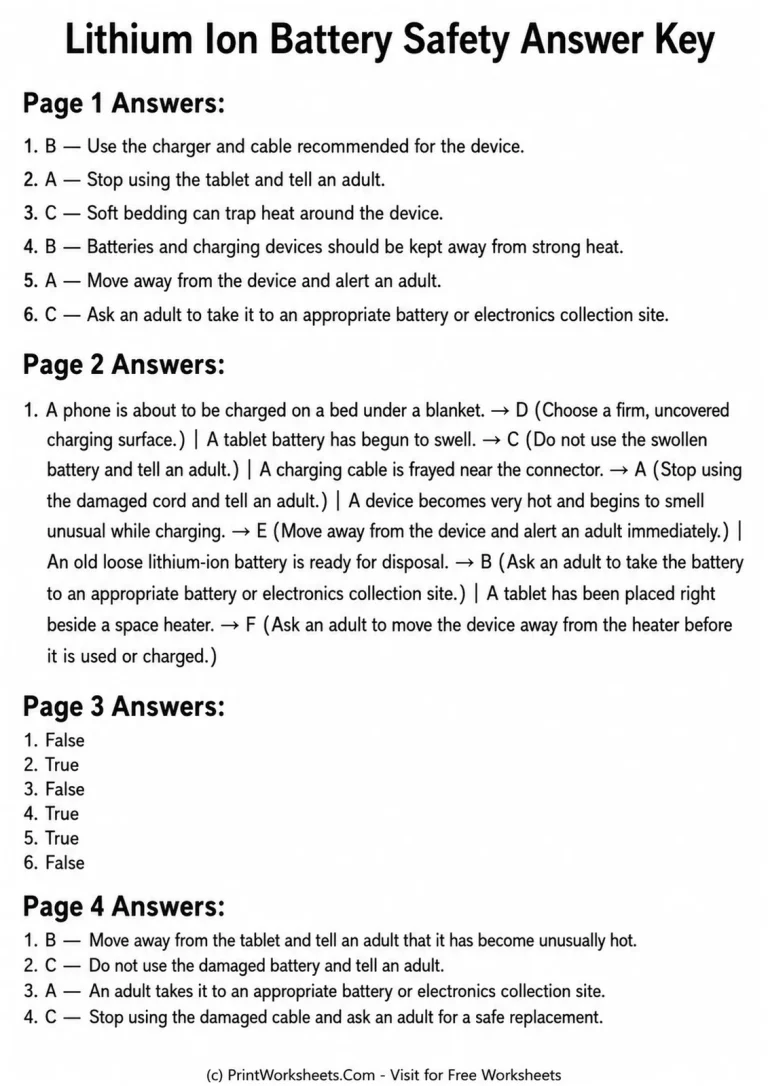
The included answer key covers all four student pages, making the set easy to check after independent work or group discussion. Used together, the worksheets give students repeated practice with one central idea: notice warning signs, stop unsafe actions, move away when necessary, and involve an adult when a battery or charging device may be damaged or dangerous.