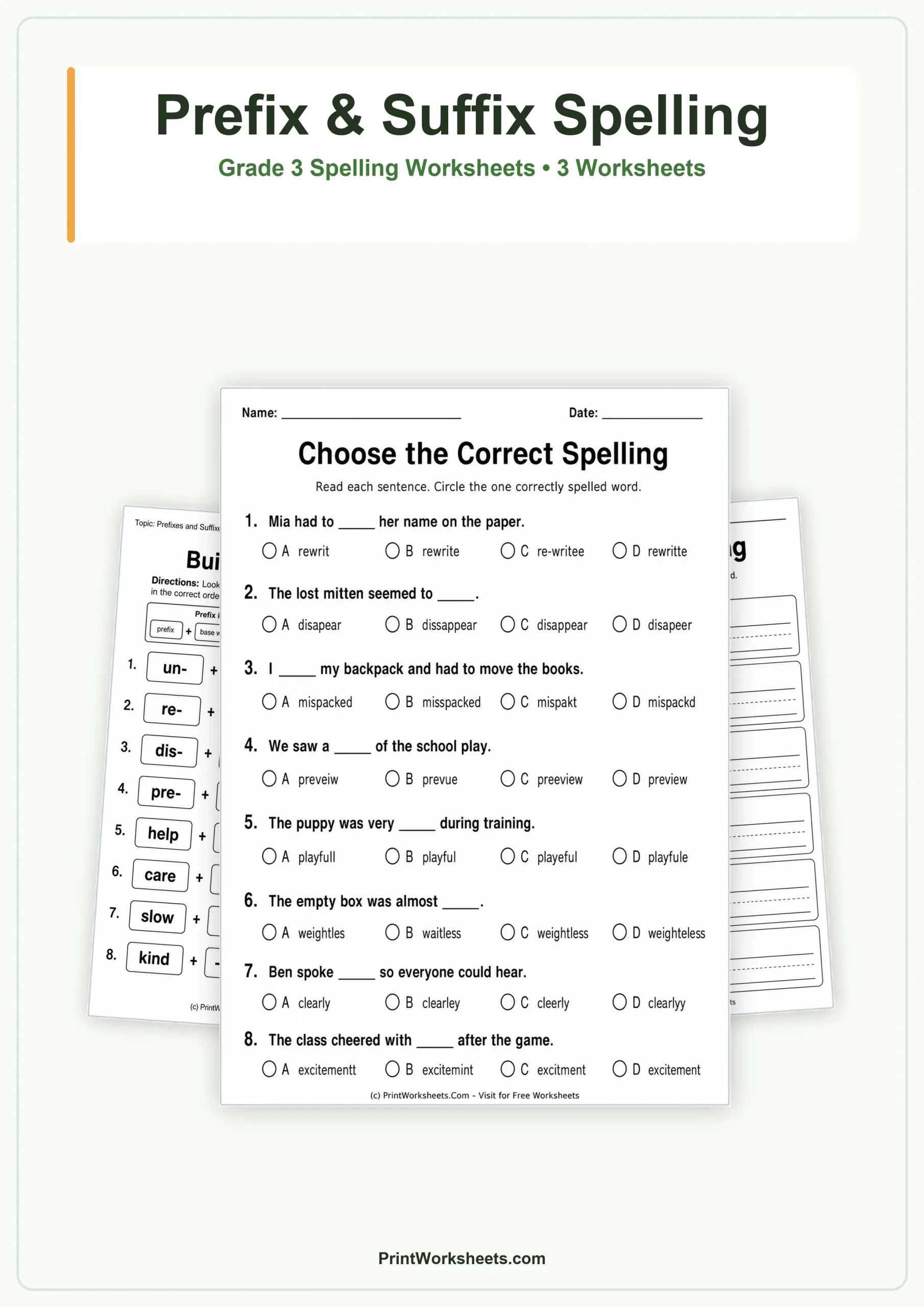
These prefixes and suffixes worksheets give third graders focused spelling practice with common affixes while asking them to use the skill in more than one way. Instead of only memorizing word lists, students build affixed words, identify correctly spelled forms inside sentences, and repair spelling errors in complete sentences. The three-page sequence works well for classroom practice, literacy centers, homework, review, or extra support with word-part spelling.
How These Prefixes and Suffixes Worksheets Build Spelling Skill
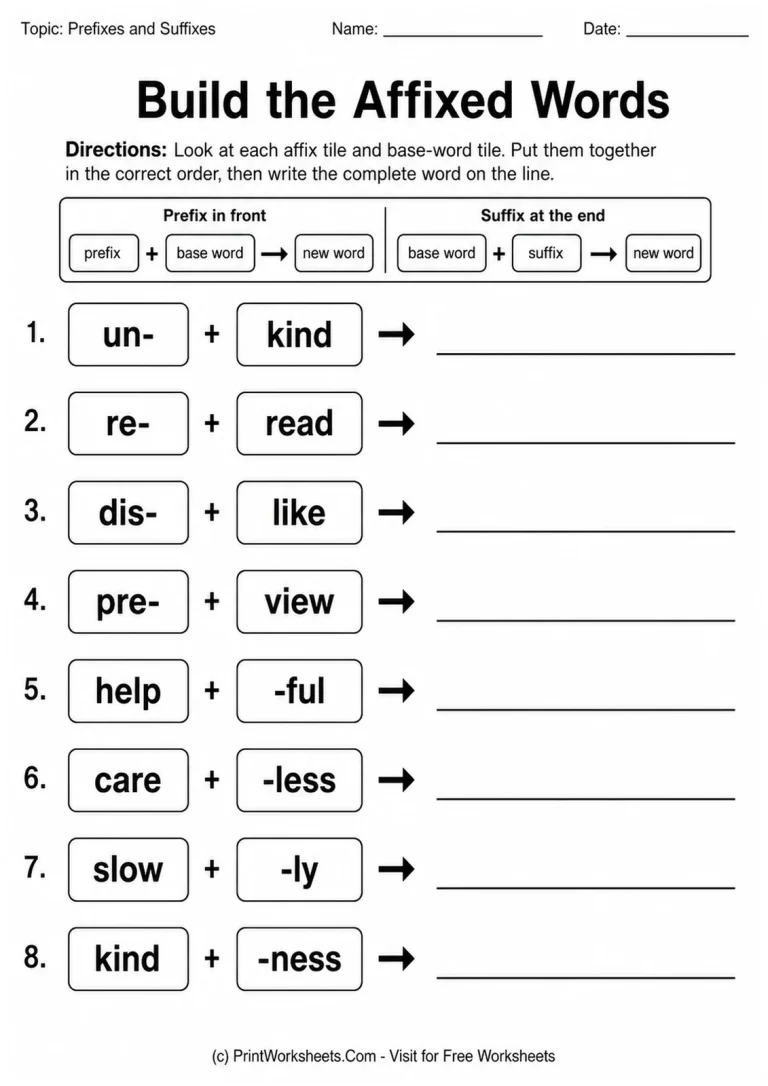
The set begins with direct word construction. Students combine an affix tile with a base-word tile and write the completed word. Prefix examples include un-, re-, dis-, and pre-, while suffix practice includes -ful, -less, -ly, and -ness. Words such as unkind, reread, dislike, and preview let students see clearly where an affix is added and how the finished spelling is formed.
This first activity is especially useful when introducing or reviewing affixes because students can focus on the structure of each word before moving into sentence-level work. Teachers can ask students to underline the base word, circle the affix, or read each completed word aloud after writing it. That makes the page useful for connecting morphology, vocabulary awareness, and accurate spelling without changing the central task.
Choose the Correct Affixed Word in Context
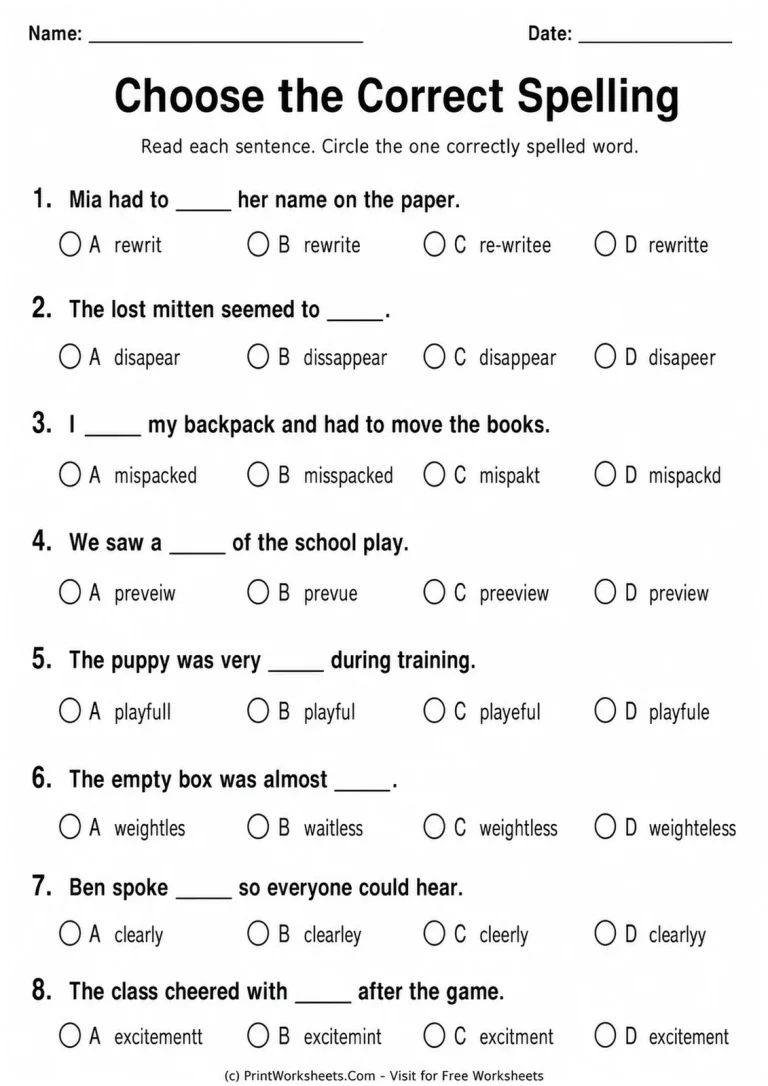
The next worksheet moves from building words to recognizing correct spellings in sentences. Students read eight sentences and choose the correctly spelled affixed word from four options. The target vocabulary includes rewrite, disappear, mispacked, preview, playful, weightless, clearly, and excitement. Because each item appears in sentence context, students must pay attention both to spelling and to which word makes sense in the sentence.
This format gives useful practice for students who can often recognize a prefix or suffix but still hesitate when writing the whole word. Seeing several possible spellings encourages careful comparison. It can also help teachers identify whether a student is noticing the affix itself, the base word, or the complete spelling pattern. The page can be completed independently or reviewed together by asking students to explain what made one spelling correct.
Move from Recognition to Editing
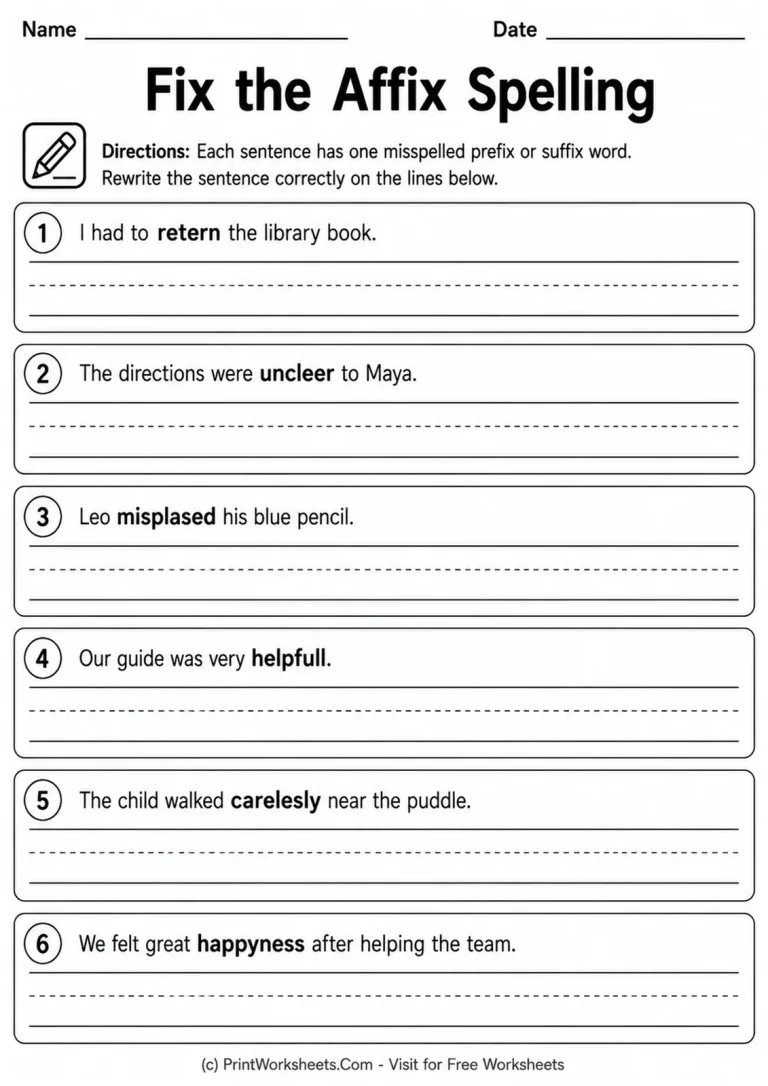
The final student worksheet raises the demand by asking learners to find and correct one misspelled prefix or suffix word in each sentence, then rewrite the full sentence correctly. Visible errors include forms such as retern, uncleer, misplased, helpfull, carelesly, and happyness. Students are not simply selecting an answer; they must notice the error, determine the correct spelling, and produce an accurate sentence.
Why Sentence Rewriting Matters
Rewriting the entire sentence adds an important proofreading step. Students practice carrying a corrected spelling into real written language instead of treating the word as an isolated exercise. This makes the activity useful for connecting spelling instruction with editing habits. A teacher or parent can also ask the student to explain what changed in the corrected word, such as removing an extra letter or fixing the spelling of the suffix.
A Practical Grade 3 Affix Spelling Sequence
The three worksheets can be used in order as a short instructional sequence. Start with word building so students can see how common prefixes and suffixes attach to base words. Follow with the multiple-choice page to check whether they can recognize accurate affix spelling in context. Finish with the editing page when students are ready to apply the skill more independently. The progression makes the set suitable for a single lesson spread across stations or for several shorter practice sessions.
These printable Grade 3 activities are also easy to adapt for different learners. Students who need support can say the base word and affix separately before writing the complete word. More confident spellers can use a finished word in a new sentence or identify whether the added word part is a prefix or suffix. With word building, contextual recognition, and sentence editing in one focused set, students get repeated practice with affix spelling while completing genuinely different tasks.