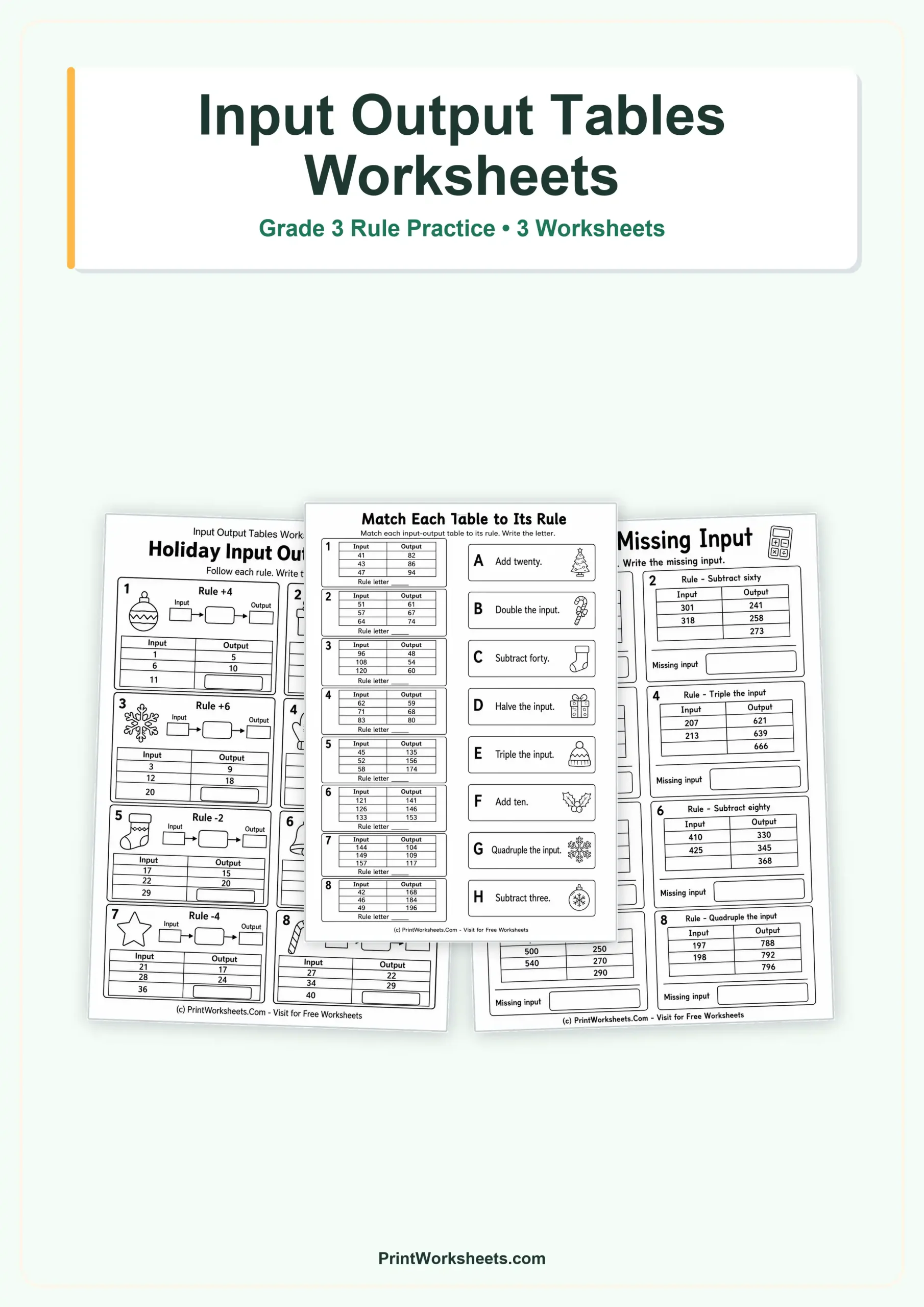
Input output tables give third graders a clear way to see how one number changes into another. These input output tables worksheets move beyond simple one-step calculation by asking students to use a rule, recognize a rule from completed number pairs, and then reverse a rule to find a missing input. Across the three printable student pages, learners work with addition, subtraction, doubling, tripling, halving, and quadrupling relationships while building confidence with table reading and operation patterns.
Grade 3 Input Output Tables Practice with Multiple Rule Types
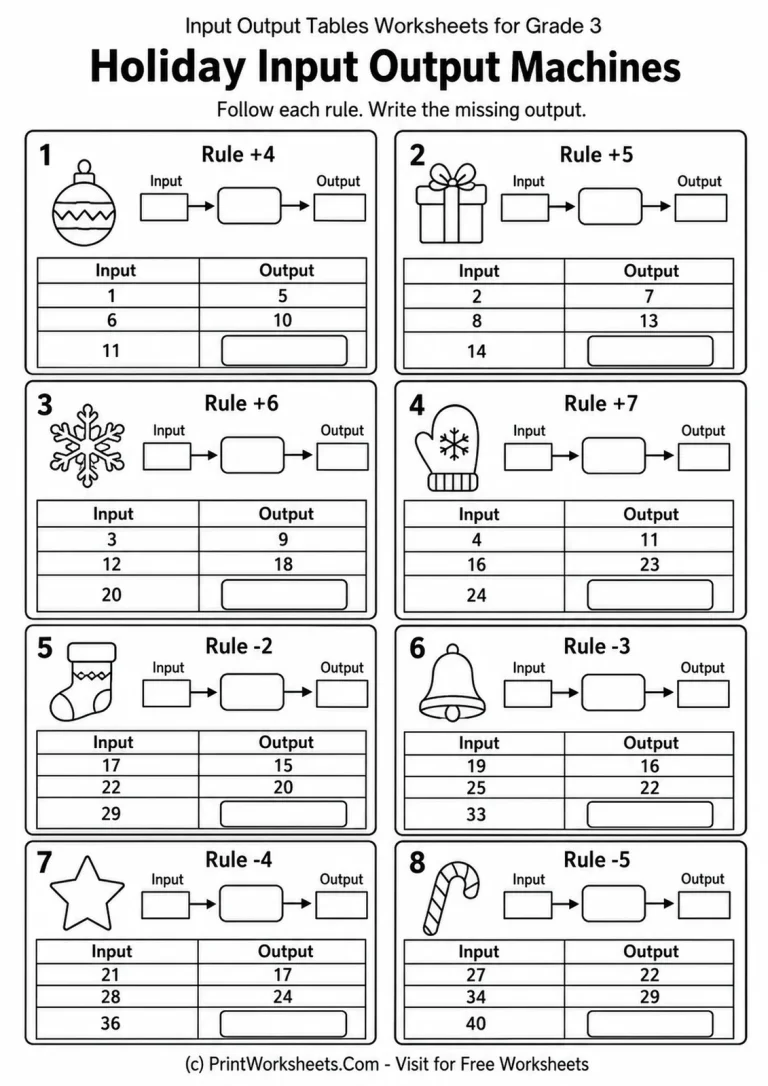
The first worksheet introduces the idea in a direct and accessible format. Students see holiday-themed input-output machines with a stated rule and two completed examples. They then calculate the missing output for each table. The eight rules include +4, +5, +6, +7, -2, -3, -4, and -5, giving students repeated practice applying a known operation without having to guess what the rule is.
This format is useful for students who are still developing fluency with addition and subtraction relationships. Because each table includes examples, children can check the pattern before solving the missing value. Teachers can also use the page as a quick warm-up, independent practice activity, math center task, or short review after introducing input-output machines.
Match Input-Output Tables to the Correct Rule
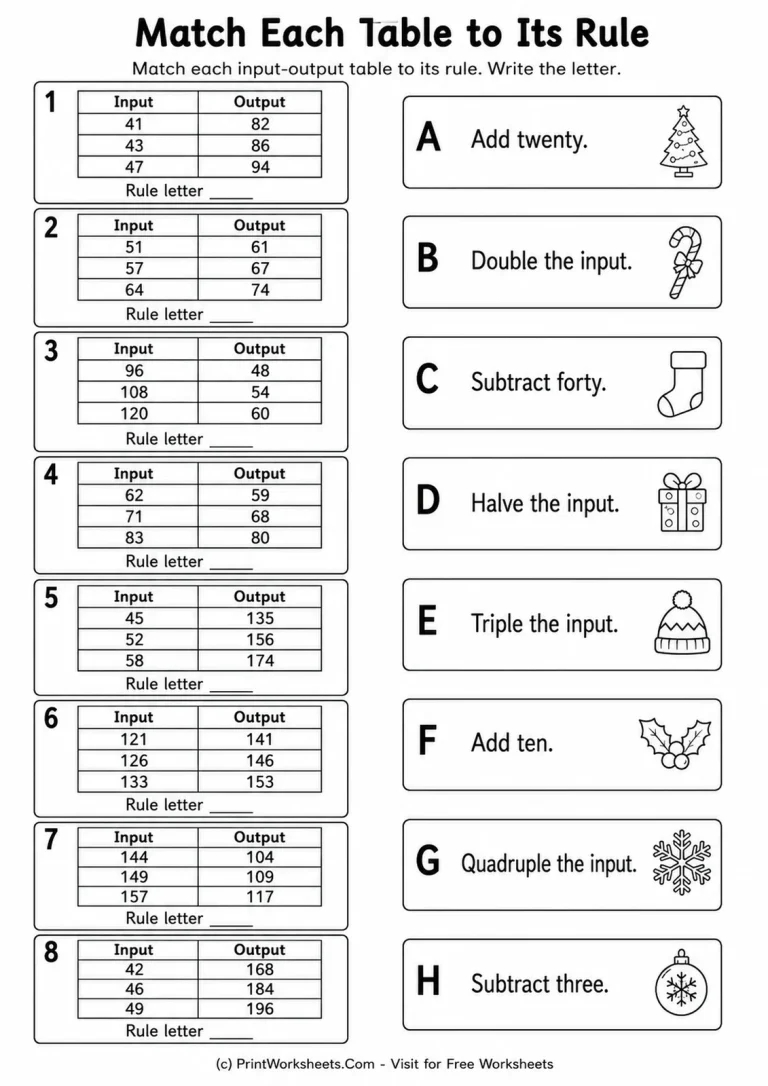
The next worksheet changes the thinking demand. Instead of being told the operation, students examine three completed input-output pairs in each table and decide which rule explains all of them. Eight lettered choices are provided, including add 10, add 20, subtract 3, subtract 40, double, triple, halve, and quadruple.
Students must look for consistency rather than relying on a single number pair. For example, a rule that appears to work for one row must also produce the correct result in the other rows. This encourages careful comparison and helps students understand that an input-output rule describes a relationship that applies throughout the entire table.
Build Addition, Subtraction, and Multiplicative Reasoning
The rule-matching activity combines familiar additive operations with early multiplicative relationships. Doubling and quadrupling help students connect repeated multiplication patterns, while halving asks them to think about an inverse relationship. Tripling adds another level of multiplicative reasoning without requiring formal function notation.
That variety makes the set useful for reviewing several Grade 3 operation ideas in one consistent format. Students are not simply completing isolated equations; they are reading numerical evidence, identifying a pattern, and selecting the operation that explains the relationship between each input and output.
Find Missing Inputs by Working Backward
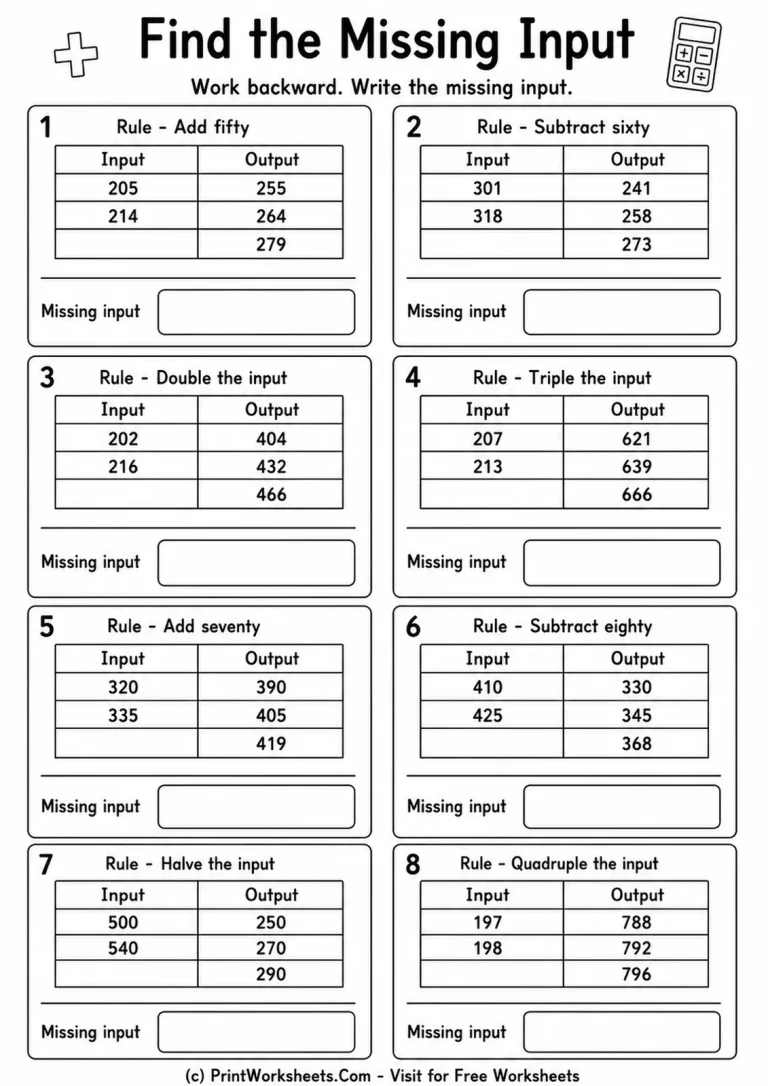
The final approved worksheet reverses the usual direction of an input-output table. Students are given an output and must determine which input would produce it. The rules include add 50, subtract 60, double, triple, add 70, subtract 80, halve, and quadruple. Many of the values are three-digit numbers, so students need to combine operation knowledge with careful backward reasoning.
Finding a missing input encourages students to think about inverse operations. If a machine adds 50, the student can subtract 50 from the output to recover the input. If the rule doubles a number, the student can halve the output. A triple rule can be reversed by dividing the output into three equal groups. These problems strengthen the connection between operations instead of treating each calculation as an unrelated fact.
Ways to Use These Worksheets
The three-page progression works well as a short sequence. A teacher may begin with the missing-output page to confirm that students can apply a stated rule, continue with the rule-matching page to check whether they can identify relationships independently, and finish with the missing-input page for a more challenging backward-thinking task. Parents can use the same order for home review because the level of reasoning increases gradually from page to page.
The worksheets can also be separated for targeted practice. The first page supports basic rule application, the matching page emphasizes pattern recognition, and the final page focuses on inverse thinking. Together, they provide focused Grade 3 practice with input-output tables while reinforcing operation fluency, number relationships, and mathematical reasoning in a format that is easy to print and use.