These consonant blends worksheets give first-grade students several ways to practice hearing, recognizing, writing, and sorting beginning blends. The four printable activities move from picture-supported word work to short sentence reading, with repeated attention to L-, R-, and S-blend families. Students work with familiar examples such as flag, cloud, frog, drum, crab, star, spoon, snail, block, globe, prize, tree, skate, swing, snake, smile, stop, and swan.
Consonant Blends Worksheets for Grade 1
Beginning blends can be challenging because students need to notice both consonant sounds while keeping the sounds connected at the start of a word. This set provides repeated practice without asking children to complete the same task four times. Each worksheet changes the way students interact with the target blends, helping them move from recognition toward independent word reading and writing.
The practice includes common L-blends such as bl, cl, fl, gl, and pl; R-blends such as br, cr, dr, fr, gr, pr, and tr; and S-blends such as sk, sm, sn, sp, st, and sw. Because the worksheets mix picture clues, printed words, missing-letter tasks, and sentences, students see blends in more than one reading context.
Start with Picture Clues and Beginning Blend Choices
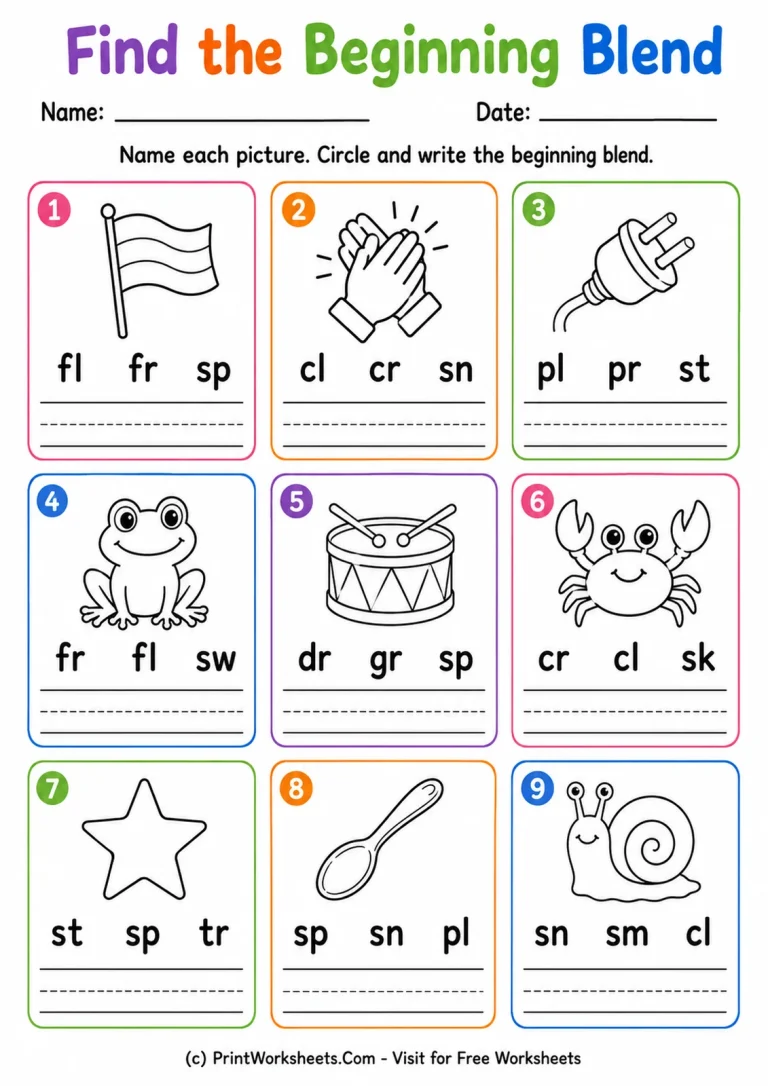
The first worksheet, Find the Beginning Blend, asks students to name nine pictures and choose the blend that begins each word. Learners circle the correct choice and write the blend, creating a simple connection between what they say, what they hear, and what they see in print. The pictured words include flag, clapping, plug, frog, drum, crab, star, spoon, and snail. These examples provide practice across several blend families instead of concentrating on only one spelling pattern.
Match Complete Words to Their Blends
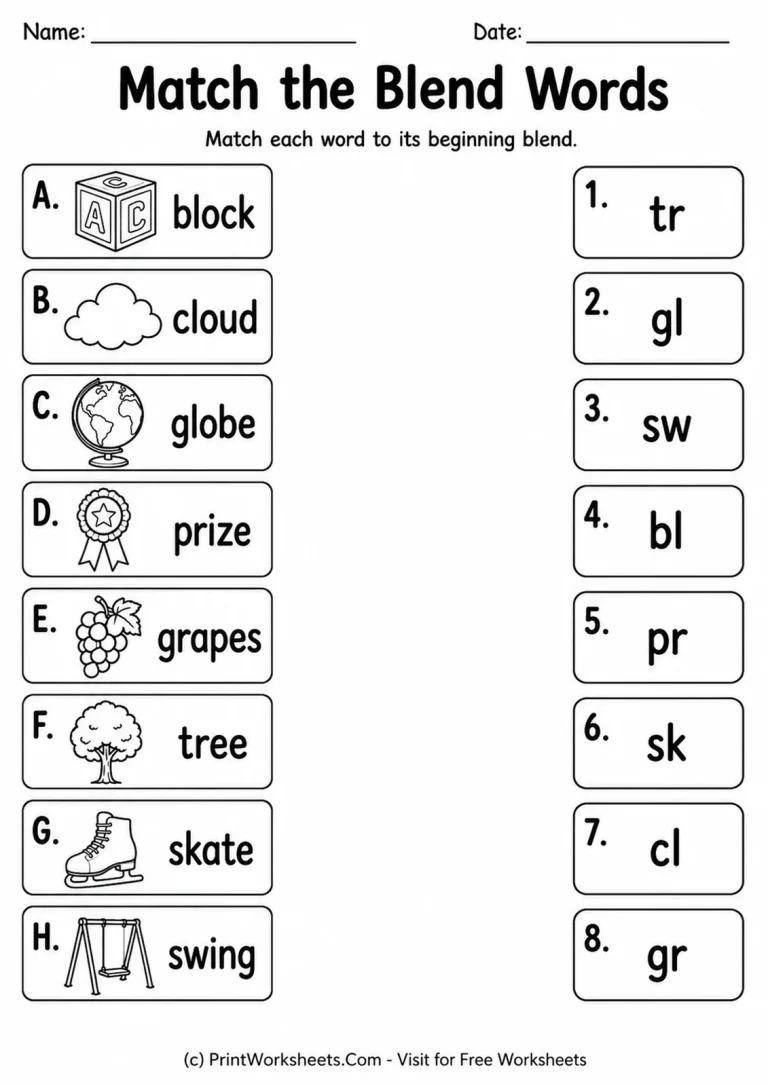
In Match the Blend Words, students work with eight pictured words: block, cloud, globe, prize, grapes, tree, skate, and swing. They match each word to its beginning blend from a set containing tr, gl, sw, bl, pr, sk, cl, and gr. This activity shifts attention from selecting among three choices to comparing several complete words and identifying which two-letter blend belongs with each one.
Complete Missing Blends and Read the Finished Words
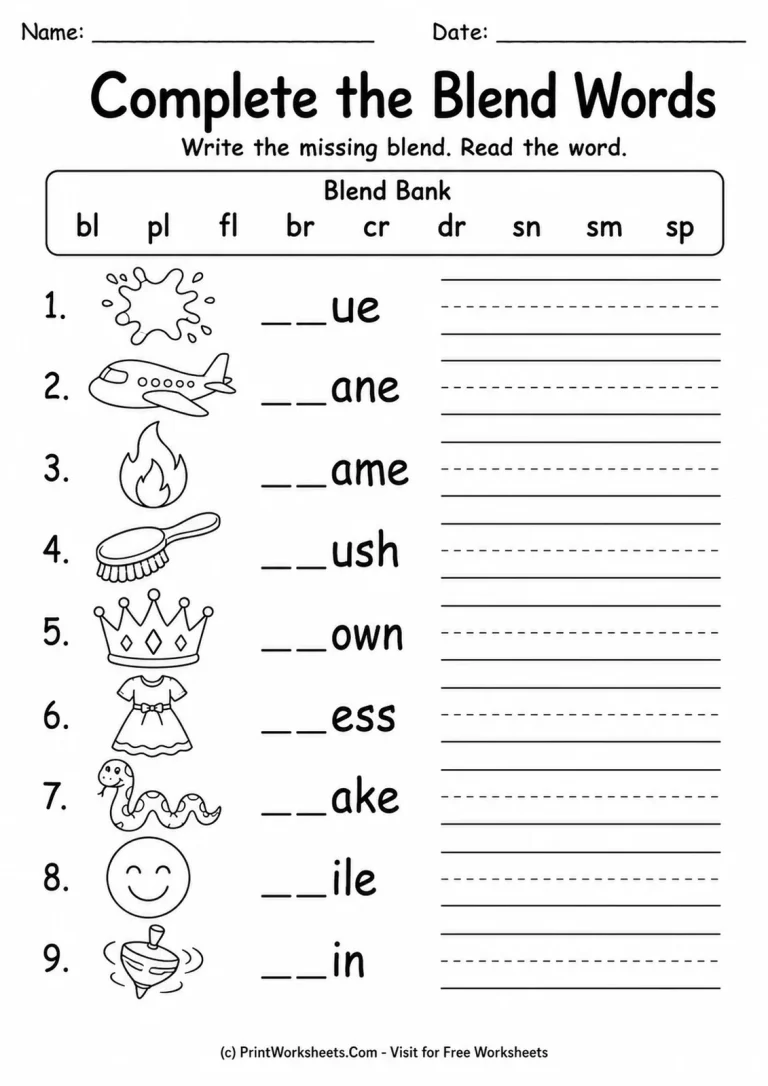
The third activity, Complete the Blend Words, increases the amount of independent word building. A Blend Bank provides bl, pl, fl, br, cr, dr, sn, sm, and sp. Students use those blends to complete nine pictured words and then read and write the finished words. The targets are blue, plane, flame, brush, crown, dress, snake, smile, and spin.
This format is useful for checking whether students can use both the picture meaning and the visible ending of a word to decide which beginning blend fits. It also gives students additional handwriting practice because they supply the missing letters rather than only circling or drawing a matching line.
Find L-, R-, and S-Blends in Sentences
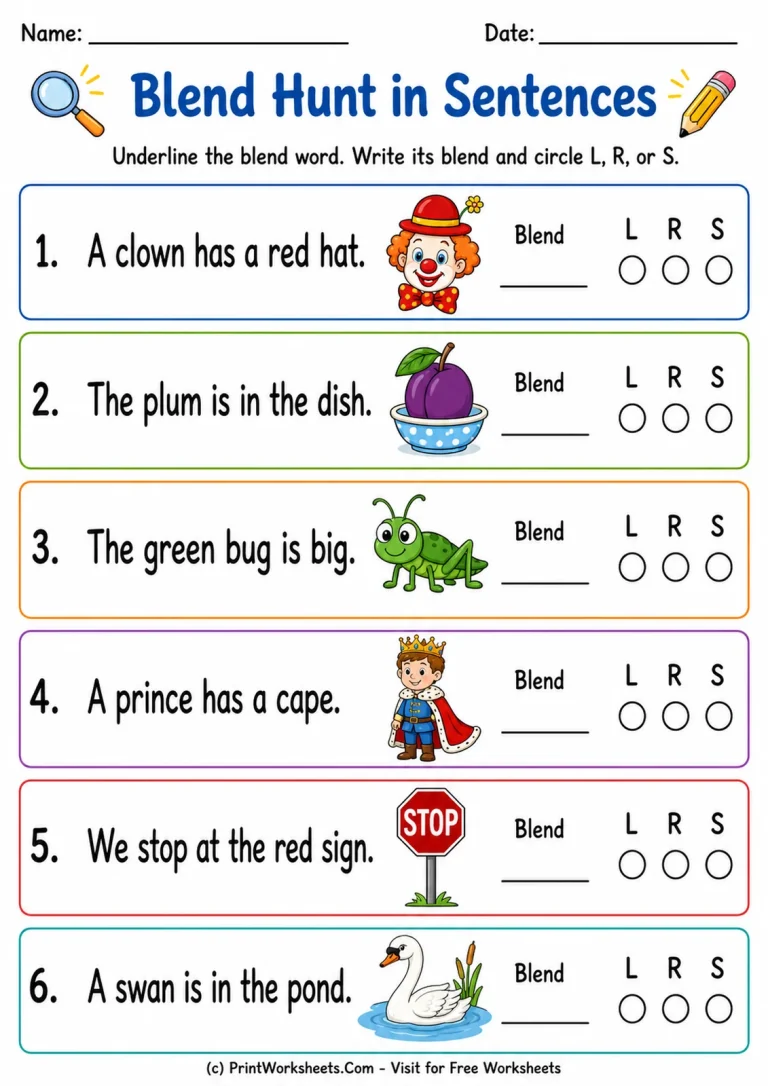
The final worksheet, Blend Hunt in Sentences, moves the skill into connected text. Students read six short sentences, underline the word that begins with a consonant blend, write its blend, and classify that blend as belonging to the L-, R-, or S-blend family. Target words include clown, plum, green, prince, stop, and swan.
This sentence-level practice helps students see that blends are not isolated phonics pieces. They appear inside words that students meet while reading. Asking learners to identify the exact blend and then sort it by family also encourages closer attention to the first two consonants of each target word.
Ways to Use the Four-Page Set
Teachers can use the worksheets in sequence during a phonics unit, assign one page for independent practice, or select individual pages for small-group review. The picture-heavy activities are especially helpful when students still benefit from visual support, while the sentence activity works well after students can recognize several beginning blends at the word level. Families can also use the pages for short at-home reading practice by asking children to say each word aloud before completing the written response.
Together, the four worksheets provide a clear progression from noticing a beginning blend to applying the skill in words and sentences. The varied tasks make the set suitable for review, extra practice, literacy centers, or focused work with first graders who are building accuracy with L-, R-, and S-blends.