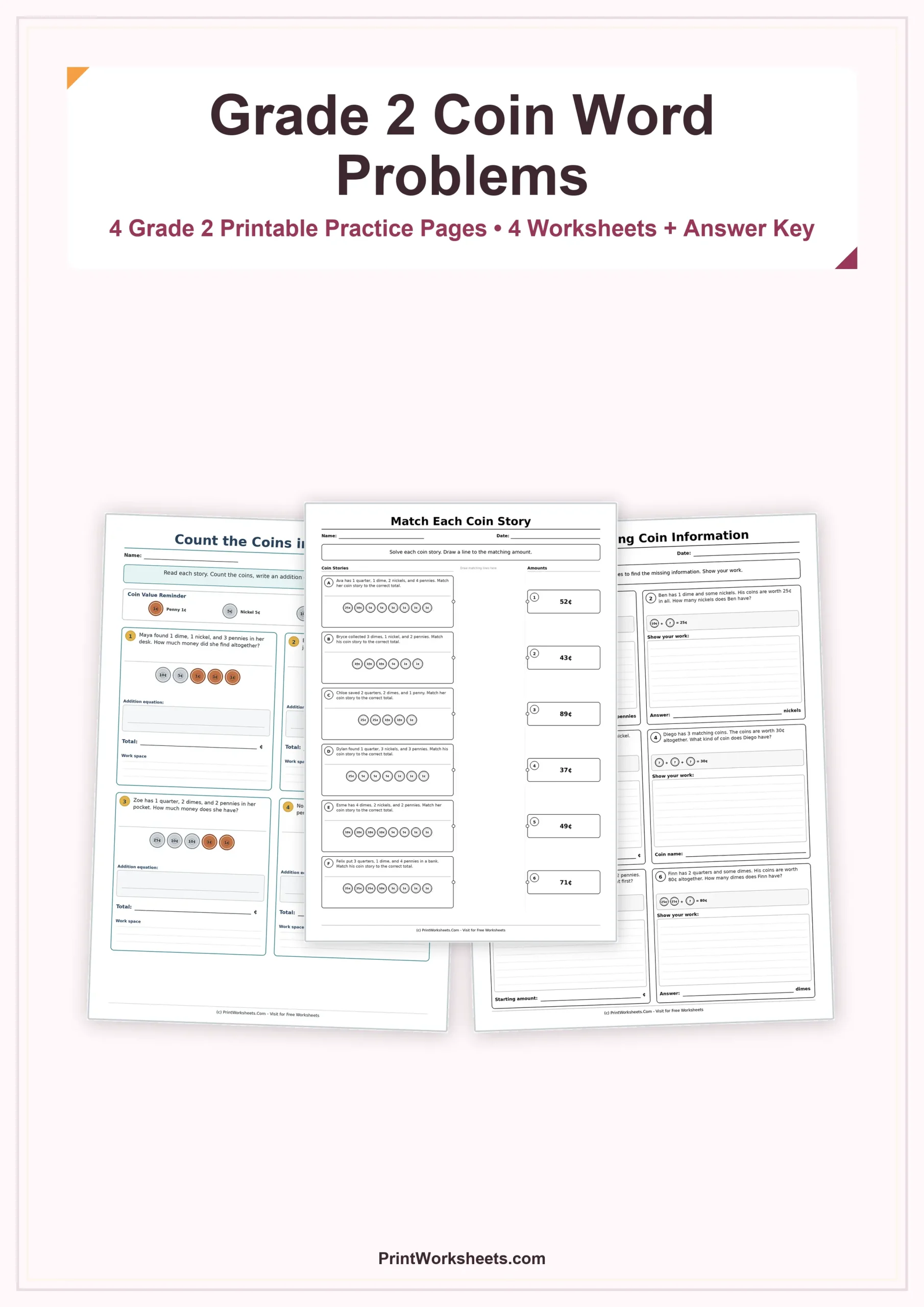
A handful of pennies, nickels, dimes, and quarters gives second graders a concrete way to connect arithmetic with everyday situations. These coin word problems move beyond simply naming coins by asking students to read short stories, interpret pictured coin sets, write equations, find totals, and reason backward when information is missing. Across four printable student pages, the work grows from straightforward counting to multi-step problem solving while keeping every amount grounded in familiar U.S. coin values.
What students practice with coin word problems
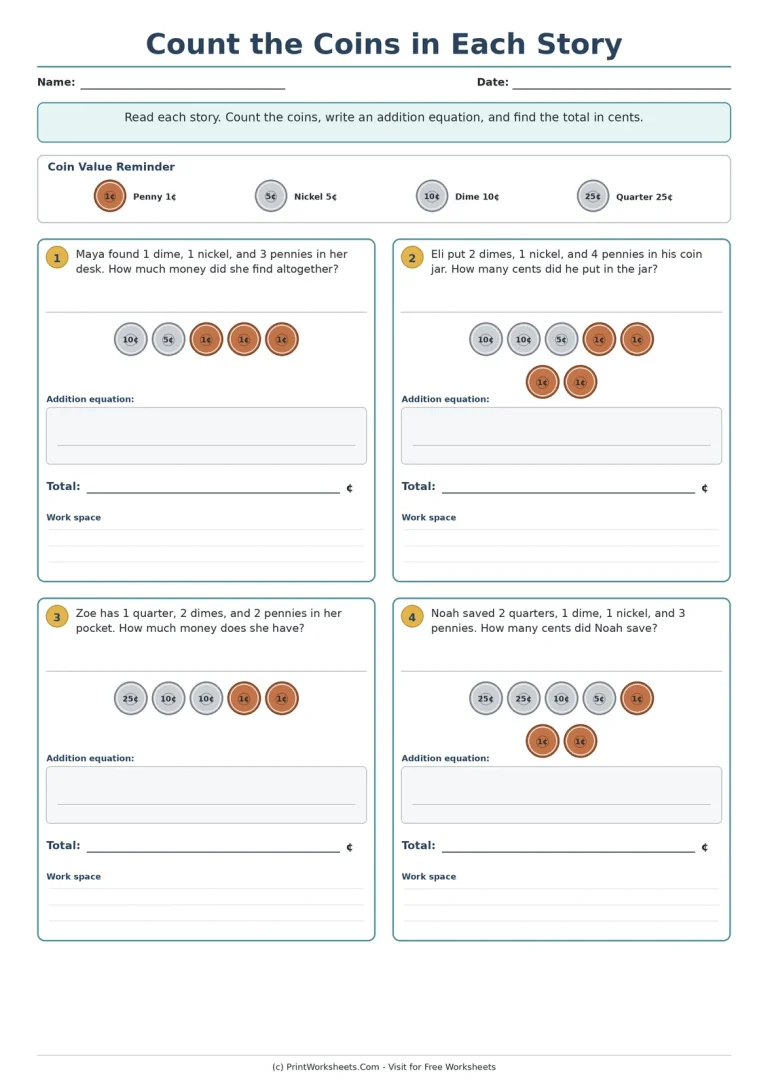
The first worksheet, Count the Coins in Each Story, begins with a visual reminder of the values of a penny, nickel, dime, and quarter. Students then solve four short situations. Maya finds a dime, a nickel, and three pennies; Eli puts dimes, a nickel, and pennies into a jar; Zoe counts a quarter, dimes, and pennies; and Noah combines quarters, a dime, a nickel, and pennies. Each problem asks students to count the pictured coins, write an addition equation, and record the total in cents. This format helps children connect the physical-looking coin models with symbolic addition instead of jumping directly to an answer.
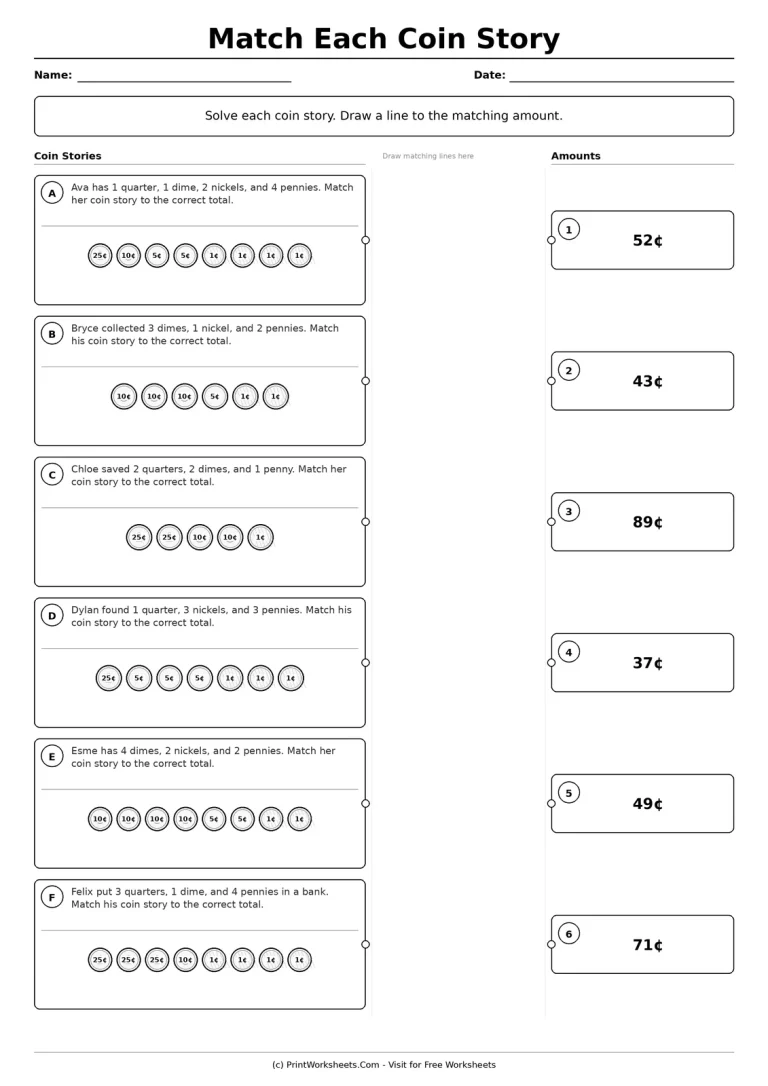
The second page changes the response style. In Match Each Coin Story, six stories appear on the left and six amount cards appear on the right. Students calculate each collection and draw a line to its matching total. The answers range from 37¢ to 89¢, and each amount is used once. Because students must compare several possible totals, the activity encourages careful computation rather than guessing from the number of coins shown.
Reasoning beyond simple coin counting
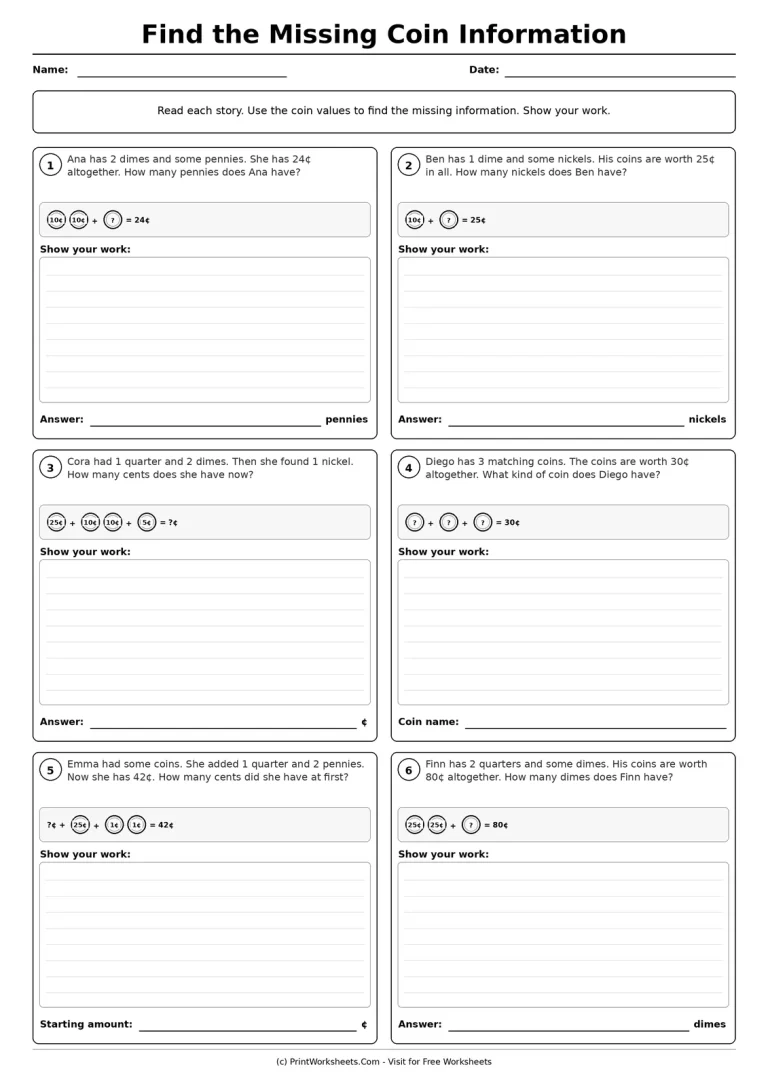
The third worksheet, Find the Missing Coin Information, adds inverse reasoning. Instead of always being given every coin, students determine what information must be missing. One problem asks how many pennies complete 24¢ when two dimes are already known. Another asks how many nickels are needed with one dime to make 25¢. Students also find a total after adding a nickel, identify the coin represented by three matching coins worth 30¢, determine a starting amount before a quarter and two pennies were added, and calculate how many dimes are needed to reach 80¢ after two quarters. Visual equations with question-mark coin symbols make the unknown quantity clear while still leaving room for written work.
Multi-step money challenges for Grade 2
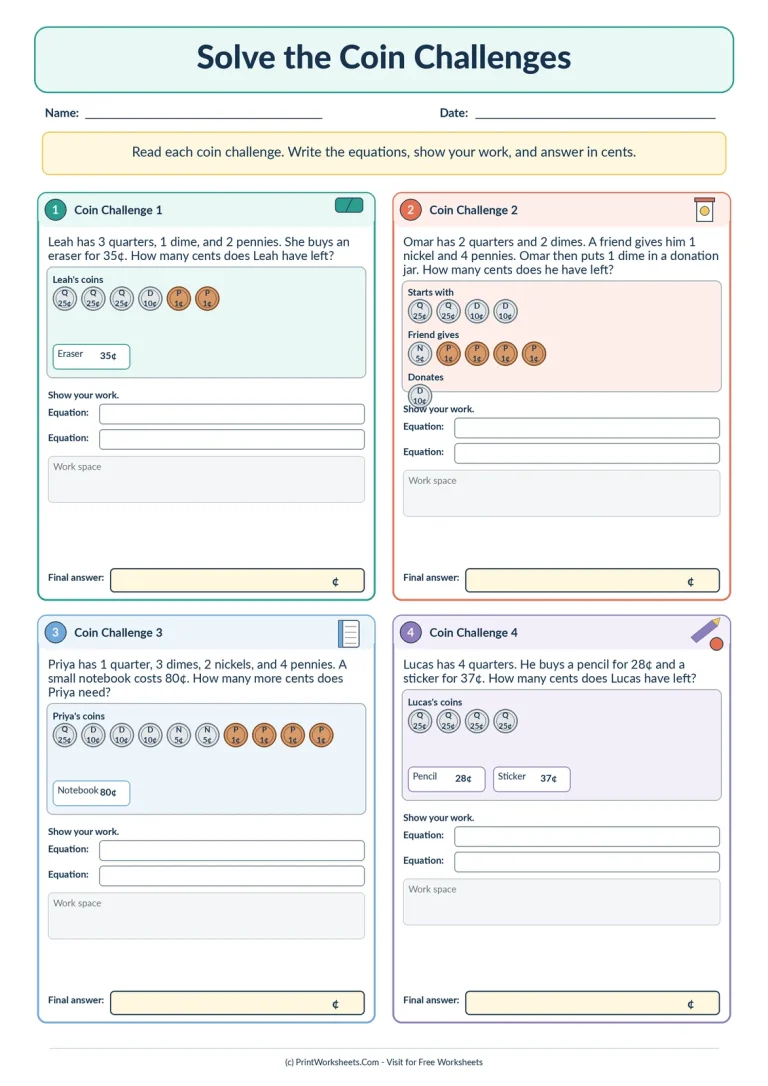
The final student page introduces four larger challenges that combine coin values with addition and subtraction. Leah starts with 87¢ and buys an eraser for 35¢. Omar begins with 70¢, receives a nickel and four pennies, and then donates a dime. Priya has 69¢ and needs to determine how much more she needs for an 80¢ notebook. Lucas starts with four quarters and buys a 28¢ pencil and a 37¢ sticker. Students are given spaces for two equations, work space, and a final answer in cents, making this page especially useful for observing how they organize multi-step reasoning.
Ways to use these money worksheets
This set works well after students already know the basic values of common U.S. coins. The first page can be used for guided practice because the coin-value reminder remains visible. The matching activity can follow as independent work or a math-center task. The missing-information page is a useful small-group lesson for students who are ready to think backward from a known total, while the final challenges can serve as a lesson check, homework page, or short assessment.
For differentiation, students who need more support can recreate each pictured amount with real or plastic coins before writing an equation. Students who are ready for an extension can solve a problem in two different ways, such as grouping 25¢ and 10¢ coins first or counting up from the largest-value coin. Teachers can also cover the pictures after reading a story and ask students to build the described coin collection themselves.
Quick checks and extension ideas
A simple exit ticket is to name a target such as 43¢ or 52¢ and ask students to create one valid coin combination, then write the matching addition equation. Another option is to let students write a short coin story for a partner to solve. For a seasonal follow-up using the same money context, see Halloween money word problems.
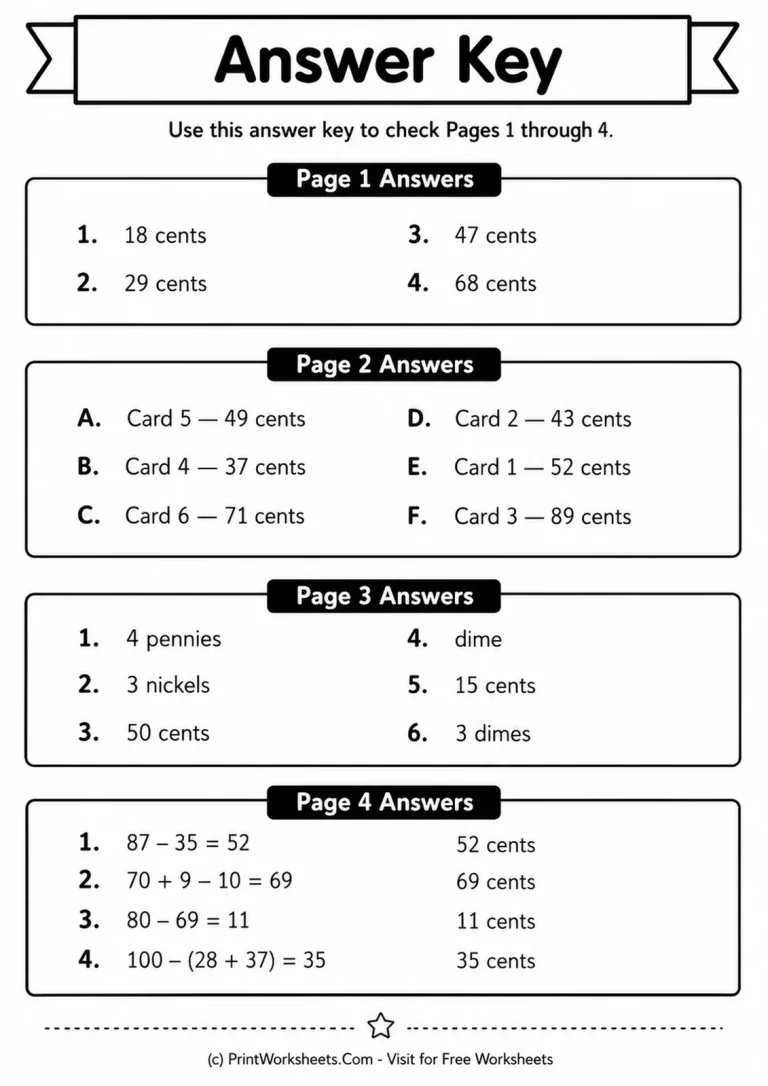
The included answer key covers all four pages, so teachers and parents can quickly check totals, matching choices, missing coin information, and multi-step answers. Used together, the worksheets provide a compact progression from recognizing and combining coin values to applying those values in realistic Grade 2 word problems.