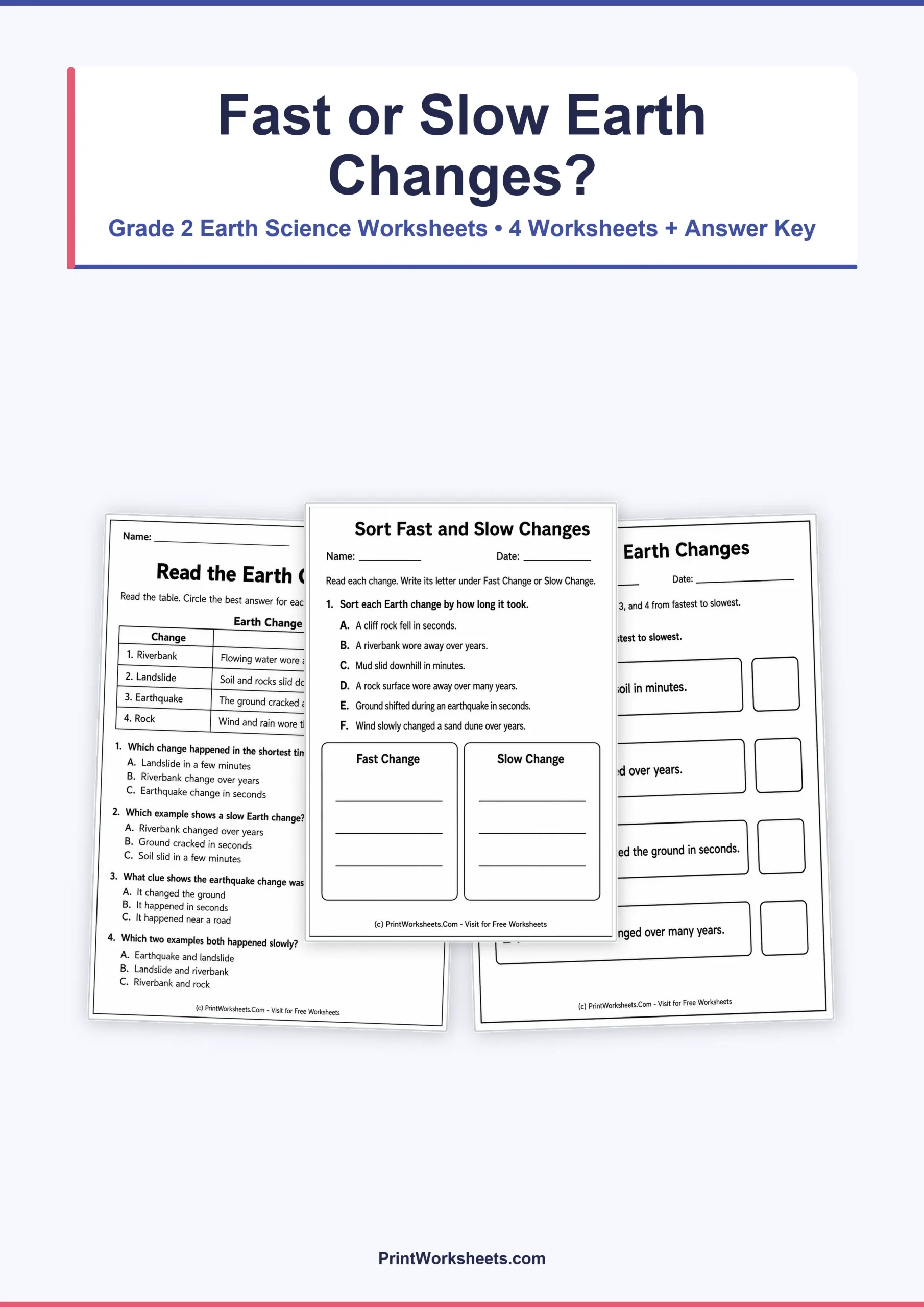


These fast and slow Earth changes worksheets help second graders use time as evidence when they think about how Earth’s surface can change. Instead of treating every Earth change as if it happens at the same rate, students work with clear clues such as seconds, minutes, years, and many years. Across four printable activities, they read examples, sort changes, place events in order, and compare which change happens faster or slower. The examples include earthquakes, landslides, mudslides, riverbank erosion, rock-surface weathering, and wind slowly reshaping a sand dune.
Fast and Slow Earth Changes Through Time Clues
The first worksheet introduces the central idea through an Earth Change Table. Students read short descriptions of four events and pay attention to how long each one takes. An earthquake shifting the ground is described in seconds, while a landslide happens in minutes. A riverbank changes over years, and a rock surface wears away over many years. Students then answer four multiple-choice questions that ask them to identify the shortest time, recognize a slow change, find evidence of a fast change, and choose two examples that both happen slowly.
This page is useful because students are not expected to rely only on memorized labels such as fast or slow. They can point to the stated duration as evidence. That makes the activity a practical introduction to comparing rates of Earth-surface change and gives teachers a simple way to check whether students understand the difference between an event and the amount of time the event takes.
Sort Earth Changes as Fast or Slow
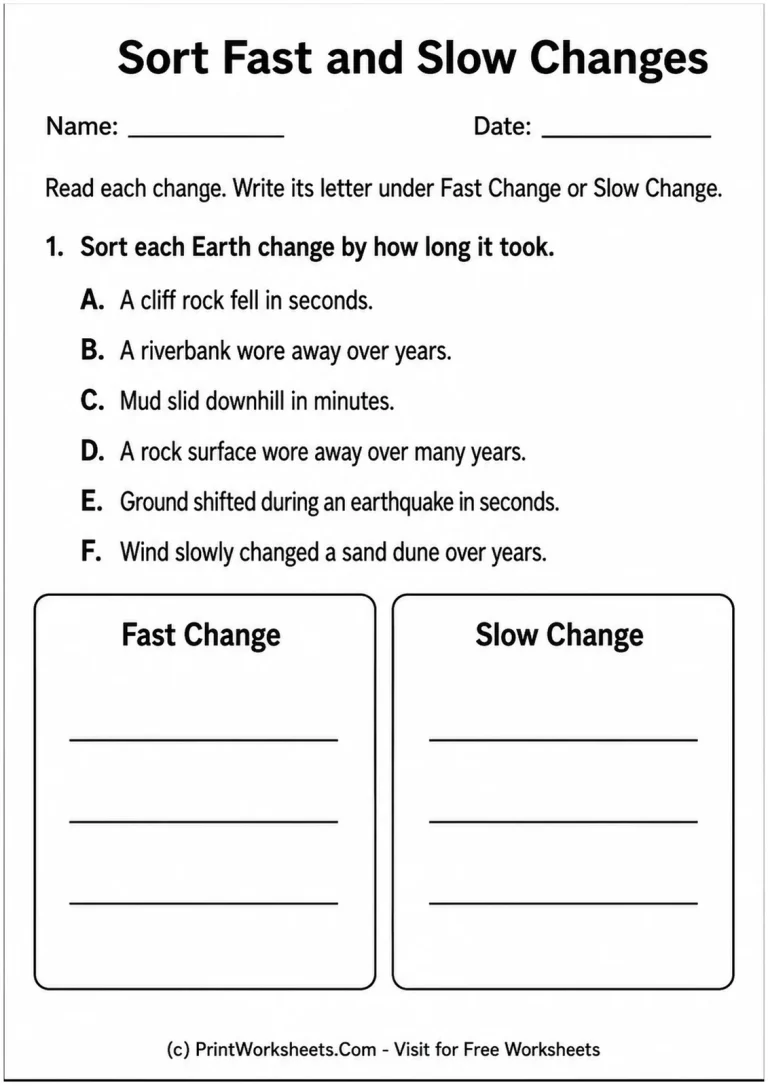
The second printable moves from reading examples to classification. Students sort six lettered Earth-change examples into Fast Change and Slow Change boxes. The set includes a cliff rock falling, a mudslide, earthquake ground movement, riverbank erosion, rock-surface weathering, and wind changing a sand dune. Because the examples cover both sudden events and gradual processes, students must focus on the time scale rather than the appearance of the change.
This sorting activity works well after a short science discussion. Teachers can ask students to explain why an earthquake belongs with fast changes or why weathering belongs with slow changes before students record their answers. For additional oral-language practice, students can use sentence frames such as “This is a fast change because it happens in…” or “This is a slow change because it takes…”
Order Changes From Fastest to Slowest
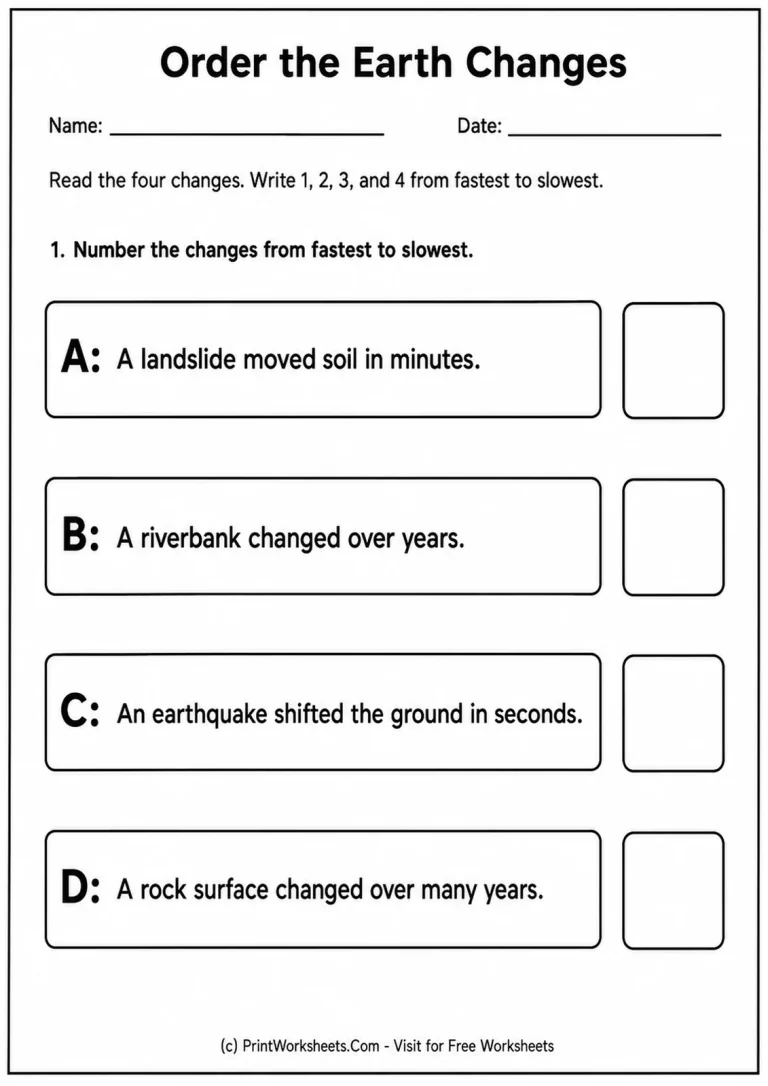
The third worksheet adds a sequencing challenge. Students number four Earth changes from fastest to slowest using explicit duration clues. Earthquake movement happens in seconds, a landslide takes minutes, a riverbank changes over years, and a rock surface changes over many years. The task strengthens understanding of relative duration because students must place all four examples on one mental timeline rather than simply sorting them into two groups.
Teachers can extend this page by writing the four time expressions on the board and asking students to arrange them before they order the Earth events. This separates the time-vocabulary skill from the science examples and can help students who understand the concept but need support with words such as minutes, years, and many years.
Practice Faster and Slower Comparisons
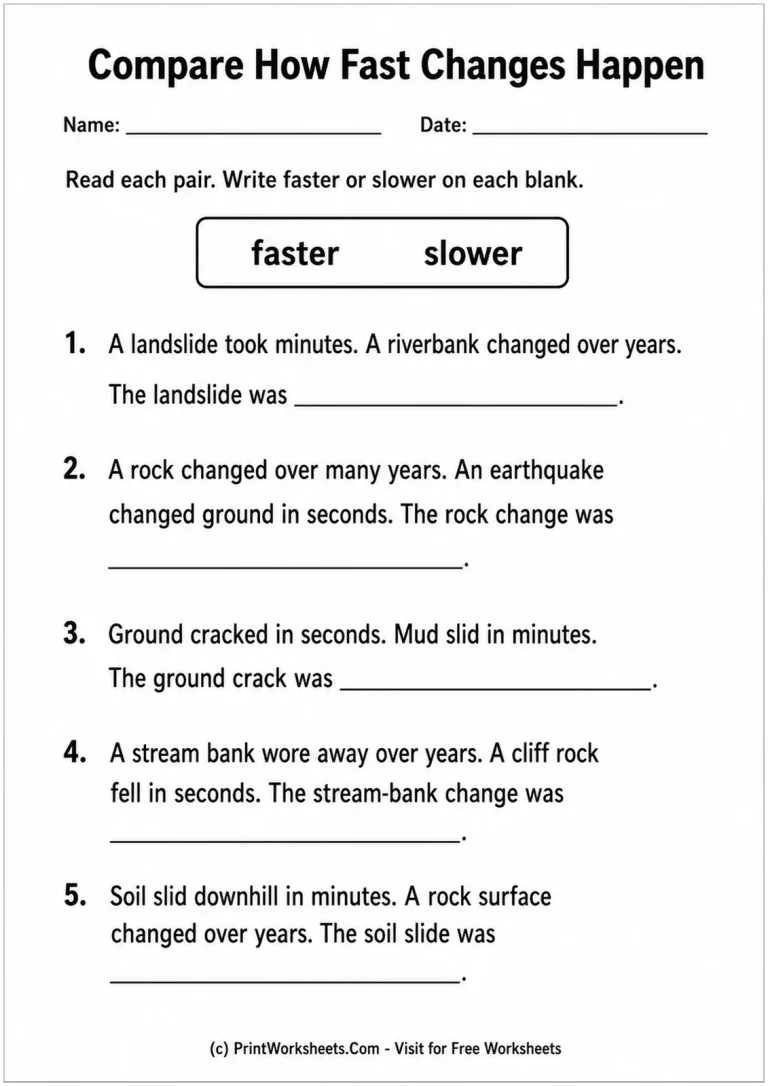
The fourth worksheet focuses directly on comparative language. Students examine five pairs of Earth changes and write either faster or slower. Each comparison contrasts clearly different durations, including changes that happen in seconds or minutes with changes that take years or many years. This gives students repeated practice using the words faster and slower accurately instead of relying only on the broader categories fast and slow.
The progression across the set makes the pages flexible for classroom instruction. A teacher can begin with the table-reading page for guided practice, use the sorting page with partners, assign the ordering activity independently, and finish with the faster-or-slower comparisons as a quick check for understanding. The included teacher answer key provides the multiple-choice answers, sorting groups, correct fastest-to-slowest sequence, and all five comparison responses.
Differentiation, Exit Tickets, and Extension Ideas
For students who need extra support, highlight or underline the time words before they answer. Students can also create a two-column reference chart labeled Fast and Slow and add examples from the worksheets. For students ready for an extension, ask them to explain why wind changing a sand dune belongs with slow changes even though wind itself can move quickly.
A simple exit ticket can name one Earth change and ask students whether it is fast or slow and what time clue supports the answer. Another option is to give two events, such as an earthquake and riverbank erosion, and ask which happens faster. These short responses reveal whether students are using evidence from duration rather than guessing from the event name.
Used together, the four worksheets give Grade 2 students repeated but varied practice with one focused Earth science idea: some changes to Earth’s surface happen suddenly, while others develop gradually over much longer periods. The shift from reading to sorting, ordering, and direct comparison helps students build a stronger understanding of both the science concept and the time vocabulary used to describe it.