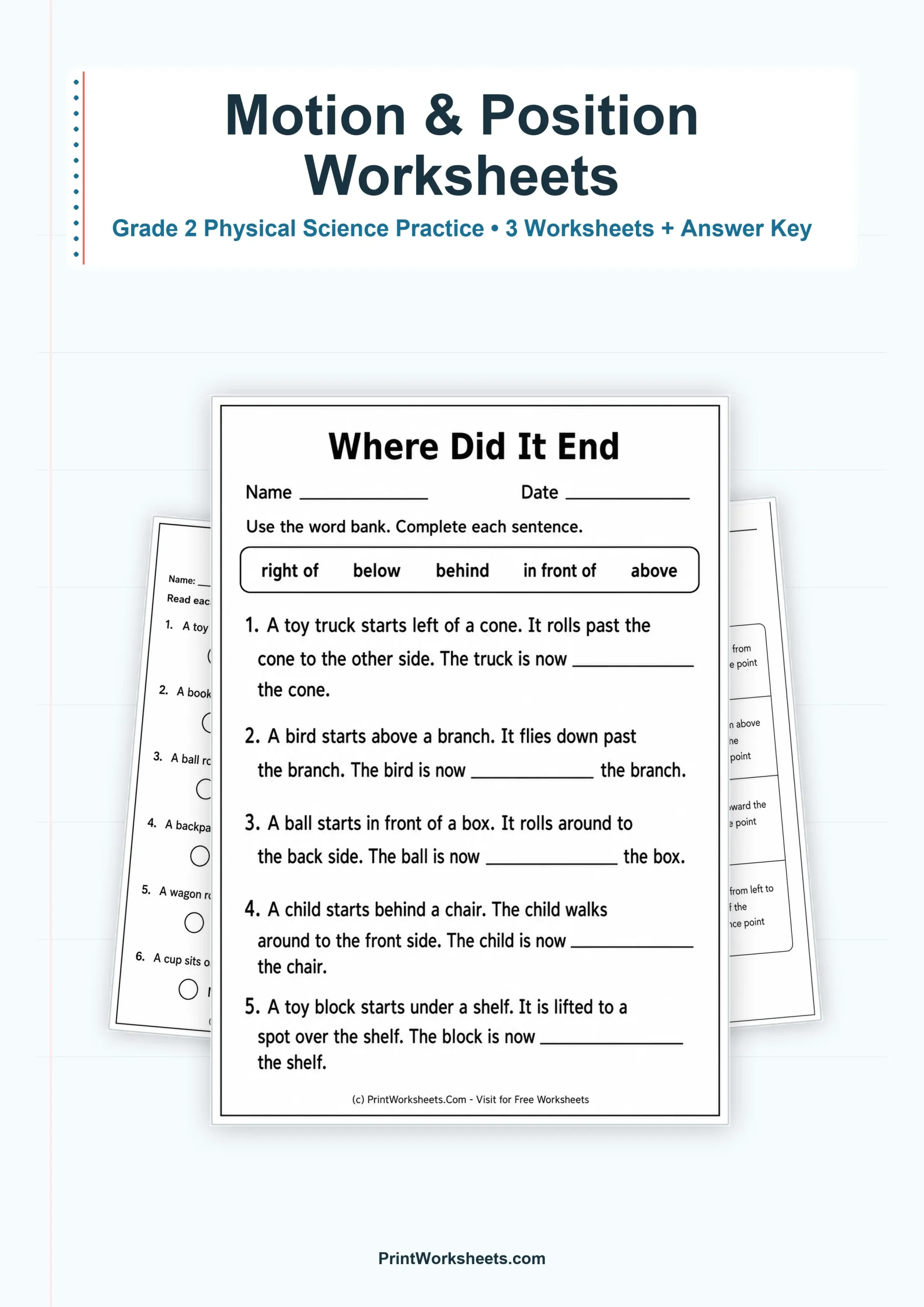
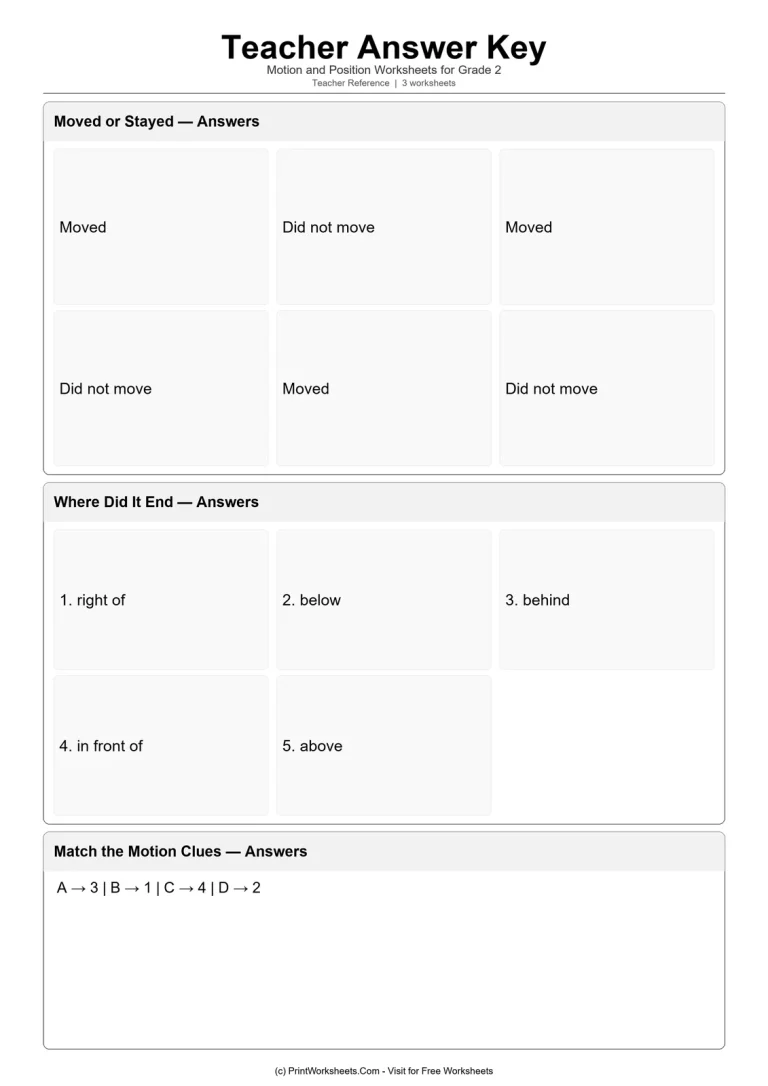
These motion and position worksheets give Grade 2 students a clear way to describe how objects move and where they end up in relation to a reference point. Across three printable activities, children decide whether an object moved, identify its ending position with words such as right of, below, behind, in front of, and above, and connect short motion clues to more general descriptions such as moving toward or away from a reference point. The set works well for a physical science lesson because each page asks students to use observable position changes rather than memorize isolated vocabulary.
Motion and Position Worksheets for Grade 2
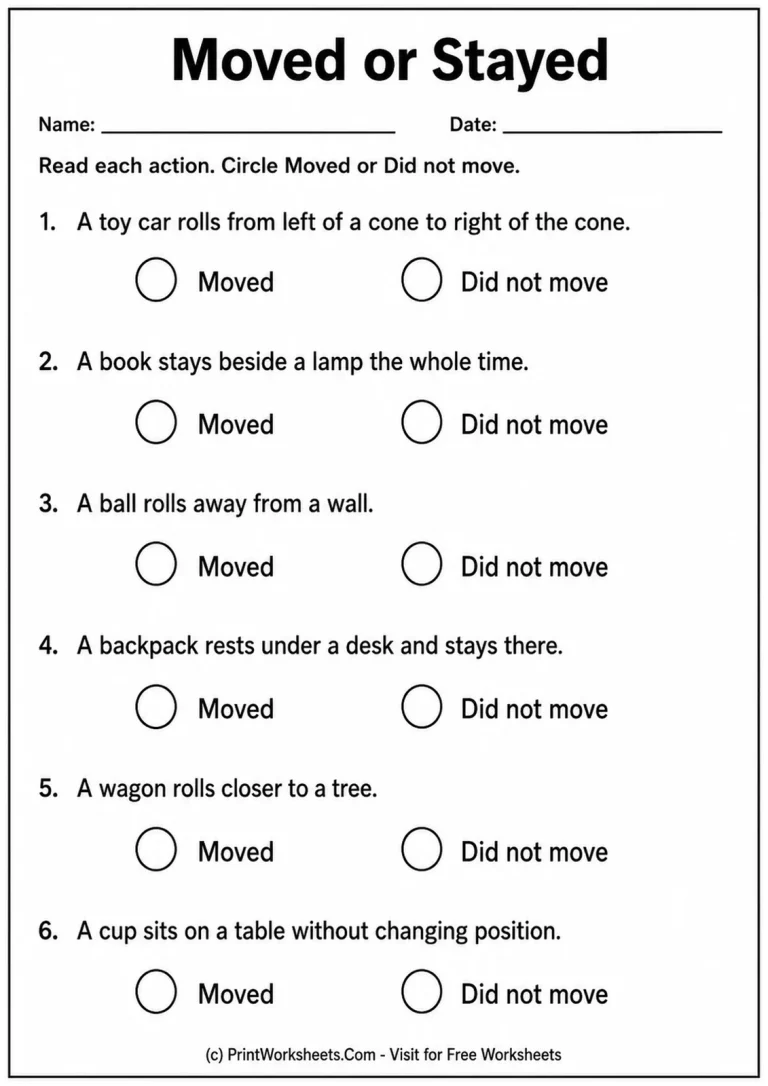
The first worksheet, Moved or Stayed, begins with a simple but important idea: motion means a change in position. Students read six everyday situations and circle either Moved or Did not move. A toy car rolls from the left side of a cone to the right side, a ball rolls away from a wall, and a wagon rolls closer to a tree. In contrast, a book stays beside a lamp, a backpack remains under a desk, and a cup sits on a table without changing position. These paired examples help children notice that the key evidence is whether the object’s position changes relative to something else.
This page can be used as a quick introduction before students work with more precise positional language. Ask students to explain why each answer is correct using a sentence such as, “The wagon moved because its position changed compared with the tree.” That oral explanation strengthens the connection between motion and reference points.
Finding an Object’s Ending Position
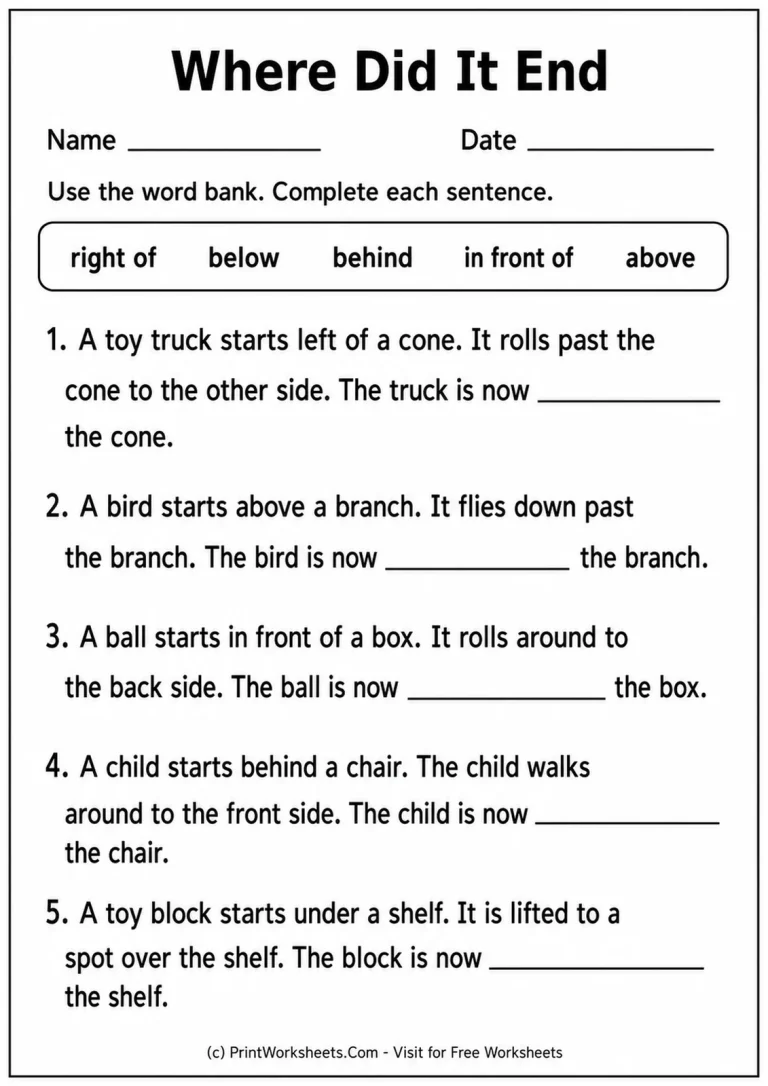
The second activity, Where Did It End, moves from recognizing motion to describing final position. Students use a five-word bank: right of, below, behind, in front of, and above. Each sentence gives a starting place and describes a movement before asking where the object is now.
For example, a toy truck starts left of a cone and rolls past it, so it ends right of the cone. A bird begins above a branch and flies down past it, ending below the branch. A ball moves from the front of a box to the back side, while a child moves from behind a chair to the front side. The final item has a block lifted from under a shelf to a spot over the shelf. Because each word-bank choice matches one item, students get focused practice reading motion descriptions and translating them into accurate position words.
Using Reference Points to Describe Motion
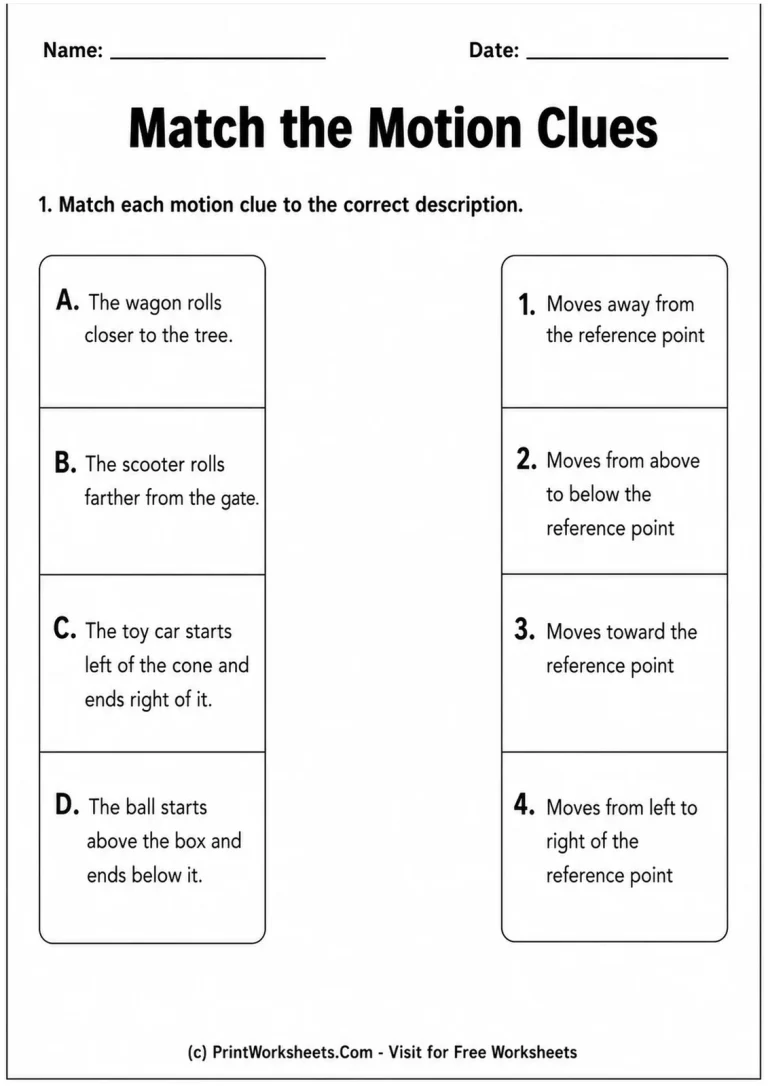
The third worksheet, Match the Motion Clues, asks students to connect specific examples with broader motion descriptions. A wagon rolling closer to a tree matches “moves toward the reference point,” while a scooter rolling farther from a gate matches “moves away from the reference point.” A toy car that starts left of a cone and ends right of it matches movement from left to right, and a ball that starts above a box and ends below it matches movement from above to below.
This matching task is useful after the earlier pages because students must generalize from a concrete sentence to a science description. It also gives teachers a natural opportunity to emphasize that the tree, gate, cone, and box act as reference points used to describe changes in position.
Teaching Ideas for Position and Motion
Before handing out the worksheets, demonstrate one or two examples with classroom objects. Place a pencil beside a book, move it to the other side, and ask students what changed. Then move the pencil closer to or farther from the book. Using a real object makes words such as toward, away, left, right, above, and below easier to connect with visible movement.
For students who need extra support, let them act out each sentence with a small toy, eraser, or classroom object before choosing an answer. You can also highlight the reference object in each sentence and ask, “Where is the moving object compared with this object?” Students ready for an extension can write their own start-and-end sentence using one reference point and challenge a partner to describe the final position.
Quick Checks and Exit Ticket Ideas
After the set, give students a simple three-part exit ticket. Ask them to name one example of an object that did not move, describe how an object can move toward a reference point, and complete a sentence such as, “The ball started above the box and ended below it.” These prompts quickly show whether students understand motion as a change in position and can use relative-position language correctly.
A teacher answer key is included for all three activities, making the set practical for independent practice, science centers, homework, small-group instruction, or review. Together, the pages build from basic observation to more precise scientific description, giving second graders repeated practice with the language they need to talk about motion and position clearly.