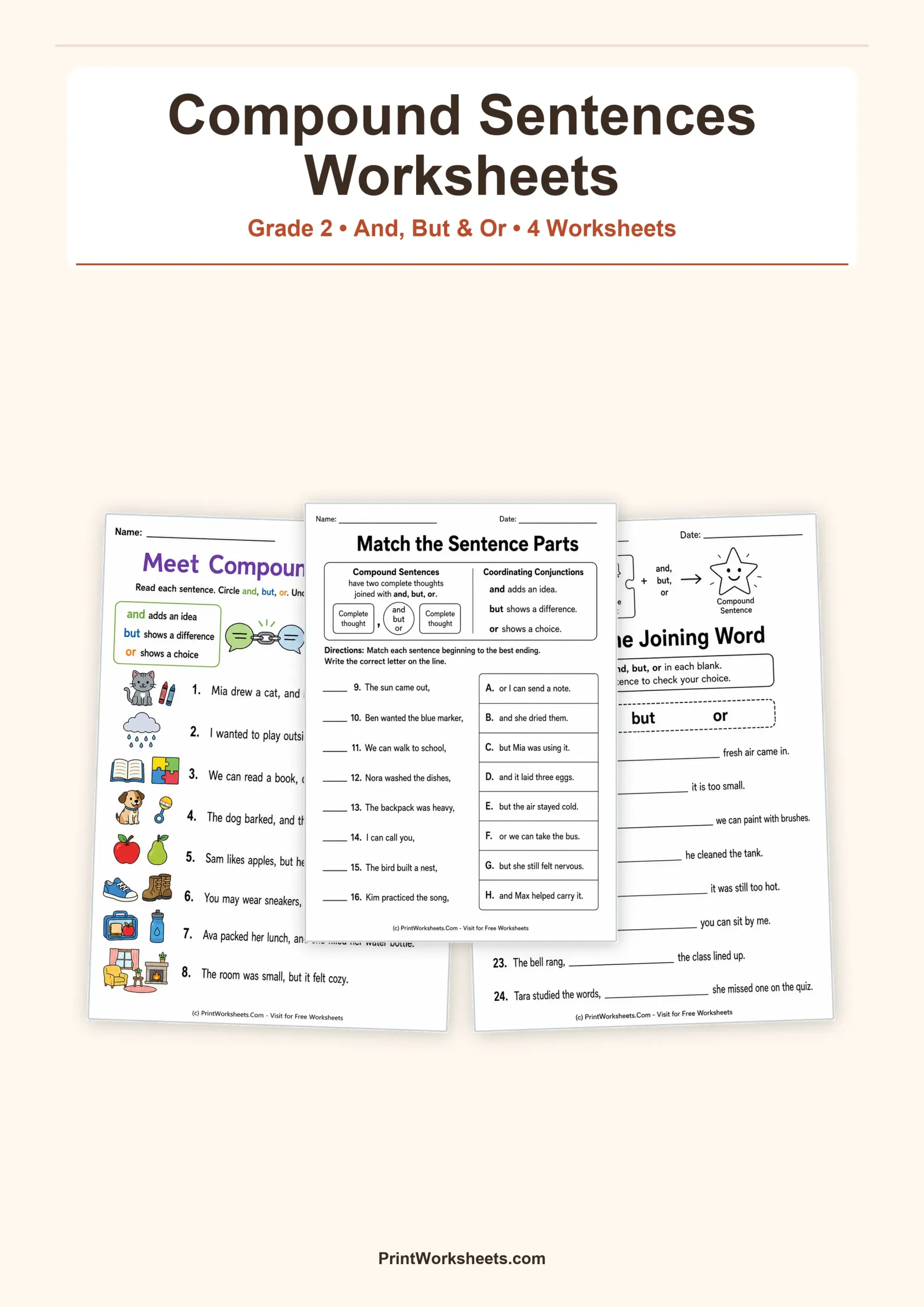
Young writers often have two related ideas to share but need practice turning them into one clear sentence. These compound sentences worksheets for Grade 2 focus on three useful joining words: and, but, and or. Across four printable activities, students learn to notice the two complete thoughts inside a compound sentence, understand what each joining word does, choose the word that fits the meaning, and finally combine short sentences on their own.
The set keeps the grammar target narrow and concrete. Students work with the idea that and adds information, but shows a difference, and or presents a choice. A simple pattern—complete thought, comma, joining word, complete thought—gives second graders a structure they can see and reuse. The activities can be taught in sequence or used separately for guided practice, literacy centers, homework, review, or a short skills check.
Compound Sentences Worksheets for Grade 2
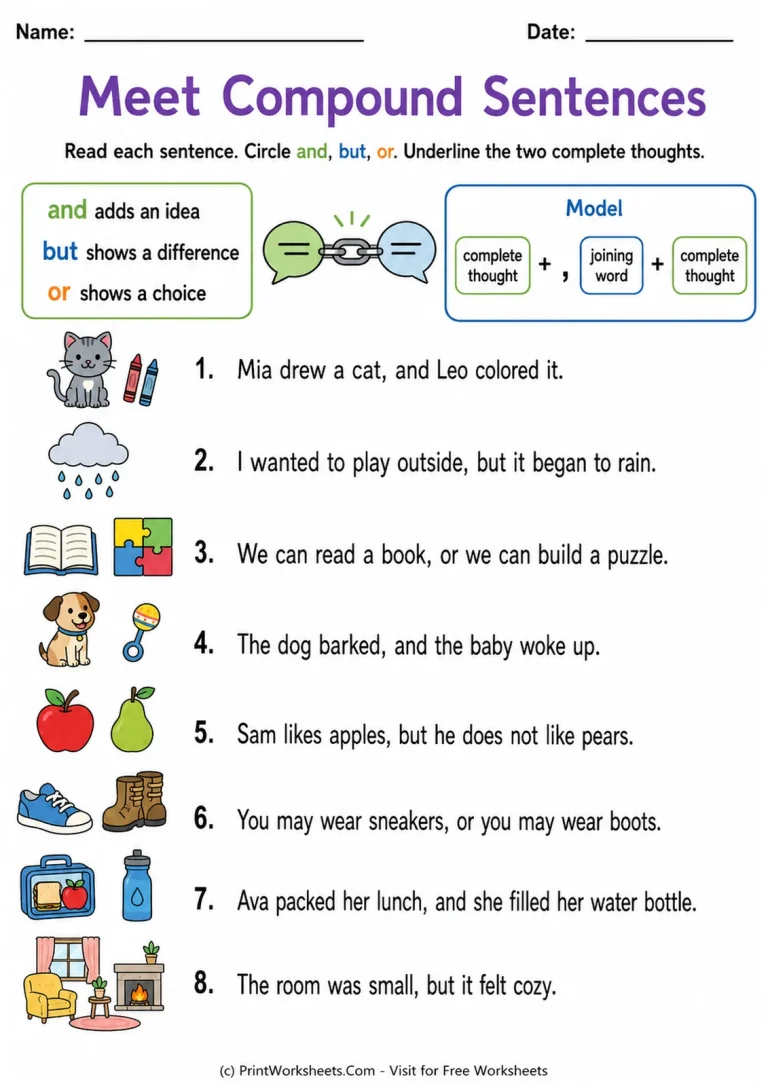
The first worksheet, Meet Compound Sentences, asks students to study eight complete compound sentences. They circle and, but, or or and underline the two complete thoughts that are being joined. This helps students see that a compound sentence is more than a long sentence: both sides can stand as complete ideas, and the joining word shows how those ideas are connected.
This opening activity is useful before students are expected to write their own sentences. By separating the joining word from the complete thoughts, learners can focus on sentence structure without having to generate new content at the same time. The examples also reinforce the comma that appears before the coordinating conjunction in the model used throughout the set.
Match Complete Ideas That Belong Together
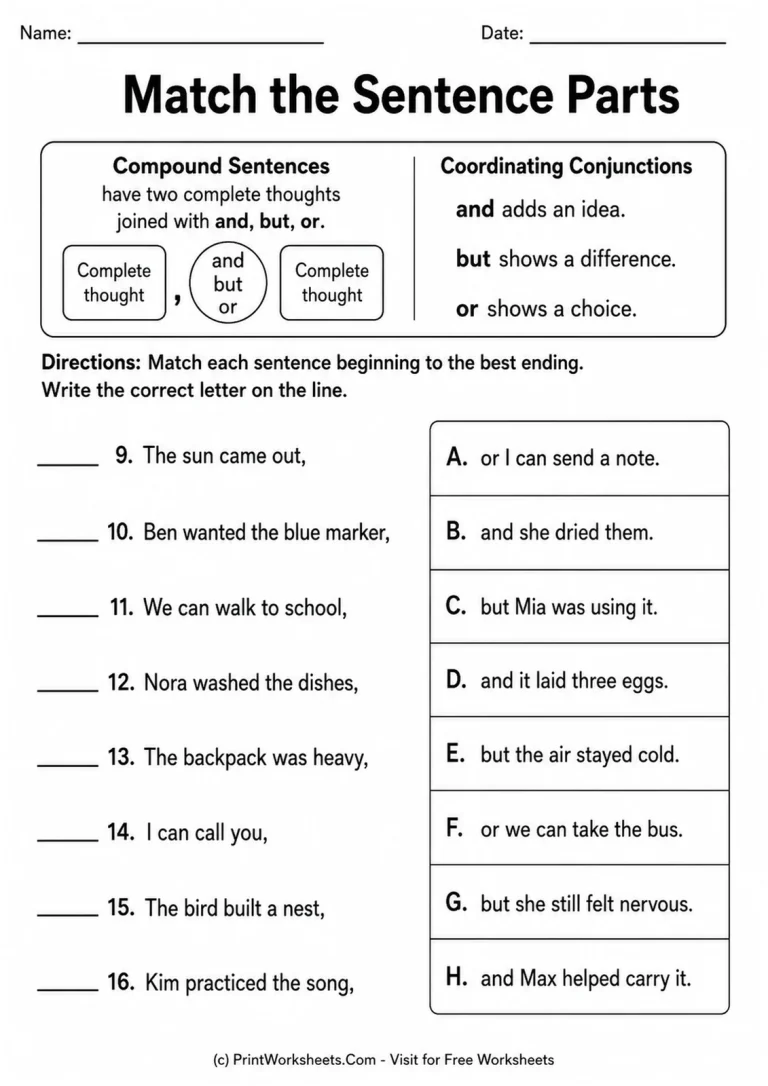
In Match the Sentence Parts, students move from identifying structure to thinking about meaning. Items 9–16 provide sentence beginnings that must be paired with the best endings from choices A–H. The goal is not simply to find two clauses that are grammatically possible. Students must consider whether the ideas make sense together and whether the relationship fits addition, contrast, or choice.
This matching format gives Grade 2 learners support while still requiring careful reading. It is especially helpful for students who understand complete sentences but need more experience recognizing how one thought can logically connect to another.
Choose And, But, or Or
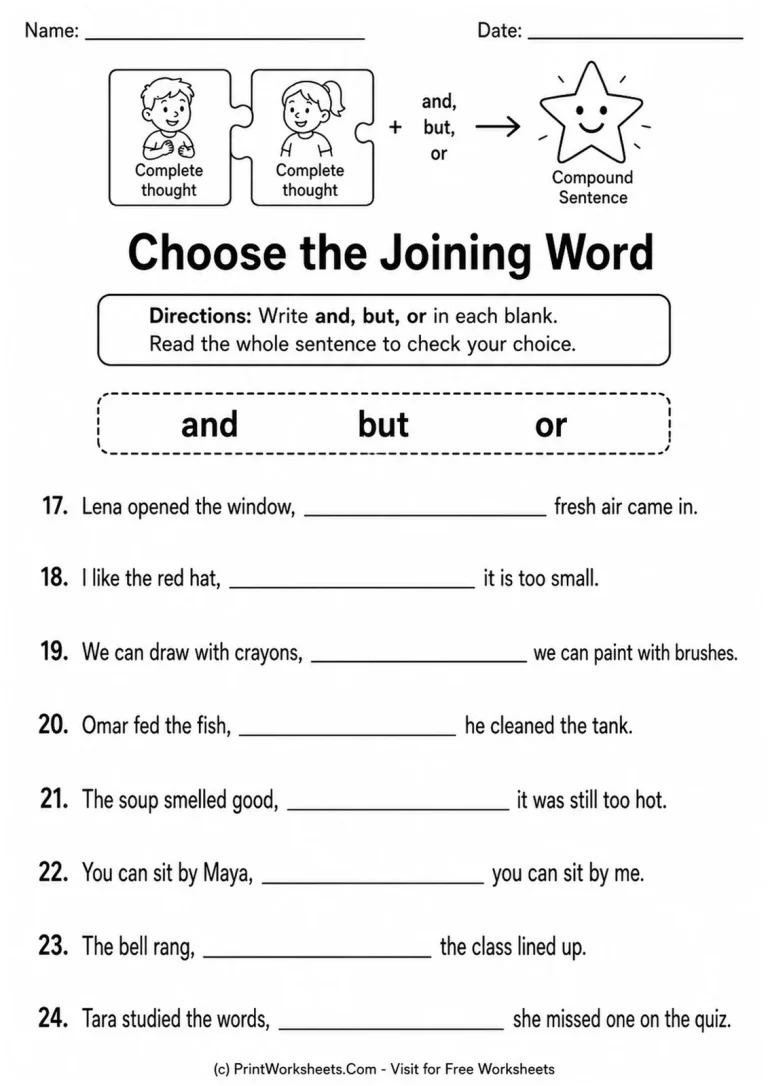
The third worksheet, Choose the Joining Word, focuses directly on conjunction choice. In items 17–24, students complete compound sentences by writing and, but, or or in each blank. Reading the whole sentence is important because each conjunction changes the relationship between the ideas.
Students can use the three meaning clues as a quick decision tool: choose and when the second thought adds something, but when it introduces a difference or contrast, and or when the sentence offers alternatives. This page works well for independent practice after a short teacher model because the choices remain limited while the reasoning becomes more independent.
Build Compound Sentences with Correct Punctuation
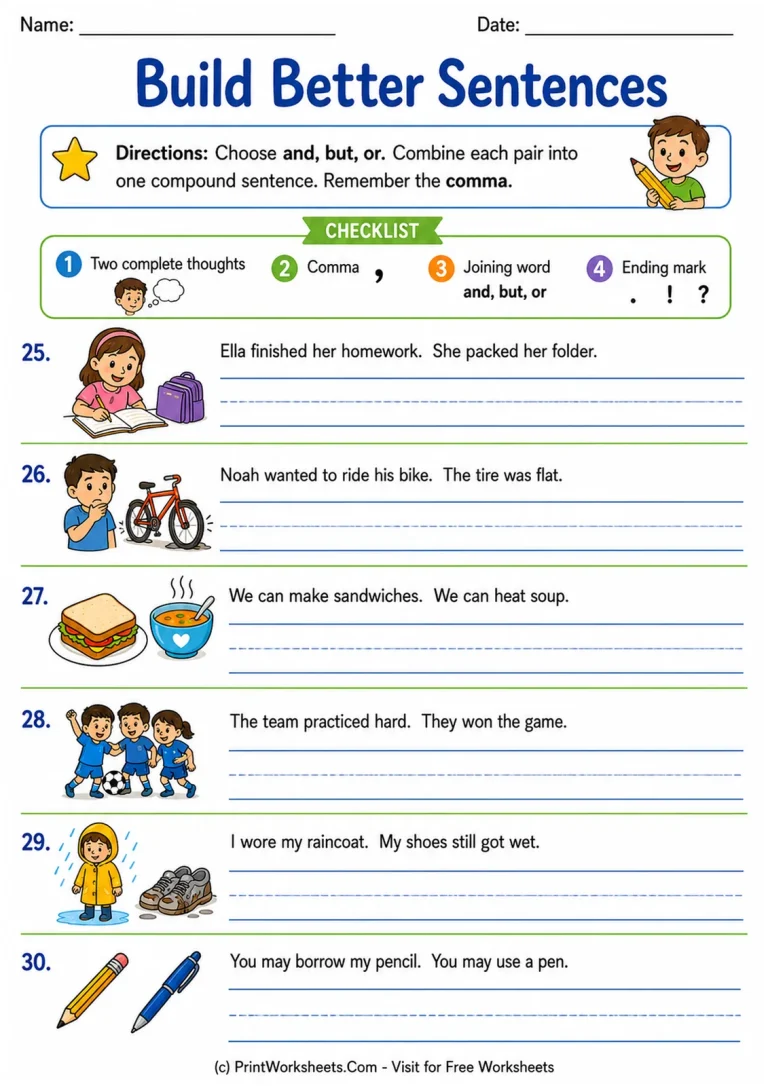
The final student page, Build Better Sentences, shifts from recognition to production. For items 25–30, students receive two short sentences and combine them into one compound sentence using the most suitable joining word. A checklist reminds them to include two complete thoughts, a comma, a joining word, and correct ending punctuation.
This writing task brings together everything practiced on the earlier pages. Students must preserve the meaning of both original sentences, decide whether the relationship calls for and, but, or or, and write the combined sentence accurately. Because the source sentences are already provided, children can concentrate on the grammar decision rather than inventing ideas from scratch.
Ways to Use the Four-Page Set
Teachers can begin with the identification page during direct instruction, use the matching and conjunction-choice activities for supported or independent practice, and save the sentence-combining page for application. The pages also fit naturally into small-group instruction because each one isolates a different step in the same skill.
Parents can use the worksheets for focused home practice without introducing a large set of grammar terms. A helpful routine is to ask the child to read each compound sentence aloud and explain the relationship between the two ideas. Questions such as “Is the second idea adding something, showing a difference, or giving another choice?” encourage students to think about meaning instead of guessing the joining word.
By the end of the set, students have practiced both reading and creating compound sentences. The progression from spotting complete thoughts to combining sentences gives second graders repeated experience with sentence structure, conjunction meaning, commas, and clear written expression in one focused printable resource.