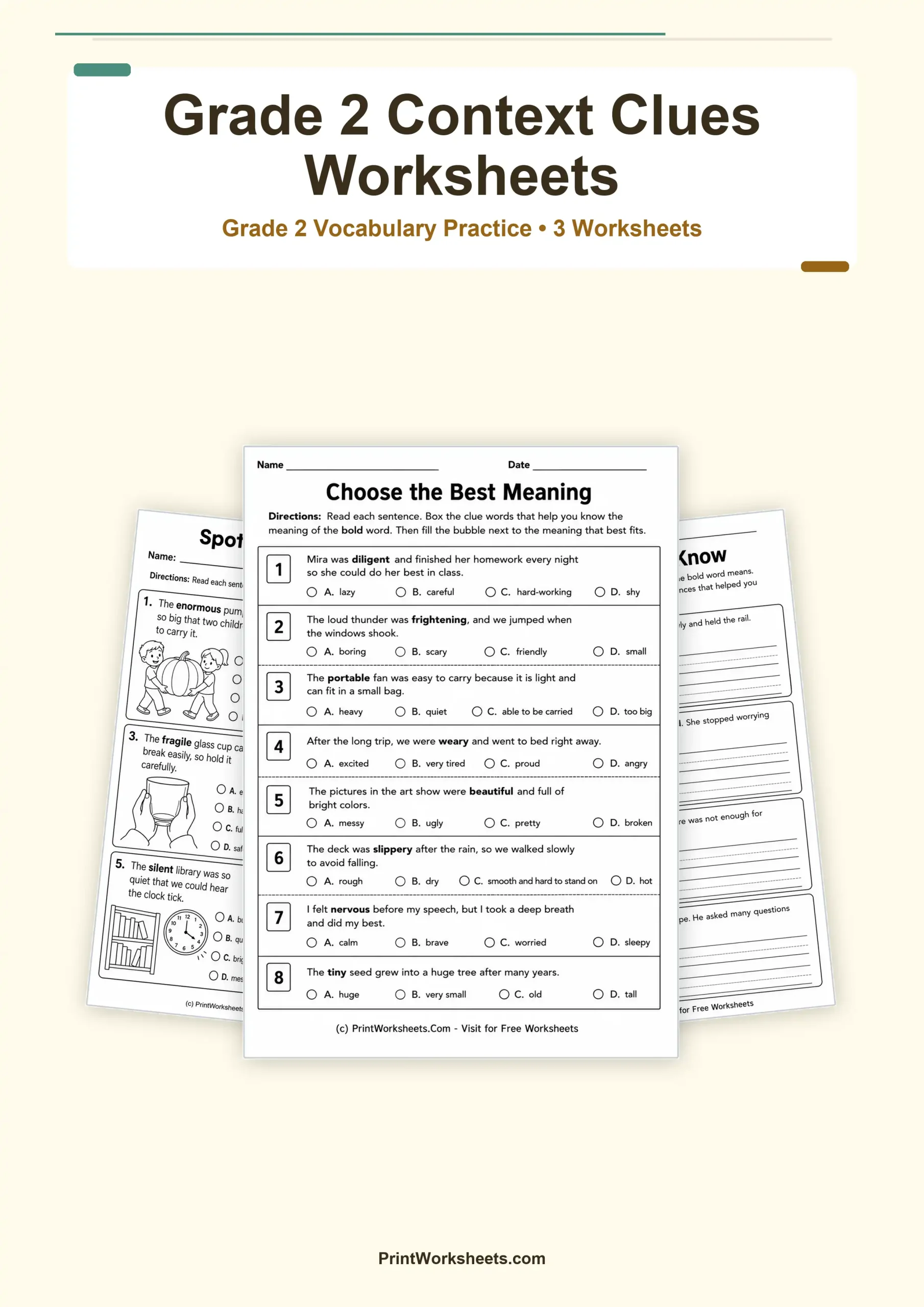
These Grade 2 context clues worksheets help students work out unfamiliar word meanings from short, manageable sentences instead of relying on definitions alone. Across the three printable pages, children look for words and phrases that reveal meaning, choose the best definition, and then explain how the sentence helped them reach an answer. The sequence moves from more supported vocabulary practice to independent written reasoning, making the set useful for whole-class instruction, centers, homework, intervention, or extra vocabulary review.
Context Clues Worksheets Built Around Short Sentences
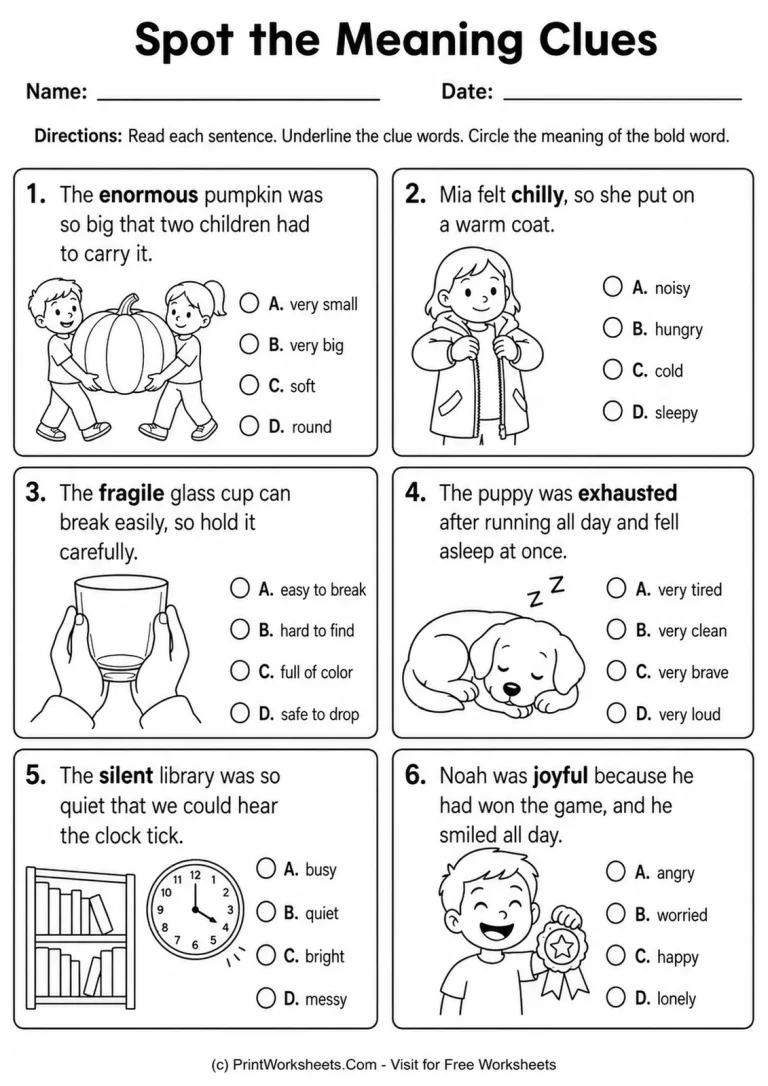
Short sentences keep the reading load controlled so students can focus on the vocabulary skill itself. On the first activity, students meet words such as enormous, chilly, fragile, exhausted, silent, and joyful. Each sentence provides enough information to infer the meaning, and picture support gives developing readers an additional entry point. Students do more than select an answer: they also identify the clue words that helped them decide.
This matters because successful context-clue work is not simply guessing from a familiar-looking option. Students need to notice evidence inside the sentence. A line describing something as enormous, for example, should contain language that signals unusually large size. A sentence using fragile should make it clear that the object can break easily. Asking children to mark or underline those signals turns their attention toward the reasoning behind the meaning.
Move from Supported Choices to Independent Vocabulary Thinking
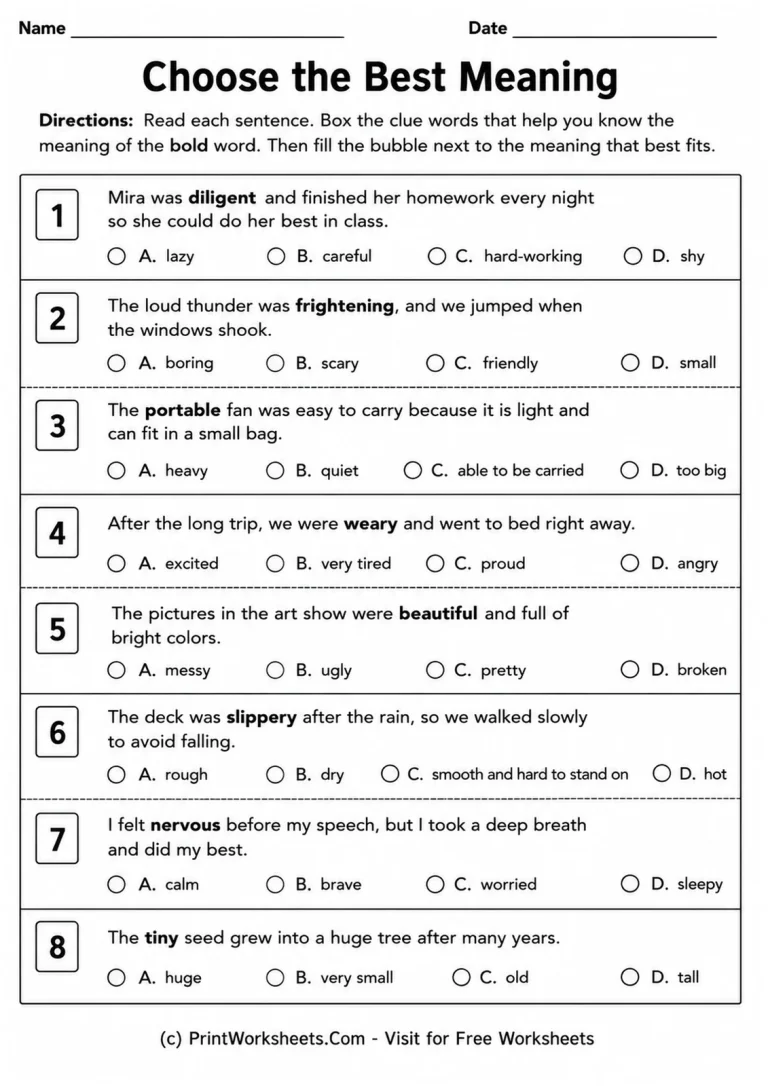
The next worksheet increases independence with eight short context-clue sentences and vocabulary including diligent, frightening, portable, weary, beautiful, slippery, nervous, and tiny. Students choose the meaning that best fits each sentence and box the words that support their choice. Because the sentences stand alone, teachers can quickly discuss one item at a time and ask students to justify why one definition fits better than the alternatives.
This page is especially useful after students understand the basic routine: read the complete sentence, locate the important clue, predict a meaning, and then compare that prediction with the answer choices. Encourage students to say the meaning in their own words before looking at the options. That habit reduces random guessing and helps build a transferable strategy they can use later with longer passages.
Explain the Meaning and the Evidence
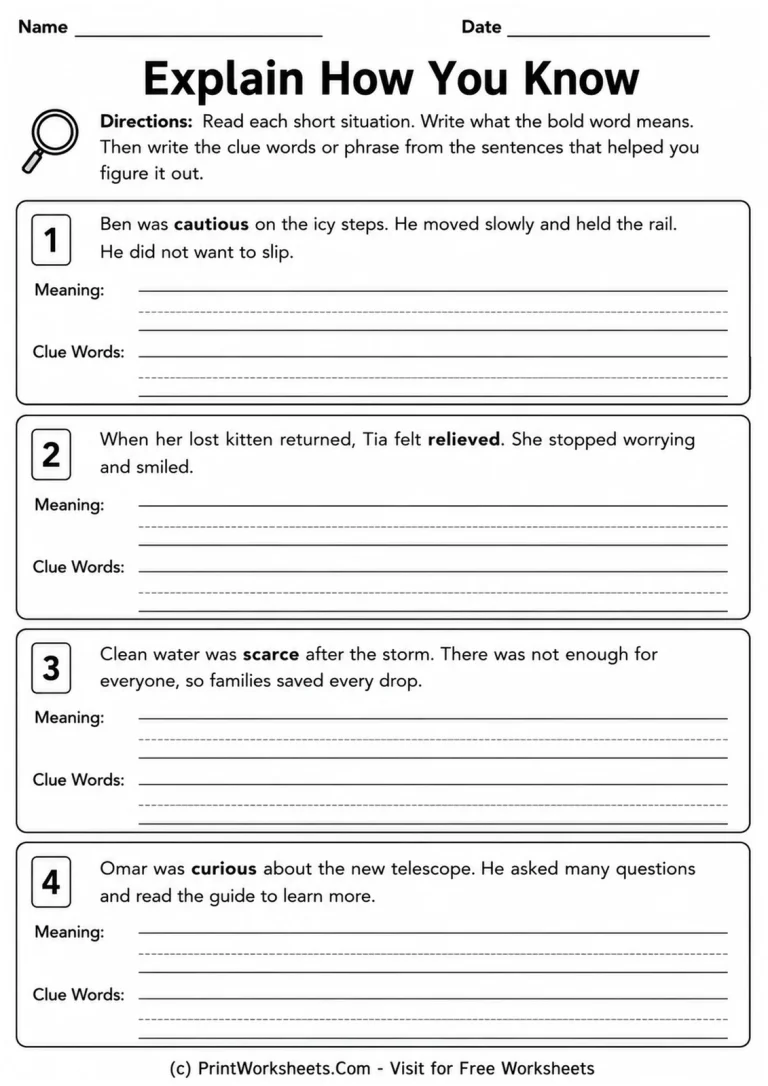
The open-response page shifts the emphasis from recognition to explanation. Students determine the meanings of cautious, relieved, scarce, and curious, then write the clue from the sentence that helped them. The cautious example uses icy steps, giving students a clear situation in which careful behavior makes sense. Instead of only producing a definition, students must connect their interpretation to evidence from the sentence.
This format is valuable for checking whether students truly understand how context clues work. A child may select a correct multiple-choice answer without being able to explain the reasoning. Written responses reveal whether students can identify both parts of the process: what the word probably means and which nearby details support that meaning.
Teaching Ideas for Grade 2 Vocabulary Practice
For a guided lesson, model one sentence aloud and separate the thinking into three steps: identify the unknown word, locate the helpful clue, and state a reasonable meaning. Then have students complete another item with a partner before working independently. During review, ask questions such as, “Which words gave you the strongest hint?” and “Would your meaning still make sense if we replaced the target word with your definition?”
For students who need additional support, let them circle the target word and underline only one or two clue phrases before choosing an answer. You can also read the sentence aloud so decoding difficulty does not hide vocabulary understanding. Students ready for extension can write a new sentence for one of the target words and include their own clear context clue.
Simple Differentiation, Exit Tickets, and Extension Work
These pages can be split across several short lessons rather than assigned all at once. Use the picture-supported activity for introduction or small-group reteaching, the eight-item multiple-choice page for independent practice, and the written explanation page for a stronger comprehension check. For an exit ticket, give students a new sentence containing an unfamiliar word and ask them to write both a possible meaning and the exact clue that supports it.
An easy extension is to create a class “clue collector” chart. After students solve a word, record the target word, its inferred meaning, and the evidence that made the meaning clear. Students can then compare different types of clues, including descriptions, actions, results, and contrasting ideas. By repeatedly connecting meaning to evidence, second graders begin to treat context as a practical reading tool they can use whenever they meet unfamiliar vocabulary.