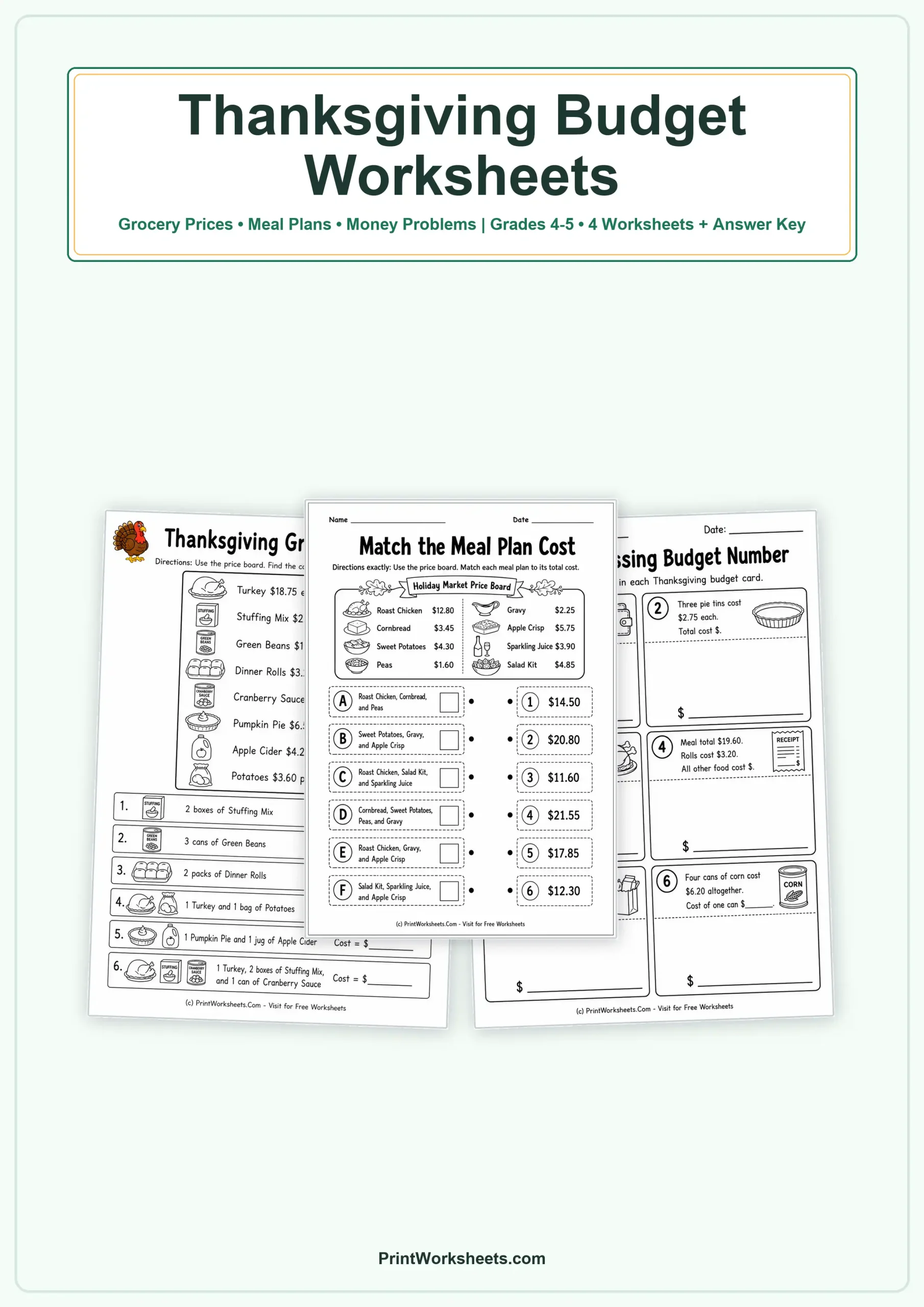
These Thanksgiving budget worksheets give fourth- and fifth-grade students a practical way to work with money, decimals, multiplication, division, and multi-step reasoning. Instead of completing isolated calculations, students use grocery prices and meal plans to decide what food costs, how much money remains, whether a budget is large enough, and how a purchase change affects the final total. The four student pages move from structured price-board practice to more independent Thanksgiving meal-budget problem solving, making the set useful for classwork, math centers, homework, or seasonal review.
Thanksgiving budget worksheets with real-world money math
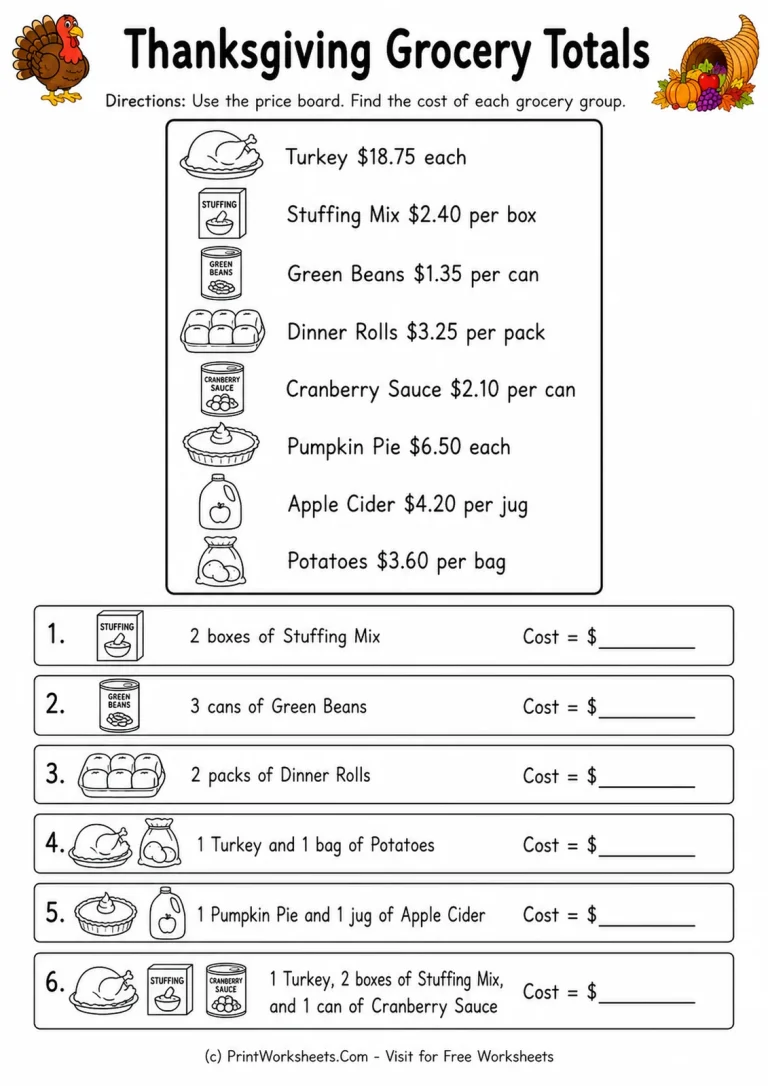
The first worksheet, Thanksgiving Grocery Totals, introduces the budgeting theme through a clear grocery price board. Students work with eight familiar meal items, including turkey, stuffing mix, green beans, dinner rolls, cranberry sauce, pumpkin pie, apple cider, and potatoes. Six questions require students to calculate individual purchase costs by adding prices or multiplying a quantity by a listed price. Examples such as buying two boxes of stuffing or three cans of green beans reinforce the connection between quantity and total cost while giving students repeated practice with decimal money values.
This page works well as an entry point because the information students need is visible in one place. Teachers can encourage students to underline the quantity, locate the matching unit price, and write an equation before calculating. That routine prepares learners for the less structured budget situations later in the set.
Compare complete Thanksgiving meal-plan costs
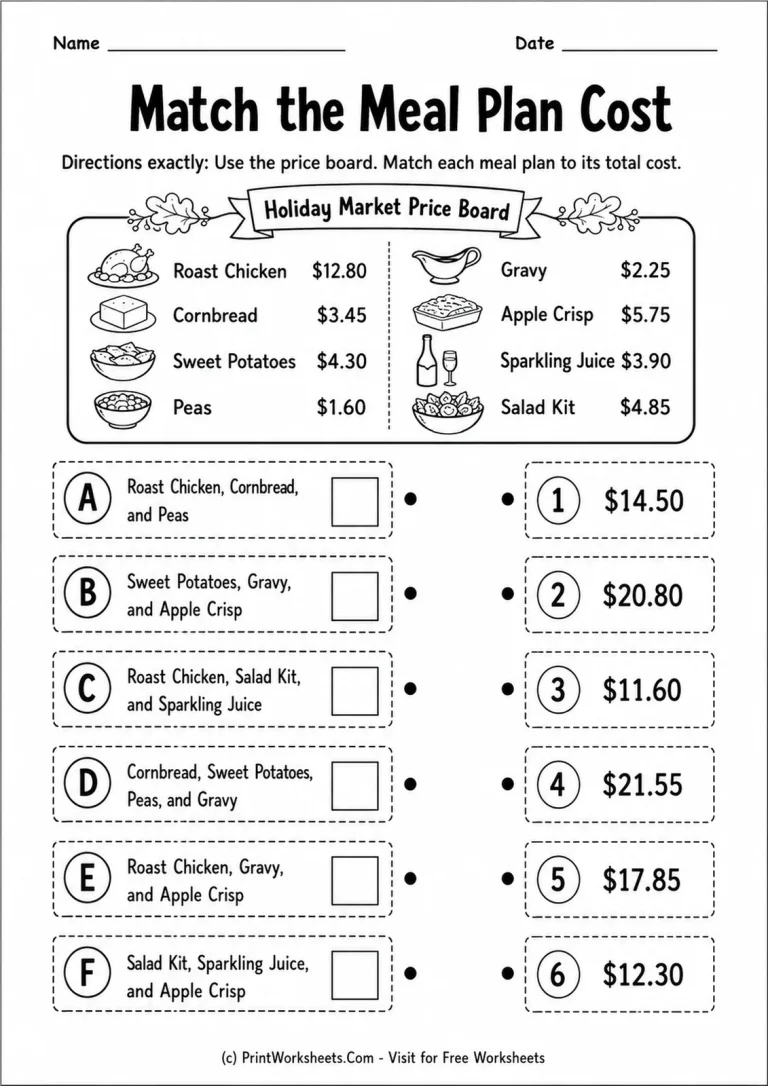
The second worksheet changes the task from finding one grocery cost to calculating an entire meal-plan total. Students use a Holiday Market Price Board featuring roast chicken, cornbread, sweet potatoes, peas, gravy, apple crisp, sparkling juice, and a salad kit. Six meal plans labeled A through F must be matched to six distinct dollar totals.
Because each plan contains several foods, students need to organize their calculations carefully. They may add the prices in stages, keep a running total, or group convenient amounts before comparing the result with the available choices. This activity gives useful practice in decimal addition while also requiring students to verify that each calculated total matches only one answer. It is a good bridge between routine computation and the more open-ended reasoning on the final pages.
Find missing budget numbers and unit costs
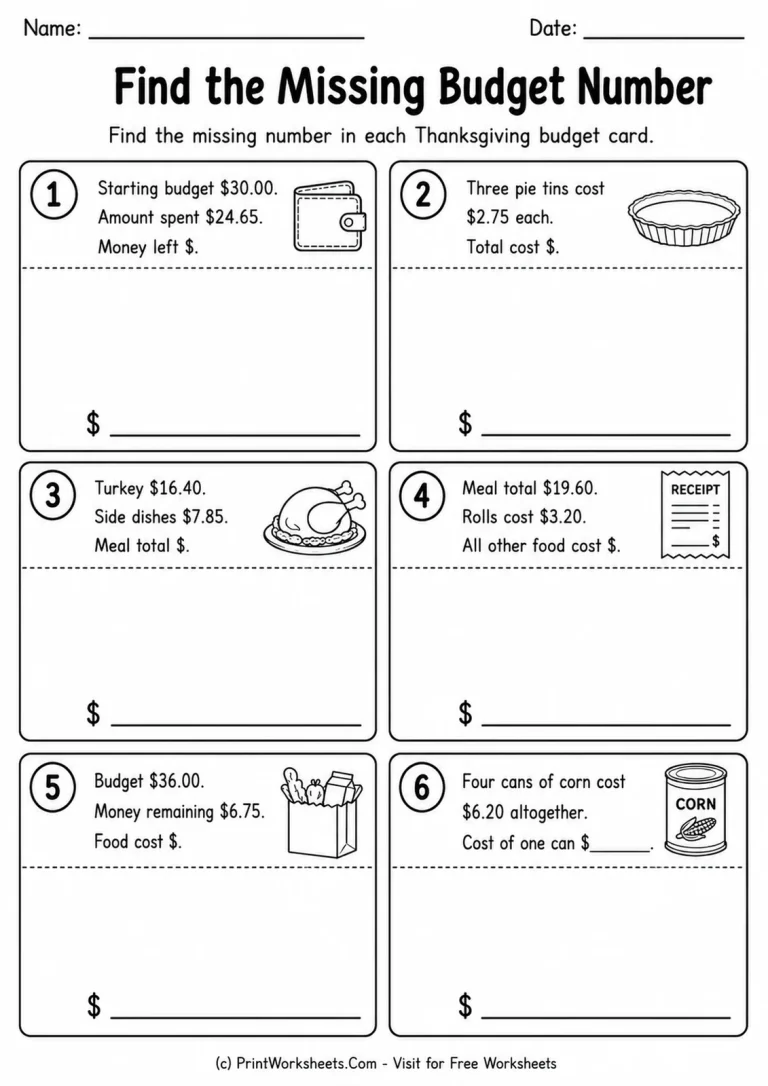
The third worksheet asks students to work backward from information in short Thanksgiving budget situations. Across six cards, students find values such as money remaining, total spending, the cost of other foods, a missing food cost, or a unit price. The problems combine addition, subtraction, multiplication, and division with decimal money amounts.
One especially useful task asks students to determine the price of one can when four cans cost $6.20 altogether. Problems like this extend the lesson beyond simply totaling a shopping list because students must decide which operation fits the unknown quantity. For differentiation, students who need support can label each number as a starting budget, amount spent, quantity, or remaining money before choosing an operation. Students ready for an extension can write an equation that represents each situation before solving.
Move into multi-step Thanksgiving meal budgeting
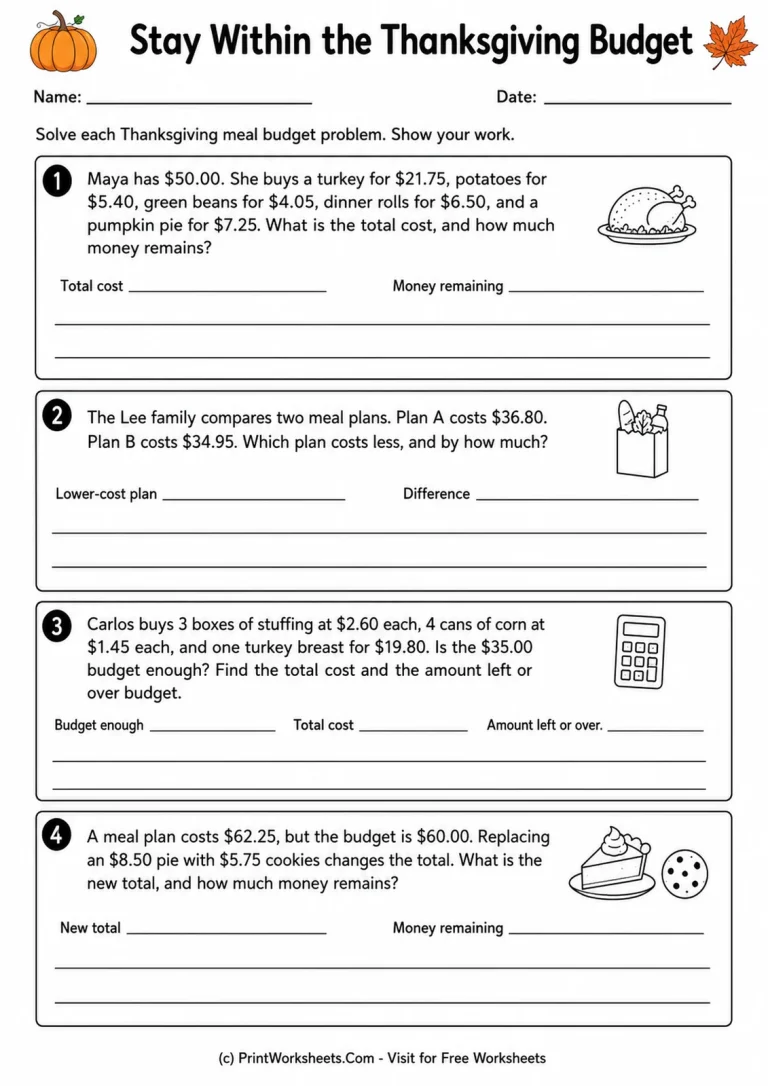
The final student worksheet, Stay Within the Thanksgiving Budget, brings the earlier skills together in four multi-step word problems. Students total purchases, compare different meal plans, determine whether a stated budget is sufficient, calculate money left over, and recalculate a meal cost after one item is replaced. These tasks require more than accurate arithmetic. Students must identify the relevant information, complete calculations in a sensible order, and interpret the result as a budget decision.
Ask students to show their work so that the reasoning behind each answer is visible. A helpful strategy is to have them write a subtotal first, compare that subtotal with the available budget, and then state the conclusion in words. For example, a student should not stop after finding a total if the question asks whether there is enough money or how much remains.
Ways to use the four-page set
The progression makes the worksheets flexible for different classroom needs. Use the grocery-total page for guided practice, assign the meal-plan matching page for independent work, and save the missing-number and multi-step budget pages for deeper application. The set can also be split across several days during a Thanksgiving math unit.
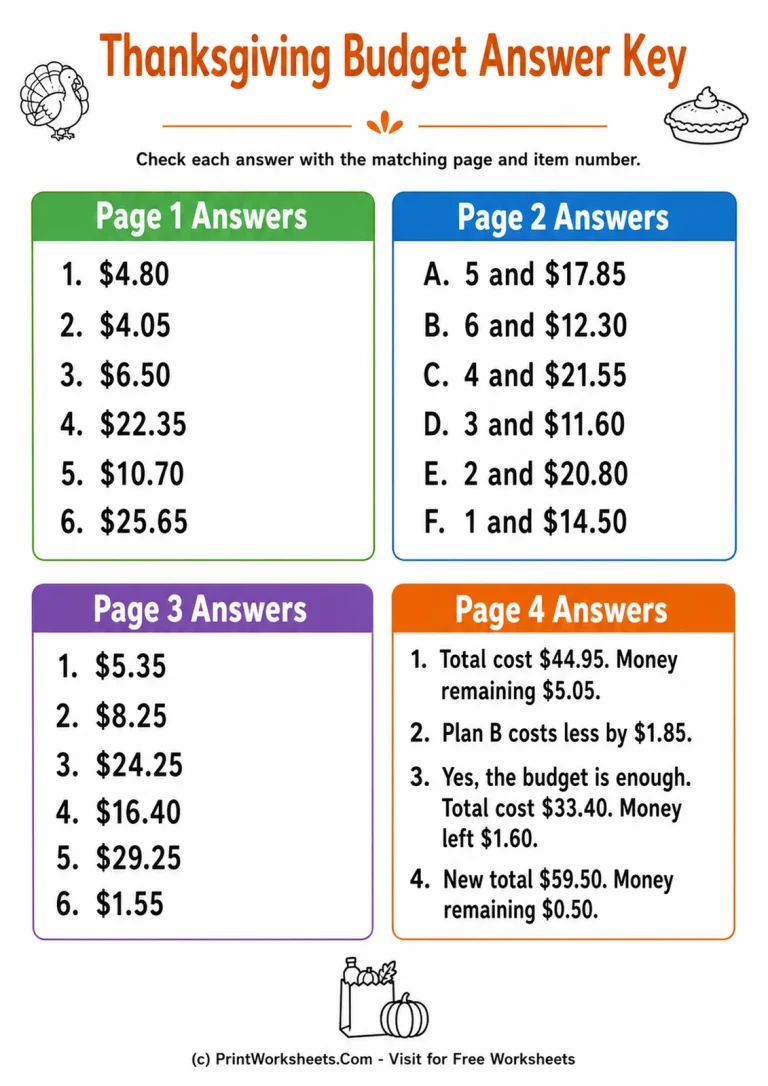
For an exit ticket, give students a simple meal budget and two food prices and ask them to calculate the remaining amount. As an extension, students can create their own small Thanksgiving menu using prices from one of the boards, find the total, and explain whether it fits a teacher-selected budget. The included answer key covers the calculations from all four student pages, allowing teachers or parents to check grocery totals, meal-plan matches, missing values, and multi-step budget results efficiently.